Flashcards for Spaced Repetition: A Simple Guide
Flashcards for spaced repetition are study cards you review on a growing schedule instead of all at once. You see a card, try to recall the answer, and then the cards you find hard come back soon while the easy ones come back later. This spacing is what makes facts stick for the long haul. The fastest way to start is to make your own deck with a free flashcard maker, then review a little each day.
Want to skip the theory and just build a deck? Open the free flashcard maker, type your terms and definitions, and print or flip them on screen. No sign-up, no app to install, and you can be reviewing in a couple of minutes.
What Spaced Repetition Actually Means
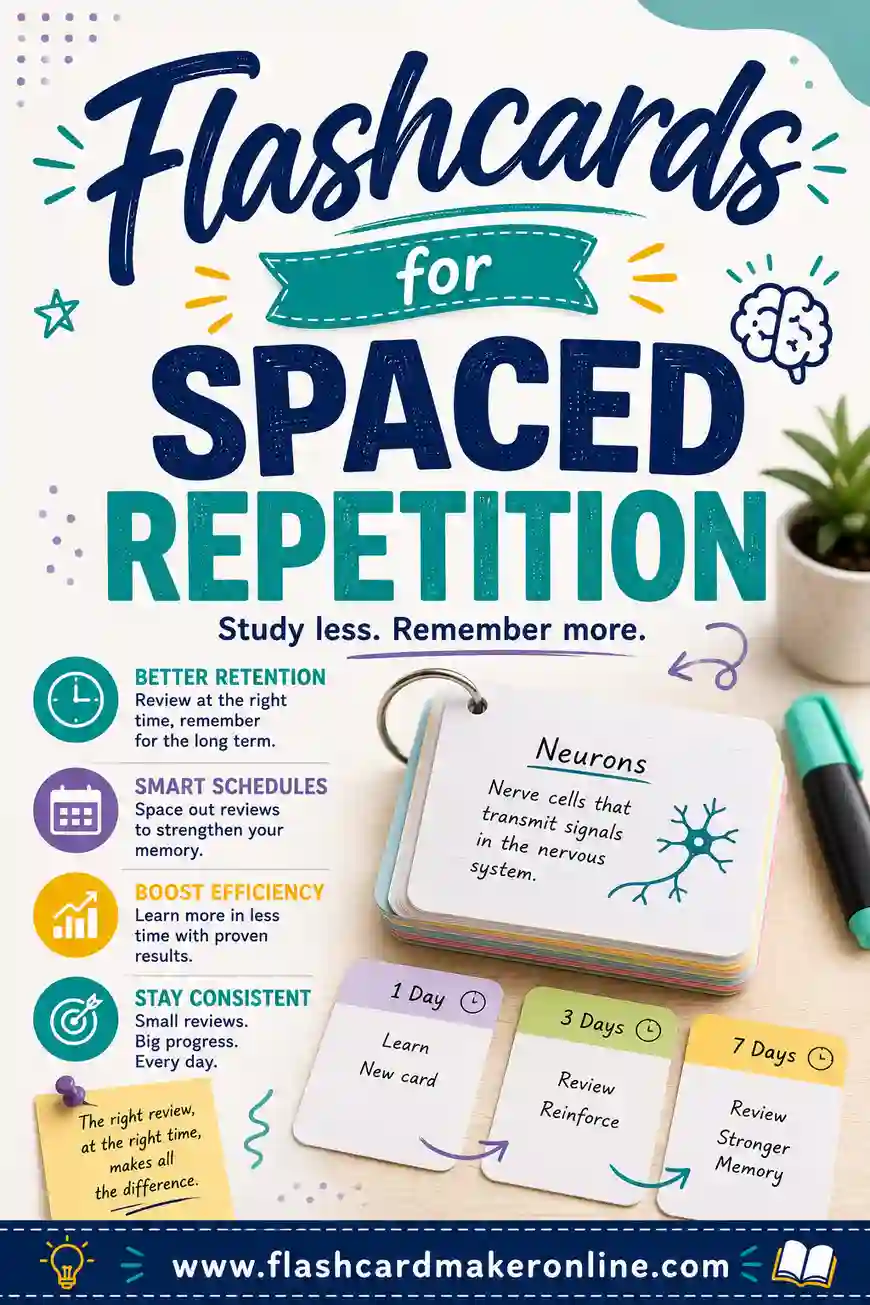
Here's the idea in one sentence: you review information right before you're about to forget it. Each time you successfully recall a fact, you wait a little longer before reviewing it again.
So you might see a card today, again in two days, then in a week, then two weeks, and so on. Every correct recall pushes the next review further out. Cards you keep missing come back fast until they stick.
This works because of something called the forgetting curve. After you learn something new, your memory of it drops off quickly. A well-timed review flattens that curve. Do it a few times and the fact moves into long-term memory, where it stays with almost no effort.
Flashcards are the perfect tool for this. Each card holds one small fact. You can shuffle them, sort them, and bring the tough ones back more often. That's exactly what spaced repetition needs.
Why Spaced Repetition Beats Cramming
Cramming feels productive. You sit for three hours, you see the material a hundred times, and you walk into the test with it fresh. The problem is that "fresh" fades fast. A week later most of it is gone.
Spaced repetition does the opposite. You spend less total time, but you spread it out. The result is memory that lasts months instead of hours.
A quick comparison:
| Cramming | Spaced repetition | |
|---|---|---|
| Total study time | High, in one block | Lower, spread out |
| How long it lasts | Days at most | Months to years |
| Stress level | High | Low and steady |
| Best for | Last-minute panic | Real, lasting learning |
If you've ever passed a test and forgotten everything by the next month, you've felt the limit of cramming. Spaced repetition is the fix.
Active Recall: The Engine Underneath
Spacing tells you when to review. Active recall tells you how.
Active recall means you try to pull the answer out of your own head before you flip the card. Don't peek. Don't reread the notes. Just look at the term, make a guess, and then check.
That little moment of struggle is the whole point. Every time you force your brain to retrieve a fact, the memory gets stronger. Rereading your notes feels easier, but it builds almost nothing by comparison.
Flashcards make active recall automatic. The front asks the question, the back hides the answer, and you can't see it until you commit. Make your cards with one clear prompt on the front and one clean answer on the back, and you're set.
A Simple Spaced-Repetition Schedule
You don't need fancy software to space your reviews. A simple plan works great. Here's one many students use:
- Day 1: Learn the card and review it once.
- Day 2: Review again.
- Day 4: Review again.
- Day 7: Review again.
- Day 14: Review again.
- Day 30: Final review.
Got a card right and it felt easy? Move it to the next interval. Got it wrong? Send it back to the start. That's the core of the famous Leitner box system, just with dates.
The Leitner box, in plain terms
Grab three to five small boxes or piles. New and missed cards go in box 1. When you get a card right, it moves up one box. When you miss a card, it drops all the way back to box 1.
- Box 1: review every day.
- Box 2: review every few days.
- Box 3: review once a week.
- Box 4: review every two weeks.
- Box 5: review once a month.
The cards you know best naturally drift to the back, and the ones you struggle with stay up front where you see them often. It's spaced repetition you can hold in your hands.
How to Build Your Spaced-Repetition Deck
The deck matters as much as the schedule. A few rules make your cards work harder:
- One fact per card. If a card holds three things, you can't tell which one you missed. Split it up.
- Keep prompts short. A clear question beats a paragraph. You want a fast back-and-forth.
- Answer first, then context. Put the key answer on top of the back, with any extra note below it.
- Use your own words. Cards you write yourself are easier to recall than ones you copy.
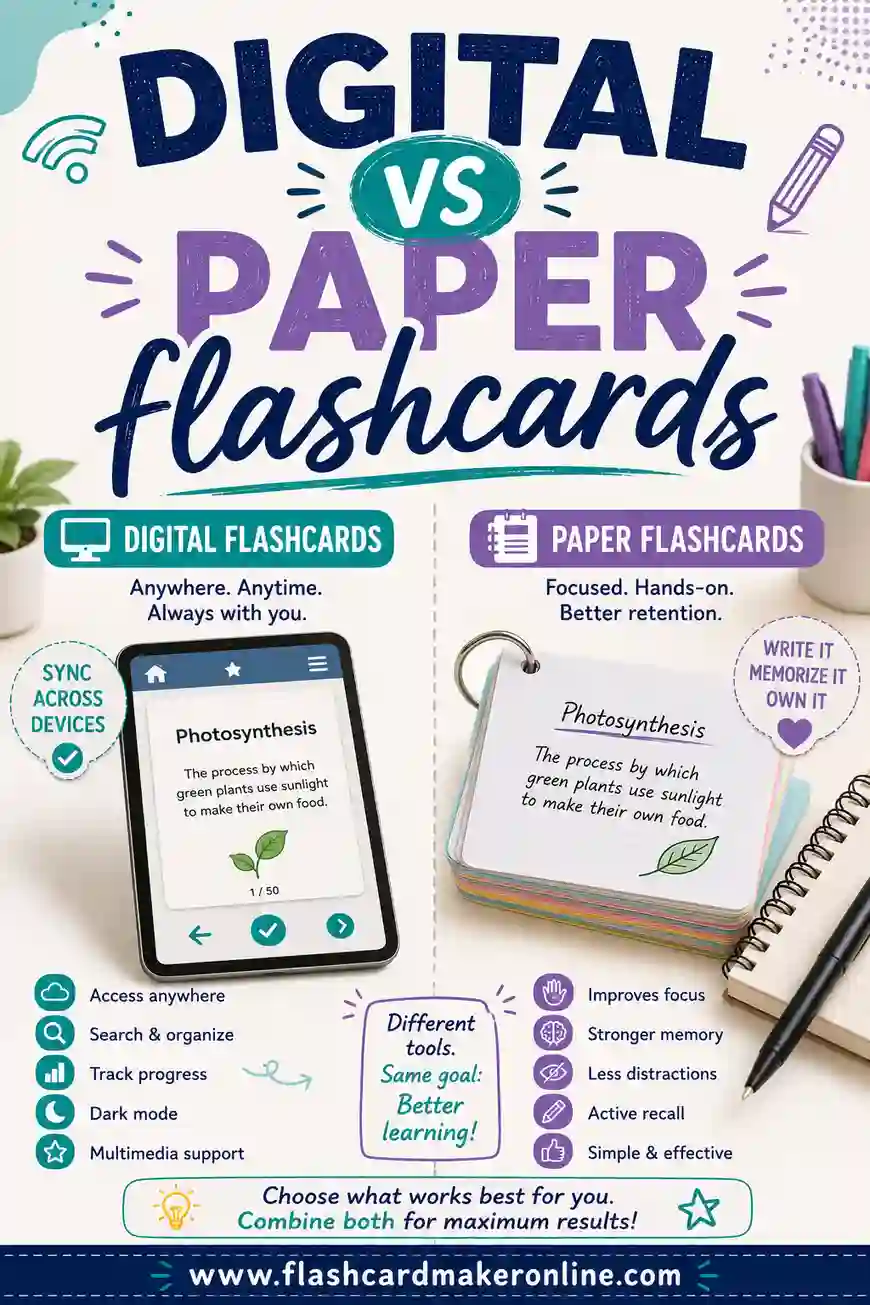
The quickest way to do this is with a free flashcard maker. Type the term, type the definition, and repeat. You can flip the cards right on the screen or print them onto cardstock for a physical Leitner box. If you prefer paper over a screen, our guide on digital vs paper flashcards walks through the trade-offs.
Sample Spaced-Repetition Deck (Copy & Paste)
Here's a ready-made starter deck about study methods themselves. Use it to practice the system, or swap in your own subject. Each row is one card: the term on the front, the definition on the back.
| Term (front) | Definition (back) |
|---|---|
| Spaced repetition | Reviewing material at growing intervals to beat forgetting |
| Active recall | Pulling an answer from memory instead of rereading |
| The forgetting curve | How fast we lose new information without review |
| Retrieval practice | Testing yourself to strengthen a memory |
| Leitner system | A box method that sorts cards by how well you know them |
| Review interval | The time gap between two reviews of the same card |
| Interleaving | Mixing different topics in one study session |
| Cramming | Studying a lot in one block right before a test |
| Long-term memory | Storage that holds facts for months or years |
| Working memory | The small, short-term space you think in right now |
| Encoding | Turning new information into a stored memory |
| Cue | A prompt that triggers recall of a fact |
| Overlearning | Practicing past the point of first getting it right |
| Spacing effect | The boost in memory from spreading study out |
| Recall failure | Not being able to retrieve something you learned |
| Confidence trap | Feeling you know material because it looks familiar |
| Chunking | Grouping items so they are easier to remember |
| Distributed practice | Another name for spreading study across days |
| Lag effect | Longer gaps often help more than short ones |
| Mastery | Reaching reliable, lasting recall of the material |
Drop any of these into the flashcard maker and start flipping. Once you've got the rhythm, build a deck for whatever you actually need to learn.
Tips to Keep the Habit Going
The system only works if you show up. A few small tricks help:
- Tie reviews to a daily anchor. Do your cards right after breakfast or before bed, every day. Same time, same place.
- Keep sessions short. Ten to fifteen minutes is plenty. Spacing does the heavy lifting, not marathon sessions.
- Shuffle the order. Reviewing cards in the same order every time lets you memorize the sequence instead of the facts. Mix them up.
- Be honest. If you only half-knew a card, mark it wrong. The system rewards honesty with better memory.
- Trim the deck. Once a card is rock-solid for weeks, you can retire it. No need to review what's truly locked in.
Study tip by goal:
| Your goal | What to focus on |
|---|---|
| Pass a test next month | Tight schedule, daily box-1 reviews |
| Learn a language | One word per card, picture cues, review daily |
| Memorize for the long run | Long intervals, fewer cards per day |
| Beat test anxiety | Practice recall out loud, like a quiz |
Frequently Asked Questions
How many flashcards should I review per day?
Start with 20 to 30 new cards a day, plus your due reviews. If you feel buried, lower the new-card count. It's better to review a few cards every day than to skip days and pile up a backlog.
How long until spaced repetition works?
You'll notice cards feeling easier within a week. Real long-term memory shows up over a few weeks of steady review. The trick is consistency, not intensity. Short daily sessions beat one long weekly one.
Do I need an app for spaced repetition?
No. A stack of cards and a few labeled boxes (the Leitner system) works perfectly. Make your cards with a free flashcard maker, print them, and sort by how well you know each one. The schedule lives in your boxes, not in any software.
What should go on the front of a card?
One short prompt: a single term, question, or image cue. Keep the answer off the front so you're forced to recall it. One fact per card is the golden rule.
Can I use spaced repetition for big topics like history?
Yes, but break the topic into small facts first. Instead of one card asking "explain World War II," make many small cards for dates, people, and causes. Small cards are easier to schedule and far easier to recall.
How is spaced repetition different from just re-reading?
Re-reading is passive. Your eyes pass over the words and your brain barely works. Spaced repetition forces active recall on a schedule, which builds memory far faster. The effort is the point.
Ready to Build Your Spaced-Repetition Deck?
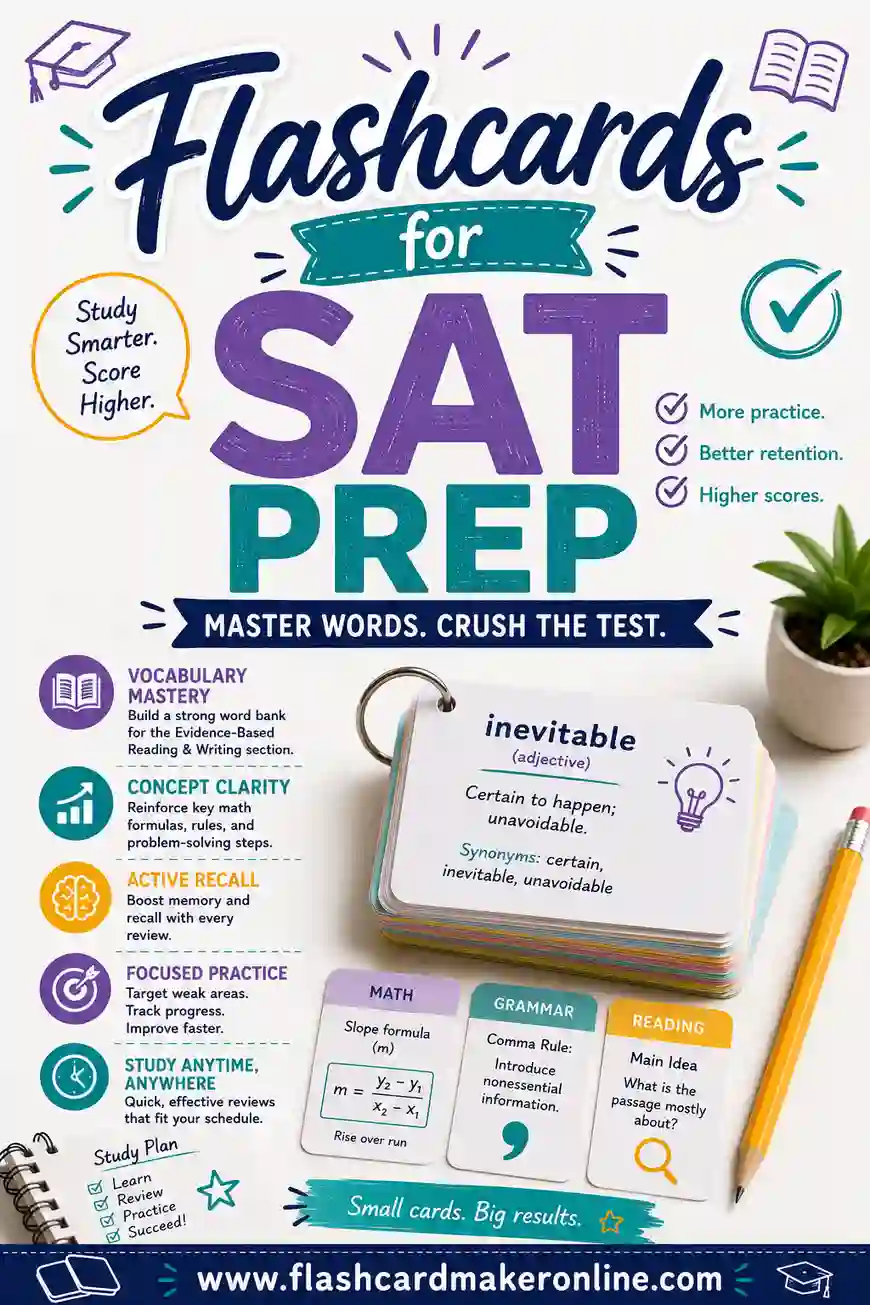
Pick a subject, open the free flashcard maker, and type in your first batch of cards. Review a little each day, push the easy ones further out, and bring the hard ones back fast. That's the whole system, and it works. For more ways to study, see our guides on flashcards for SAT prep and flashcards for group study. Happy studying.