Flashcards for SAT Prep: A Smart Study Guide
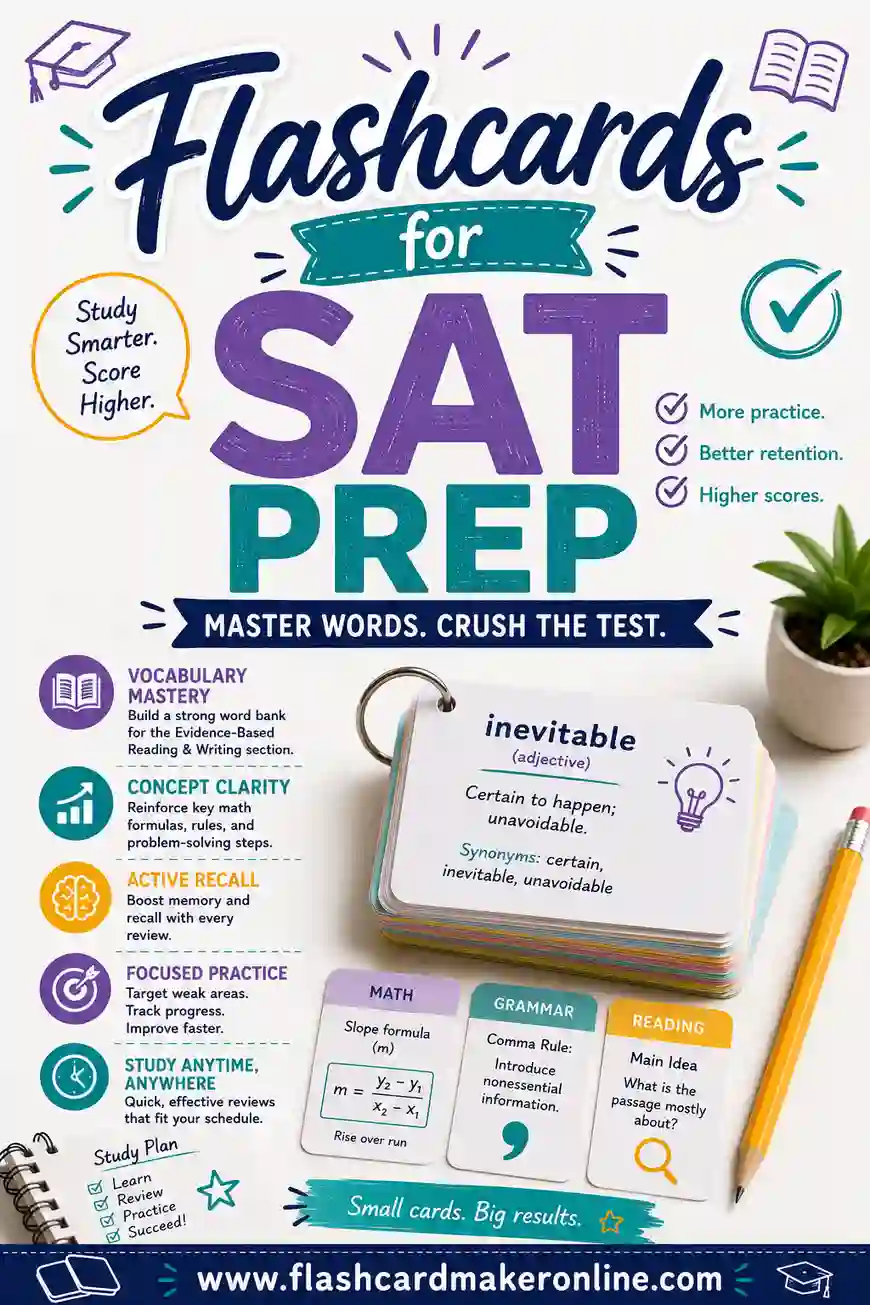
Flashcards for SAT prep help you lock in vocabulary, math formulas, and grammar rules through quick, repeated recall. You make a card for each fact, review it on a schedule, and the things you keep missing come back more often until they stick. It's one of the highest-value ways to study for the test. The fastest way to start is to build your own deck with a free flashcard maker and review a little every day.
Test coming up? Open the free flashcard maker, type in your SAT terms and formulas, and start flipping today. No sign-up, no cost, and you can print a set to study anywhere.
Why Flashcards Are Perfect for the SAT
The SAT rewards facts you can recall fast. You don't have time during the test to slowly work out a formula or puzzle over a word you half-remember. You need it to come to you instantly. That's exactly what flashcards train.
Each card holds one small piece: a vocab word, a math formula, a grammar rule. You see the prompt, pull the answer from memory, and check. Do that enough times and the answer becomes automatic. On test day, it just shows up.
Flashcards beat re-reading a prep book for one big reason: they force active recall. Re-reading feels productive but builds little. Flashcards make your brain do the work of retrieving the answer, which is what actually builds memory.
What to Put on SAT Flashcards
Not everything on the SAT belongs on a card. Cards work best for clean, factual bits. Focus on these:
- Vocabulary. High-frequency SAT words with short, plain definitions.
- Math formulas. Area, slope, the quadratic formula, anything you must memorize.
- Grammar rules. Comma rules, subject-verb agreement, common error patterns.
- Word roots. Common Latin and Greek roots help you decode unknown words.
- Reading strategies. Quick reminders like "find the main idea first."
Skip the big, fuzzy stuff. A card asking "how do I write a good essay?" won't help. Break ideas into small, recall-able facts and you'll get far more from your deck.
A Sample SAT Flashcard Deck
Here's a starter deck mixing vocab, math, and grammar, the three big areas. Type it into the flashcard maker to practice, then build your own from your weak spots. Each row is one card.
| Term (front) | Definition / answer (back) |
|---|---|
| Ambiguous | Open to more than one meaning; unclear |
| Pragmatic | Practical; focused on real results |
| Candid | Honest and direct in speech |
| Meticulous | Very careful about small details |
| Concise | Saying a lot in few words |
| Area of a circle | A = pi times the radius squared |
| Slope formula | Rise over run; change in y over change in x |
| Pythagorean theorem | a squared plus b squared equals c squared |
| Quadratic formula | x = negative b plus or minus root b squared minus 4ac, over 2a |
| Area of a triangle | One half times base times height |
| Comma rule | Use a comma before a conjunction joining two full sentences |
| Subject-verb agreement | The verb must match the subject in number |
| Its vs it's | "Its" shows possession; "it's" means "it is" |
| Root "bene" | Means good or well (benefit, benevolent) |
| Root "mal" | Means bad or evil (malice, malfunction) |
| Inevitable | Certain to happen; unavoidable |
| Arbitrary | Based on whim, not reason |
| Probability | Favorable outcomes divided by total outcomes |
| Mean | The average; sum divided by how many numbers |
| Median | The middle value when numbers are in order |
Twenty cards is just a taste. A full SAT vocab deck might run a few hundred, which is why a tool that makes cards fast is so handy.
Build a Smart SAT Study Schedule
Don't cram. The SAT covers too much, and crammed facts fade fast. Space your reviews instead. Here's a simple plan over the weeks before the test:
- Week 1–2: Make cards as you study. Writing them is itself great review.
- Daily: Review 20 to 30 cards, plus any that are due from earlier.
- Sort by difficulty. Cards you miss come back tomorrow. Cards you nail wait a few days.
- Final week: Review only your hardest cards. The easy ones are already locked in.
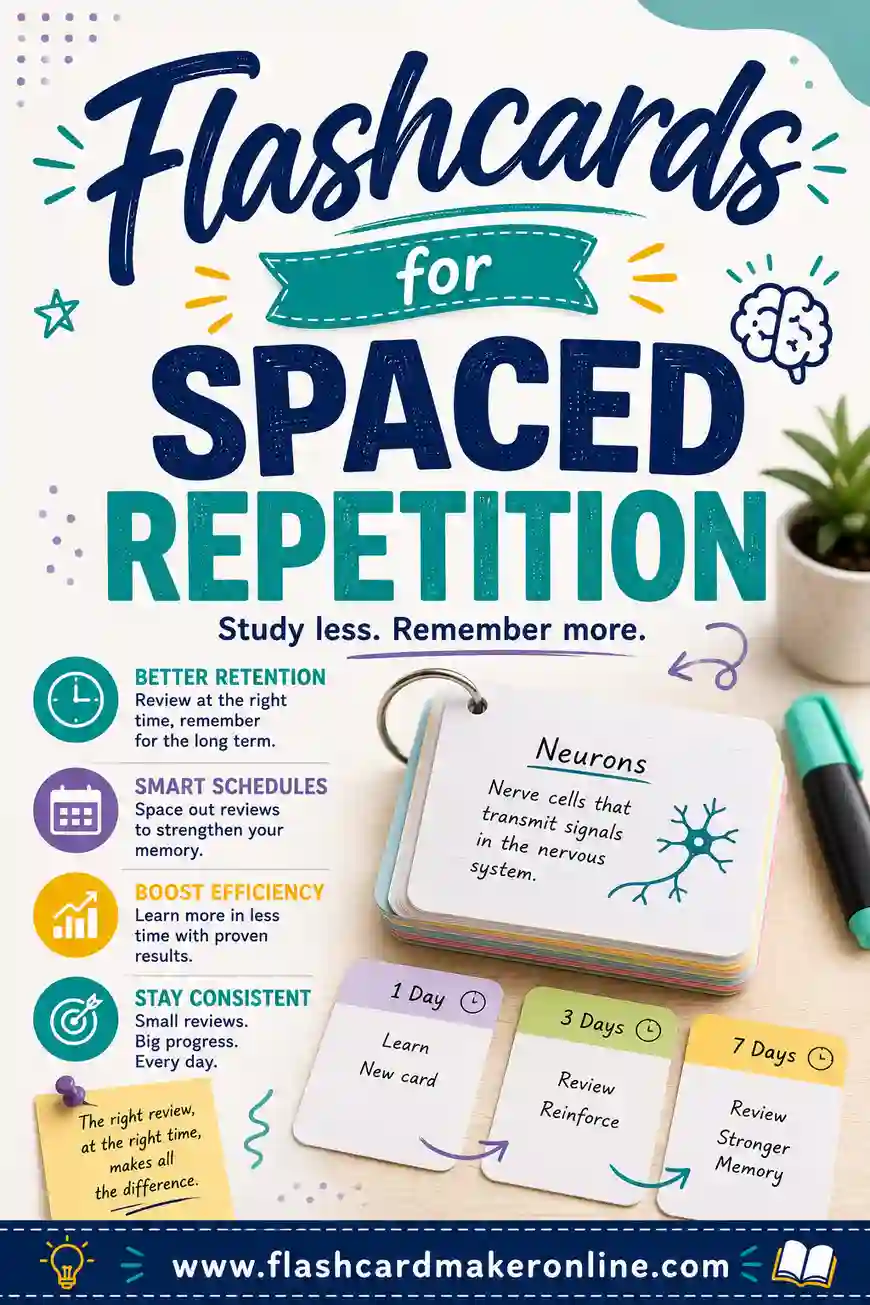
This is spaced repetition, and it's the most efficient way to study for a big test. Our full guide on flashcards for spaced repetition breaks down the exact intervals.
A simple sorting system
Use the Leitner box method with a few piles:
| Pile | What goes here | Review how often |
|---|---|---|
| 1 | New and missed cards | Every day |
| 2 | Cards you got right once | Every 2–3 days |
| 3 | Cards you know well | Once a week |
| 4 | Nearly mastered | Every two weeks |
Cards move up a pile when you get them right and drop back to pile 1 when you miss. Your weak spots stay front and center automatically.
Tips to Get More From Your SAT Cards
A few habits make your deck work harder:
- One fact per card. If a card has three formulas, you can't tell which one tripped you. Split them.
- Use a sentence for vocab. On the back, add a short example sentence so the word sticks in context.
- Say it out loud. Speaking the answer locks it in better than thinking it.
- Shuffle every time. Same order means you memorize the sequence, not the facts.
- Be honest. If you only half-knew it, mark it wrong and send it back to pile 1.
For vocab especially, link the word to something memorable, a picture, a rhyme, a silly sentence. Weird associations stick.
Study Solo or With Friends
Flashcards flex to fit how you like to study.
Solo is great for daily spaced review. Ten quiet minutes with your deck, every day, adds up fast.
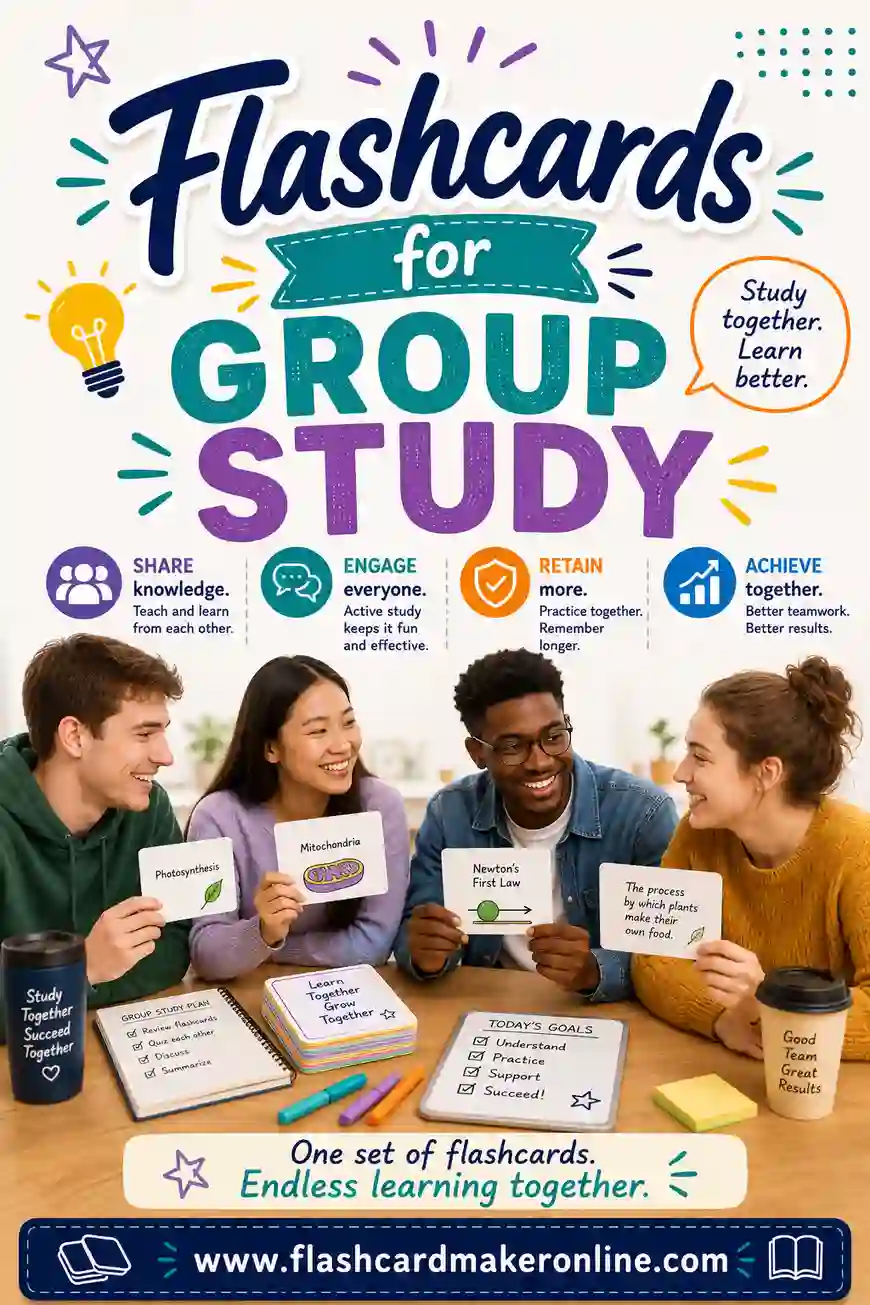
With friends, flashcards turn into quiz games. One person reads the front and the group races to answer. Saying answers out loud in front of others is a powerful test of what you really know, and a little competition keeps energy up. Our guide on flashcards for group study has game formats you can use.
The best plan often uses both: solo spaced review through the week, then a group quiz session before the test to find your last weak spots.
Common SAT Flashcard Mistakes to Avoid
A deck can quietly work against you if you build it wrong. Watch out for these:
- Cramming too many words on one card. Three formulas on a single card means you can't tell which one you missed. One fact per card, always.
- Definitions that are too long. A wall of text on the back slows you down and is hard to recall. Keep it short and plain.
- Only studying the cards you like. It's tempting to flip through the easy ones for a confidence boost. But the cards you dread are the ones boosting your score. Spend your time there.
- Reviewing in the same order. If the deck never shuffles, you start memorizing the sequence instead of the facts. Mix it up every session.
- Making the deck and never reviewing it. Building cards feels productive, but the real gains come from daily recall. Schedule the reviews, not just the building.
- Waiting until the last week. A deck only helps if you space the reviews over weeks. Start early and study a little each day.
Dodge these and your deck does its job: turning facts into instant recall by test day.
Digital or Printed SAT Cards?
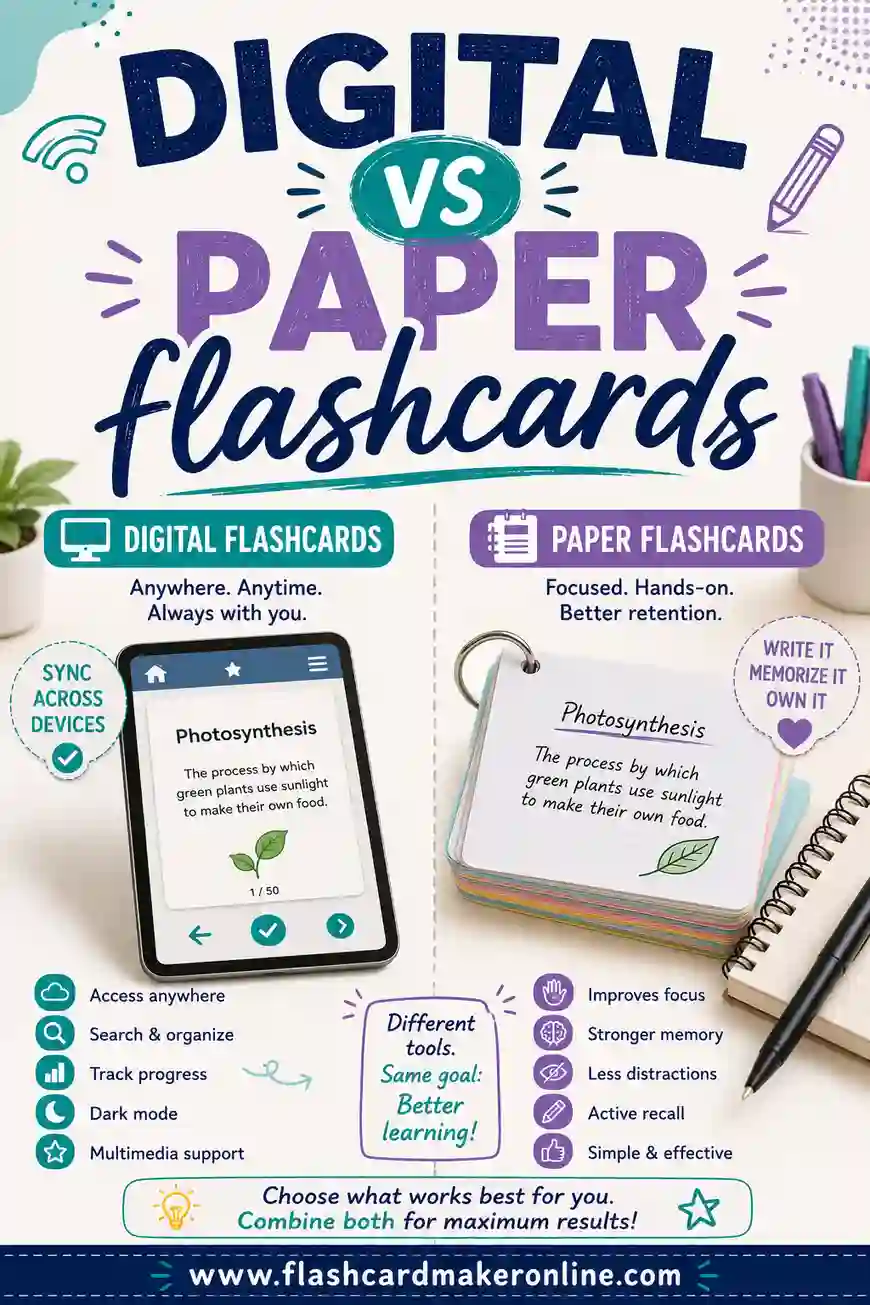
Both work for SAT prep. Digital cards are fast to make, easy to edit, and you can review them on your phone during any spare minute, on the bus, between classes, in line. Printed cards are screen-free and great for a focused final review the night before the test.
The smart move is to build your deck digitally with the flashcard maker, flip it on your phone all month, then print a set for the last week of distraction-free study. One deck, both formats. For a deeper look, see digital vs paper flashcards.
Frequently Asked Questions
How many SAT flashcards should I make?
For vocab, aim for a few hundred cards covering high-frequency words. For math and grammar, 30 to 60 cards each is usually enough to cover the key formulas and rules. Start with your weak areas, since those cards give you the biggest score boost.
When should I start studying with SAT flashcards?
The earlier the better, ideally two to three months before the test. Flashcards reward spaced, steady review over time. Starting early lets you space out your study so facts move into long-term memory instead of fading after a cram session.
Are flashcards better than an SAT prep book?
They're a great partner to one, not a replacement. Use the book to learn concepts and find your weak spots, then make flashcards to drill the facts. Flashcards force active recall, which builds memory far better than re-reading the book.
How do I study SAT vocab with flashcards?
Put the word on the front and a short, plain definition plus an example sentence on the back. Review daily, shuffle the order, and bring back the words you miss. Linking each word to a vivid mental image helps it stick.
Can I make SAT flashcards for free?
Yes. Our flashcard maker is free with no sign-up. Type your terms and answers, then flip them on screen or print a set to study anywhere. You can build a full SAT deck in one sitting.
Should I study SAT flashcards alone or with friends?
Both help. Solo daily review with spaced repetition builds steady memory. Group quiz sessions test your recall out loud and keep you motivated. Many students do solo review through the week and a group session before the test.
Ready to Build Your SAT Flashcard Deck?
Pick your weakest area, open the free flashcard maker, and start typing cards. Review a little every day, sort by what you miss, and watch the facts become automatic. It's free, there's no sign-up, and you can print your deck to study anywhere. For your next step, see our guides on flashcards for spaced repetition and flashcards for group study. You've got this.