Test Anxiety: Causes, Signs and Research-Backed Ways to Calm It
Test anxiety is the nervous, worried feeling some people get before or during exams, strong enough to get in the way of showing what they know. It usually mixes worried thoughts ("I'm going to fail") with body signs like a racing heart or an upset stomach. It's common, it's not a sign you're bad at school, and research has found several simple, low-cost ways to take the edge off, from writing down your worries before a test to preparing with practice quizzes.
A note before you read: this article is general information for students, parents and teachers. It isn't medical or mental health advice, and it can't diagnose anything. If anxiety is affecting your daily life, please talk with a doctor, school counselor or school psychologist. There's more on that near the end of this article.
This guide covers what test anxiety is, what causes it, how it shows up, why it can lower scores, and what studies say about calming it. Most of the strategies here are about how you prepare and what you do in the minutes before an exam, because those are things any student can try.
What test anxiety is
Nemours KidsHealth, in an article reviewed by psychologist Margaux J. Barnes, describes test anxiety as a type of performance anxiety, the kind of nerves people can feel when there's pressure to do well. A little pressure isn't a bad thing. It can help you focus and get moving. Test anxiety is when the nervousness grows big enough that it gets in the way of concentrating and remembering.
It helps to separate ordinary nerves from anxiety that interferes. The US National Library of Medicine's MedlinePlus explains that anxiety can be a normal response to stress and can even help you focus. It becomes a disorder when it doesn't go away, gets worse over time, and gets in the way of work, school or relationships. Test anxiety on its own is usually tied to specific situations, such as exams. If worry spills into many other parts of life, that's a reason to talk to a professional.
The two sides of test anxiety
Researchers have long described test anxiety as having two parts that often show up together:
- Worry: the thinking side. Thoughts about failing, comparing yourself with others, imagining what happens if you do badly, or doubting what you know.
- Emotionality: the body side. A racing heart, sweaty hands, shaky legs, a tight chest or a churning stomach.
The distinction is useful because the two sides call for different tools. Worried thoughts take up mental space you'd rather use for the test, which is why the attention research later in this article focuses on them. Body signs feel awful, and they can feed the worry ("my heart is pounding, so something must be wrong"). Some of the strategies below target the thoughts, and some target how you interpret the body signs.
How common test anxiety is and how it affects scores
Test anxiety has been studied for decades, so there's a lot of data on how it relates to grades and test scores. In 2018, Nathaniel von der Embse and colleagues published a large meta-analysis, meaning a study that combines results from many earlier studies. Their review in the Journal of Affective Disorders pulled together 238 studies published from 1988 onward. Here's what they found:
- Higher test anxiety was linked to lower performance on a wide range of measures, including standardized tests, university entrance exams and grade point average.
- The link was strongest in the middle grades.
- Self-esteem was a strong predictor of test anxiety: students with lower self-esteem tended to report more of it.
- Tests that felt harder, and tests with high stakes or big consequences, were associated with more anxiety.
- Most of the relationships were small to moderate in size.
That last point is worth holding onto. Test anxiety is linked to lower scores, but it doesn't doom anyone. Plenty of anxious students do well, and the size of the effect varies a lot from person to person.
For a broader picture of anxiety in general, the National Institute of Mental Health notes that roughly a third of US adolescents and adults have an anxiety disorder at some point in their lives. Test anxiety isn't the same thing as an anxiety disorder, but the number is a reminder that anxiety in general is very common, and you're far from alone.
What causes test anxiety
There's rarely one cause. Usually several things stack up. KidsHealth and the research above point to these common contributors.
The body's alarm system
When you feel threatened, your body releases adrenaline, a stress hormone, and switches on the "fight or flight" response. KidsHealth explains that this is the same system that gets you ready to react to danger. It speeds up your heart and breathing and sends energy to your muscles. That's helpful if you need to run, but not so helpful when you need to sit still and remember the causes of World War I.
Negative thinking
KidsHealth puts it simply: "The more you focus on the negative things that could happen, the stronger the feeling of anxiety becomes." Worry tends to feed itself. One anxious thought ("I don't know this") leads to another ("I'll fail the class"), and soon your attention is on the spiral instead of the question.
High stakes and perfectionism
The von der Embse meta-analysis found that higher-stakes tests and tests that seem harder are linked to more anxiety. KidsHealth adds that people who hold themselves to perfect standards are more likely to experience test anxiety. If any score below an A feels like a disaster, every test becomes a high-stakes test.
Feeling unprepared
KidsHealth notes that students who care about doing well but don't feel ready, maybe because they didn't have enough time, the material was hard, or they were tired, can be especially vulnerable. This is one cause you can do a lot about, and it's where good study habits come in.
Past experiences
A bad experience on an earlier test can make the next one feel scarier. So can pressure from others, whether it's real or just how it feels. Self-esteem also matters: in the meta-analysis, it was one of the strongest predictors of test anxiety.
Signs of test anxiety
Test anxiety looks different for different people. Here's a breakdown of common signs, drawn from the ones KidsHealth lists and the general anxiety symptoms MedlinePlus describes.
| Type | Common signs |
|---|---|
| Body | Sweating, racing heartbeat, fast breathing, upset stomach or nausea, headache, shakiness, feeling faint |
| Thoughts | Worry about doing badly, fear of forgetting everything, "going blank," doubting what you know, comparing yourself to others |
| Feelings | Dread, panic, frustration, feeling overwhelmed, feeling upset about your own body's reactions |
| Behavior | Putting off studying, avoiding thinking about the test, rushing through questions, second-guessing answers repeatedly |
Some of these overlap with plain old tiredness or not having studied, so it's worth noticing the pattern. If the signs show up mainly around tests and fade afterward, that points toward test anxiety. If they show up in lots of situations or don't fade, that's a reason to talk to a professional.
Why anxiety makes your mind go blank
One of the most frustrating parts of test anxiety is knowing the material at home and then blanking during the test. There's a reason for that, and understanding it can make it feel less mysterious.
Michael Eysenck and colleagues proposed a well-known explanation called attentional control theory. In their 2007 paper in the journal Emotion, they argued that anxiety "impairs efficient functioning of the goal-directed attentional system." In plain English, anxiety makes it harder to keep your attention on the task you chose, such as the test question, and easier for your attention to get pulled toward threats, such as worried thoughts or the clock.
Their theory has another useful idea. Anxious people can often keep their performance up by working harder. But that extra effort costs something: it's tiring and less efficient. That's why a test can leave an anxious student exhausted even when they do fine.
Gerardo Ramirez and Sian Beilock built on a similar idea in their research on pressure. They argued that worries about the test and its consequences can interfere with performance, because those worries compete for the mental resources you need for the problems in front of you. That's also what made them wonder whether getting the worries out of your head first might help.
Research-backed ways to calm test anxiety
Here's the encouraging part. Several simple techniques have been tested in real studies. None of them is a cure, and results vary from person to person, but they're low-cost, low-risk and easy to try. This table gives a quick overview.
| Strategy | What it involves | Key study | When to use it |
|---|---|---|---|
| Expressive writing | Writing freely about your worries for a few minutes | Ramirez & Beilock (2011), Science | Right before an important test |
| Expressive writing for math | Same idea, before a math test | Park, Ramirez & Beilock (2014) | Before math tests if math makes you anxious |
| Reappraising nerves as excitement | Telling yourself "I'm excited" instead of "calm down" | Brooks (2014) | When you feel the jitters start |
| Practice testing | Quizzing yourself on the material ahead of time | Roediger & Karpicke (2006) | Days and weeks before the test |
| Spacing and early start | Studying in shorter sessions over several days | Supported in study research; recommended by KidsHealth | As soon as the test is announced |
| Slow breathing | A few slow, steady breaths | Recommended by KidsHealth | Before and during the test |
Write about your worries before the test
In a study published in Science in 2011, Ramirez and Beilock ran two lab experiments and two field experiments in real classrooms. Students who spent a short time writing about their thoughts and feelings about an upcoming test right before taking it scored significantly higher than students who didn't. The benefit was especially strong for students who usually feel anxious about tests. The authors summed it up this way: "Simply writing about one's worries before a high-stakes exam can boost test scores."
A later study by Park, Ramirez and Beilock looked at math anxiety specifically. They worked with 80 students and compared expressive writing with sitting quietly. In the sit-quietly group, highly math-anxious students did much worse on math problems than less anxious students. In the writing group, that gap shrank significantly. Interestingly, anxious students who used more words about their anxiety, its causes and insights about it tended to do better.
How to try it: Before a test, take a few minutes, whatever you have, and write freely about how you feel about it. Be honest. "I'm worried I'll forget the formulas and my parents will be disappointed." Don't worry about spelling or neatness. Some students like to throw the page away afterward. The goal isn't to fix the worries. It's to get them out of your head and onto paper.
Call it excitement instead of trying to calm down
Most people believe the best way to handle nerves is to calm down. Alison Wood Brooks of Harvard Business School tested a different idea. Since anxiety and excitement feel similar in the body (racing heart, energy, alertness), maybe it's easier to relabel the feeling than to make it go away.
Across several studies involving karaoke singing, public speaking and math, Brooks found that people who reappraised their anxiety as excitement felt more excited and performed better than people who tried to calm down. Even very simple steps, like saying "I am excited" out loud, shifted people toward seeing the situation as an opportunity rather than a threat.
How to try it: When you feel your heart speed up before a test, say to yourself, "I'm excited," or "My body is getting ready." You're not pretending the feeling isn't there. You're giving it a more useful name. A fast heartbeat can mean your body is ready to work.
Prepare with practice tests
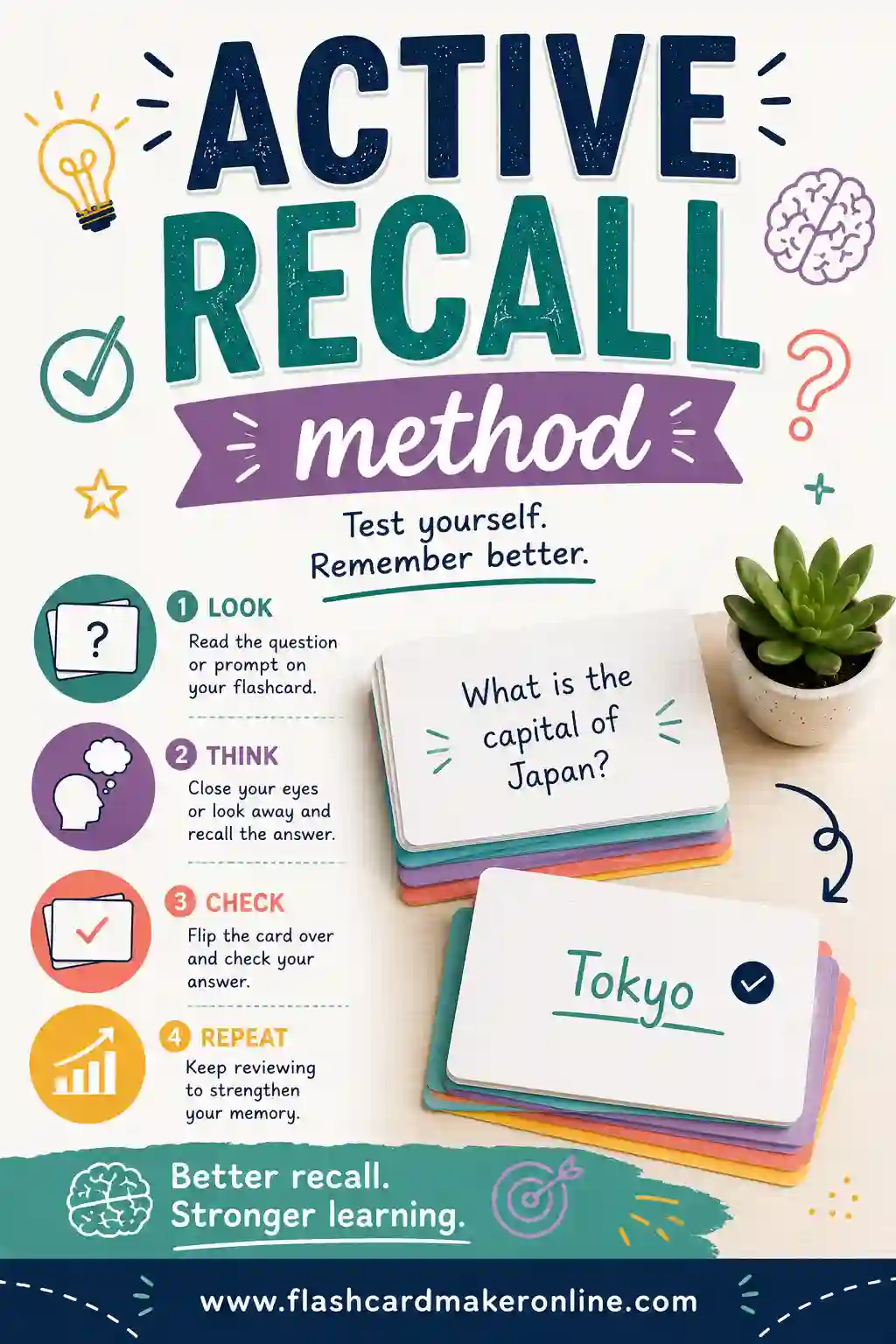
One of the most reliable ways to feel calmer on test day is to have already practiced the exact thing the test asks you to do: recall answers without help. In Henry Roediger and Jeffrey Karpicke's classic study, students who practiced recalling material remembered substantially more after two days and one week than students who just restudied it, even though restudying made them feel more confident at first.
That last detail matters for anxiety. Rereading can create false confidence that crumbles under pressure. Practice testing gives you an honest read on what you know, so you can fix gaps before the test instead of discovering them during it. Flashcards are a simple way to do this. Our guide to the active recall method explains how to set it up.
Start early and spread it out
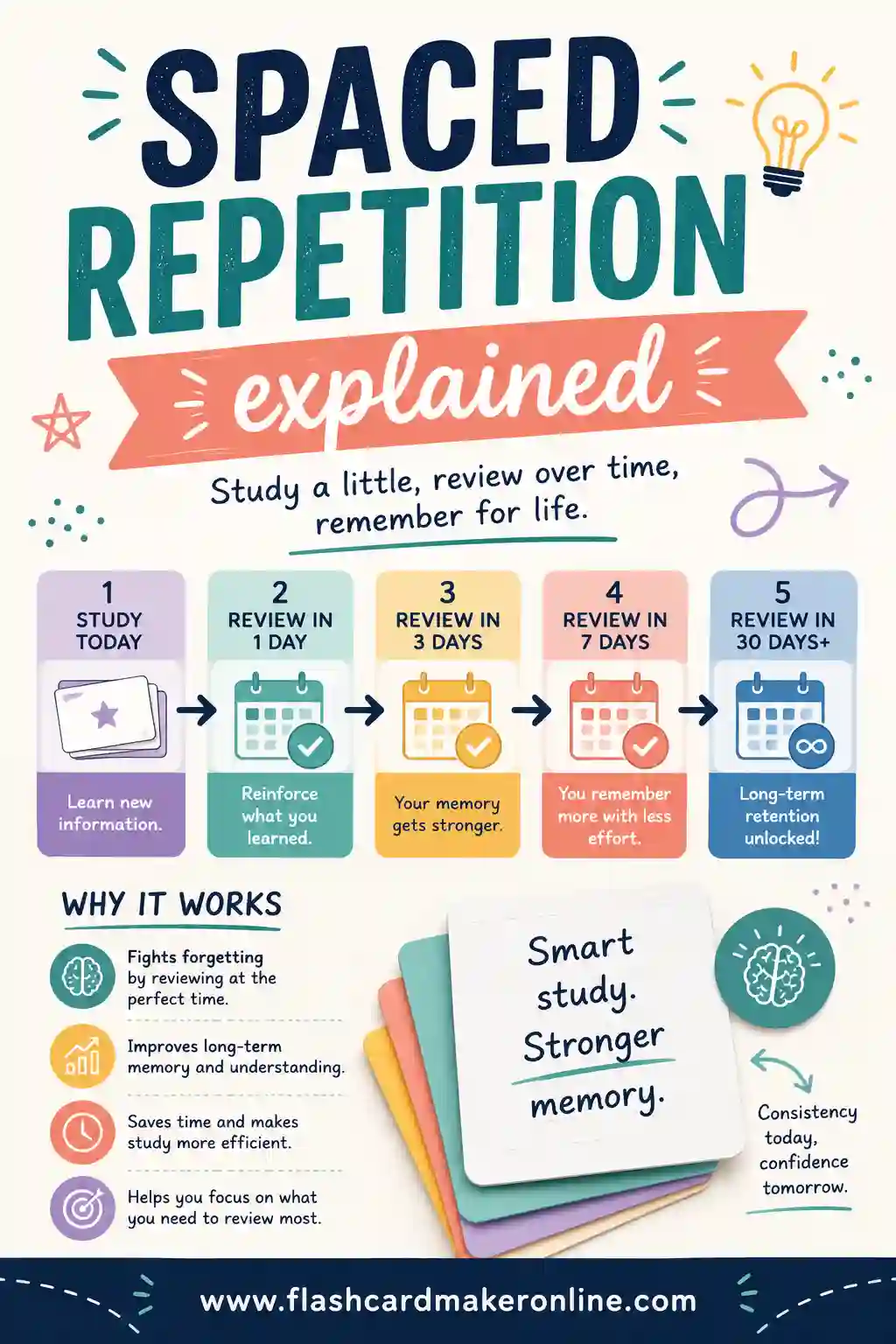
KidsHealth recommends starting to study as soon as you know about a test, scheduling study sessions, and breaking material into smaller pieces so you're not cramming. That lines up with a large body of research on spacing, which shows that shorter sessions spread across days lead to better long-term memory than one long session. Our article on spaced repetition covers simple schedules.
There's an anxiety angle here too. Cramming the night before means walking into the test tired and unsure. Starting early means you've seen the material several times, you've caught your weak spots, and you're more likely to sleep.
Breathe slowly
KidsHealth recommends breathing exercises as a way to relax. A simple approach is to breathe in slowly through your nose, pause briefly, and breathe out slowly through your mouth, a few times in a row. It's quiet, it takes seconds, and you can do it at your desk during a test without anyone noticing.
A test anxiety plan for the weeks before an exam
Putting it all together, here's an example plan. Adjust the timing to fit your schedule and how far away the test is.
- When the test is announced: Write down the date and what it covers. Break the material into chunks.
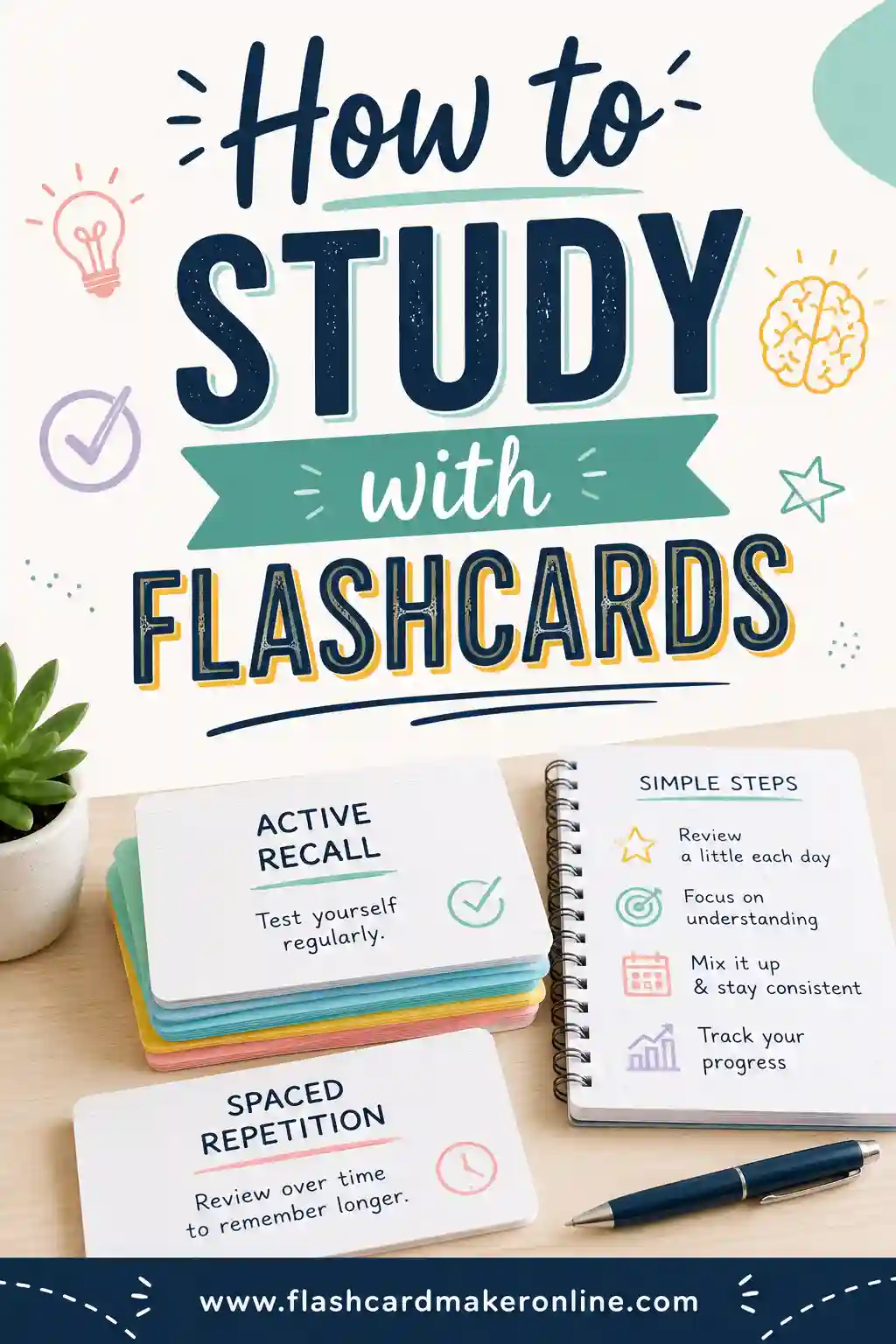
- Make your flashcards early. Turn each chunk into question-and-answer cards. Writing the questions is itself a good first pass through the material. See how to study with flashcards for tips on writing cards that work.
- Quiz yourself in short sessions. Ten to twenty minutes a day beats a three-hour marathon. Answer each card before flipping. If you're not sure how many to do, our guide on how many flashcards per day can help you set a manageable number.
- Track what you miss. Keep a "still learning" pile. Watching that pile shrink over the week is real evidence that you're getting ready, which can quiet the "I don't know anything" worry.
- Do one practice run under test-like conditions. A few days before the test, sit at a desk, set a timer and go through mixed questions without notes. It makes the real thing feel more familiar.
- Protect your sleep the night before. Do a short, light review, then stop. Late-night cramming usually costs more than it gains.
- On test day: Arrive with a few minutes to spare. If you can, take a few minutes to write out your worries. When the jitters hit, tell yourself you're excited. Take a few slow breaths.
A worked example
Here's an illustrative example with a made-up student. Marcus is a tenth grader with a chemistry test in ten days. He usually crams the night before, sleeps badly, and freezes on the first hard question. This time he tries a different approach.
- Day 1: He lists the five topics on the test and makes about 15 flashcards per topic, mixing definitions with short practice problems.
- Days 2 to 7: He spends 15 minutes a day on the cards, answering each one before flipping. His "still learning" pile starts at about 40 cards and drops to 12 by the end of the week.
- Day 8: He does a timed practice test from the textbook at the kitchen table, with no notes. He gets stuck on two problems and adds them to his cards.
- Day 9: Light review of the 12 tricky cards, then bed at his usual time.
- Test day: He writes for a few minutes about his worries before class, tells himself he's excited when his heart starts racing, and starts with a question he knows.
Marcus still feels nervous. That's normal. But this time he has evidence that he's prepared, and a few tools ready for when the nerves hit.
What to do during the test
Even with good preparation, nerves can spike when the test is in front of you. These general tips help many students keep going.
- Start with a question you know. An early win can steady you. Skim the test and answer an easy question first.
- Do a "brain dump." If allowed, jot down key formulas, dates or facts on scrap paper as soon as you start. It takes the pressure off holding them in your head.
- Skip and come back. If you blank on a question, mark it and move on. Answers often come back once you've calmed down or a later question jogs your memory.
- Notice the spiral. If you catch yourself thinking "I'm failing," name it ("that's a worry thought") and bring your attention back to the question in front of you.
- Breathe. A few slow breaths can help reset you between sections.
- Check the clock on purpose. Decide in advance when you'll check the time, such as at the halfway point, instead of glancing at it constantly.
Test anxiety and different kinds of tests
Anxiety doesn't always look the same across subjects and formats. Many students feel fine on one kind of test and very nervous on another. Here are some general ideas for common situations.
Math and science tests
Math anxiety is common enough that it has its own research area, including the Park, Ramirez and Beilock study described above. For math, practice testing means working fresh problems, not just rereading worked examples. Make flashcards for formulas and for "which method do I use here?" questions, then do a few mixed problems each day. On the test, write down formulas as soon as you're allowed, and show your steps so you can pick up partial credit even if you get stuck.
Essay and short-answer tests
Blank-page panic is real. Prepare by practicing outlines for likely questions, and make flashcards for key terms, examples and quotes you might use. During the test, spend a minute jotting a quick outline before you start writing. Having a plan on paper can quiet the "I don't know where to start" feeling.
Standardized and entrance exams
These are the high-stakes tests the von der Embse meta-analysis linked to more anxiety. Familiarity helps: learn the format, the timing and the question types well before test day, and take at least one full timed practice test. If you're preparing for one, our page on flashcards for SAT prep shows how to build a review deck that covers vocabulary and math facts.
Oral exams, presentations and performance tests
Speaking or performing in front of others adds a social layer to the pressure. Brooks's research on reappraisal included public speaking, so the "I'm excited" approach fits well here. Rehearse out loud several times, ideally in front of a friend or family member, so the real event isn't the first time you've said the words in front of someone.
Building confidence over the long run
The strategies above help with a single test. Over months and years, a few habits can make tests feel less threatening overall.
- Treat mistakes as information. KidsHealth suggests treating mistakes as learning opportunities and reminds readers: "Remind yourself that you don't have to get a perfect score on every test." A missed flashcard tells you what to study next. It isn't a verdict on you.
- Keep evidence of progress. Write down your practice quiz scores or how many cards you've mastered each week. When the "I never learn anything" thought shows up, you'll have proof that it isn't true.
- Study with others sometimes. KidsHealth also suggests studying with a classmate to stay on track. Quizzing each other is good practice, and hearing that others feel nervous too can make it feel more normal.
- Practice under mild pressure. Timed practice sessions at home build familiarity with the feeling of being tested, in a setting where nothing is on the line.
- Look after the basics. Regular sleep, meals and breaks don't solve test anxiety, but being worn out makes everything feel harder.
Common myths about test anxiety
"Test anxiety means you're not smart enough."
No. Anxiety is about how you feel under pressure, not how capable you are. Many high-achieving students experience it. In fact, the Ramirez and Beilock research focused on how worry can stop people from showing what they already know.
"The only fix is to stop caring about grades."
Caring about doing well is fine. The goal isn't to stop caring. It's to keep the worry from taking over. Strategies like expressive writing and reappraisal work with your feelings instead of asking you to switch them off.
"You just need to calm down."
Brooks's research suggests that trying to calm down isn't always the best move, and that relabeling nerves as excitement can work better for performance. Telling someone to calm down rarely helps, as anyone who's been told it knows.
"If I study more, the anxiety will go away by itself."
Preparation helps a lot, and it's one of the most useful things you can do. But some students are well prepared and still very anxious. If that's you, it isn't a sign you studied wrong. It may be a sign that it's worth talking to someone who can help with the anxiety itself.
"Everyone gets nervous, so it's not worth mentioning."
Everyone does get nervous sometimes. But if anxiety is regularly getting in the way of your schoolwork, sleep or daily life, it's worth bringing up with a parent, teacher, counselor or doctor. You don't have to wait until it's severe.
For parents and teachers
Adults can make a real difference in how students experience tests. A few general ideas:
- Talk about effort and strategy, not just scores. "How did you prepare?" is a more useful question than "What did you get?"
- Help with planning. Younger students especially may need help breaking material into small chunks and spreading study over days.
- Make low-stakes practice normal. Frequent, ungraded quizzes and flashcard games help students get used to recalling answers without the pressure of a grade. Our page on flashcards for exams has ideas.
- Offer a few minutes before tests. Teachers can give students a short window to write about their worries or take a few breaths, based on the expressive writing research.
- Watch for patterns. If a student's anxiety is intense, frequent or spreading beyond tests, involve the school counselor or school psychologist.
About testing accommodations
Some students with documented conditions can receive testing accommodations, such as extra time or a quieter room. Whether a student qualifies, and what's available, depends on the school, the testing organization, and the laws and policies where you live. Rules vary by place, so ask your school counselor or the testing organization directly about what applies to you.
When to talk to a professional about test anxiety
The strategies in this article are general study and coping tips, not treatment. Please talk with a doctor, school counselor, school psychologist or other qualified professional if anxiety:
- shows up in many situations, not just tests;
- doesn't fade after the test is over, or keeps getting worse;
- causes panic, physical symptoms that worry you, or trouble sleeping or eating;
- leads you to avoid school, skip tests or stop doing things you used to enjoy;
- is affecting your daily life, your relationships or how you feel about yourself.
KidsHealth suggests talking with a parent, teacher or school counselor if test anxiety is hard to manage on your own. A professional can look at the bigger picture, check for other causes, and talk with you about options that fit your situation. If you or someone you know is in crisis or having thoughts of suicide, the National Institute of Mental Health points to the 988 Suicide & Crisis Lifeline: in the US, you can call or text 988. In a life-threatening emergency, call 911.
Try it yourself: a before-test routine
Here's a short routine you can test on your next quiz. Use it for a few tests and notice what helps.
- The week before: Make flashcards and review them in short daily sessions. Keep a "still learning" pile.
- Two days before: Do one timed, no-notes practice run.
- The night before: Do a light review of your "still learning" pile, then stop and get some sleep.
- A few minutes before: Write freely about your worries on a scrap of paper. Toss it if you like.
- Two minutes before: Take a few slow breaths. Say to yourself, "I'm excited. My body is getting ready."
- During: Start with an easy question. Skip and return to tough ones.
- After: Jot down what helped and what didn't. Adjust the routine for next time.
Small experiments like this help you build your own toolkit. What works for a friend might not work for you, and that's fine.
Feeling more ready, one card at a time
Test anxiety is common and understandable. It has a thinking side and a body side, it's linked to lower scores on average, and it often grows when stakes feel high or preparation feels thin. The good news is that research points to simple steps that help many students: writing about your worries before a test, calling your nerves excitement, and, maybe most of all, preparing with practice tests spread over several days so you walk in knowing what you know.
If you'd like a gentle way to start preparing early, the free flashcard maker on our homepage lets you add words and your own pictures, study with flip cards on screen, and print your cards double-sided or as cut-out sheets. A few cards a day, well before the test, is one of the kindest things you can do for your future self. For more practical ideas, see our flashcard study tips.
Common Causes of Test Anxiety Compared
Test anxiety rarely has one cause. This table lines up the contributors the article describes, with where each idea comes from.
| Cause | What the article says | Where it comes from |
|---|---|---|
| The body's alarm system | Adrenaline switches on the fight-or-flight response, which speeds up your heart | KidsHealth |
| Negative thinking | The more you focus on bad outcomes, the stronger the anxiety gets, and worry feeds itself | KidsHealth |
| High stakes and perfectionism | Higher-stakes and harder-seeming tests are linked to more anxiety, and so are perfect standards | The von der Embse meta-analysis and KidsHealth |
| Feeling unprepared | Students who care but don't feel ready are especially vulnerable, and this is one cause you can do a lot about | KidsHealth |
| Past experiences and self-esteem | A bad earlier test can make the next one scarier, and lower self-esteem was a strong predictor of more anxiety | KidsHealth and the meta-analysis |
Frequently Asked Questions
What is test anxiety?
Test anxiety is a type of performance anxiety: nervous, worried feelings before or during an exam that are strong enough to get in the way of concentrating and remembering. It usually has a thinking side, such as worry about failing, and a body side, such as a racing heart, sweating or an upset stomach. Some nerves before a test are normal and can even help you focus. It becomes a problem when the worry takes over and stops you from showing what you know.
What are the main causes of test anxiety?
Usually several things combine. Stress triggers the body's fight-or-flight response, which speeds up your heart and breathing. Negative thinking can spiral, with one worried thought leading to the next. High-stakes tests and tests that seem harder are linked to more anxiety, and so is perfectionism. Feeling unprepared plays a big role, as can bad experiences on past tests. A large 2018 meta-analysis also found that lower self-esteem was a strong predictor of test anxiety.
Does test anxiety lower test scores?
On average, yes, though the effect varies a lot between people. A 2018 meta-analysis of 238 studies found that higher test anxiety was linked to lower scores on standardized tests, university entrance exams and grade point average, with the strongest link in the middle grades. Most of the relationships were small to moderate. Many anxious students still do well, and simple strategies like good preparation and expressive writing can help close the gap.
Why do I go blank during tests even when I studied?
Attentional control theory suggests that anxiety makes it harder to keep your attention on the task you chose and easier for it to be pulled toward worries. Those worried thoughts compete for the mental space you need to recall answers. It can also happen if you studied by rereading, which feels familiar but doesn't practice recall. Practicing with flashcards or quizzes, skipping hard questions and returning later, and taking a few slow breaths can help.
Does writing about your worries before a test really help?
Research suggests it can. In a 2011 study in Science, Ramirez and Beilock found that students who wrote briefly about their thoughts and feelings about a test right before taking it scored significantly higher than students who didn't, and the benefit was strongest for students who usually feel anxious about tests. A later study found similar benefits for students with math anxiety. It's quick, free and low risk, so many students find it worth trying.
Is it better to calm down or get excited before a test?
Research by Alison Wood Brooks suggests that reappraising anxiety as excitement can work better than trying to calm down. Across studies involving singing, public speaking and math, people who told themselves they were excited felt more excited and performed better than those who tried to relax. Because anxiety and excitement feel similar in the body, relabeling the feeling may be easier than making it disappear. Saying 'I am excited' to yourself is a simple way to try it.
Can flashcards help with test anxiety?
Flashcards can help with one of the biggest contributors to test anxiety: feeling unprepared. Quizzing yourself is a proven way to strengthen memory, and it gives you an honest picture of what you know, so you can fix gaps before the test instead of discovering them during it. Watching your pile of missed cards shrink over several days can also be reassuring. Flashcards aren't a treatment for anxiety, but they're a practical way to prepare with more confidence.
When should I see someone about test anxiety?
Talk with a doctor, school counselor or school psychologist if anxiety shows up in many situations, doesn't fade after tests, keeps getting worse, causes panic or trouble sleeping or eating, leads you to avoid school or tests, or affects your daily life and relationships. You don't need to wait until it's severe. A professional can look at the bigger picture and discuss options that fit your situation. If you're in crisis in the US, call or text 988.
Can students with test anxiety get extra time on tests?
Some students with documented conditions can receive testing accommodations, such as extra time or a quieter room. Whether a student qualifies depends on the school, the testing organization and the laws and policies where you live, and the rules vary from place to place. The best first step is to ask your school counselor or contact the testing organization directly. They can explain what documentation, if any, is needed and what options are available.
Sources
We checked every source below while writing this guide. Last reviewed October 30, 2026, by Joan Ramos.
- Writing about testing worries boosts exam performance in the classroom (Ramirez & Beilock, 2011) (Science, via PubMed)
- The role of expressive writing in math anxiety (Park, Ramirez & Beilock, 2014) (Journal of Experimental Psychology: Applied, via PubMed)
- Get excited: reappraising pre-performance anxiety as excitement (Brooks, 2014) (Journal of Experimental Psychology: General, via PubMed)
- Anxiety and cognitive performance: attentional control theory (Eysenck et al., 2007) (Emotion, via PubMed)
- Test anxiety effects, predictors, and correlates: A 30-year meta-analytic review (von der Embse et al., 2018) (Journal of Affective Disorders, via PubMed)
- Test-Enhanced Learning: Taking Memory Tests Improves Long-Term Retention (Roediger & Karpicke, 2006) (Psychological Science, via PubMed)
- Test Anxiety (for Teens) (Nemours KidsHealth)
- Anxiety (MedlinePlus, US National Library of Medicine)
- Anxiety Disorders (National Institute of Mental Health)