AP Exam Flashcards: Make, Study & Print Your Own
AP exam flashcards are quick term-and-answer cards that drill the vocabulary, dates, formulas, and concepts you need for recall on AP tests, things like key terms in AP Psychology, dates in AP U.S. History, or formulas in AP Calculus. The most effective way to learn them is active recall plus spaced repetition: read the prompt, answer before you flip, then review your misses more often. To build a deck shaped around your course and weak spots, use a free flashcard maker and type your own cards in minutes.
Want to start now? Open the free flashcard maker, paste a few terms (there's a ready-made AP list below), and you'll have a deck you can flip on screen or print to study anywhere. No sign-up, nothing to install.
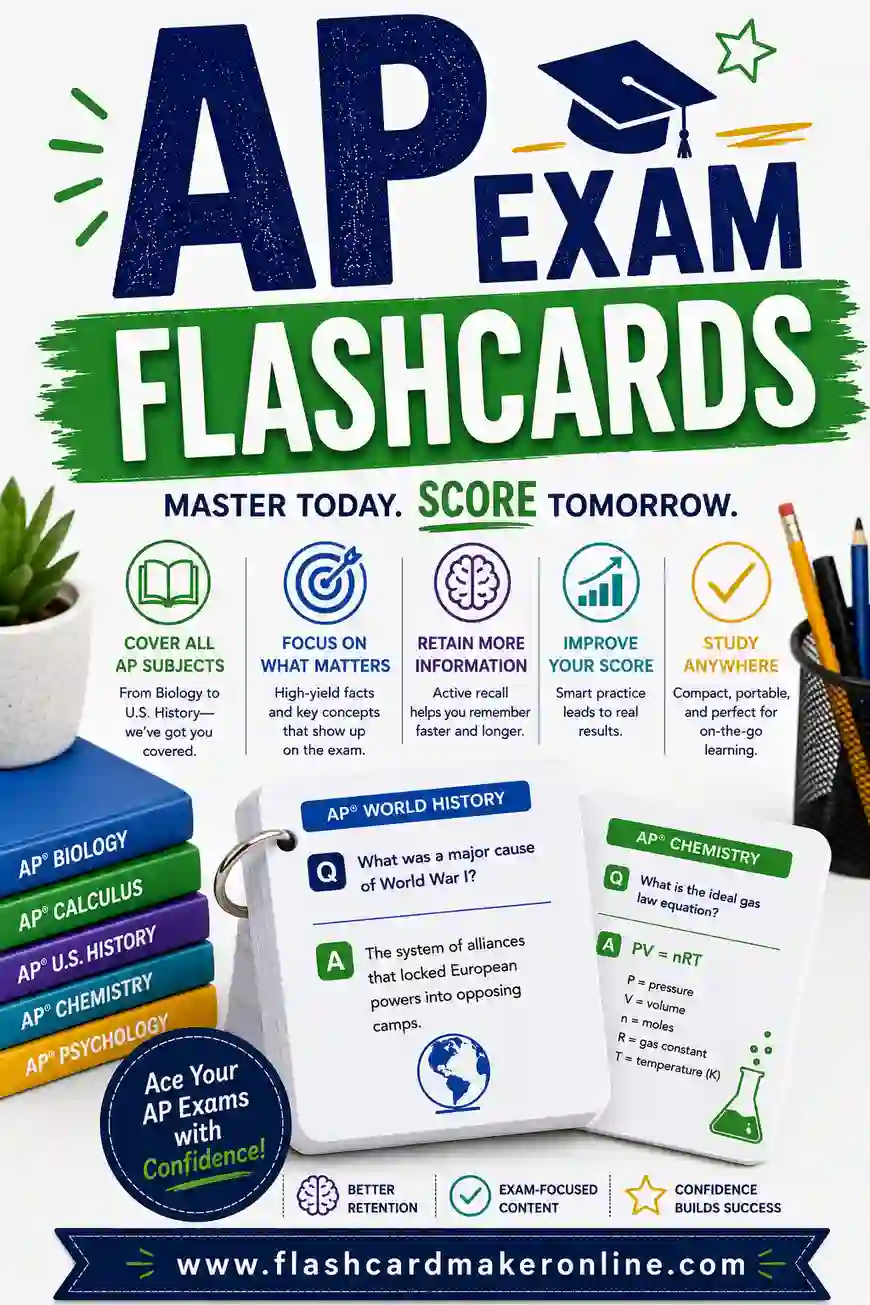
Why Flashcards Work for AP Exams
AP exams are demanding, but a big share of the score comes down to recall: knowing the term, the date, the formula, or the concept so you can deploy it fast on multiple choice and free response. Flashcards are the most efficient tool for that recall layer, freeing your brain to focus on analysis during the actual test.
There's a catch worth being honest about. AP free-response questions reward reasoning and writing, not just memorized facts. Flashcards won't write your DBQ or your lab analysis. What they do is make the building blocks automatic, so when you sit down to write, the facts and vocabulary are already there.
Cards also beat rereading the textbook because they force recall. Pulling an answer from memory strengthens it far more than passively reading it again. That's active recall, the most efficient way to study a content-heavy course.
High-Yield AP Flashcard Deck (Copy & Paste)
Here's a starter deck spanning several popular AP subjects. Drop it into the flashcard maker and build out the subject you're actually taking. Prompt on the left, answer on the right.
| Term / Prompt | Answer |
|---|---|
| Operant conditioning (Psych) | Behavior shaped by rewards and punishments |
| Classical conditioning (Psych) | Learning by association of two stimuli |
| Confirmation bias (Psych) | Favoring info that fits your beliefs |
| Manifest Destiny (APUSH) | Belief the U.S. should expand across the continent |
| Checks and balances (Gov) | Each branch limits the power of the others |
| Federalism (Gov) | Power shared between national and state govts |
| Opportunity cost (Econ) | Value of the next best alternative given up |
| Supply and demand (Econ) | Price set by availability vs. desire |
| Marginal cost (Econ) | Cost of producing one more unit |
| Photosynthesis (Bio) | Light energy converted to glucose |
| Mitosis vs. meiosis (Bio) | Mitosis = identical cells; meiosis = gametes |
| Natural selection (Bio) | Fittest traits survive and reproduce |
| Power rule (Calc) | d/dx[xⁿ] = n·xⁿ⁻¹ |
| Derivative meaning (Calc) | Instantaneous rate of change / slope |
| Fundamental theorem of calculus | Integration and differentiation are inverses |
| Newton's second law (Physics) | F = m × a |
| Kinetic energy (Physics) | KE = ½mv² |
| Ohm's law (Physics) | V = I × R |
| Tone vs. mood (Lit) | Tone = author's attitude; mood = reader's feeling |
| Theme (Lit) | The central message of a text |
| Ethos, pathos, logos (Lang) | Appeals to credibility, emotion, logic |
| Standard deviation (Stats) | How spread out data is from the mean |
| Separation of powers (Gov) | Splitting government into three branches |
| Allele (Bio) | One version of a gene |
| Limiting reactant (Chem) | The reactant that runs out first |
| Gilded Age (APUSH) | Late-1800s era of wealth and corruption |
| Inflation (Econ) | A general rise in prices over time |
| Chain rule (Calc) | Derivative of a function inside a function |
About 20 cards per unit is a solid start. Build the deck for your specific course, since AP covers dozens of subjects and your exam is the one that matters.
Build cards from practice questions
Your most valuable deck is the set of questions you got wrong on practice multiple choice. Every miss becomes a card that night. By exam week, that "mistakes" deck targets exactly the gaps that would otherwise cost you points.
How to Study AP Flashcards So They Stick
Making cards is the easy part. Drilling them well is where the 4 or 5 comes from.
- Recall before you flip. Read the front, answer out loud, then check. The effort to remember is what builds the memory.
- Space your reviews. New cards the same day, then 2 days, then a week, then exam week. Cards you miss come back sooner.
- Shuffle the order. Don't memorize the sequence. Mix the deck every session so you learn the content.
- Add a "so what?" line. For concept cards, write one line on why it matters or how it connects. That helps on free response, not just multiple choice.
- Short and steady beats cramming. Several 20-minute sessions across the week outperform one panicked all-nighter. Start early; AP rewards spaced practice.
A simple spaced-repetition schedule
No software needed. Three small piles and this rhythm will do it.
| Review | When | What to review |
|---|---|---|
| 1st | Same day | All new cards |
| 2nd | 2 days later | Cards you missed |
| 3rd | 1 week later | Misses + a full pass |
| 4th | 2–3 weeks later | Trouble cards |
| Final | Exam week | Your "mistakes" deck |
Printed vs. Digital AP Flashcards
Both help, and most students use a mix.
Digital cards are great for quick reviews on your phone between classes or on the bus. You can flip 30 vocab terms in a few minutes.
Printed cards are better for focused study. You can spread them on a table, sort known from unknown, and write a memory hook in the margin. For dense subjects like AP Bio vocabulary or APUSH timelines, a physical stack you can shuffle and re-sort is hard to beat.
You don't have to choose. Build the deck once in the flashcard maker, review on your phone during the week, then print the cards you keep missing for a focused weekend session.
Subject-by-Subject Card Strategy
Different AP courses reward different kinds of cards.
AP History (APUSH, World, Euro)
Make term, person, and event cards, plus a few "cause and effect" cards. Timelines are perfect for printed cards you can lay out in order. Don't just memorize dates; add a one-line "why it mattered" to each event.
AP Sciences (Bio, Chem, Physics, Environmental)
Mix vocabulary cards with formula and process cards. For Bio, drill the heavy vocabulary load. For Chem and Physics, formula cards plus "when do I use this?" cards pay off most.
AP Math and Statistics
Formula cards (derivatives, integrals, key stats formulas) plus concept cards that explain what a formula means. Understanding beats blind memorization on the free-response sections.
AP English (Lang and Lit)
You can't flashcard the essay, but you can drill rhetorical and literary terms, ethos/pathos/logos, theme, tone, and devices. Knowing these cold lets you write faster and analyze sharper.
AP Psychology and Government
Term-and-definition heaven. Theorists, named effects, branches of government, and key cases map perfectly onto one-line cards. These courses reward flashcards more than almost any others.
Printing Tips for AP Flashcards
A few small choices make printed cards far nicer to use.
- Use cardstock. It survives a semester of shuffling and a backpack. Thin paper wears out fast.
- Two columns per page. More cards per sheet, less paper to cut and carry.
- Color-code by unit. Print each unit on a different color so you can grab a topic by sight.
- Add a binder ring. Punch a corner so each unit becomes its own flip deck.
- Test print first. If you go double-sided, confirm the answer lands behind the right term before printing the stack.
How Many AP Flashcards Do You Need?
There's no fixed number, but here's a realistic range per exam. Most students build 200 to 700 cards across a course, growing the deck a handful at a time.
| Prep stage | Rough card count | Focus |
|---|---|---|
| During the year | 100–300 | Terms + formulas per unit |
| Spring review | 300–500 | Add practice-question misses |
| Final weeks | 500–700+ | Heavy review, trim mastered cards |
A focused deck you review often beats a giant one you build and forget. Starting early and reviewing steadily is what earns the top scores.
Common AP Flashcard Mistakes to Avoid
Plenty of students make cards and still don't see the score bump they hoped for. Usually it's one of these habits getting in the way.
- Cramming an entire concept onto one card. If the back of a card is a paragraph, it's really five cards in disguise. Break it apart. One card, one idea, every time.
- Copying the textbook word for word. Long, dense definitions are hard to recall. Reword each answer in your own plain language. The act of rewording is itself studying.
- Reading both sides instead of recalling. Flipping a card and reading the answer feels productive, but it barely works. Always answer first, then check. The reach for the answer is the whole point.
- Building one massive deck and never sorting it. A 600-card pile you shuffle blindly wastes time on cards you already know. Pull the easy ones aside and drill the misses.
- Starting in April. A deck you build in May can't give spaced repetition time to work. Make cards as you learn each unit so the facts are automatic by exam day.
- Skipping the free-response prep. Flashcards lock in the facts, but they won't teach you to write a DBQ or a lab analysis. Pair card drills with timed practice essays.
Fix these and your cards start pulling real weight. Most of them come down to the same rule: one idea per card, recall before you flip.
Pair Flashcards With the Rest of Your AP Prep
Flashcards are a piece of the puzzle, not the whole thing. The top scorers fold them into a wider routine. Here's how the parts fit together.
Flashcards plus practice exams
Take a timed practice section, then turn every miss into a card that same night. Your flashcards become a custom map of your weak spots, and your next practice exam shows whether the cards are working. It's a tight feedback loop.
Flashcards plus the textbook and notes
Read or take notes first to understand the material, then make cards to lock it in. Flashcards aren't for first-time learning; they're for cementing what you've already met once. Understand it, then drill it.
Flashcards plus study groups
Quiz a friend with your printed deck, then have them quiz you. Saying answers out loud to another person is a powerful form of active recall, and you'll catch gaps you didn't know you had. Trade decks for subjects where your partner is stronger.
Flashcards plus the official rubrics
For free-response courses, read the College Board scoring guidelines so you know what graders reward. Then make a few cards from the rubric itself: "What earns the thesis point?" or "What does evidence need to include?" Knowing the rubric cold is its own kind of recall.
The deck does the heavy lifting on facts. The practice tests, the writing, and the rubric do the rest. Together they're what turn a 3 into a 5.
Frequently Asked Questions
Are flashcards good for AP exams?
Yes, especially for the recall layer: vocabulary, dates, formulas, and concepts. They're most powerful for term-heavy courses like AP Psychology, AP Biology, and AP U.S. History. Pair them with practice free-response questions, since AP also rewards reasoning and writing.
How do I make my own AP exam flashcards?
Open the free flashcard maker, put a term or prompt on the front and the answer on the back, and repeat. Build cards from the questions you miss on practice multiple choice for the biggest payoff, then study with active recall and spaced repetition.
When should I start using AP flashcards?
Start during the school year, not just before the May exams. Making cards as you cover each unit gives spaced repetition time to work, so the content is automatic by test day. Early, steady review beats last-minute cramming.
Are printed or digital AP flashcards better?
Both work. Digital cards are great for quick reviews on your phone between classes; printed cards are better for focused study and laying out timelines or sorting by hand. Many students build a deck once and use both.
How many cards should I review each day?
Short daily sessions work best. Review new cards the day you make them, then revisit missed cards every couple of days. A daily pass of 40 to 100 cards keeps everything fresh without overwhelming you.
Can flashcards help with AP free-response questions?
Indirectly, yes. Flashcards make the underlying facts, terms, and formulas automatic, so when you write a DBQ or work a free-response problem, you're not stuck digging for a date or a definition. They free up your brain for the analysis and writing the graders actually reward. Just don't rely on cards alone for the essay; pair them with timed practice writing.
Should I make my own AP flashcards or download a set?
Making your own is usually better, because writing the cards is itself a form of studying and you can word them the way that clicks for you. The single most valuable deck is the one built from your own practice-test misses. Pre-made decks are a fine shortcut for big, standardized subjects, but a tailored deck always beats a generic one.
Ready to Build Your AP Exam Deck?
Grab the starter list above, open the free flashcard maker, and turn the terms and formulas you keep missing into automatic recall. It's free, there's no sign-up, and you can study on screen or print a stack to take anywhere. Build a little every day, drill with active recall, and walk into the exam ready for a 5. Want more exam decks? Try our MCAT flashcards, GED flashcards, and ASVAB flashcards.