GED Flashcards: Make, Study & Print Your Own
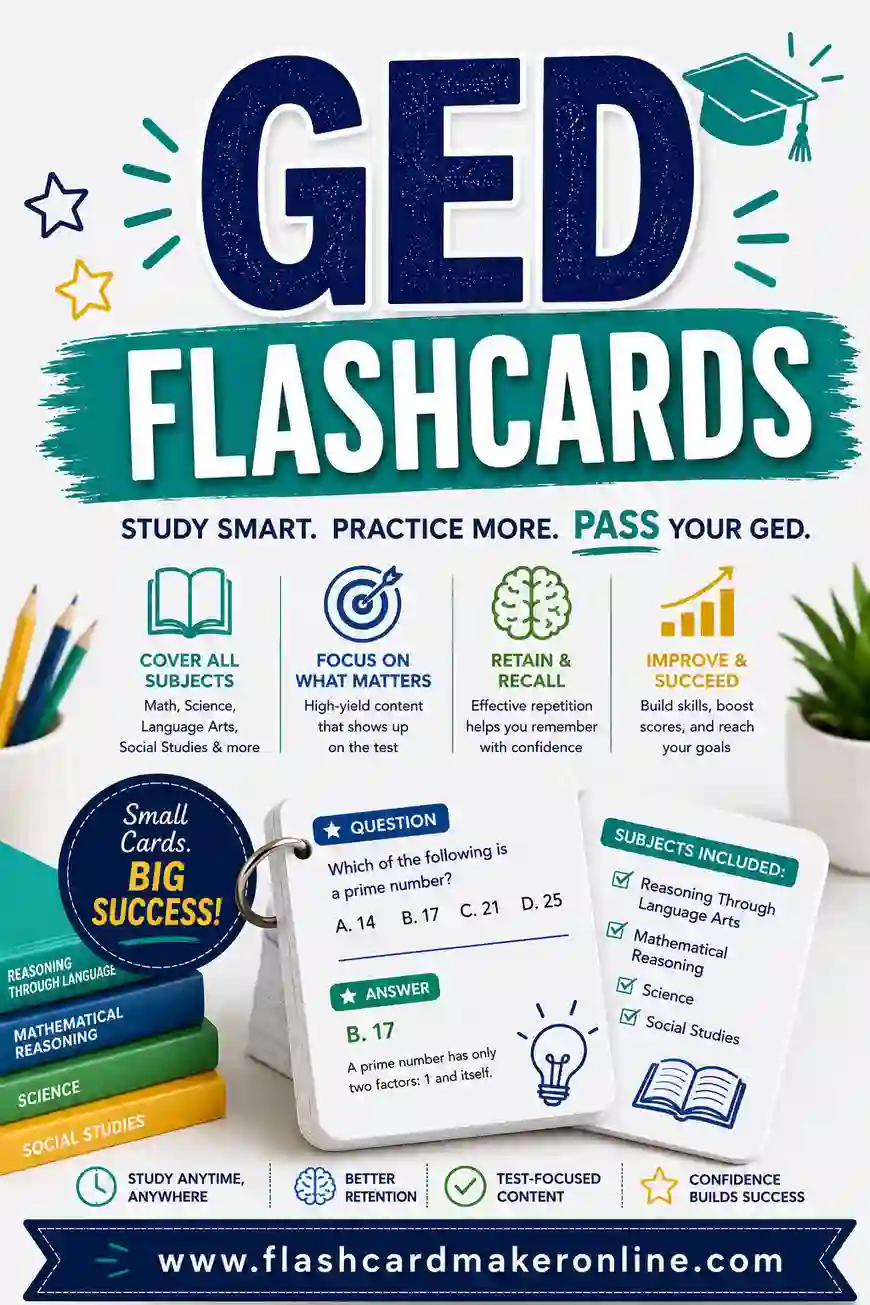
GED flashcards are quick term-and-answer cards that drill the key facts, formulas, and vocabulary across the four GED subjects: Math, Science, Social Studies, and Reasoning Through Language Arts. The most effective way to learn them is active recall plus spaced repetition: read the prompt, answer before you flip, then review your misses more often. To build a deck that targets your weak subjects, use a free flashcard maker and type your own cards in minutes.
Want to start now? Open the free flashcard maker, paste a few terms (there's a ready-made GED list below), and you'll have a deck you can flip on screen or print to study anywhere. No sign-up, nothing to install.
Why Flashcards Work for the GED
The GED covers a lot of ground across four subjects, but much of it comes down to knowing specific facts, formulas, and terms. That's exactly what flashcards are made for. They let you carve a big test into small, learnable pieces you can drill in spare minutes.
Flashcards also fit real life. Most GED students are juggling work, family, or both, and don't have hours to sit with a textbook. A deck of cards works in five-minute windows: a coffee break, a bus ride, the time before dinner. Those small sessions add up to real progress.
And cards beat rereading your notes because they force you to produce the answer. Pulling a fact from memory makes it stick far better than passively reading it again. That's active recall, and it's the most efficient way to study a fact-heavy test.
High-Yield GED Flashcard Deck (Copy & Paste)
Here's a starter deck across all four GED subjects. Drop it into the flashcard maker and keep adding cards as you study. Prompt on the left, answer on the right.
| Term / Prompt | Answer |
|---|---|
| Area of a rectangle | length × width |
| Area of a triangle | ½ × base × height |
| Slope of a line | rise ÷ run |
| Pythagorean theorem | a² + b² = c² |
| Mean (average) | sum of values ÷ how many |
| Median | middle value when sorted |
| Percent | part ÷ whole × 100 |
| Order of operations | PEMDAS |
| Photosynthesis | Plants make food from sunlight |
| Mitochondria | Powerhouse of the cell |
| States of matter | Solid, liquid, gas |
| Newton's first law | Objects stay in motion unless acted on |
| Food chain | Energy passes from one organism to the next |
| Three branches of U.S. government | Legislative, executive, judicial |
| Checks and balances | Each branch limits the others |
| Bill of Rights | First 10 amendments to the Constitution |
| Supply and demand | Price set by what's available vs. wanted |
| Simile | Comparison using "like" or "as" |
| Metaphor | Direct comparison, no "like" or "as" |
| Theme | The central message of a text |
| Main idea | What a passage is mostly about |
| Subject-verb agreement | Subject and verb must match in number |
| Mode (statistics) | The value that appears most often |
| Range (statistics) | Highest value minus lowest value |
| Newton's third law | Every action has an equal, opposite reaction |
| Cell membrane | Controls what enters and leaves the cell |
| Supreme Court role | Interprets the Constitution and laws |
| GDP | Total value of goods and services produced |
| Personification | Giving human traits to non-human things |
| Context clues | Using nearby words to figure out a meaning |
About 20 cards per subject is a strong start. Lean hardest on the subjects you find toughest, since that's where flashcards close the gap fastest.
Build cards from practice-test mistakes
Your most valuable deck is the list of questions you got wrong. Every time a practice test catches a gap, write a card for it that day. By test week, that "mistakes" deck is the most useful study tool you own.
This matters even more for the GED because the four subjects cover so much ground. You can't drill everything, so let your mistakes point you to what actually needs work. If you keep missing percent problems, make three or four percent cards. If a science term trips you up twice, it earns a card. Studying your own gaps is far more efficient than trying to review an entire textbook from front to back.
How to Study GED Flashcards So They Stick
Making cards is the easy part. Drilling them well is where the pass comes from.
- Recall before you flip. Read the front, say the answer out loud, then check. The effort to remember is what builds the memory.
- Space your reviews. New cards the same day, then 2 days, then a week, then test week. Cards you miss come back sooner.
- Shuffle the order. Don't memorize the sequence. Mix the deck every session so you learn the content.
- Keep subjects separate. One stack per subject so you can target a weak area on its own.
- Short and steady. Fifteen focused minutes a day beats a long, draining cram. Consistency is what works.
A simple spaced-repetition schedule
You don't need any software. Three small piles and this rhythm will do it.
| Review | When | What to review |
|---|---|---|
| 1st | Same day | All new cards |
| 2nd | 2 days later | Cards you missed |
| 3rd | 1 week later | Misses + a full pass |
| 4th | 2–3 weeks later | Trouble cards |
| Final | Test week | Your "mistakes" deck |
Printed vs. Digital GED Flashcards
Both help, and many students use a mix.
Digital cards are great for quick reviews on your phone in spare moments. You can flip 25 cards while dinner cooks.
Printed cards are better for focused study. You can spread them on a table, sort known from unknown, and write a memory hook in the margin. For math formulas you want to nail down, a physical stack you can shuffle is hard to beat.
You don't have to choose. Build the deck once in the flashcard maker, review on your phone during the week, then print the cards you keep missing for a focused weekend pass.
Subject-by-Subject Card Ideas
Each GED subject rewards a slightly different card style.
Mathematical Reasoning
Make formula cards (area, slope, percent) and a few "which formula?" cards. For word problems, write a card that captures the setup, like "distance problem → distance = rate × time." The official formula sheet is provided on test day, so focus your cards on knowing when and how to use each formula.
Science
Term-and-fact cards work great: cell parts, the scientific method, energy, basic physics, and biology vocabulary. Keep each card to one idea.
Social Studies
Government, history, economics, and geography are full of clean term-and-definition cards. The branches of government, key amendments, and economic basics like supply and demand are perfect flashcard material.
Reasoning Through Language Arts
You can't flashcard the essay, but you can drill grammar rules and literary terms. Subject-verb agreement, common punctuation rules, and terms like simile, theme, and main idea make solid cards.
Printing Tips for GED Flashcards
A few small choices make printed cards far nicer to use.
- Use cardstock. It survives weeks of shuffling and a bag. Thin paper wears out fast.
- Two columns per page. More cards per sheet, less paper to cut and carry.
- Color-code by subject. Math on one color, Science on another. Grab a subject by sight.
- Add a binder ring. Punch a corner so each subject becomes its own flip deck.
- Test print first. If you go double-sided, confirm the answer lands behind the right prompt before printing the stack.
How Many GED Flashcards Do You Need?
There's no fixed number, but here's a realistic range. Most students build 200 to 600 cards over a few weeks or months, growing the deck a handful at a time.
| Prep stage | Rough card count | Focus |
|---|---|---|
| Getting started | 50–150 | Core facts + formulas per subject |
| Mid prep | 150–350 | Add practice-test misses |
| Final stretch | 300–600 | Heavy review, trim mastered cards |
A focused deck you review often beats a giant one you build and forget. Steady practice is what gets you across the line.
Remember that the GED isn't about being perfect, it's about reaching a passing score on each subject. Flashcards help you get there by turning the facts you can control into easy points, so you can spend your test-day energy on the reasoning questions that take more thought. Build a steady habit, lean on your mistakes deck, and let the small daily wins stack up.
Common GED Flashcard Mistakes to Avoid
A few simple slips can slow your progress. Avoid these and your deck works harder for you.
- Packing too much on one card. If the back is a full paragraph, you'll memorize how it looks instead of what it means. Keep it to one fact or one formula.
- Studying only the cards you know. Flying through easy cards feels productive, but it teaches you nothing new. Spend your time on the ones you miss.
- Skipping the subject you dread. If math scares you, that's where flashcards help most. Build cards for your weakest subject first, not last.
- Trying to flashcard the essay. The Language Arts essay is a writing skill, not a recall task. Drill grammar and literary terms with cards, but practice the essay by actually writing.
- Making the whole deck the night before. Cards need days of repetition to stick. A pile built in one sitting is just cramming on paper.
Fix these early and every card you make earns its place.
Fitting Flashcards Into a Busy GED Schedule
Most GED students aren't full-time students. You're squeezing study around work, family, or both, and that's exactly where flashcards fit best. They don't ask for a free hour; they ask for five free minutes.
Here's a way to make it work. Start with a short practice test in each subject to find your weak spots. Those become your first cards. Then build a tiny daily habit: a few new cards in the morning, a quick flip through yesterday's cards at night. You're not carving out a study block, you're filling the gaps you already have, the coffee break, the bus ride, the wait at an appointment.
A realistic week might be ten new cards a day plus one short practice quiz on the weekend. Every question you miss on that quiz becomes a card or two. Over a month, that quiet rhythm builds a focused deck covering the exact facts standing between you and a passing score.
The whole thing rests on consistency, not intensity. You don't need long sessions or perfect focus. You need to keep showing up in small windows, and let spaced repetition turn those five-minute flips into facts that hold on test day.
Frequently Asked Questions
Are flashcards good for the GED?
Yes. The GED rewards knowing specific facts, formulas, and vocabulary across four subjects, and flashcards are the strongest tool for drilling that into recall. Pair them with full practice tests so you also build pacing and the writing skills the essay needs.
How do I make my own GED flashcards?
Open the free flashcard maker, put a term or prompt on the front and the answer on the back, and repeat. Build cards from the questions you miss on practice tests for the biggest payoff, then study with active recall and spaced repetition.
Which GED subject should I focus my flashcards on?
Focus on whichever subject you find hardest, since that's where flashcards close the gap fastest. Math formulas, science terms, and social studies facts all map cleanly onto cards. For language arts, drill grammar rules and literary terms.
Are printed or digital GED flashcards better?
Both work. Digital cards are great for quick reviews on your phone in spare minutes; printed cards are better for focused study and sorting by hand. Many students build a deck once and use both.
How many cards should I review each day?
Short daily sessions work best. Review new cards the day you make them, then revisit missed cards every couple of days. A daily pass of 40 to 100 cards keeps everything fresh without overwhelming you.
Can flashcards help with the GED essay?
Not directly, since the Extended Response is a writing task, not a recall task. But cards can sharpen the building blocks: grammar rules, punctuation, transition words, and literary terms. Drill those with flashcards, then practice the essay itself by writing timed responses to sample prompts.
How long should I study with GED flashcards before testing?
Give yourself at least a few weeks, and longer if your schedule is tight. Spaced repetition needs several review cycles to move facts into lasting memory. Even ten cards a day over a month or two beats a last-minute cram, and it fits far more easily around a busy life.
Ready to Build Your GED Deck?
Grab the starter list above, open the free flashcard maker, and turn the facts you keep missing into automatic recall. It's free, there's no sign-up, and you can study on screen or print a stack to take anywhere. Build a little every day, drill with active recall, and walk into the test center ready to pass. Want more exam decks? Try our ASVAB flashcards, MCAT flashcards, and AP exam flashcards.