ASVAB Flashcards: Make, Study & Print Your Own
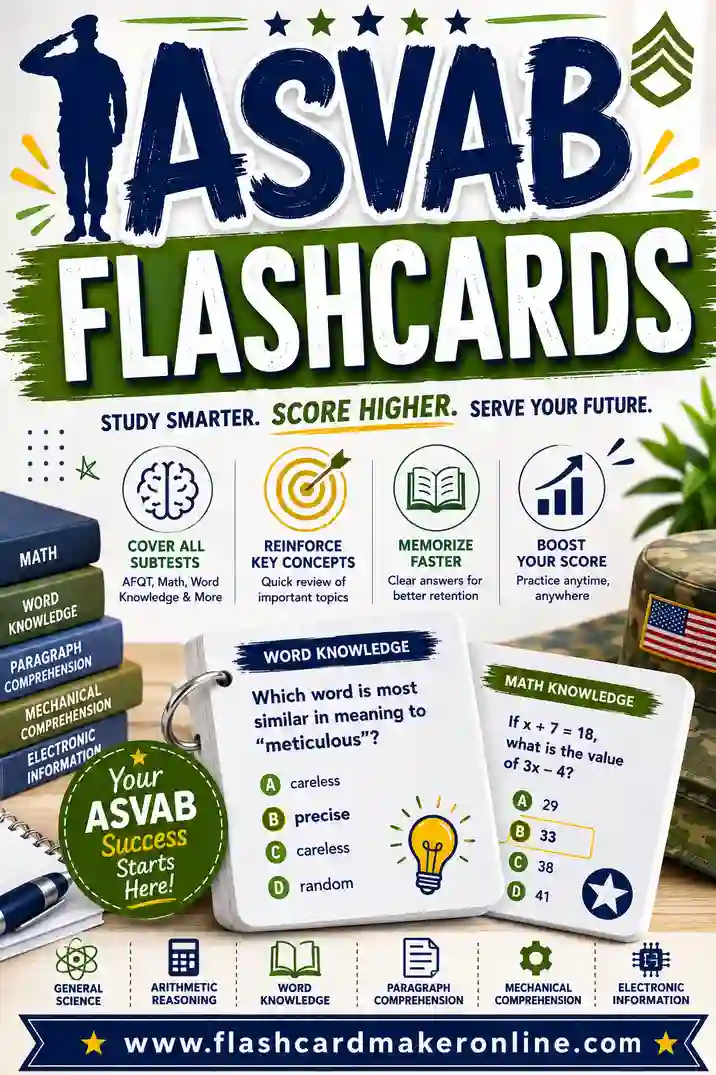
ASVAB flashcards are quick term-and-answer cards that drill the vocabulary, math formulas, science facts, and electronics basics that show up across the test, the same content that drives your AFQT and line scores. The best way to learn them is active recall plus spaced repetition: read the prompt, answer before you flip, then review your misses more often. To build a deck that targets your weakest subtests, use a free flashcard maker and type your own cards in minutes.
Want to jump in? Open the free flashcard maker, paste a few terms (there's a ready-made ASVAB list below), and you'll have a deck you can flip on screen or print to study anywhere. No sign-up, no app to download.
Why Flashcards Are Perfect for the ASVAB
The ASVAB is broad but shallow. It touches vocabulary, arithmetic, basic algebra, general science, mechanics, and electronics, but it rarely goes deep on any one of them. That's the ideal setup for flashcards: lots of discrete facts, formulas, and word meanings you just need to know.
Your AFQT score, the number recruiters care about most, comes from four subtests: Arithmetic Reasoning, Math Knowledge, Word Knowledge, and Paragraph Comprehension. Two of those four reward raw recall. Word Knowledge is pure vocabulary, and Math Knowledge leans on formulas you can drill. Flashcards move the needle fast here.
Cards beat rereading a study guide because they force you to produce the answer. Every time you recall a definition or formula from memory, you make it stickier. That's active recall, and it's the most efficient way to study a recall-heavy test.
High-Yield ASVAB Flashcard Deck (Copy & Paste)
Here's a starter deck spanning vocabulary, math, and science. Drop it into the flashcard maker and keep adding cards as you study. Term or prompt on the left, answer on the right.
| Term / Prompt | Answer |
|---|---|
| Abate | To lessen or reduce |
| Candid | Honest and direct |
| Frugal | Careful with money; thrifty |
| Tedious | Boring and long |
| Diligent | Hard-working and careful |
| Area of a circle | A = πr² |
| Circumference of a circle | C = 2πr |
| Area of a triangle | A = ½ × base × height |
| Pythagorean theorem | a² + b² = c² |
| Slope of a line | m = (y₂−y₁)/(x₂−x₁) |
| Speed | distance ÷ time |
| Percent change | (new − old) ÷ old × 100 |
| Ohm's law | V = I × R |
| Newton's second law | F = m × a |
| Conductor vs. insulator | Conductor carries current; insulator resists |
| Number of bones in adult body | 206 |
| Powerhouse of the cell | Mitochondria |
| Speed of sound (approx., air) | ~343 m/s |
| Three states of matter | Solid, liquid, gas |
| Simple machine examples | Lever, pulley, inclined plane, wheel |
| Series circuit trait | One path; same current throughout |
| Parallel circuit trait | Multiple paths; voltage stays the same |
| Benevolent (vocab) | Kind and generous |
| Volatile (vocab) | Likely to change suddenly; unstable |
| Area of a rectangle | length × width |
| Power formula (electrical) | P = V × I |
| Mechanical advantage | Output force ÷ input force |
| Fulcrum | The pivot point of a lever |
| Density formula | mass ÷ volume |
| Torque | Force × distance from the pivot |
About 20 cards per subtest is a solid start. Lean heaviest on vocabulary and math formulas, since those give the most score for the effort.
Build vocab cards from words you don't know
The fastest way to grow your Word Knowledge score is to make a card every time you hit a word you can't define, whether in a practice test, a book, or an article. Write the word on the front and a short, plain-English meaning on the back. A few new words a day adds up quickly.
A helpful trick: add a tiny memory hook to tricky words. For "frugal," you might jot "frugal = thrifty, saves money." For "tedious," think "tedious = tiring and dull." These little anchors make the word easier to recall under pressure than a dry dictionary definition. Aim for five new vocab cards a day and you'll have learned over a hundred words in three weeks without ever feeling like you're cramming.
How to Study ASVAB Flashcards So They Stick
Making cards is half the job. Drilling them the right way is where the score comes from.
- Recall before flipping. Read the front, answer out loud, then flip. The effort to remember is what builds the memory.
- Space your reviews. New cards the same day, then 2 days, then a week, then test week. Cards you miss come back sooner.
- Shuffle the deck. Don't memorize the order. Mix it up every session so you learn the content, not the sequence.
- Group by subtest. Keep vocab, math, and science in separate stacks so you can target a weak area on its own.
- Keep it short and daily. Fifteen minutes a day beats a two-hour cram once a week. Consistency wins.
A simple spaced-repetition plan
No software needed. Three small piles and this schedule will do it.
| Review | When | What to review |
|---|---|---|
| 1st | Same day | All new cards |
| 2nd | 2 days later | Cards you missed |
| 3rd | 1 week later | Misses + a full pass |
| 4th | 2–3 weeks later | Trouble cards |
| Final | Test week | Your "weak words/formulas" deck |
Printed vs. Digital ASVAB Flashcards
Both help, and most people use a mix.
Digital cards are perfect for quick reviews on your phone, on a break, on the bus, or waiting around. You can flip 30 vocab words in a few minutes.
Printed cards are better for focused study. You can fan them on a table, sort known from unknown, and write a memory trick in the margin. For math formulas you want to drill until they're automatic, a physical stack you can shuffle is hard to beat.
You don't have to choose. Build the deck once in the flashcard maker, review on your phone during the week, and print the cards you keep missing for a focused weekend session.
Subtest-by-Subtest Card Ideas
Each part of the ASVAB rewards a slightly different card.
Word Knowledge
Pure flashcard gold. Word on the front, a short definition on the back. Add a sample sentence if a word is tricky. This is the single highest-payoff deck you can build.
Arithmetic Reasoning and Math Knowledge
Make formula cards (area, slope, percent change) and a few "which formula?" cards. For word problems, write a card that captures the setup: "distance, rate, time problem → d = r × t."
General Science
Term-and-fact cards work great: cell parts, body systems, states of matter, basic chemistry. Keep each card to one fact.
Electronics, Mechanical, and Auto/Shop
These subtests matter for specific military jobs. Make cards for key terms (conductor, resistor, torque, fulcrum) and simple relationships like Ohm's law. Focus here only if your target job needs a strong line score.
Printing Tips for ASVAB Flashcards
A few small choices make printed cards much nicer to use.
- Use cardstock. It holds up to weeks of shuffling and a backpack. Thin paper gets soft fast.
- Two columns per page. More cards per sheet, less paper to cut and carry.
- Color-code by subtest. Vocab on one color, math on another. Grab a subject by sight.
- Add a binder ring. Punch a corner so each subtest is its own flip deck.
- Test print first. If you go double-sided, confirm the answer lands behind the right term before printing the stack.
How Many ASVAB Flashcards Do You Need?
There's no fixed number, but here's a realistic range. Most people build 200 to 600 cards over a few weeks of prep, growing the deck a handful at a time.
| Prep stage | Rough card count | Focus |
|---|---|---|
| Week 1–2 | 50–150 | Core vocab + key formulas |
| Mid prep | 150–350 | Add practice-test misses |
| Final week | 300–600 | Heavy review, trim mastered cards |
A focused deck you actually review beats a giant one you build once and forget. Steady daily practice is what raises the score.
One more tip on timing: give yourself at least two to three weeks with your deck before test day. Spaced repetition needs those review cycles to move facts into long-term memory. If you build all your cards the night before, you're really just cramming on cardstock, and the recall won't hold. Start small and start early, even ten cards a day, and the test-day payoff is dramatically better.
Common ASVAB Flashcard Mistakes to Avoid
A few easy-to-make slips can stall your progress. Steer clear of these and your deck does its job.
- Cramming a whole concept onto one card. If the back reads like a paragraph, you'll memorize the wording, not the idea. One word or one formula per card.
- Studying only the easy cards. Breezing through words you already know feels good but teaches you nothing new. Spend your minutes on the ones you miss.
- Ignoring your weakest subtest. If math formulas scare you, that's exactly where the most points are hiding. Build cards for the area you dread first.
- Skipping the memory hook. A bare dictionary definition is hard to recall under pressure. A tiny anchor like "frugal = saves money" sticks far better.
- Building the deck the night before. Spaced repetition needs days to work. A pile made in one sitting is just a cram session on cardstock.
Fix these early and every card you make pulls its weight on test day.
Building Your ASVAB Study Schedule Around Flashcards
Flashcards work best as one piece of a simple, steady routine rather than your whole study plan. Here's how to fit them in without it feeling like a chore.
Start by taking a short practice test to find your weakest subtests. Those become your card priorities, usually Word Knowledge and Math Knowledge, since they're pure recall and drive your AFQT score. Make a small batch of cards for each weak area and start flipping them daily.
A realistic week might look like this: ten new cards a day, a short flip session each morning and night, and one full practice subtest on the weekend. Every wrong answer on that subtest becomes a few new cards. Over a month, that rhythm quietly builds a deck of a few hundred cards covering exactly the gaps that were costing you points.
The key is to keep the sessions tiny and frequent. Five minutes on the bus, five minutes before bed. Those small windows are where flashcards shine, and they add up to far more review than one long Sunday cram ever could. Pair the cards with full practice tests for pacing, and you walk into the test center with the facts already automatic.
Frequently Asked Questions
Are flashcards good for the ASVAB?
Yes, especially for Word Knowledge and Math Knowledge, which reward straight recall of definitions and formulas. Pair flashcards with full practice tests so you also build pacing and test-taking skills, not just memorization.
How do I make my own ASVAB flashcards?
Open the free flashcard maker, put a word or prompt on the front and the answer on the back, and repeat. Build vocab cards from words you don't know and formula cards from your practice-test misses, then study with active recall and spaced repetition.
Which ASVAB subtests should I focus my flashcards on?
Start with the four AFQT subtests: Word Knowledge, Paragraph Comprehension, Arithmetic Reasoning, and Math Knowledge, since they drive the score recruiters watch most. Vocabulary and math formulas give the biggest payoff for flashcard study.
Are printed or digital ASVAB flashcards better?
Both work. Digital cards are great for quick reviews on your phone; printed cards are better for focused study and sorting by hand. Many people build a deck once and use both throughout their prep.
How many cards should I review each day?
Short daily sessions beat long cramming. Review new cards the day you make them, then revisit missed cards every couple of days. A daily pass of 40 to 100 cards keeps everything fresh without burning you out.
How long before the test should I start using flashcards?
Give yourself at least two to three weeks, and more if you can. Spaced repetition needs several review cycles to move facts into long-term memory, so an early start beats a last-minute push. Even ten cards a day for a few weeks before test day makes a big difference in what holds.
Will flashcards help my AFQT score specifically?
Yes. The AFQT comes from four subtests, and two of them, Word Knowledge and Math Knowledge, are pure recall of definitions and formulas. That's exactly what flashcards drill best. Focus most of your cards there and you target the score recruiters watch most.
Ready to Build Your ASVAB Deck?
Grab the starter list above, open the free flashcard maker, and turn the words and formulas you keep missing into automatic recall. It's free, there's no sign-up, and you can study on screen or print a stack to take anywhere. Build a little every day, drill with active recall, and walk into the test center ready. Want more exam decks? Try our MCAT flashcards, GED flashcards, and AP exam flashcards.