MCAT Flashcards: Build, Study & Print Your Own
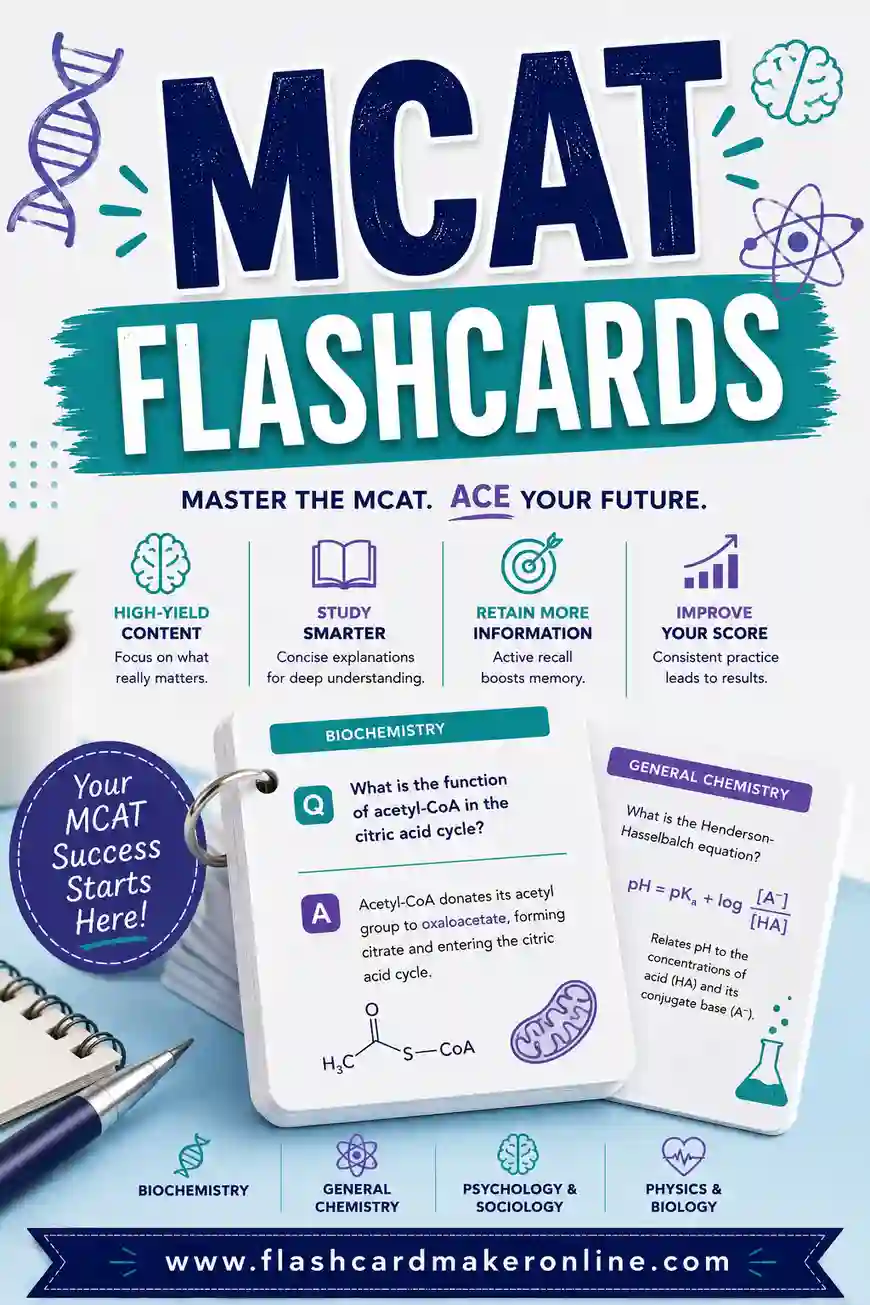
MCAT flashcards are short term-and-answer cards that drill the high-yield facts, formulas, and amino acids you have to recall instantly on test day. The fastest way to learn them is active recall plus spaced repetition: you see a prompt, force yourself to answer before flipping, and review the cards you miss more often. The quickest way to build a set that fits your weak spots is to use a free flashcard maker and type your own cards in minutes.
Want to start right now? Open the free flashcard maker, paste a few terms (there's a ready-made MCAT list below), and you'll have a deck you can flip on screen or print for the car, the gym, or your study desk. No sign-up, no app to install.
What Makes a Good MCAT Flashcard
The MCAT rewards two things: deep reasoning and fast recall. Flashcards can't teach the reasoning for you, but they're the single best tool for the recall half. Every fact you can pull up automatically is mental energy you don't have to spend during a brutal seven-and-a-half-hour exam.
A strong MCAT card does three things:
- Tests one idea. One term, one answer. "List the entire citric acid cycle" is a chapter, not a card. "Which step of the citric acid cycle produces GTP?" is a card.
- Forces recall, not recognition. The front should make you generate the answer, not pick it from a list. That's what active recall means, and it's far stronger than rereading.
- Stays in your own words. Cards you write yourself stick better than cards you buy, because the act of phrasing them is itself a study session.
Keep the front short. If you can't read the prompt in two seconds, it's doing too much.
High-Yield MCAT Flashcard Deck (Copy & Paste)
Here's a starter deck across the four MCAT sections. Drop these straight into the flashcard maker, then keep adding your own as you find weak spots. Term on the left, answer on the right.
| Term / Prompt | Answer |
|---|---|
| Net ATP from glycolysis | 2 ATP |
| Start codon | AUG (Methionine) |
| Rate-limiting enzyme of glycolysis | Phosphofructokinase-1 |
| Henderson-Hasselbalch equation | pH = pKa + log([A-]/[HA]) |
| Resting membrane potential | About -70 mV |
| Sympathetic neurotransmitter at target | Norepinephrine |
| Michaelis constant (Km) meaning | Substrate conc. at half Vmax |
| Hardy-Weinberg allele equation | p + q = 1 |
| Hardy-Weinberg genotype equation | p² + 2pq + q² = 1 |
| Competitive inhibitor effect on Km | Increases Km, Vmax unchanged |
| Hydrophobic amino acid example | Valine, Leucine, Isoleucine |
| Bohr effect | Higher CO2/H+ lowers Hb O2 affinity |
| Weber test lateralizes to | Affected ear (conductive loss) |
| Ideal gas law | PV = nRT |
| Doppler effect direction | Frequency rises as source approaches |
| Index of refraction relationship | n = c / v |
| Photoelectric effect | Light ejects electrons above threshold ν |
| First law of thermodynamics | ΔU = Q − W |
| Operant conditioning (Skinner) | Behavior shaped by consequences |
| Stages of sleep with REM | REM = dreaming, beta-like EEG |
| Confounding variable | Affects both independent & dependent var |
| Saponification | Base hydrolysis of an ester to soap |
| Net ATP from one glucose (aerobic) | About 30–32 ATP |
| Acid-base titration equivalence point | Moles acid = moles base |
| Action potential trigger | Threshold reached, Na+ channels open |
| Glucagon function | Raises blood glucose |
| Le Chatelier's principle | System shifts to relieve a stress |
| Peptide bond type | Amide linkage between amino acids |
Aim for 20 to 25 solid cards per topic to start. You'll naturally grow each deck as practice exams expose what you keep missing.
Build cards from your wrong answers
Your best deck isn't a pre-made one. It's the list of questions you got wrong on practice tests. Every time you miss something, write a card for it that night. By test week, that "mistakes" deck is the most valuable study tool you own.
How to Study MCAT Flashcards So They Stick
Making cards is the easy part. Studying them the right way is where the score comes from.
- Use active recall. Read the front, say the answer out loud or in your head, then flip. Don't peek early. The struggle to remember is what builds the memory.
- Space your reviews. Don't cram a deck once. Review new cards the same day, again in two days, then a week, then before the exam. Cards you keep missing get reviewed more often.
- Shuffle the order. If you always study cards in the same sequence, you start memorizing the order, not the content. Shuffle every session.
- Say why, not just what. For tricky cards, add a one-line "because" on the back. Understanding the reason locks the fact in deeper than rote memory.
- Keep sessions short and frequent. Three 20-minute flashcard blocks across a day beat one exhausting 90-minute slog.
A simple spaced-repetition schedule
You don't need fancy software to space your reviews. This rhythm works on paper or on screen:
| Review | When | What to review |
|---|---|---|
| 1st | Same day you make the card | All new cards |
| 2nd | 2 days later | The ones you missed |
| 3rd | 1 week later | Missed + a quick pass of all |
| 4th | 2–3 weeks later | Trouble cards only |
| Final | Exam week | Your "mistakes" deck |
Digital vs. Printed MCAT Flashcards
Both have a place. Most high scorers use a mix.
Digital cards are great for fast building, shuffling, and reviewing on a phone between classes. You can flip through 50 cards waiting for coffee.
Printed cards shine for deep focus. There's no notification to pull you away, you can spread them on a table to sort known from unknown, and writing on them by hand adds another memory channel. Printing a stack for biochemistry pathways or amino acid structures gives you something to scribble on.
The good news: you don't have to choose. Build your deck once in the flashcard maker, study it on screen during the week, then print the cards you keep missing for a focused weekend session.
Section-by-Section Card Ideas
The MCAT has four sections, and each one rewards a slightly different kind of card.
Chem/Phys
Lean on equations and unit relationships. Put the equation name on the front, the formula on the back. Add a second card that flips it: formula on front, "what does this calculate?" on the back.
Bio/Biochem
This is the section flashcards crush. Amino acids (name, abbreviation, polarity, structure), enzyme names, metabolic steps, and hormone functions are pure recall. Make a card per amino acid and review them daily.
Psych/Soc
Term-and-definition heaven. Theorists, study designs, and named effects (the bystander effect, the actor-observer bias) map perfectly onto one-line cards. This section can swing your score the most for the least effort.
CARS
CARS is reasoning, not recall, so don't try to make content cards. Instead, make a few strategy cards: "What do I do when two answers look right?" or "How do I summarize a paragraph in five words?" Drill your process, not facts.
Printing Tips for MCAT Flashcards
A few small choices make printed cards far nicer to use.
- Print on cardstock. It survives months of shuffling and a backpack. Regular paper gets soft fast.
- Two columns per page. Fit more cards per sheet, then cut them apart. Less paper, less ink.
- Front and back alignment. If you print double-sided, run one test page to confirm the answer lands behind the right term.
- Group by topic. Print amino acids on one color of paper, equations on another. Sorting by sight saves time.
- Punch a corner and ring them. A single binder ring turns a loose stack into a flip deck you can carry anywhere.
How Many MCAT Flashcards Do You Need?
There's no magic number, but here's a realistic guide. Most students build somewhere between 500 and 1,500 cards over a full prep cycle. That sounds huge, but it grows a handful at a time as you study.
| Prep stage | Rough card count | Focus |
|---|---|---|
| Early content review | 50–150 | Core terms per subject |
| Mid prep | 300–600 | Add practice-test misses |
| Final month | 600–1,000+ | Heavy review, trim mastered cards |
Quality beats quantity. A tight deck of 400 cards you review religiously will outperform 2,000 cards you make once and never open again.
Common MCAT Flashcard Mistakes to Avoid
Even good students waste hours on cards that don't move their score. Here are the traps to skip.
- Cramming a whole pathway onto one card. If the back of a card looks like a paragraph, you'll memorize the shape of the text, not the content. Break it into one fact per card.
- Making recognition cards instead of recall cards. A front that lists three options and asks you to pick is a multiple-choice question, not a flashcard. The front should force you to generate the answer cold.
- Copying a pre-made deck without reading it. Borrowed decks feel productive, but you skip the part that actually builds memory: writing the card yourself. If you use one, rewrite the cards you keep missing in your own words.
- Studying only the cards you already know. It feels great to fly through easy cards, but it's wasted time. Spend your minutes on the ones you miss.
- Ignoring CARS. Flashcards won't fix CARS, and dumping more content cards on it won't either. Budget that time for timed passages instead.
Fix these early and every minute you spend with your deck pays off harder.
Fitting Flashcards Into a Full MCAT Study Plan
Flashcards are a piece of the puzzle, not the whole picture. The students who score well treat them as the recall layer that supports everything else.
Here's a simple way to slot them in. During content review, make cards as you finish each chapter so the facts start cycling through spaced repetition right away. During practice-test season, your flashcard time shifts toward the "mistakes" deck you build from wrong answers. In the final month, you're mostly reviewing trouble cards while your full-lengths do the heavy lifting on stamina and timing.
A realistic daily mix in mid-prep might look like this: one full content block, one practice section, and two or three short flashcard passes squeezed into the gaps. The cards aren't competing with your practice tests for time, they're filling the dead minutes between them, like the walk to class or the wait for dinner.
The point is consistency. A deck you touch every single day, even for ten minutes, beats a giant cram session the week before. Build the habit early and let spaced repetition do the slow, quiet work of moving high-yield facts into automatic recall.
Frequently Asked Questions
Are flashcards good for the MCAT?
Yes, especially for the recall-heavy parts: biochemistry, psychology/sociology, and equations. They're less useful for CARS, which is a reasoning section. Pair flashcards with full-length practice tests for the best results.
How do I make my own MCAT flashcards?
Open the free flashcard maker, type a term on the front and the answer on the back, and repeat. Build cards from your own practice-test mistakes for the highest payoff, then study them with active recall and spaced repetition.
When should I start using MCAT flashcards?
Start during content review, not at the end. Make cards as you learn each topic so spaced repetition has time to work. The earlier you build a card, the more review cycles it gets before test day.
Are printed or digital MCAT flashcards better?
Both work. Digital cards are best for quick reviews on your phone; printed cards are best for focused, distraction-free sessions. Many students build a deck once, study it digitally during the week, and print their trouble cards for the weekend.
How many cards should I review each day?
Aim for short, frequent sessions: review new cards the day you make them, then revisit missed cards every couple of days. A daily pass of 50 to 150 cards is manageable and keeps everything fresh without burning you out.
Should I use pre-made MCAT decks or build my own?
Both can work, but your own cards stick best because writing them is itself a study session. A practical middle ground: start from a pre-made deck for broad coverage, then rebuild the cards you keep missing in your own words inside a free flashcard maker. The cards you struggle with are the ones worth rewriting.
Can flashcards replace content review for the MCAT?
No. Flashcards are the recall layer, not the understanding layer. The MCAT tests reasoning you can only build by learning the concepts deeply through review and practice passages. Use cards to lock in the facts once you understand them, not as a shortcut around the learning.
Ready to Build Your MCAT Deck?
Grab the starter list above, open the free flashcard maker, and start turning your weak spots into automatic recall. It's free, there's no sign-up, and you can study on screen or print a stack for the road. Build a little every day, review with active recall, and watch the high-yield facts become second nature. You've got this, future doctor. Looking for more exam decks? Try our bar exam flashcards, ASVAB flashcards, and AP exam flashcards.