Bar Exam Flashcards: Make, Study & Print Your Own
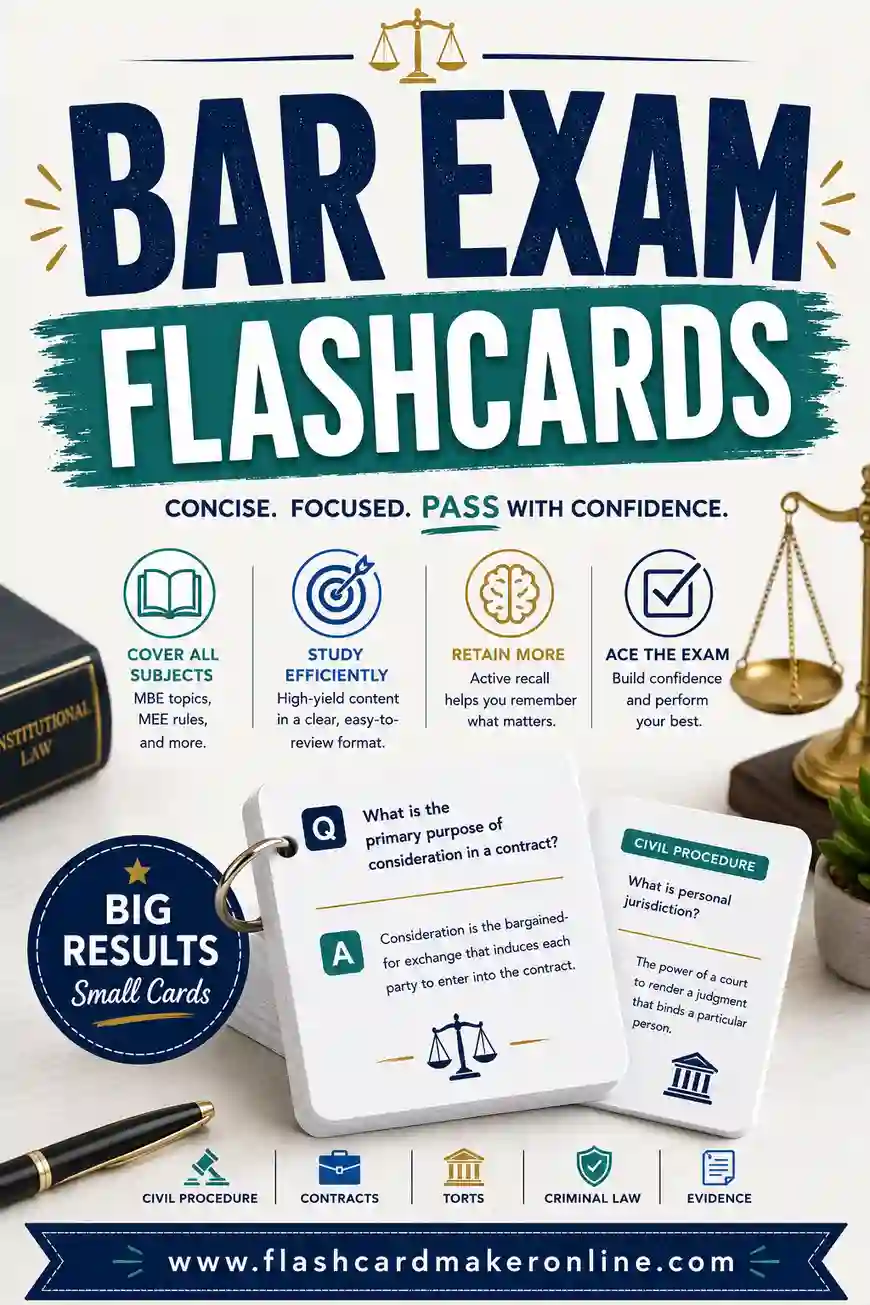
Bar exam flashcards are quick rule-and-answer cards that drill the black-letter law you have to recall cold for the MBE and essays, things like the elements of negligence, the hearsay exceptions, and the rule against perpetuities. The fastest way to lock them in is active recall plus spaced repetition: read the prompt, state the rule before you flip, then review the ones you miss more often. To build a set shaped around your own weak subjects, use a free flashcard maker and type your cards in minutes.
Want to start now? Open the free flashcard maker, paste a few rules (there's a ready-made bar list below), and you'll have a deck you can flip on screen or print to carry to the library. No sign-up, nothing to install.
Why Flashcards Work for the Bar Exam
The bar tests an enormous volume of rules across many subjects. You're not asked to be creative; you're asked to know the law and apply it fast. That's exactly the kind of recall flashcards are built for.
The MBE rewards instant rule recognition. The essays reward your ability to state a rule cleanly before you analyze. In both cases, the rule has to be automatic, sitting in memory so you can spend your time on application, not on digging for the elements.
Flashcards beat rereading your outline for one reason: they force you to produce the answer. Every time you generate a rule from memory, you strengthen the pathway. Rereading only builds a false sense of familiarity.
High-Yield Bar Exam Flashcard Deck (Copy & Paste)
Here's a starter deck across the core MBE subjects. Drop these into the flashcard maker and grow each subject as you study. Rule prompt on the left, answer on the right.
| Rule / Prompt | Answer |
|---|---|
| Elements of negligence | Duty, breach, causation, damages |
| Hearsay | Out-of-court statement offered for its truth |
| Consideration | Bargained-for exchange of legal value |
| Rule against perpetuities | Vest no later than 21 yrs after a life in being |
| Burden of proof (criminal) | Beyond a reasonable doubt |
| Adverse possession elements | Open, notorious, continuous, hostile, exclusive |
| Battery | Intentional harmful or offensive contact |
| Assault | Intent to cause apprehension of imminent contact |
| Promissory estoppel | Reasonable reliance + injustice without enforcement |
| Mailbox rule | Acceptance effective on dispatch |
| Felony murder | Death during an inherently dangerous felony |
| Miranda warning trigger | Custodial interrogation |
| Strict liability tort | Abnormally dangerous activity / defective product |
| Statute of frauds | Certain contracts must be in writing |
| Easement by prescription | Like adverse possession, for use not possession |
| Hearsay exception: excited utterance | Statement during stress of a startling event |
| Standard for summary judgment | No genuine dispute of material fact |
| Personal jurisdiction test | Minimum contacts + fair play |
| Fee simple absolute | Largest estate; full ownership, no conditions |
| Parol evidence rule | Bars prior terms contradicting a final writing |
| Self-defense (force) | Reasonable force against imminent threat |
| Equal Protection scrutiny levels | Rational basis, intermediate, strict |
| Specific intent crimes | Require intent to achieve a specific result |
| Res ipsa loquitur | Negligence inferred from the accident itself |
| Best evidence rule | Original writing required to prove its contents |
| Erie doctrine | Federal courts apply state substantive law |
| Diversity jurisdiction amount | Over $75,000 between citizens of different states |
| Contract: when UCC applies | Sale of goods |
| Recording act: "BFP" | Bona fide purchaser for value without notice |
| Fifth Amendment double jeopardy | No second trial for the same offense |
Twenty-plus solid cards per subject is a strong start. The bar covers a lot, so build steadily over weeks rather than trying to make everything at once.
Turn essay misses into cards
When you finish a practice essay, look at what you forgot to state. Did you skip an element? Misname a rule? Write a card for it that night. Your card deck should track your actual gaps, not just the obvious rules you already know.
A quick way to mine essays: read the model answer, highlight every rule statement, and turn each one into a card. Model answers are written in clean, exam-ready language, so the cards you pull from them are phrased exactly how you'd want to write them yourself. Over a few weeks this builds a deck of the precise rule statements the graders are looking for.
How to Study Bar Exam Flashcards
A deck is only as good as how you drill it. These habits matter more than the cards themselves.
- Recall before you flip. State the full rule out loud. If you can't, you don't know it yet, no matter how familiar it looks.
- Space your reviews. New cards the same day, then 2 days, then a week, then bar week. The cards you miss come back sooner.
- Shuffle every session. Don't let your brain memorize the order of the deck instead of the law.
- State rules in clean, essay-ready language. Practice phrasing each rule the way you'd write it on an essay. That doubles your card's value.
- Keep sessions short. Several focused 20-minute blocks beat one marathon. Recall fades when you're fried.
A spaced-repetition rhythm that works on paper
You don't need software. This schedule works with a stack of cards and three small piles.
| Review | When | What to review |
|---|---|---|
| 1st | Same day | All new cards |
| 2nd | 2 days later | Cards you missed |
| 3rd | 1 week later | Misses + a full pass |
| 4th | 2–3 weeks later | Trouble cards |
| Final | Bar week | Your "weak rules" deck |
Printed vs. Digital Bar Flashcards
Both have a place in a bar-prep routine.
Digital cards let you review on your phone between lectures or while commuting. You can flip 40 contracts cards in a coffee line.
Printed cards are better for deep, distraction-free work. You can fan them across a table, sort known from unknown, and write a memory hook in the margin. For dense subjects like Property and Civil Procedure, a physical stack you can shuffle and re-sort is hard to beat.
You don't have to pick. Build the deck once in the flashcard maker, study digitally during the week, then print the rules you keep blanking on for a focused weekend pass.
Subject-by-Subject Card Strategy
Each MBE subject rewards a slightly different card style.
Torts and Criminal Law
Element-heavy. Put the cause of action on the front and the elements on the back. These map perfectly onto flashcards and pay off fast.
Contracts
Mix rule cards (consideration, the mailbox rule) with "trigger" cards: "When does the UCC apply?" or "What makes an offer revocable?" Drilling triggers helps you spot issues on essays.
Property
Future interests and the rule against perpetuities are pure memorization. Make a card per estate and per future interest. Repetition is the only path here.
Civil Procedure
This is rule-and-standard territory: jurisdiction tests, the summary judgment standard, joinder rules. Short cards work well, but add a few "which rule governs?" cards to sharpen issue spotting.
Evidence and Constitutional Law
Both are full of named rules and exceptions. Hearsay exceptions alone could fill 20 cards. Constitutional scrutiny levels and key tests are clean front-and-back material.
Printing Tips for Bar Flashcards
A few small choices make printed cards far more usable.
- Use cardstock. It survives weeks of shuffling and a commute. Thin paper wears out fast.
- Two columns per page. More cards per sheet, less paper to cut and carry.
- Color-code by subject. Print Torts on one color, Evidence on another. You can grab a subject by sight.
- Ring them. Punch a corner and add a binder ring so each subject is its own flip deck.
- Run a test page. If you print double-sided, confirm the answer lands behind the right rule before printing the whole stack.
How Many Bar Flashcards Do You Need?
There's no fixed number, but here's a realistic range. Most bar-takers build 600 to 1,500 cards across all subjects over a prep cycle, growing the deck a few at a time.
| Prep stage | Rough card count | Focus |
|---|---|---|
| Early review | 100–250 | Core rules per subject |
| Mid prep | 400–800 | Add practice-question misses |
| Final weeks | 800–1,500 | Heavy review, trim mastered rules |
A tight deck you actually review beats a giant one you build and abandon. Quality and consistency win.
Common Bar Flashcard Mistakes to Avoid
A few habits quietly waste your prep hours. Skip these and your deck pulls its weight.
- Cards that are too long. If the back holds three sentences of analysis, you'll memorize the wording instead of the rule. Keep one rule per card, stated cleanly.
- Memorizing rule names without elements. Knowing "promissory estoppel exists" earns nothing on an essay. Your card should make you produce the actual elements, not just the label.
- Skipping the subjects you dislike. It's tempting to drill Torts because it's fun and dodge Future Interests because it's painful. The bar doesn't care. Make cards for your weak subjects first.
- Studying cards you've already mastered. Flying through easy cards feels productive, but it's wasted time. Pull mastered cards out and spend the minutes on rules you still blank on.
- Building the whole deck the night before. Cards work through repeated exposure over weeks. A pile you make in one sitting is just an outline you didn't read.
Catch these early and every card in your stack earns its place.
Fitting Flashcards Into Your Bar Prep
Flashcards are the recall layer of bar prep, not the whole plan. They support your lectures, outlines, and practice questions rather than replacing them.
Here's how they slot in. Early on, you make cards as you cover each subject so the rules start cycling through spaced repetition right away. In the middle stretch, your card time shifts toward the rules you blank on during practice MBE sets and essays. In the final weeks, you're mostly reviewing your "weak rules" deck while full practice exams build your stamina and timing.
A typical mid-prep day might pair a lecture or two with a set of MBE questions, a timed essay, and a few short flashcard passes squeezed into the gaps, the commute, the lunch line, the ten minutes before bed. The cards aren't fighting your bigger study blocks for time. They're filling the dead minutes those blocks leave behind.
The thread running through all of it is consistency. A deck you open every day, even briefly, beats a marathon cram the week before the exam. Start early, drill daily, and let spaced repetition turn the black-letter law into something automatic.
Frequently Asked Questions
Are flashcards effective for the bar exam?
Yes. The bar is heavily rule-based, and flashcards are the strongest tool for drilling black-letter law into automatic recall. Pair them with practice MBE questions and timed essays so you also build application skills, not just memorization.
How do I make my own bar exam flashcards?
Open the free flashcard maker, put a rule or prompt on the front and the answer on the back, and repeat. Build cards from the rules you forget on practice essays and MBE sets for the biggest payoff, then study with active recall and spaced repetition.
When should I start using bar flashcards?
Start early in your prep, as you cover each subject, not in the final cram. Making cards as you learn gives spaced repetition time to work, so the rules are automatic by exam day.
Should I use printed or digital bar flashcards?
Both. Digital cards are great for quick reviews on your phone; printed cards are better for focused, distraction-free study and for dense subjects you want to sort by hand. Many students build a deck once and use both.
How many cards should I review per day?
Short, frequent sessions work best. Review new cards the day you make them, then revisit missed cards every couple of days. A daily pass of 50 to 150 cards keeps the law fresh without overwhelming you.
Should I make flashcards for the MEE and MPT too?
Cards help most with the MEE, since the essays test the same black-letter rules as the MBE, just in written form. Make rule-statement cards and a few "which subject is this?" issue-spotting cards. The MPT is a skills test with the law provided, so flashcards barely apply there; drill timed MPT practice instead.
Can I pass the bar with flashcards alone?
No. Flashcards lock the rules into recall, but the bar also tests application, issue spotting, and writing under time pressure. Pair your deck with timed MBE sets and graded essays so you build the skills the rules support. Cards make the law automatic; practice teaches you to use it.
Ready to Build Your Bar Exam Deck?
Grab the starter list above, open the free flashcard maker, and turn the rules you keep forgetting into automatic recall. It's free, there's no sign-up, and you can study on screen or print a stack for the library. Build a little every day, drill with active recall, and the black-letter law will be there when you need it. Want more exam decks? Check out our MCAT flashcards, ASVAB flashcards, and AP exam flashcards.