APUSH Flashcards: How to Build AP US History Cards That Actually Stick
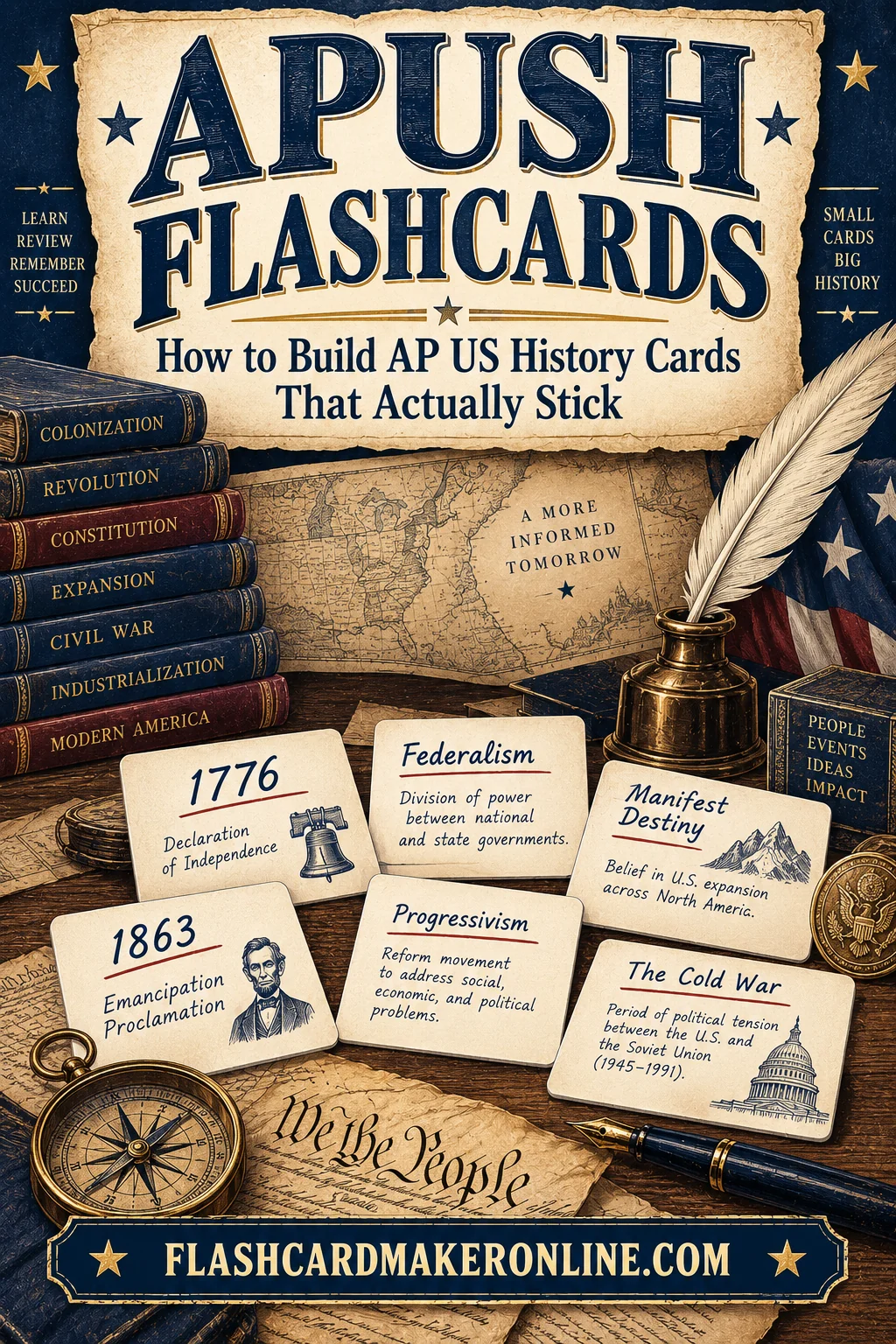
The reason most APUSH flashcards fail is that students card the wrong half of the course. They write hundreds of term-and-definition cards, learn every one of them cold, and then sit down to a document-based question and discover that knowing what the Wilmot Proviso was does almost nothing to help them argue why sectional tension escalated in the 1840s. The vocabulary was necessary. It was not sufficient.
AP US History splits cleanly into two kinds of knowledge, and they need two different study tools. One half is recall: names, dates, acts, court cases, treaty terms, the order things happened in. That half is what flashcards were built for, and a good deck will lock it down permanently. The other half is reasoning: causation, comparison, continuity and change, contextualization, argument. Cards can support that half, but only if you write them as prompts instead of labels. This guide covers both, plus a realistic schedule for running a deck across an entire school year rather than cramming it in April.
What Actually Needs Memorizing Versus What Needs Understanding
Memorize anything whose value is being retrievable instantly and exactly. Understand anything whose value is being explainable in a sentence you compose yourself.
That distinction is the whole game. Here is how it plays out in practice:
| Needs memorizing (card it) | Needs understanding (drill it differently) |
|---|---|
| What the Kansas-Nebraska Act did | Why popular sovereignty made things worse rather than calmer |
| The year the Constitution was ratified | Why the Anti-Federalists lost but got the Bill of Rights anyway |
| The holding in Plessy v. Ferguson | How that holding shaped the next sixty years of law and life |
| The four points of the Compromise of 1850 | Whether the Compromise delayed or accelerated the Civil War |
| Who wrote the Federalist Papers | What problem the Federalist Papers were written to solve |
| The dates of the Great Depression | Why the New Deal changed the relationship between citizens and government |
The left column is finite. It is maybe four to six hundred discrete items across the whole course, and a deck handles it. The right column is unlimited, and it is where the essay points live. You do not memorize an answer to "why did the New Deal change the relationship between citizens and government." You build the ability to construct that answer from evidence you already hold.
The practical consequence: write recall cards to make the evidence automatic, and write reasoning cards to rehearse using it. A student who has both will walk into the exam with facts on tap and a habit of turning them into claims. A student with only the first will write beautifully sourced essays that never make an argument.
Card Types That Work for APUSH
Five card shapes cover almost everything the course asks.
1. The straight identification card. Front: a term, act, case, person, or event. Back: what it was, when, and one clause of significance. Keep the back short. If the back needs a paragraph, the card is doing too much.
Front: Dawes Severalty Act (1887) Back: Broke tribal landholdings into individual allotments to force assimilation; opened "surplus" land to white settlers and cost tribes roughly two-thirds of their land base.
2. The date-anchor card. Front: a year or a narrow span. Back: two or three things that happened in it. These are what let you place an unfamiliar document in the right decade during a DBQ.
Front: 1848 Back: Treaty of Guadalupe Hidalgo ends the Mexican-American War; Seneca Falls Convention; gold discovered at Sutter's Mill; Free Soil Party formed.
3. The "so what" card. Front: a term you already know. Back: its consequence, not its definition. This is the card most students skip, and it is the one that converts vocabulary into essay evidence.
Front: So what? — The Northwest Ordinance Back: Set the template for admitting new states as equals rather than colonies, and banned slavery north of the Ohio River — drawing the first federal line between free and slave territory.
4. The comparison card. Front: two things and a dimension. Back: one similarity and one difference, stated in full sentences.
Front: Compare Hamilton's and Jefferson's visions for the economy. Back: Both accepted the Constitution and wanted national stability. Hamilton wanted manufacturing, a national bank, and a loose reading of federal power; Jefferson wanted an agrarian republic, strict construction, and debt paid down rather than funded.
5. The evidence-retrieval card. Front: a thesis-shaped prompt. Back: three specific pieces of evidence you could use to support it. These are your LEQ ammunition.
Front: Evidence that Reconstruction achieved real constitutional change despite its collapse. Back: 14th Amendment (citizenship and equal protection); 15th Amendment (voting); Freedmen's Bureau schools producing a generation of Black literacy and Black colleges that outlived Reconstruction itself.
Notice that four of the five have backs written in sentences. That is deliberate. If your card backs are fragments, your essays will be fragments.
Building Cards Around the Course's Period Structure
APUSH is organized chronologically into periods running from pre-contact North America to the present, and each period carries a defined share of the exam. The College Board publishes the current period boundaries and weightings in the course and exam description, and you should build your deck against that document rather than against a review book's chapter list — review books renumber and recombine.
The structural move that matters: give every card a period tag, and make the period tag the first thing you can filter on. A deck of eight hundred untagged cards is a wall. The same eight hundred cards tagged by period is nine manageable decks that you can review independently, and it lets you do the single most useful drill in the course, which is reviewing one period end to end the night before a unit test and then never letting it go cold again.
Within each period, build in this order:
- Spine cards first. Ten to fifteen cards per period covering the events without which the period makes no sense. For the 1754–1800 period that is the French and Indian War, the imperial acts, the Declaration, the Articles' failures, the Constitutional Convention, the ratification fight, Washington's precedents, and the first party system.
- Then fill. Everything your teacher emphasized, every bolded term, every court case.
- Then "so what" cards for the spine items only. You do not need a consequence card for every minor act.
- Then two or three comparison cards linking this period to the one before it. Continuity and change is a tested skill, and this is where you rehearse it.
Aim for roughly sixty to ninety cards per period. If a period balloons past 120, you are carding detail the exam does not reward. The heavier periods — the Civil War era, the Gilded Age through Progressivism, and the twentieth century from the Depression forward — will naturally run bigger. The pre-contact and early colonial material runs smaller and shows up more often as context than as a question topic.
A flashcard maker that lets you tag and filter is worth more here than a prettier one that only holds flat lists, because the whole method depends on being able to pull "Period 5 only" or "every court case" out of a large deck on demand.
Cards for the SAQ, DBQ and LEQ
The free-response sections reward practiced moves, and moves can be drilled.
For short-answer questions, the useful card is a three-part prompt with a three-part back. Short answers typically want you to identify and then explain, briefly, without a thesis. So write cards that mirror that.
Front: Briefly describe ONE way the Second Great Awakening influenced reform movements before 1860. Back: Its emphasis on individual moral perfectibility gave abolitionists and temperance advocates a religious argument that social evils could and must be eliminated — William Lloyd Garrison and the Seneca Falls organizers both drew directly on revivalist language.
Write these in your own words, out loud, before flipping. The skill being trained is compression under time pressure.
For the document-based question, cards cannot supply documents, but they can supply the two things students most often lack: outside evidence and contextualization. Build a set of "context cards" — one per decade — whose back is three or four sentences establishing what was going on broadly at that moment. When a DBQ drops you into 1919 or 1968, you want a paragraph already in your head about what surrounded that year.
Front: Context — the 1890s Back: Deep depression after the Panic of 1893; Populist revolt against railroads, banks and the gold standard; Jim Crow codified and Plessy decided; heavy immigration from southern and eastern Europe; the frontier declared closed; the US moving toward overseas expansion.
Also card sourcing verbs. The DBQ rewards explaining a document's point of view, purpose, audience, or historical situation, and students lose that point because they describe the document instead of analyzing it. A card that says "How do I explain PURPOSE?" with a back giving a sentence frame — the author wrote this in order to persuade X to do Y, which means the document overstates Z — is not content, but it is worth as many points as content.
For the long essay question, build thesis cards. Front: a classic prompt phrasing. Back: a defensible one-sentence thesis plus the three evidence buckets you would use. You are not memorizing an essay. You are rehearsing the act of taking a position quickly, which is the thing that eats time in the exam room.
Front: LEQ — Evaluate the extent to which the Market Revolution changed American society, 1800–1860. Back: Thesis: it transformed labor and geography more than it transformed the distribution of power. Buckets: transportation and the national market (canals, railroads, telegraph); wage labor, the factory system and Lowell; regional specialization deepening slavery in the South rather than weakening it.
A Realistic Review Schedule Across the School Year
The failure mode is not studying too little. It is studying every period once, in order, and letting eight of nine go cold while you work on the ninth. Spaced review fixes that, and it costs about fifteen minutes a day.
| When | What you do | Roughly how long |
|---|---|---|
| Each new unit | Build cards as you go, 10–15 per class week | 20 min/week to write |
| Daily, all year | Review the current period plus a rotating older period | 15 min |
| Each Sunday | Full pass on the two most recently completed periods | 30 min |
| End of each unit | Write 3 "so what" and 2 comparison cards for that unit | 20 min |
| Winter break | Full deck pass, periods 1–5, flag everything shaky | 2–3 hours total |
| February | Add SAQ and thesis cards; begin timed writing weekly | 30 min/week |
| March | Cumulative rotation: every period touched twice a week | 25 min/day |
| Two weeks out | Flagged cards only, plus one full timed essay every other day | 45 min/day |
| Final week | Date-anchor and context cards; stop adding new cards entirely | 30 min/day |
Two rules make this work. First, never delete a card because you know it — retire it to a low-frequency pile instead, and touch that pile monthly. Confidence in October means nothing in May. Second, stop writing new cards two weeks before the exam. Late-added cards are unrehearsed, they crowd out review of material you nearly have, and the anxiety of a growing deck at the end is corrosive.
If you fall behind, cut fill cards before you cut spine cards, and cut new-card writing before you cut review. A smaller deck reviewed twenty times beats a complete deck reviewed twice.
Mistakes That Waste a Whole Deck
Copying a premade deck without editing it. Someone else's cards reflect someone else's gaps and someone else's teacher. Downloaded decks are useful as a checklist of terms you might have missed, not as a study tool. The act of writing the card is a large share of the learning.
Writing backs that are too long. If you cannot say the back out loud in under fifteen seconds, split the card. Long backs create the illusion of review because you read them and nod.
Carding numbers you will never be asked. Exact troop counts, precise vote tallies, and minor treaty clauses are noise. Card the year and the outcome.
Reviewing in the same order every time. Order becomes a crutch — you recall the Homestead Act because it always follows the Pacific Railway Act. Shuffle every session.
Treating the deck as the whole study plan. Cards make evidence automatic. They do not teach you to write under time pressure. From February on, every week needs at least one timed written response, scored honestly against the official rubric.
Frequently Asked Questions
How many APUSH flashcards do I actually need? Somewhere between 500 and 800 for the full course, which works out to roughly 60 to 90 per period. Going past 1,000 usually means you are carding detail the exam does not reward, and a smaller deck you genuinely review beats a bigger one you skim.
Should I make digital or paper APUSH cards? Digital wins for a course this size because you can tag by period, filter to court cases or to flagged cards, and carry 700 cards on a phone. Paper is better only if you find yourself getting distracted or if physically sorting cards into piles helps you feel the shape of a period.
When should I start making cards for the AP exam? The first week of the school year, building alongside each unit. Starting in March means writing and learning at the same time, which is the most expensive way to do both, and you lose the whole benefit of spacing early material across eight months.
Can flashcards prepare me for the DBQ and LEQ? Partly. They can supply outside evidence, decade-level context paragraphs, and rehearsed thesis moves, and those are worth real points. They cannot substitute for writing full timed responses and scoring them against the rubric, so plan on doing both from about February onward.