Best Flashcard Apps for Medical Students (2026)
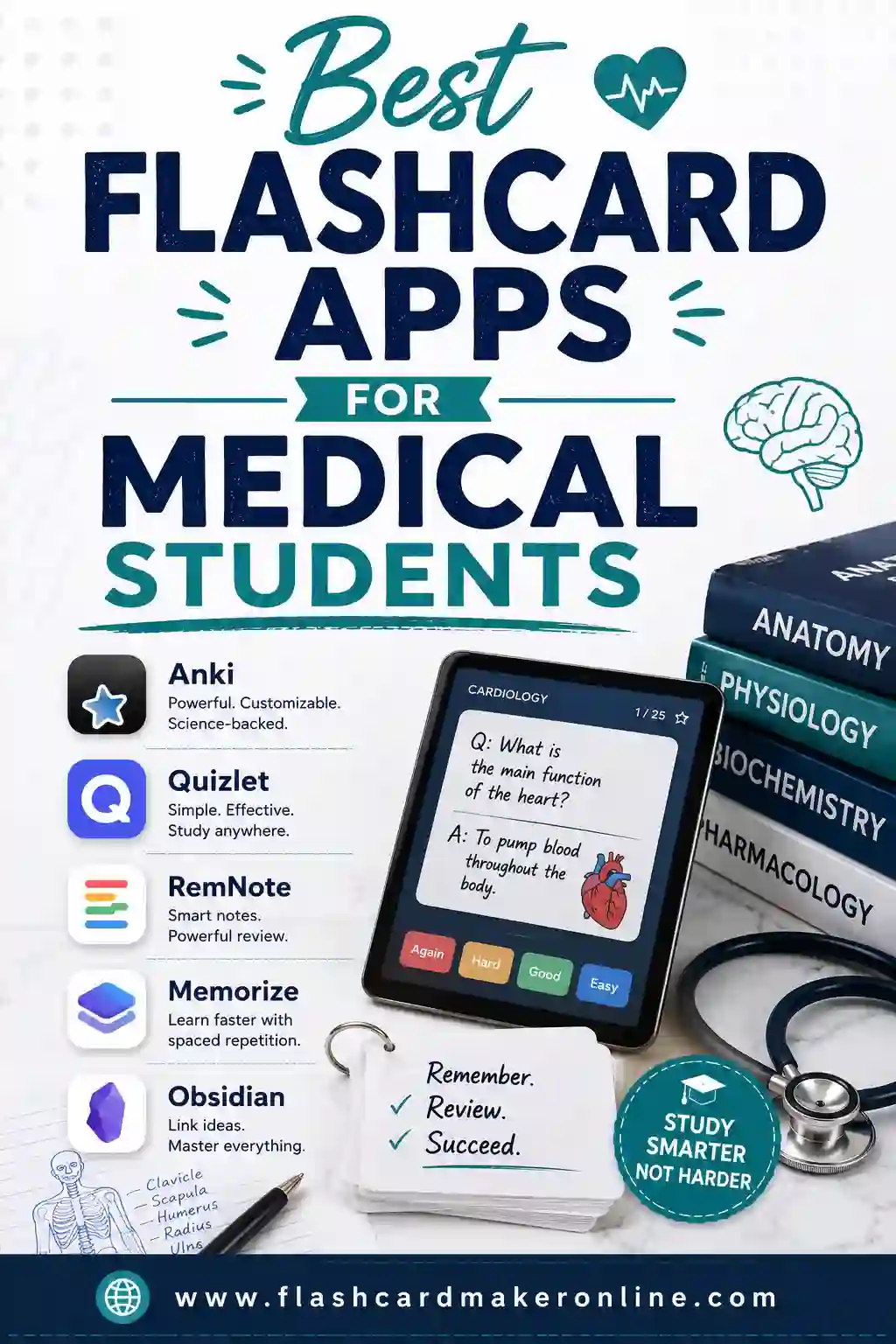
The best flashcard apps for medical students are built around spaced repetition, because med school means memorizing a mountain of facts and keeping them for years. Anki is the runaway favorite, paired with premade decks like AnKing for boards. Brainscape and Quizlet have their place for lighter review. And for making and printing your own quick reference cards, Flashcard Maker Online is a free, no-account option that complements the heavy hitters.
Want to start a set right now? Open the free flashcard maker, type your terms and definitions, and study or print in under a minute. There's a med-themed sample set below to show you the format.
Why Flashcards Matter So Much in Med School
Medical school is, at its core, a memory marathon. You're learning thousands of drugs, diseases, pathways, and presentations, and you can't cram them the night before. You need them to stick for boards, for clinicals, and ideally for your career.
That's where flashcards earn their reputation. Two evidence-backed ideas drive them. Active recall means pulling an answer from memory instead of rereading notes, which forces your brain to do the work that builds memory. Spaced repetition means reviewing each fact right before you'd forget it, at intervals that stretch as you master it.
Together, they let you hold a huge volume of material with manageable daily review. For med students, this isn't a study hack. It's the standard operating procedure.
What to Look For in a Med-School Flashcard App
Not every flashcard tool suits medicine. The right one needs:
- Strong spaced repetition. Non-negotiable for retaining thousands of cards over years.
- Image support. Anatomy, histology, and radiology cards live or die on pictures.
- Cloze deletion. Fill-in-the-blank cards are huge for pathways and lists.
- Premade deck compatibility. The med community shares enormous, curated decks.
- Sync across devices. You'll review on your phone between rotations and on a laptop at home.
- Cost sanity. Med school is expensive enough.
With that lens, here's how the main options stack up.
The Best Flashcard Apps for Medical Students at a Glance
| App | Spaced repetition | Premade med decks | Images & cloze | Cost | Best for |
|---|---|---|---|---|---|
| Anki | Best in class | Yes (AnKing, etc.) | Yes | Free (paid iOS app) | The core workhorse |
| Brainscape | Yes | Some certified | Limited | Free tier + paid | Confidence-based review |
| Quizlet | Learn mode (paid) | Many user sets | Some | Free tier + paid | Quick, lighter review |
| Memorang | Yes | Med-focused | Yes | Paid plans | Polished med study |
| Osmosis | Built into platform | Curated | Yes | Subscription | Videos + cards combined |
| Flashcard Maker Online | Manual | Your own | Basic | Free, no account | Custom + printable cards |
1. Anki — The Undisputed Med-School Standard
Ask almost any medical student about flashcards and you'll hear Anki. It's free on desktop and Android, its spaced-repetition scheduler is the best available, and it supports images and cloze deletion, the exact features med material demands.
The real magic is the ecosystem. Massive community decks like AnKing (for Step 1 and Step 2), Pepper (pharmacology and other topics), and others give you tens of thousands of vetted, high-yield cards mapped to common curricula. You can use these as-is or unsuspend cards as you cover topics.
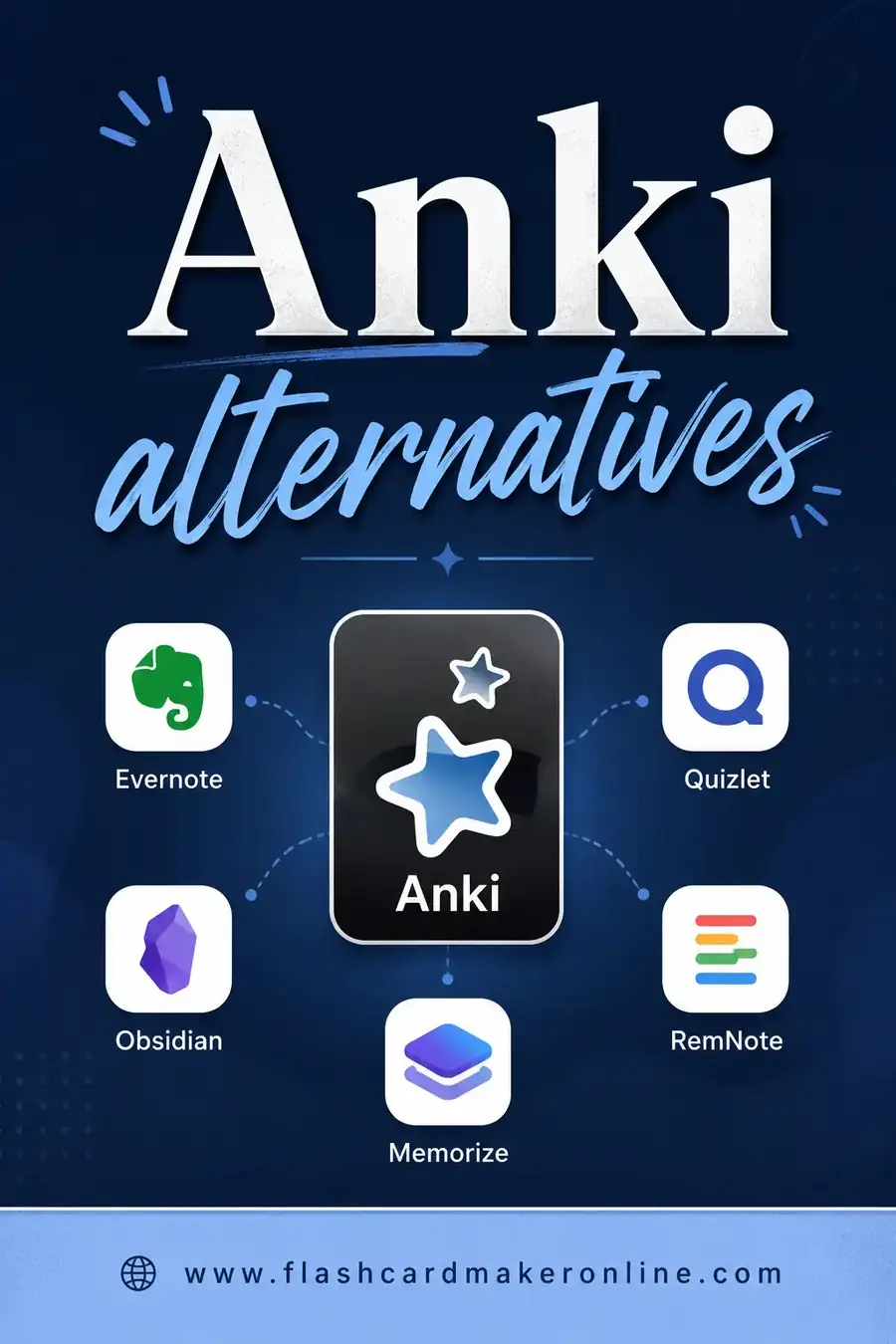
The downside is the learning curve, which is steep, and a dated interface. But for med students, the payoff is so large that it's worth the climb. If Anki feels like too much at first, our Anki alternatives guide lists gentler options.
2. Premade Decks — The Force Multiplier
It's worth treating premade decks as their own category, because they're often the real reason Anki wins. Building a complete boards deck from scratch would take hundreds of hours. The community has already done it.
- AnKing is the most popular comprehensive deck for USMLE Step 1 and Step 2, organized to follow major resources.
- Pepper decks cover pharmacology, micro, and other dense topics.
- Specialty and course-specific decks exist for almost everything.
The smart workflow: start with a premade deck, unsuspend cards as your classes cover them, and add a few of your own cards for weak spots. You get curated coverage plus personal tuning.
3. Brainscape — Spaced Repetition Without the Setup
If Anki's interface is a wall, Brainscape is a friendlier door. You rate your confidence on each card from 1 to 5, and it schedules reviews accordingly. There are some certified medical decks, and the free tier lets you study.
It's less customizable than Anki and has fewer giant community decks, but for students who want spaced repetition without the configuration, it's a reasonable choice.
4. Quizlet — For Lighter, Quicker Review
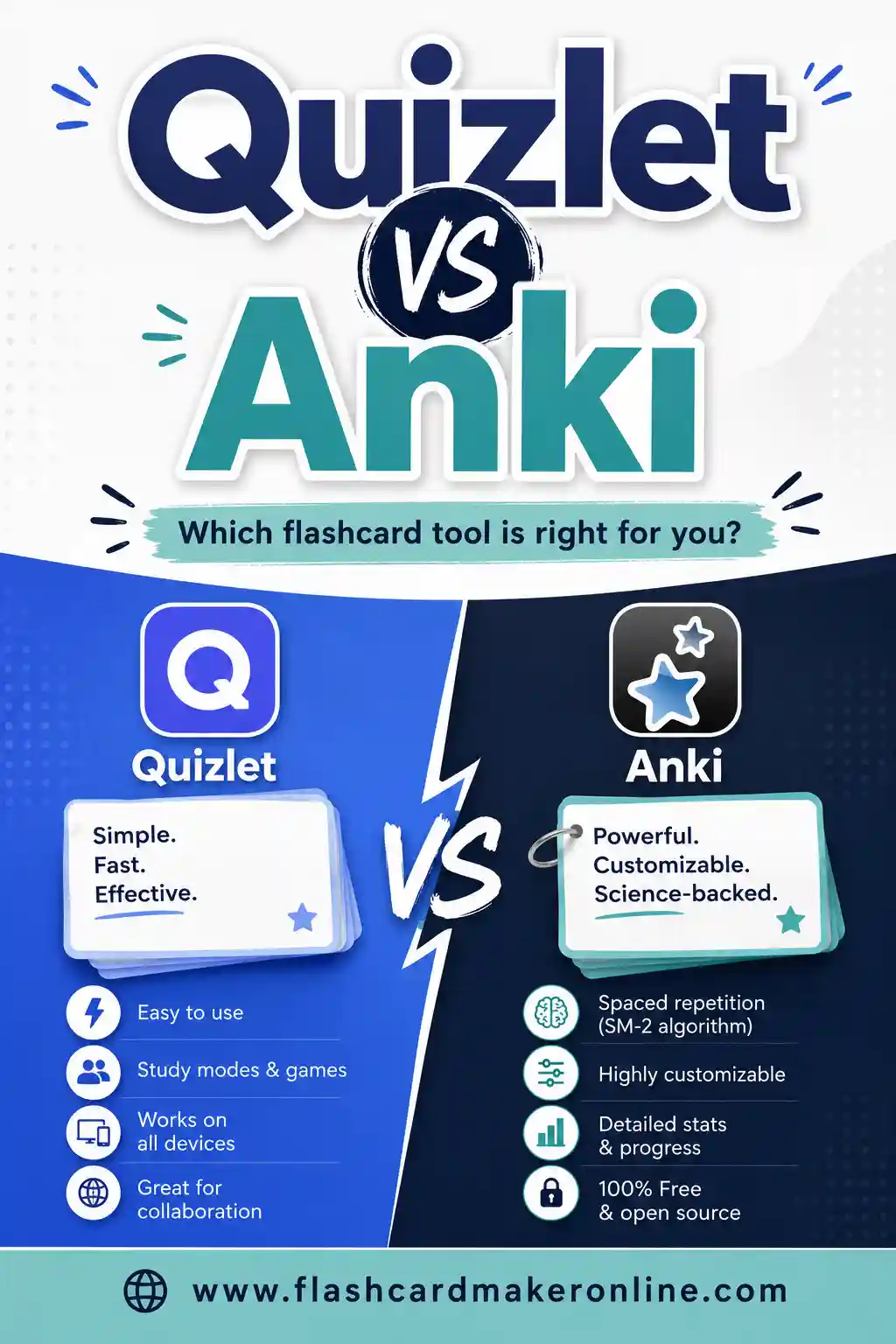
Quizlet isn't the boards workhorse, but it has a place. For a quick quiz on a lecture, a friendly interface, or a fast set you make in minutes, it's pleasant and easy. The catch is that its best study features sit behind Quizlet Plus, and its spaced repetition is lighter than Anki's. See our Quizlet vs Anki breakdown for the full comparison.
5. Memorang and Osmosis — Polished, Paid Options
A couple of med-focused platforms deserve a mention. Memorang offers a slick spaced-repetition experience with med content. Osmosis blends videos with flashcards and questions in one subscription platform, popular for visual learners. Both cost money, but for students who want everything in a polished package, they're worth a look.
6. Flashcard Maker Online — Your Custom and Printable Layer
Premade decks are fantastic, but you'll always have personal weak spots: a mnemonic that works for you, a tricky drug list, your attending's favorite pimping questions. For those, a fast, free maker beats firing up Anki's full machinery.
Flashcard Maker Online lets you type a quick set, flip through it, and print a clean copy, with no account. Print a pocket card of high-yield values for the wards, or make a focused 20-card set for a quiz tomorrow. It's the simple, printable companion to your heavy spaced-repetition app.
A Sample Med Deck You Can Use Today
Here's a ready-made set of common med-school facts. Copy it into the free flashcard maker for an instant deck. (Always verify clinical facts against current course material; this is a study format sample, not medical advice.)
| Term | Definition |
|---|---|
| Tachycardia | A heart rate over 100 beats per minute |
| Bradycardia | A heart rate under 60 beats per minute |
| Hypertension | Chronically elevated blood pressure |
| Hypotension | Abnormally low blood pressure |
| Hemostasis | The process that stops bleeding |
| Ischemia | Reduced blood flow to a tissue |
| Necrosis | Cell death due to injury or disease |
| Apoptosis | Programmed, controlled cell death |
| Diuretic | A drug that increases urine output |
| Antibiotic | A drug that kills or stops bacteria |
| Tachypnea | An abnormally fast breathing rate |
| Edema | Swelling from excess fluid in tissues |
| Anemia | Low red blood cell count or hemoglobin |
| Leukocytosis | An elevated white blood cell count |
| Hyperkalemia | High potassium level in the blood |
| Hyponatremia | Low sodium level in the blood |
| Gluconeogenesis | Making glucose from non-carb sources |
| Phagocytosis | A cell engulfing a particle or microbe |
| Vasodilation | Widening of blood vessels |
| Cloze deletion | A fill-in-the-blank style flashcard |
A Realistic Med-School Flashcard Workflow
Here's how strong students actually use these tools together.
| Step | Tool | Why |
|---|---|---|
| Daily core review | Anki + premade deck | Spaced repetition over months |
| Unsuspend as you learn | Anki | Only review what you've covered |
| Personal weak spots | Custom Anki or Flashcard Maker | Tune to your gaps |
| Pocket reference | Flashcard Maker Online (printed) | Quick values on the wards |
| Quick lecture quiz | Quizlet | Fast, friendly, low stakes |
The principle: one serious spaced-repetition app does the heavy lifting, and a simple maker fills the gaps and handles printing.
Tips to Avoid Flashcard Burnout
Med-school flashcard piles can become crushing. Keep them manageable.
- Do your reviews daily. Skip a few days and the backlog snowballs. Small daily sessions beat marathon catch-ups.
- Don't over-add. Quality over quantity. A few precise cards beat fifty vague ones.
- Use cloze for lists and pathways. Fill-in-the-blank cards encode sequences far better than front/back dumps.
- Suspend what you've mastered. Free up review time by retiring cards you reliably know.
- Print a few high-yield cards. A printed pocket card for the wards saves you from pulling out your phone constantly.
Frequently Asked Questions
What flashcard app do most medical students use?
Anki is by far the most popular, thanks to its powerful spaced repetition and huge community decks like AnKing for board exams. Most med students build their study routine around it.
Is Anki free for medical students?
Anki is free on desktop and on Android (AnkiDroid). The only cost is AnkiMobile, the official iPhone app, which has a one-time price. The community decks themselves are generally free to download.
What is the AnKing deck?
AnKing is a large, community-maintained Anki deck for USMLE Step 1 and Step 2, organized to follow major study resources. Many students use it as their core deck and unsuspend cards as their classes cover the material.
Are flashcards good for studying medicine?
Yes. Medicine requires retaining huge volumes of facts over years, and flashcards using active recall and spaced repetition are among the most effective methods for that. They're a standard part of most successful med-school study plans.
Can I make my own medical flashcards for free?
Yes. Flashcard Maker Online lets you create, study, and print custom cards for free with no account, which is great for personal weak spots and printable pocket references. For automated spaced repetition, pair it with Anki.
Should I use premade decks or make my own?
Most students do both. Premade decks like AnKing give you curated, high-yield coverage fast, while custom cards target your personal gaps and your specific course content. Combining them is the common, effective approach.
Ready to Build Your Own Study Deck?
Premade decks cover the broad strokes, but your weak spots are personal. Open the free flashcard maker, paste in your terms, and flip through or print a clean deck in minutes, no account and no paywall. Try the med sample set above to see the format, then make a focused set for your next exam or rotation. For more options, our Anki alternatives and Quizlet vs Anki guides go deeper.