Flashcards for Professional Certification Exams: ACLS, Security+ and Other Credentials
Studying for a professional certification is not studying for a school exam, and the study methods that got you through college mostly do not survive contact with a full-time job. A student can lose a Saturday to review. A nurse working three twelves, or a systems administrator on call, is studying in twenty-minute fragments between other obligations, often for a credential that has a hard deadline attached to their employment. That constraint changes what a good study tool looks like, and it is exactly the constraint flashcards were designed for.
This is a guide to building card decks for working professionals, using ACLS and CompTIA Security+ as the two worked examples because they represent the two dominant flavors of certification content: protocol and algorithm recall on one side, terminology and concept coverage on the other. The principles transfer to PALS, PMP, CISSP, Network+, CDL endorsements, HVAC and electrical licensing, and most other credentials built on a published blueprint.
One rule before anything else: every certifying body publishes a current exam blueprint or objectives document, and that document is the only source you should build a deck against. Fees, passing standards, question counts, algorithm details and objective lists all get revised on their own schedules. Download the current official version at the start of your study block, and check it again if your study period stretches across a version change.
How Adult Professional Study Actually Differs
Five differences change the whole approach.
Time comes in fragments, not blocks. You will get seven minutes before a shift, fifteen in a parking lot, twenty before bed. A study method that requires setup, a desk, and an uninterrupted hour will simply not run. Cards run in seven minutes.
The stakes are concrete. A bad grade in a college course is a bad grade. A failed certification can mean a delayed hire, a lost promotion, a lapsed credential that pulls you off the schedule, or a retake fee out of your own pocket. That pressure is real, and it pushes people toward cramming, which is the worst possible response to it.
You already know some of it. This is the biggest and most under-used advantage. A paramedic studying ACLS already knows a great deal of the pharmacology. A network engineer studying Security+ already knows subnetting cold. Student study assumes a blank slate; professional study should start by aggressively identifying what you already own and refusing to spend a minute on it.
The vocabulary is dense and acronym-heavy. Certification material is written in a professional shorthand that assumes fluency. Security+ alone will hand you dozens of three- and four-letter acronyms, and many of them are only distinguishable from each other by one word. This is precisely the kind of material where cards outperform reading.
It recurs. Most credentials expire. ACLS runs on a renewal cycle measured in a small number of years, and most IT certifications require either a retake or continuing education credits to stay current. That means your deck is not disposable — it is an asset you will want again, and building it well the first time saves the second and third round entirely.
| Student study | Professional certification study |
|---|---|
| Long blocks, flexible schedule | Fragments between shifts and meetings |
| Grade consequences | Employment and licensure consequences |
| Assumes little prior knowledge | Large existing base to exploit |
| Broad conceptual coverage | Blueprint-defined, testable scope |
| Studied once | Restudied on a renewal cycle |
| Content mostly narrative | Content acronym- and protocol-dense |
ACLS Flashcards: Algorithms, Drugs and Rhythms
ACLS is a protocol certification. The material rewards fast, accurate recall of sequences under pressure, and the exam is only a proxy for the real test, which is a code in progress at three in the morning. That makes card-based drilling unusually appropriate: you are trying to make recall automatic so that cognitive capacity is free for the parts of a resuscitation that are not scripted.
Build the deck in four groups.
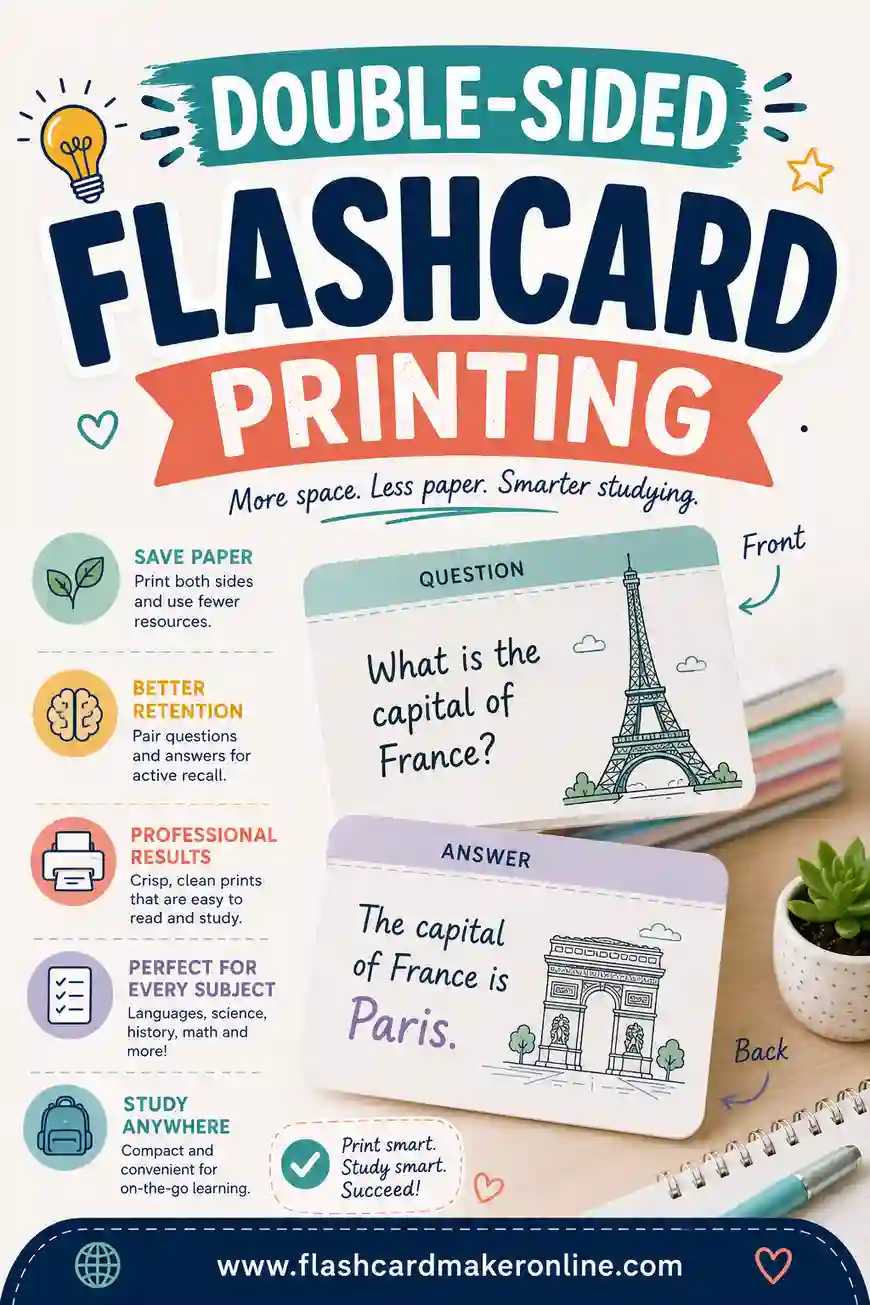
Rhythm recognition. These are the cards you want to be able to answer in under two seconds. Front: a rhythm name or a short description of what you would see. Back: what it is and the first branch it sends you down.
Front: Pulseless ventricular tachycardia Back: Organized wide-complex tachycardia with no pulse. Shockable. Treated on the same branch as ventricular fibrillation — high-quality CPR, defibrillation, and the cardiac arrest algorithm.
Front: Which arrest rhythms are shockable and which are not? Back: Shockable — ventricular fibrillation and pulseless ventricular tachycardia. Non-shockable — asystole and pulseless electrical activity, where the priority is compressions and treating reversible causes.
Reversible causes. The H's and T's are pure list recall and belong on cards phrased as retrieval prompts, not as a printed list you reread.
Front: Name the H's among reversible causes of arrest. Back: Hypovolemia, hypoxia, hydrogen ion (acidosis), hypo- and hyperkalemia, hypothermia.
Front: Name the T's. Back: Tension pneumothorax, tamponade (cardiac), toxins, thrombosis (pulmonary), thrombosis (coronary).
Drug cards. Front: drug name plus a context. Back: the indication and the role it plays in the sequence. Keep the specific dosing on a separate card set and confirm every number against the current provider manual, since the recommendations are periodically revised.
Front: Amiodarone — where does it sit in the arrest algorithm? Back: An antiarrhythmic used in shockable arrest that persists after defibrillation and epinephrine. Check the current manual for dose, timing and the lidocaine alternative.
Front: Atropine — when is it indicated, and when is it not? Back: Indicated in symptomatic bradycardia. Not useful in asystole or PEA under current guidance, and less effective in high-degree blocks where pacing or an infusion is the better path.
Sequence and role cards. These rehearse the parts of ACLS that are choreography rather than knowledge.
Front: What are the components of high-quality CPR you are assessed on? Back: Adequate rate and depth, full chest recoil, minimized interruptions, avoiding excessive ventilation, and rotating compressors regularly to prevent fatigue.
Front: Team leader — what do you say when you receive an order you cannot safely carry out? Back: Speak up immediately and clearly, name the concern, and use closed-loop communication. Closed-loop is itself tested: orders are directed to a named person, repeated back, and confirmed when complete.
For rhythm cards specifically, images beat text. If your card tool supports images, put a rhythm strip on the front and the identification plus first action on the back. That is closer to the actual recognition task than any verbal description.
Security+ Flashcards: Acronyms, Concepts and Scenarios
Security+ flashcards serve a different content shape. The exam covers a broad published set of objectives, and the failure mode is not forgetting a sequence but confusing two similar terms. Studying it well means separating three card types that most people mash together.
Acronym expansion cards. The cheapest, highest-volume cards you will make. Front: the acronym. Back: the expansion and one clause of meaning. Make them, drill them until they are instant, and then largely retire them — they are the floor, not the ceiling.
Front: SIEM Back: Security Information and Event Management — a platform that aggregates logs from across an environment, correlates events, and raises alerts.
Front: MFA vs 2FA Back: Multi-factor authentication uses two or more factors from different categories. Two-factor is the specific case of exactly two. Two passwords are not MFA — the factors must differ in kind: something you know, something you have, something you are.
Discrimination cards. These are the cards that actually earn points, because scenario questions are built on distinctions. Front: two terms that get confused. Back: the line between them.
Front: Vulnerability, threat, risk — what is the difference? Back: A vulnerability is a weakness. A threat is something that could exploit it. Risk is the likelihood and impact of that exploitation actually happening. You patch vulnerabilities, you model threats, you accept, transfer, mitigate or avoid risk.
Front: Symmetric vs asymmetric encryption — when do you use each? Back: Symmetric uses one shared key, is fast, and is used for bulk data. Asymmetric uses a public and private key pair, is slow, and is used to exchange keys and to sign. Real systems use asymmetric to establish a symmetric session key.
Front: Authentication, authorization, accounting Back: Authentication proves who you are. Authorization determines what you may do. Accounting records what you did. Exam questions frequently hinge on which of the three is failing.
Front: RTO vs RPO Back: Recovery Time Objective is how long you can be down. Recovery Point Objective is how much data you can afford to lose, measured backward from the incident. RPO drives backup frequency; RTO drives recovery architecture.
Scenario cards. Front: a short situation. Back: the correct control or first action. These rehearse the applied reasoning the exam favors over pure definition recall.
Front: Employees are reusing passwords across internal and external services. Which control addresses this most directly? Back: Federated single sign-on plus MFA, backed by password policy. A longer password expiration interval does not fix reuse; reducing the number of credentials a person must manage does.
Front: You have contained a compromised host. What comes next in the incident response process, and why does order matter? Back: Eradication, then recovery, then lessons learned. Skipping straight to recovery reintroduces the compromise. The lessons-learned step is frequently the answer to "what was missing" questions.
What to Do With Limited Hours
The single biggest gain available to a working professional is not studying what you already know. Most people skip this step and lose weeks to it.
Do this before writing a single card. Open the current official objectives document. Go line by line. Mark each item with one of three marks: I could teach this, I have seen this but could not explain it, I do not recognize this. Then build cards only for the second and third categories. On a typical certification, an experienced professional will already own thirty to fifty percent of the blueprint. Refusing to card that portion is the difference between a six-week study plan and a twelve-week one.
Then run the deck in fragments, on a rotation.
| Slot | Length | What you do |
|---|---|---|
| Before a shift or the workday | 7–10 min | New cards only, 10–15 of them |
| Break or commute (as a passenger) | 10–15 min | Mixed review, shuffled |
| Evening | 20 min | Missed cards from the day, plus one objective area read in full |
| Weekend session | 60–90 min | Practice questions under time, then card every miss |
| Final ten days | Daily 30 min | Flagged cards plus full-length practice, no new cards |
Two habits do most of the work. Card every practice question you get wrong, immediately, phrased as the distinction you missed rather than as the question itself. And stop making new cards ten days out — late cards are unrehearsed and their only real effect is anxiety.
A flashcard maker that lets you tag cards by blueprint domain is worth choosing deliberately here, because the whole approach depends on filtering. When a practice test tells you that you are weak in one domain, you want to pull exactly those cards and drill them, not scroll a thousand-card list.
Building a Deck You Will Reuse at Renewal
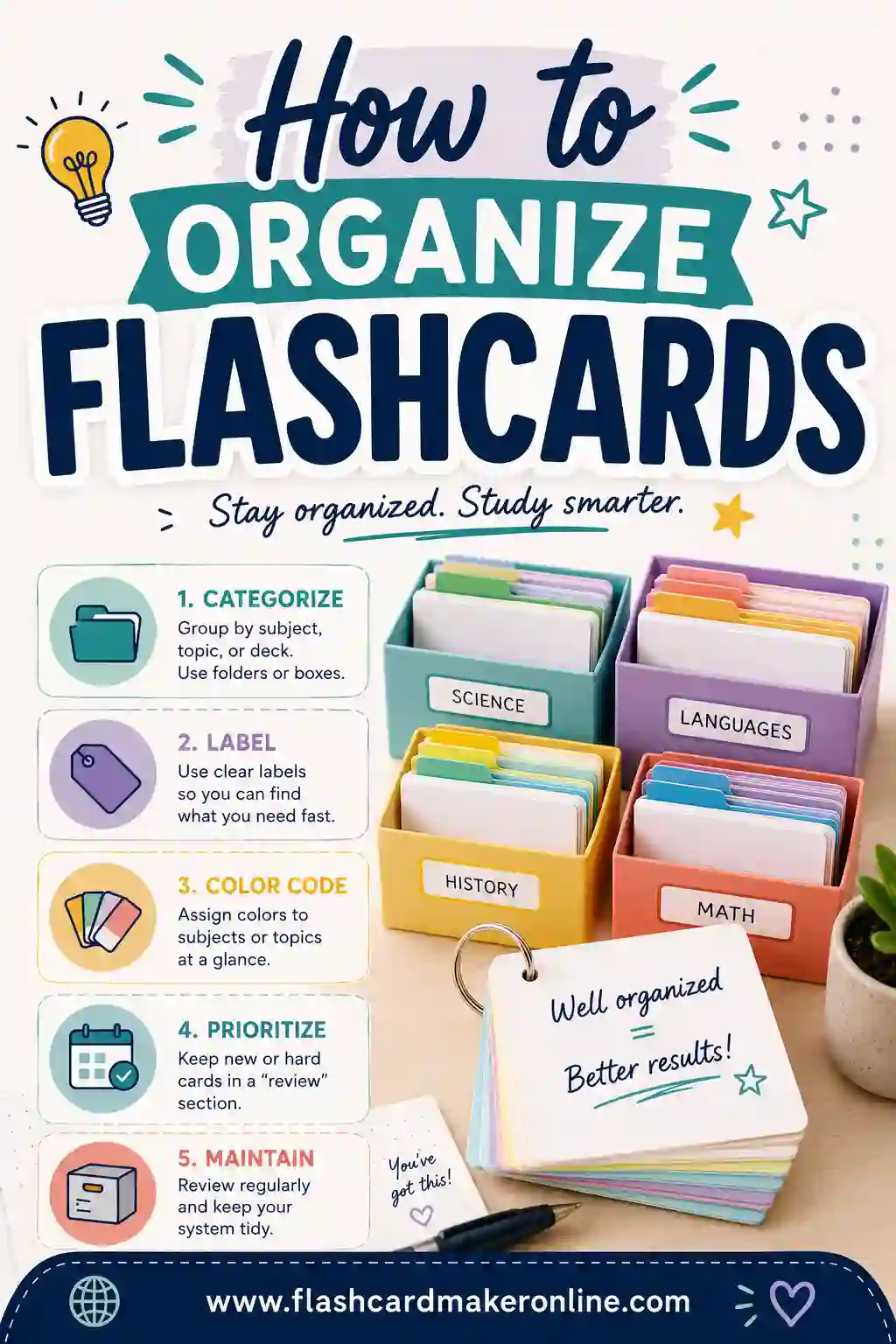
Most credentials come back around. If your deck is a disposable pile of index cards, you rebuild from nothing every cycle. If it is tagged, dated and stored, renewal becomes a two-week refresh instead of a two-month rebuild.
Three things make a deck survive to the next cycle. Tag by blueprint version, so that when the objectives are revised you can see which cards belong to the old edition and audit them rather than trusting them. Date the cards that contain anything time-sensitive — protocol specifics, recommended sequences, control frameworks — and treat every one of those as unverified at renewal until you have re-checked it against the current official document. Keep the discrimination and scenario cards even when you retire the acronym cards, because the conceptual distinctions age far more slowly than the terminology does.
At renewal, the workflow is short: download the current blueprint, diff it against your tags, delete cards for objectives that no longer exist, write cards for objectives that are new, re-verify anything dated, and then run the whole deck for two weeks. That is a fraction of the original effort, and it is the main reason to build the deck carefully the first time rather than downloading someone else's.
Frequently Asked Questions
How long before the exam should I start making cards? Six to eight weeks is realistic for a working professional studying in fragments, assuming you have audited the blueprint first and are only carding genuine gaps. Two weeks is enough only for a renewal where you already have a deck from the previous cycle.
Are premade ACLS or Security+ decks worth buying? Use them as a gap-finding checklist, not as your study tool. Someone else's deck reflects their gaps and may be built against an outdated blueprint, and writing a card in your own words is a substantial share of the learning. Verify anything clinical or protocol-related against the current official manual regardless of the source.
Should I use flashcards or practice questions? Both, for different jobs. Cards build the recall floor — acronyms, algorithms, distinctions — cheaply and in small time slices. Practice questions train the applied reasoning that scenario items test, and they tell you where your deck has holes. Card every question you miss.
What are the current exam fees and passing scores? Those change, sometimes annually, so check the certifying body's official page rather than any article or forum post. Blueprint contents, question counts and renewal requirements are revised on their own schedules too, which is why the official objectives document should be the first thing you download.