Driving Test Flashcards: Study Cards for the Written Permit Exam
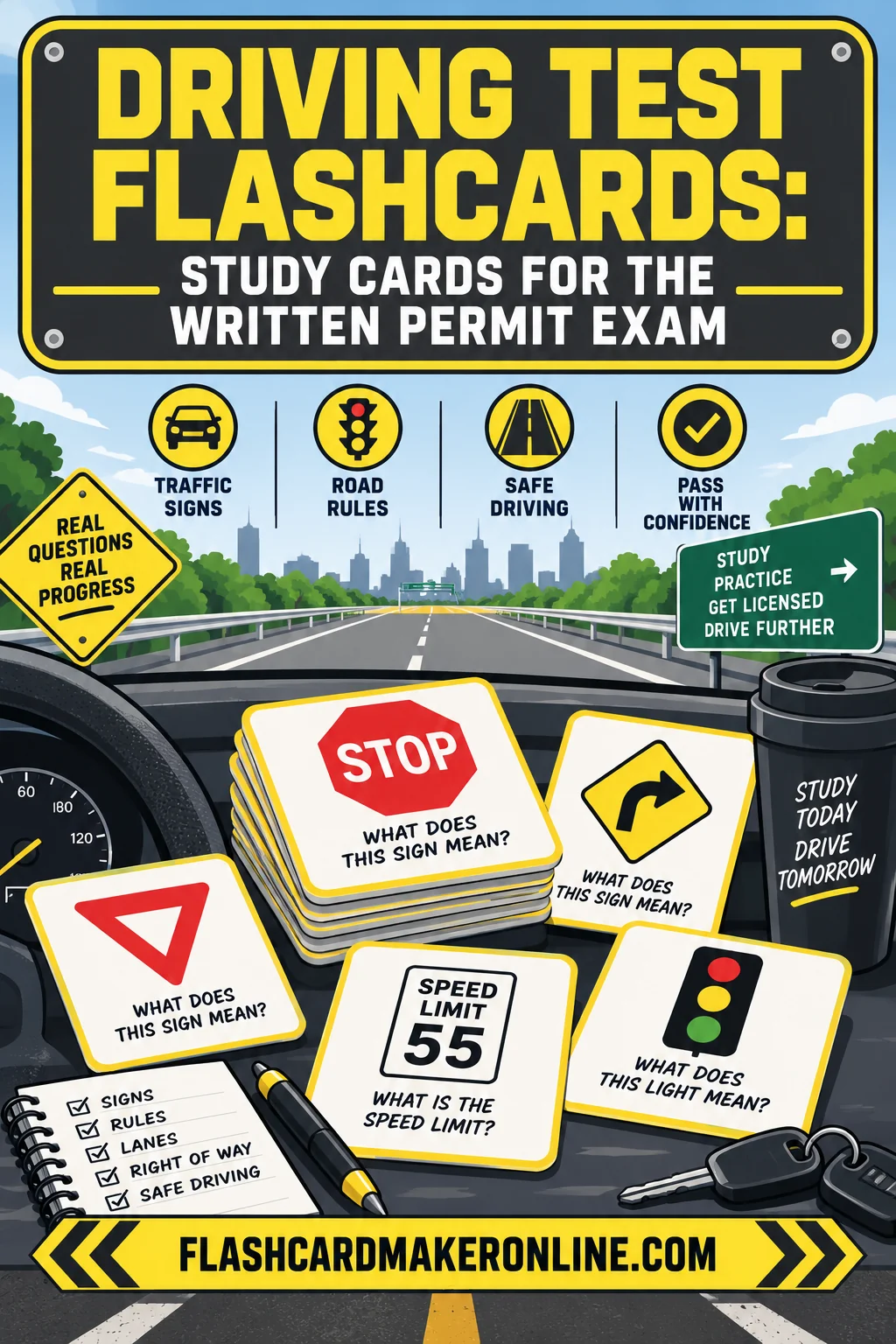
The written permit exam is mostly recognition and rules, which is exactly what flashcards are built for, but the rules themselves are set by your state and they are not the same everywhere. That one fact should shape your entire deck. Build the categories from this article, then fill in every actual number and every actual rule from the current driver handbook published by your own state's licensing agency.
This matters more than people expect. Speed limits, following distance guidance, blood alcohol thresholds, penalties, right-of-way details at uncontrolled intersections, rules for turning on red, school bus stopping requirements, and even the number of questions you will face all vary by jurisdiction, and states revise their handbooks. Every example in this article is an illustration of a card's shape, not a statement of law. If you memorize a number from a website instead of from your own state's current handbook, you are studying the wrong material with great discipline.
With that settled, here is how to build a deck that actually works.
The Four Categories a Permit Deck Needs
Almost everything on a written permit exam falls into one of four buckets, and each bucket wants a different card style.
Sign recognition. Shape, color, and meaning. Pure visual and verbal recall, and the single most card-friendly content on the test.
Right of way. Situational rules with a defined answer. Card-friendly, but the wording of your card has to match the situation precisely.
Speed, distance and stopping. Numbers and concepts. The concepts transfer everywhere; the numbers are state-specific.
Road markings and lane rules. Line colors, line patterns, and what each one permits. Highly card-friendly and consistently under-studied.
A fifth bucket, sometimes folded into the others, covers sharing the road, impairment, and administrative rules like license restrictions and insurance requirements. Those are worth cards too, but only after you have written them from your own handbook, because they are the most state-specific material on the whole test.
Sign Shapes and Colors
Sign shape and color are a designed system, which means they are learnable as a system rather than as a hundred separate pictures. That is why they belong on cards near the front of any set of traffic sign study cards you build.
Shape carries meaning on its own. An octagon means one thing and only one thing, and a driver who sees only the back of it in fog still knows what it is. A triangle pointing down is used for yielding. A diamond is used for warning. A pentagon shape is used for school zones and crossings in most systems. A round sign is used at railroad crossings. Learning the shapes first means that when a sign is faded, snow-covered, or shown at an angle on the test, you still get the answer.
Color carries a second layer. Red for prohibition and stopping. Yellow for general warning. Orange for construction and temporary conditions. Green for permitted movements, guidance and directions. Blue for motorist services. Brown for recreation and cultural sites. White with black lettering for regulatory signs stating a law.
| Front | Back |
|---|---|
| What does an octagonal sign always mean? | Stop |
| What does a downward-pointing triangle mean? | Yield |
| What does a diamond-shaped sign indicate? | A warning about conditions ahead |
| What do orange signs indicate? | Construction, maintenance or a temporary condition |
| What do brown signs indicate? | Recreational areas and points of interest |
| What does a round sign warn of? | A railroad crossing ahead |
Then build a second pass of cards for individual signs your handbook actually pictures. Use the handbook's own images and the handbook's own wording, because that phrasing is what the question writers used. This is where road rules flashcards and sign cards start to overlap: many warning signs are really rules in visual form, and the card should capture both the picture and the required action.
Right of Way
Right of way is the section that trips up the most people, because the situations feel similar and the correct answers hinge on small differences. Cards help here, but only if you write the situation tightly enough that there is one answer.
Bad card: "Who has the right of way at an intersection?" That has no single answer.
Good card: "At a four-way stop where two vehicles arrive at the same time, who proceeds first?" That has a defined answer in your handbook.
The core scenarios to cover:
- Four-way stops, including simultaneous arrival and arrival order
- Uncontrolled intersections
- T-intersections
- Left turns across oncoming traffic
- Entering a road from a driveway or parking lot
- Roundabouts and traffic circles
- Merging onto a highway
- Emergency vehicles approaching from behind and from ahead
- Funeral processions, where your state addresses them
- Pedestrians in marked and unmarked crosswalks
- Cyclists in bike lanes and sharing the lane
- School buses with flashing lights, on undivided and divided roads
That last one deserves a warning. School bus stopping rules are genuinely different across states, particularly on divided highways and multi-lane roads, and getting it wrong on the test is the least of the consequences. Write that card from your own handbook, word for word.
A useful framing for the whole section: the handbook rarely says who "has" the right of way. It says who must yield. Writing your cards in the yielding direction matches the legal language and matches the test.
Speed, Distance and Stopping Concepts
Here is where the split between concept and number matters most.
The concepts are universal. Stopping distance is made of perception distance, reaction distance, and braking distance, and only the last of those is about your brakes. Braking distance grows much faster than speed does, so a modest increase in speed produces a large increase in the distance needed to stop. Wet, icy, or gravel surfaces extend braking distance substantially. A loaded vehicle takes longer to stop than an empty one. A following interval measured in seconds automatically adjusts for speed in a way that a fixed number of car lengths does not.
The numbers are not universal. Posted maximums, statutory limits where no sign is posted, school zone limits, work zone penalties, the recommended following interval expressed in seconds, and any threshold related to impairment are all set by state law. Do not memorize a number you read anywhere except your own state's current handbook.
The same applies to alcohol. Every state sets its own thresholds and its own rules for drivers under the legal drinking age and for commercial drivers, and those rules change. Your dmv test flashcards should have a card for the threshold that applies to you, with the number taken directly from the handbook you are studying, and a second card for the consequences of refusing a chemical test, which is also state-defined. Nothing about impairment should be memorized from a general article, including this one.
Concept cards that transfer anywhere:
| Front | Back |
|---|---|
| What three components make up total stopping distance? | Perception distance, reaction distance, and braking distance |
| Why is a following interval measured in seconds rather than car lengths? | Because a time interval scales automatically with speed, while a fixed length does not |
| How does a wet road surface affect stopping? | It lengthens braking distance, so a larger following interval is needed |
| Why does braking distance rise sharply with speed? | Because the energy that has to be dissipated grows much faster than speed itself |
Road Markings and Lane Rules
Markings are a language, and most permit tests lean on them. They are also the easiest section to master with cards, because the vocabulary is small and completely regular in the systems used across the country.
Yellow lines separate traffic moving in opposite directions. White lines separate traffic moving in the same direction. A solid line restricts crossing; a broken line permits it. A double line with one solid and one broken side permits passing only from the broken side. Crosshatched areas mark space you are not meant to drive in. Stop lines, crosswalk markings, turn arrows and lane-use arrows tell you what a lane is for.
| Front | Back |
|---|---|
| What do yellow center lines separate? | Traffic traveling in opposite directions |
| What do white lane lines separate? | Traffic traveling in the same direction |
| A solid line beside a broken line on your side means what? | Passing is permitted from the broken side only |
| What does a broken white line between lanes permit? | Changing lanes when it is safe to do so |
Confirm the specifics in your handbook anyway. Some states include markings, colors, or lane types the general system does not, especially around toll lanes, transit lanes and shared turn lanes.
Building the Deck Efficiently
A permit deck is small enough to finish in a weekend and useful enough to be worth doing carefully.
Work straight through the handbook, one section at a time. Read a section, then immediately write cards for anything in it that has a defined answer. This is the whole method. It sounds slow and it takes about three focused hours for most handbooks.
Write the question the way the handbook words it. Test questions are drafted from the handbook, so matching its language means your recall lines up with the phrasing you will see.
Make sign cards visual on one side. A card that shows the sign and asks for the meaning trains the recognition you actually need. A card that names the sign and asks for the shape trains the other direction. Build both.
Keep numbers on their own cards, clearly labeled with your state. If you ever move, you will know exactly which cards to rewrite.
Do not build cards for things you cannot be asked. Handbooks contain a lot of advice that is genuinely good driving practice but is not a testable rule. It is worth reading and not worth carding.
Typing the deck into a flashcard maker rather than writing it out by hand means you can drill on a phone in the ten minutes before a shift or a class, which is when most of this studying actually happens.
How to Drill Without Wasting Time
Short and frequent beats long and rare. Ten minutes in the morning and ten at night for a week will outperform one three-hour session, because the gap between sessions is what moves material into durable memory.
Sort ruthlessly. After two passes through the deck, split it into cards you get right every time and cards you keep missing. Drill only the second pile. Most people find their misses concentrate in right of way and in the numeric rules, which is exactly where the test is hardest.
Say answers out loud. It is slower per card and considerably more accurate as self-assessment, because thinking "yeah, I knew that" is not the same as producing the answer.
Finish with a full run of the deck the day before, then stop. Cramming the morning of adds anxiety and very little recall.
Anyone using these as drivers ed flashcards alongside a classroom course has an advantage worth using: build your cards from the same handbook the course teaches from, and add a card every time an instructor emphasizes something. Instructors know which items people fail on.
What Permit Test Cards Cannot Do
Cards get you through the written exam. They do nothing at all for the road test, which is a separate skill built only through supervised hours behind the wheel.
They also do not build hazard perception, which is the actual safety skill underneath all of this. Knowing that you must yield to a pedestrian in an unmarked crosswalk is a fact. Noticing the pedestrian is a skill, and it comes from driving with someone experienced who narrates what they are seeing.
Treat permit test flashcards as what they are: an efficient way to clear the knowledge test so you can start the part that actually takes time.
Frequently Asked Questions
How many cards does a permit deck need? Usually somewhere between one hundred and two hundred once signs, right of way, markings and the numeric rules are covered. The right number is whatever your handbook contains, so build from the handbook rather than to a target count.
Are pre-made driving decks safe to use? Use them only as a checklist of topics. Any deck built for a general audience will contain numbers and rules from some other state, and you have no way to tell which entries are wrong for you. Verify every rule against your own current handbook before you drill it.
Should I study signs or rules first? Signs. They are the fastest section to lock in, they show up throughout the rest of the material, and finishing one section completely gives you a real sense of progress early.
Do I still need to read the handbook if I have good cards? Yes, and reading it is how you write the cards in the first place. The handbook also carries context and explanations that make the rules stick, and it is the only source that is authoritative for where you live.