Japanese Flashcards: Everyday Vocabulary to Study and Print
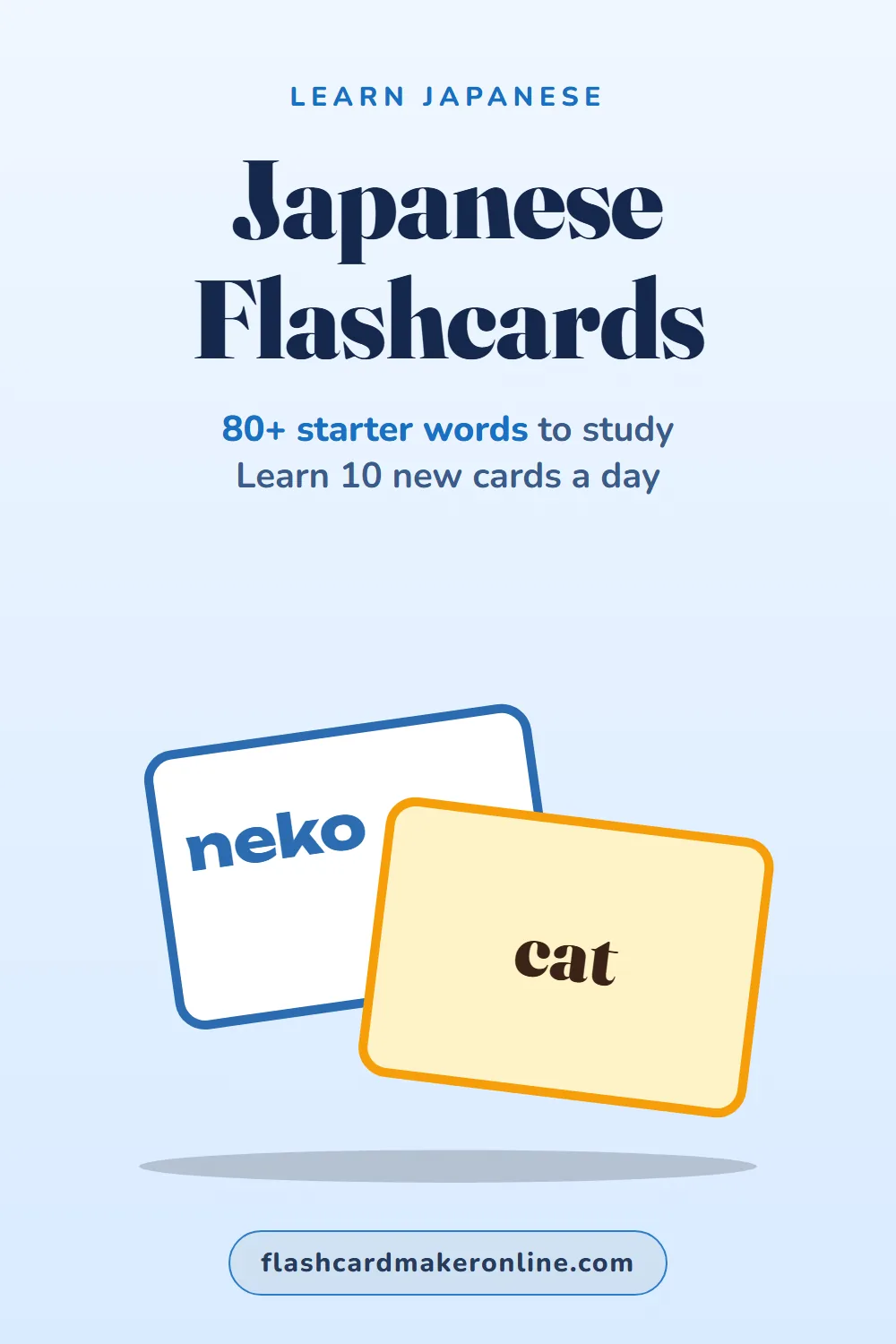
Good Japanese flashcards put the word on the front the way it's really written (in kana or kanji) and the reading plus the English meaning on the back. Start with about 100 everyday words: greetings, numbers, food, people, places and a handful of verbs. Learn 10 new cards a day, review the old ones, and you'll be reading simple phrases within a few weeks.
Below is a starter list of more than 80 real, high-use words you can drop straight into a deck. Try a few cards first:
🃏 Quiz yourself: 10 cards from this page
Read the front, say your answer, then tap the card to check.
Make, study & print this deck → Opens the free flashcard maker with all 10 cards ready to edit or print.How should you set up Japanese vocab flashcards?
Japanese uses three scripts together, which is why a plain "word on the front, English on the back" card doesn't quite work. Quick refresher:
- Hiragana: the basic sound alphabet, used for grammar bits and many native words (ありがとう).
- Katakana: the same sounds in a sharper style, mostly for words borrowed from other languages (コーヒー, coffee).
- Kanji: characters borrowed from Chinese that carry meaning (猫, cat).
So here's the card setup that works for most learners:
| Front | Back |
|---|---|
| 猫 | ねこ (neko): cat |
| ありがとう | arigatou: thank you |
| コーヒー | koohii: coffee |
If kanji feels like too much right now, put the hiragana on the front instead and add the kanji later. That's completely fine. Just don't stay on romaji (Japanese written in English letters) forever. It's a crutch that makes real reading harder later.
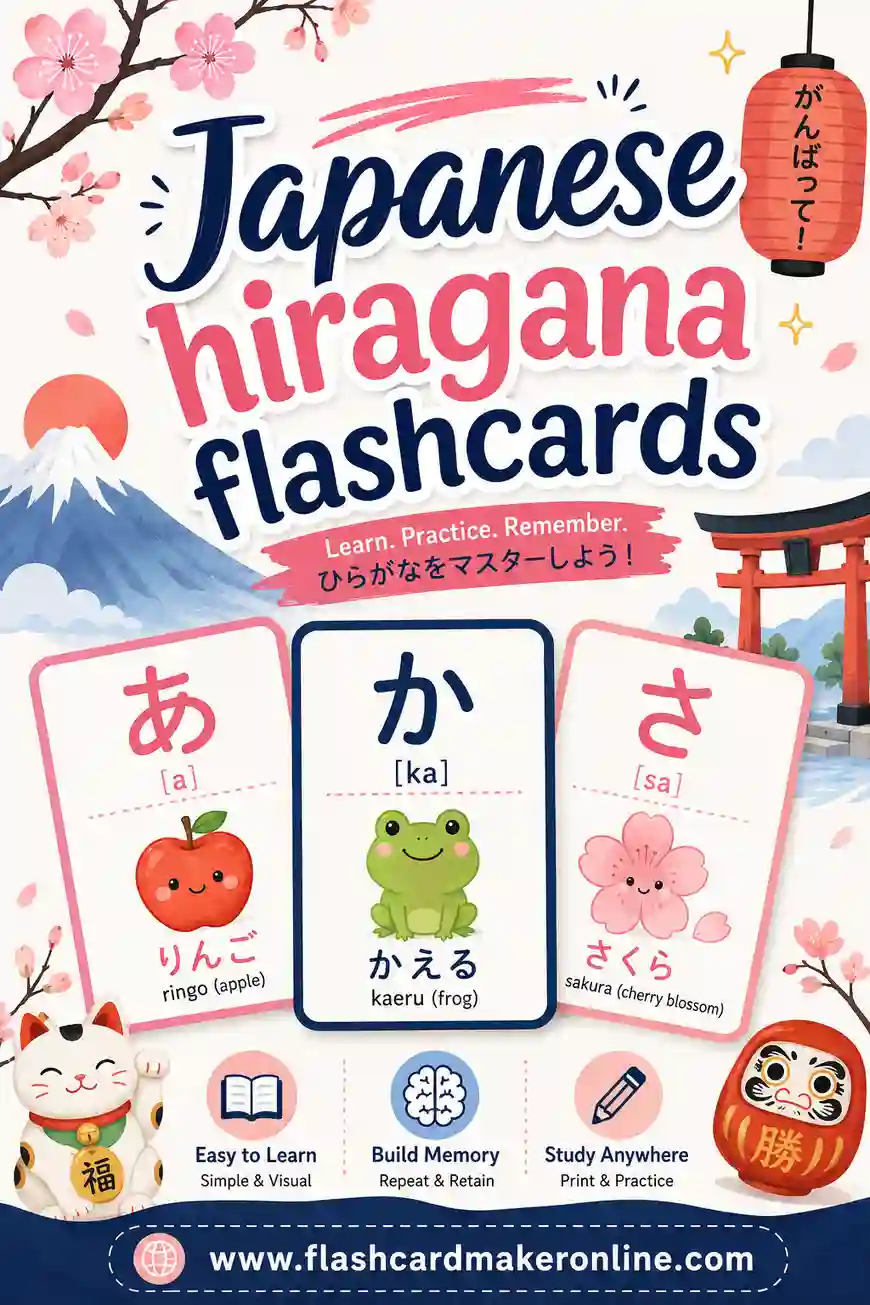
Not comfortable with kana yet? Spend a week on our hiragana flash cards first. Vocabulary goes much faster once you can sound words out.
Japanese vocabulary flashcards: 80+ starter words
These are all common, everyday words. The romaji spells long vowels out (ou, uu, ii), which is one of a few styles you'll see. Copy any rows into the flashcard maker.
Greetings and basics
| Japanese | Reading | Meaning |
|---|---|---|
| こんにちは | konnichiwa | hello, good afternoon |
| おはようございます | ohayou gozaimasu | good morning (polite) |
| こんばんは | konbanwa | good evening |
| ありがとう | arigatou | thank you |
| すみません | sumimasen | excuse me, I'm sorry |
| おねがいします | onegaishimasu | please (when asking for something) |
| はい | hai | yes |
| いいえ | iie | no |
| さようなら | sayounara | goodbye |
| おやすみなさい | oyasuminasai | good night |
Numbers 1 to 10
| Kanji | Reading | Meaning |
|---|---|---|
| 一 | いち (ichi) | one |
| 二 | に (ni) | two |
| 三 | さん (san) | three |
| 四 | よん (yon), also し (shi) | four |
| 五 | ご (go) | five |
| 六 | ろく (roku) | six |
| 七 | なな (nana), also しち (shichi) | seven |
| 八 | はち (hachi) | eight |
| 九 | きゅう (kyuu) | nine |
| 十 | じゅう (juu) | ten |
People and family
| Kanji | Reading | Meaning |
|---|---|---|
| 私 | わたし (watashi) | I, me |
| 友達 | ともだち (tomodachi) | friend |
| 先生 | せんせい (sensei) | teacher |
| 学生 | がくせい (gakusei) | student |
| 家族 | かぞく (kazoku) | family |
| 母 | はは (haha) | (my) mother |
| 父 | ちち (chichi) | (my) father |
| 子供 | こども (kodomo) | child |
Food and drink
| Japanese | Reading | Meaning |
|---|---|---|
| 水 | みず (mizu) | water |
| お茶 | おちゃ (ocha) | tea, green tea |
| ご飯 | ごはん (gohan) | cooked rice, a meal |
| 魚 | さかな (sakana) | fish |
| 肉 | にく (niku) | meat |
| 卵 | たまご (tamago) | egg |
| パン | pan | bread |
| りんご | ringo | apple |
| コーヒー | koohii | coffee |
| アイスクリーム | aisukuriimu | ice cream |
Places and nature
| Kanji | Reading | Meaning |
|---|---|---|
| 家 | いえ (ie) | house, home |
| 学校 | がっこう (gakkou) | school |
| 駅 | えき (eki) | train station |
| 店 | みせ (mise) | shop, store |
| 日本 | にほん (nihon) | Japan |
| 山 | やま (yama) | mountain |
| 川 | かわ (kawa) | river |
| 空 | そら (sora) | sky |
| 雨 | あめ (ame) | rain |
| 雪 | ゆき (yuki) | snow |
Time words
| Kanji | Reading | Meaning |
|---|---|---|
| 今日 | きょう (kyou) | today |
| 明日 | あした (ashita) | tomorrow |
| 昨日 | きのう (kinou) | yesterday |
| 今 | いま (ima) | now |
| 毎日 | まいにち (mainichi) | every day |
| 時間 | じかん (jikan) | time, hours |
| 朝 | あさ (asa) | morning |
| 夜 | よる (yoru) | night |
Everyday verbs
| Kanji | Reading | Meaning |
|---|---|---|
| 食べる | たべる (taberu) | to eat |
| 飲む | のむ (nomu) | to drink |
| 行く | いく (iku) | to go |
| 来る | くる (kuru) | to come |
| 見る | みる (miru) | to see, to watch |
| 読む | よむ (yomu) | to read |
| 書く | かく (kaku) | to write |
| 話す | はなす (hanasu) | to speak |
| 分かる | わかる (wakaru) | to understand |
| 寝る | ねる (neru) | to sleep, to go to bed |
Describing words
| Kanji | Reading | Meaning |
|---|---|---|
| 大きい | おおきい (ookii) | big |
| 小さい | ちいさい (chiisai) | small |
| 新しい | あたらしい (atarashii) | new |
| 古い | ふるい (furui) | old (for things, not people) |
| 高い | たかい (takai) | tall, high, expensive |
| 安い | やすい (yasui) | cheap |
| 美味しい | おいしい (oishii) | delicious |
| 暑い | あつい (atsui) | hot (weather) |
| 寒い | さむい (samui) | cold (weather) |
| 楽しい | たのしい (tanoshii) | fun, enjoyable |
Animals and loanwords
| Japanese | Reading | Meaning |
|---|---|---|
| 犬 | いぬ (inu) | dog |
| 猫 | ねこ (neko) | cat |
| 鳥 | とり (tori) | bird |
| テレビ | terebi | TV |
| カメラ | kamera | camera |
| ホテル | hoteru | hotel |
How many Japanese words should you learn a day?
Ten new words a day is a great pace for most people. It sounds small, but that's about 300 words a month, and the reviews add up fast. If you have more time, go to 15 or 20, but watch your review pile. If reviews start taking longer than 20 minutes, slow the new cards down for a few days.
The secret isn't the number. It's coming back to each card right before you'd forget it, which is spaced repetition in a nutshell. A simple way to do it on paper: keep cards in three piles (new, shaky, solid), check the shaky pile daily and the solid pile once a week.
Tips that make Japanese flashcards stick
- Say it out loud. In the maker's Study tab, the Read aloud button reads the current side. For kana fronts it uses a Japanese voice if your device has one installed, so you hear the real pronunciation.
- Test both directions. Japanese to English is easier. Once a word feels solid, flip the deck and go English to Japanese.
- Add a tiny phrase. On the back, add a two-word example like 猫が好き (neko ga suki, I like cats). Words in context stick better.
- Keep kanji cards separate at first. Learning a kanji character on its own is a different job from learning a word. Our kanji flashcards guide covers that side.
- Pair with an app if you like. If an app keeps showing you words that won't stick, pull them onto paper cards. Here's how to add flashcards when Duolingo isn't sticking.
Mistakes most beginners make
- Only using romaji. It feels faster for a week, then slows you down for months. Move to kana as soon as you can.
- Cramming 50 words on day one. The reviews pile up and motivation drops. Steady wins.
- Cards with three meanings on the back. Start with the main meaning. Add extra ones once the word feels familiar.
- Skipping reviews over the weekend. Five minutes still counts.
Print your Japanese flashcards
Paste your list into the free flashcard maker (one card per line, like 猫 : ねこ (neko) cat), then open the Print tab. Big cards (4 per page) make kanji easy to read, and double-sided printing puts the reading on the back. Put "Japanese" in your deck title and you're set to study, listen and print, all in one place.
Frequently Asked Questions
What should go on a Japanese vocabulary flashcard?
Put the word as it's written in Japanese (kana or kanji) on the front, and the reading plus the English meaning on the back. A short example phrase on the back helps too.
Should I use romaji on Japanese flashcards?
Use it on the back as a pronunciation hint while you're starting out, but put kana or kanji on the front. Relying only on romaji makes real reading harder later.
How many Japanese words can I learn a day with flashcards?
Ten new words a day is a comfortable pace for most learners, which adds up to about 300 a month. Go higher only if your daily reviews stay under about 20 minutes.
Should I learn hiragana before Japanese vocabulary?
It helps a lot. A week or two of hiragana practice lets you sound out new words on your own, so vocabulary cards go much faster.
Can the flashcard maker read Japanese out loud?
Yes. The Read aloud button in the Study tab uses a Japanese voice for kana and, with Japanese in your deck title, for kanji, as long as your device has a Japanese voice installed.
Are Japanese flashcards free to print?
Yes. Paste your list into our maker, pick a layout such as Big (4 per page) or Standard (8 per page), and print. No account needed.