Key Signatures Flashcards: Every Major and Minor Key, With the Circle of Fifths
A key signature is the group of sharps or flats at the start of each staff that tells you the key. No sharps or flats is C major (or A minor), one sharp is G major, one flat is F major, and so on around the circle of fifths. These key signatures flashcards show the sharps or flats on the front and the major key with its relative minor on the back, plus two quick tricks that name any key in seconds.
Try the deck. Read the sharps or flats, name the key, then tap to check:
🃏 Quiz yourself: 15 cards from this page
Read the front, say your answer, then tap the card to check.
Make, study & print this deck → Opens the free flashcard maker with all 15 cards ready to edit or print.Key signatures chart: sharps
| Sharps | Major key | Relative minor |
|---|---|---|
| None | C major | A minor |
| 1 sharp: F♯ | G major | E minor |
| 2 sharps: F♯ C♯ | D major | B minor |
| 3 sharps: F♯ C♯ G♯ | A major | F♯ minor |
| 4 sharps: F♯ C♯ G♯ D♯ | E major | C♯ minor |
| 5 sharps: F♯ C♯ G♯ D♯ A♯ | B major | G♯ minor |
| 6 sharps: F♯ C♯ G♯ D♯ A♯ E♯ | F♯ major | D♯ minor |
| 7 sharps: all seven | C♯ major | A♯ minor |
Key signatures chart: flats
| Flats | Major key | Relative minor |
|---|---|---|
| 1 flat: B♭ | F major | D minor |
| 2 flats: B♭ E♭ | B♭ major | G minor |
| 3 flats: B♭ E♭ A♭ | E♭ major | C minor |
| 4 flats: B♭ E♭ A♭ D♭ | A♭ major | F minor |
| 5 flats: B♭ E♭ A♭ D♭ G♭ | D♭ major | B♭ minor |
| 6 flats: B♭ E♭ A♭ D♭ G♭ C♭ | G♭ major | E♭ minor |
| 7 flats: all seven | C♭ major | A♭ minor |
Some keys sound the same but are written differently, like F♯ major (6 sharps) and G♭ major (6 flats). These are called enharmonic keys. Beginners mostly meet keys with up to 4 sharps or flats.
The order of sharps and flats
Sharps and flats always appear in the same order, so you only need to learn two lists:
| Order | Memory sentence | |
|---|---|---|
| Sharps | F C G D A E B | Father Charles Goes Down And Ends Battle |
| Flats | B E A D G C F | Battle Ends And Down Goes Charles' Father (the sharp sentence backwards) |
Notice the flat order is just the sharp order reversed, and the first four flats spell BEAD. More tricks like these are on our mnemonic devices examples page.
Two tricks to name any key signature
Sharp keys: go up a half step from the last sharp
Find the last sharp (the one farthest right) and go up one half step. That's the major key. Three sharps (F♯ C♯ G♯): the last is G♯, a half step up is A, so it's A major.
Flat keys: the second-to-last flat is the key
Look at the next-to-last flat. That's the major key. Three flats (B♭ E♭ A♭): the second-to-last is E♭, so it's E♭ major. The one exception is one flat, which you simply memorize: F major.
Finding the relative minor
Every major key shares its key signature with a minor key. To find it, go down three half steps (a minor third) from the major key, or count up to the 6th note of the major scale. C major's relative minor is A minor; G major's is E minor.
The circle of fifths, simply
Picture a clock with C at 12 o'clock. Going clockwise, each key is a fifth higher and adds one sharp: C, G, D, A, E, B, F♯, C♯. Going counterclockwise, each key is a fifth lower (a fourth higher) and adds one flat: C, F, B♭, E♭, A♭, D♭, G♭, C♭. The bottom of the clock is where the sharp and flat sides meet with the enharmonic keys.
| Clock position | Major key | Sharps or flats |
|---|---|---|
| 12 | C | 0 |
| 1 | G | 1♯ |
| 2 | D | 2♯ |
| 3 | A | 3♯ |
| 4 | E | 4♯ |
| 5 | B / C♭ | 5♯ / 7♭ |
| 6 | F♯ / G♭ | 6♯ / 6♭ |
| 7 | D♭ / C♯ | 5♭ / 7♯ |
| 8 | A♭ | 4♭ |
| 9 | E♭ | 3♭ |
| 10 | B♭ | 2♭ |
| 11 | F | 1♭ |
A two-week plan to learn every key signature
| Days | Cards | Goal |
|---|---|---|
| 1 to 2 | C, G, D, F, B♭ | The keys most beginners play first |
| 3 to 4 | A, E, E♭, A♭ | Up to 4 sharps and 4 flats |
| 5 to 6 | Relative minors for days 1 to 4 | Use the 'down three half steps' rule |
| 7 to 9 | B, F♯, C♯, D♭, G♭, C♭ | The rest, plus the enharmonic pairs |
| 10 to 12 | All 15, shuffled, both directions | Key to signature and signature to key |
| 13 to 14 | Name the key of real pieces you're playing | Use it, not just drill it |
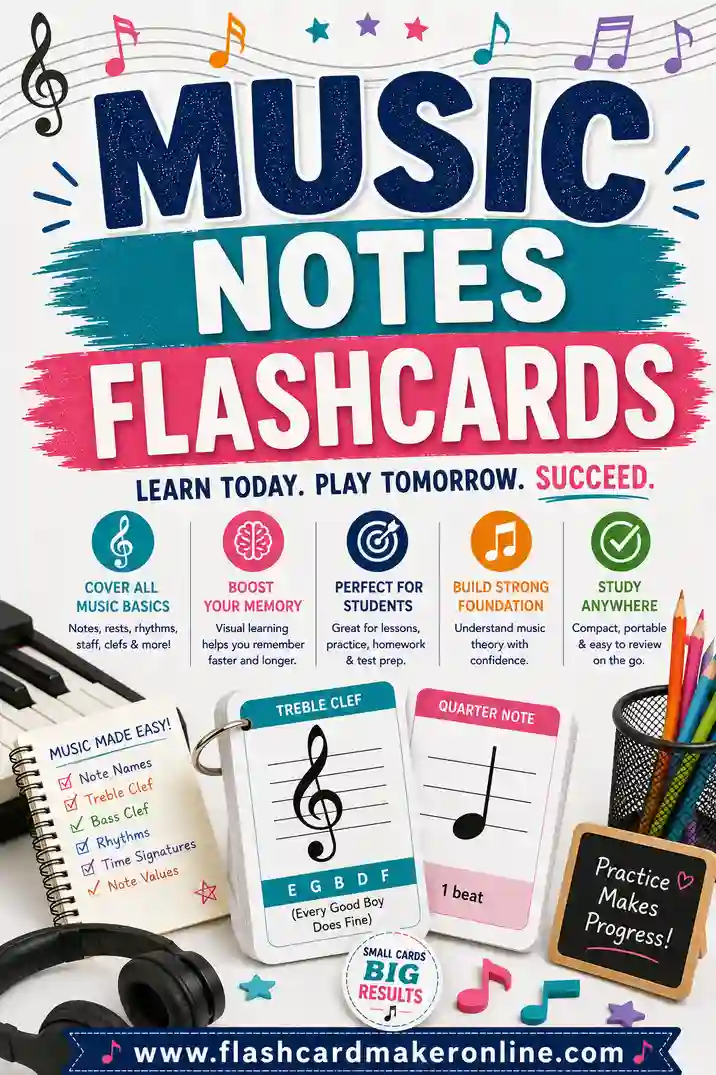
Five minutes a day before practice is plenty. If you're still learning to read notes, start with our music notes flashcards and bass clef flashcards, then come back to key signatures.
How to make your own key signature flashcards
- Open the free flashcard maker, or use the button under the practice card.
- On the front, write the sharps or flats in order ("3 flats: B♭ E♭ A♭"), or add a photo of a staff you've drawn.
- On the back, write the major key and its relative minor.
- Make a reverse set ("E♭ major" on the front, "3 flats" on the back) for theory tests.
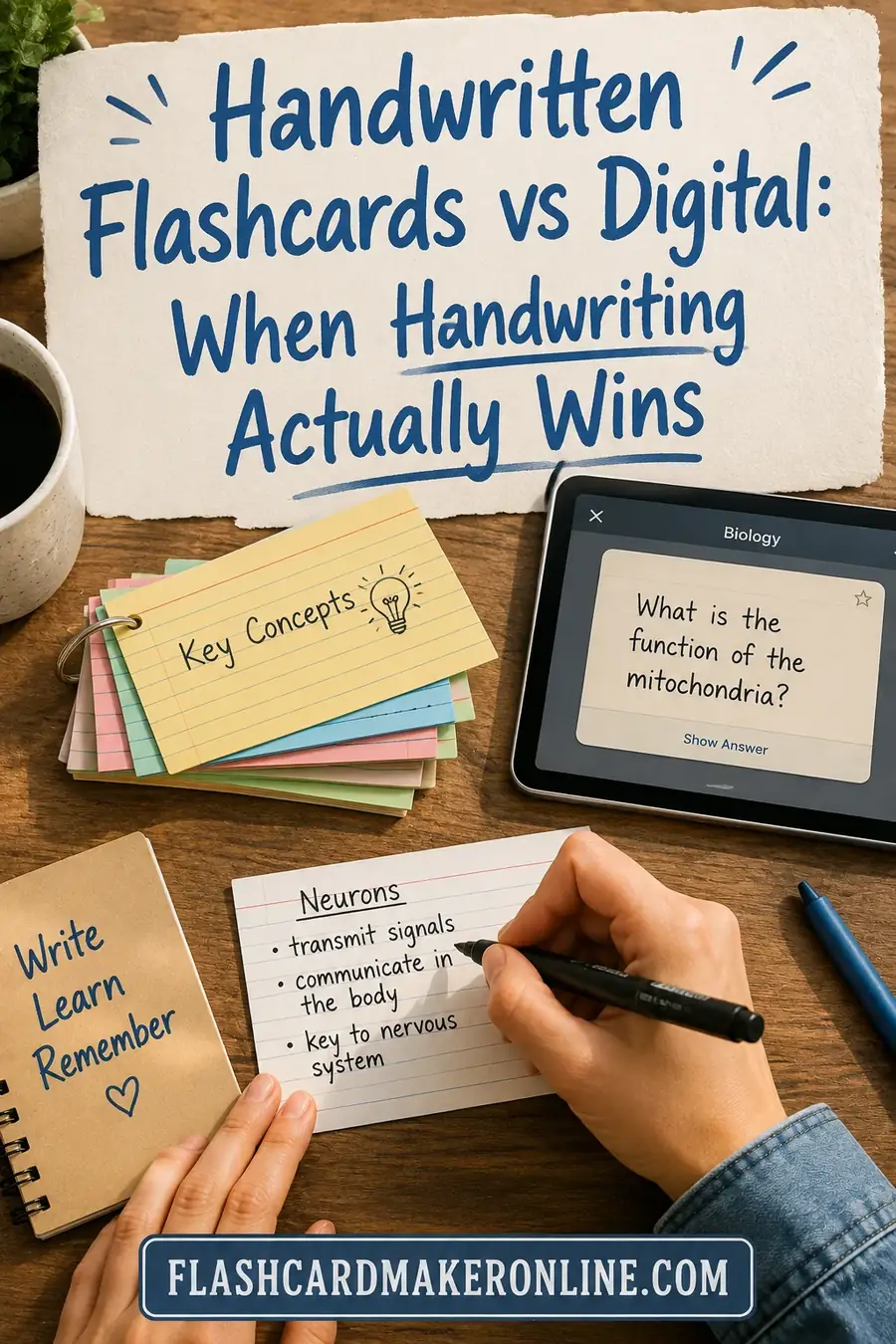
Teachers: hand-drawn staff cards are great for January lessons. Our handwritten flashcards page has tips for making a set that lasts.
Frequently Asked Questions
How do you identify a key signature?
For sharp keys, go up a half step from the last sharp. For flat keys, the second-to-last flat names the key. No sharps or flats is C major, and one flat is F major.
What is the order of sharps?
F, C, G, D, A, E, B. A common memory sentence is 'Father Charles Goes Down And Ends Battle'.
What is the order of flats?
B, E, A, D, G, C, F, the order of sharps backward. The first four spell BEAD.
What is the circle of fifths?
A circle of the 12 keys arranged so each step clockwise is a fifth higher and adds a sharp, and each step counterclockwise adds a flat.
How do I find the relative minor of a major key?
Go down three half steps (a minor third) from the major key's name. C major's relative minor is A minor; F major's is D minor.