Portuguese Flashcards: How to Build a Deck That Actually Sticks
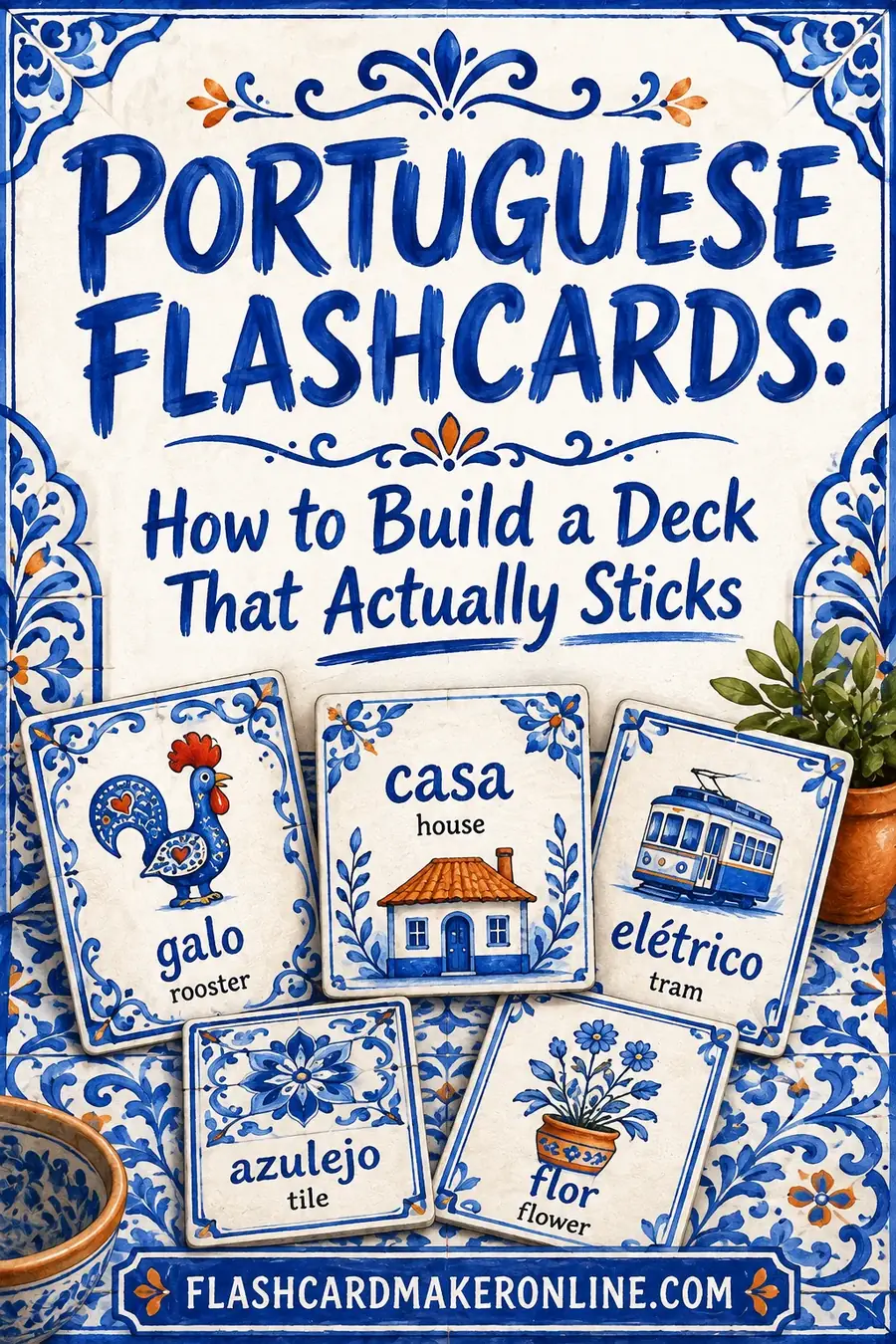
The single biggest mistake people make with Portuguese flashcards is building the deck out of order — starting with random vocabulary lists instead of the 200-300 highest-frequency words that appear in almost every sentence. Get the word selection and card format right, and even a small deck teaches you faster than a huge one built from a random word list.
European vs. Brazilian Portuguese: Pick One First
Decide which variant you're learning before you build a single card. European and Brazilian Portuguese differ enough in pronunciation, some vocabulary, and a handful of grammar points that mixing them in one deck creates confusion rather than flexibility.
Key differences that matter for flashcards:
- Vocabulary: "bus" is autocarro in European Portuguese, ônibus in Brazilian. "Ice cream" is gelado vs. sorvete. There are dozens of these pairs.
- Pronoun placement: European Portuguese tends to place object pronouns before the verb more often; Brazilian Portuguese is more flexible and often places them after.
- Pronunciation: European Portuguese tends to swallow unstressed vowels more; Brazilian Portuguese is generally more open and vowel-clear, which is part of why many learners find Brazilian pronunciation slightly easier to start with.
If you're learning for travel to Portugal, use European. For Brazil, use Brazilian. If you genuinely don't know yet, Brazilian Portuguese has more learning resources available, which makes it a practical default for many beginners.
The First 200 Words: What to Actually Put on Your Cards
Frequency matters more than theme when you're starting out. These categories cover an outsized share of everyday spoken Portuguese:
Core verbs (conjugated in present tense first): ser/estar (to be), ter (to have), fazer (to do/make), ir (to go), poder (to be able to), querer (to want), dizer (to say), ver (to see), dar (to give), saber (to know).
High-frequency connectors: e (and), mas (but), porque (because), que (that/which), quando (when), se (if), também (also), mais (more), muito (very/much).
Essential nouns: casa (house), tempo (time/weather), dia (day), pessoa (person), coisa (thing), lugar (place), trabalho (work), água (water), comida (food).
Question words: o quê (what), quem (who), onde (where), quando (when), por quê (why), como (how), quanto (how much).
Master these before branching into themed vocabulary (food, travel, family) — they're the connective tissue that makes any sentence work, and they show up constantly regardless of what topic you're discussing.
Card Format: What Goes on Each Side
Front: the Portuguese word or short phrase, ideally with the article included for nouns (a casa, not just casa) since gender is one of the hardest things to internalize later if you skip it early.
Back: the English meaning, plus one short example sentence using the word in context. A bare translation without an example sentence is one of the weakest flashcard formats — you learn the word but not how it's actually used.
Example card: - Front: a casa - Back: house — "Eu moro numa casa pequena." (I live in a small house.)
For verbs, build separate cards for each key conjugated form you're drilling (eu sou, você é, nós somos) rather than one card with the whole conjugation table — testing yourself on one form at a time is far more effective than trying to recall an entire table from a single prompt.
Handling Gender and Accents Without Losing Your Mind
Always include the article (o/a) on noun cards from day one. Portuguese noun gender isn't always predictable from the word ending the way it partly is in Spanish, so building the habit of learning noun + article as a single unit saves enormous frustration later.
Don't skip accent marks. Está (is/are, informal) and esta (this, feminine) are different words that are only distinguished by the accent. Writing flashcards without accents trains you to ignore a distinction that matters in real reading and writing.
Group false friends separately. Portuguese has several words that look like English or Spanish words but mean something different — pretender means "to intend," not "to pretend" (that's fingir). A dedicated small deck of these false friends prevents them from quietly corrupting your vocabulary.
Building the Deck Efficiently
Typing out 200+ cards by hand in a notes app works, but a dedicated flashcard maker speeds up building and printing a deck significantly when you're working through a large vocabulary list, and gives you a clean, consistent card format without manually formatting each one.
Batch by category, not randomly. Build 15-20 cards on one theme (numbers, family, food) in one sitting rather than jumping between topics — it's faster to write and easier to review as a coherent set.
Add audio if your tool supports it, or record yourself saying each word once. Portuguese pronunciation (especially nasal vowels like não and pão) is genuinely hard to get right from spelling alone, and hearing the word alongside seeing it dramatically improves both pronunciation and recall.
Review Schedule That Actually Works
Building the deck is half the work — reviewing it correctly is the other half:
- New cards: review the same day you make them, then again the next day
- Cards you get right twice in a row: space out to every 3-4 days
- Cards you get right consistently: space out to weekly, then monthly
- Cards you keep missing: pull into a small "trouble deck" and review daily until they stick
This spaced pattern (reviewing right before you'd naturally forget) is far more efficient than reviewing the whole deck equally every day, which wastes time on words you already know solidly.
Common Beginner Mistakes With Portuguese Vocabulary Specifically
Confusing "ser" and "estar." Portuguese, like Spanish, splits "to be" into two distinct verbs — ser for permanent or defining qualities, estar for temporary states or locations. This distinction doesn't exist in English at all, which makes it one of the most persistent early errors for English-speaking learners. Building separate flashcard sections specifically drilling ser vs. estar scenarios (rather than mixing them into general vocabulary) helps this distinction become automatic faster than encountering both verbs scattered randomly throughout a general deck.
Ignoring nasal sounds. Portuguese has nasal vowels (marked with a tilde, as in não and mãe) that don't have a true equivalent in English or even in Spanish, which trips up many learners coming from a Spanish-language background who assume the two languages sound more alike than they actually do. Flashcards alone can't fully teach pronunciation, which is exactly why pairing written cards with audio (even just your own recorded pronunciation) matters more for Portuguese than for languages with more predictable, English-like vowel sounds.
Treating cognates as automatically safe. Portuguese has many words that look similar to English or Spanish and mean the same thing (informação = information, hospital = hospital), which is genuinely useful — but it creates a false sense of security that causes learners to under-practice the words that look familiar, even though pronunciation and gender still need to be learned separately for each one.
A Sample Study Session Using Your Deck
To make the review process concrete: a typical 20-minute session with a well-built Portuguese deck might look like flipping through 15-20 "due for review" cards based on your spacing schedule, saying each word or phrase out loud (not just reading it silently) before checking the answer side, sorting any missed cards into your trouble pile as you go, and finishing with a quick 5-card round specifically from that trouble pile to reinforce whatever you just got wrong. Ending every session on a small trouble-pile round, rather than stopping right after a miss, means your last active memory of a hard word is a correct recall rather than an error — a small habit that measurably improves next-day retention.
Building Toward Real Conversation, Not Just Vocabulary Recall
Flashcards are excellent for building a vocabulary base, but it's worth being honest that they have a real limitation: they test recognition and recall in isolation, not the ability to actually produce Portuguese in real-time conversation, where you don't get to flip a card and check an answer. Once your core deck feels solid, supplementing flashcard review with active output practice — narrating your day out loud in Portuguese, writing short journal entries using words from your deck, or finding a conversation partner or language exchange — closes the gap between "I recognize this word" and "I can actually use this word when I need it." Many intermediate learners plateau specifically because they kept building vocabulary through flashcards alone without ever practicing production, and the fix isn't more flashcards, it's more speaking and writing practice built on the foundation the flashcards provide.
Common Portuguese Grammar Points Worth Their Own Card Sections
Beyond individual vocabulary, a few grammar patterns are common enough and tricky enough for English speakers that they deserve dedicated flashcard sections rather than being absorbed passively through vocabulary cards alone:
Verb conjugation patterns. Rather than treating each conjugated form as a totally separate vocabulary item, group cards by conjugation pattern (regular -ar verbs, regular -er verbs, regular -ir verbs, then irregular verbs separately) so you start to internalize the pattern itself, not just memorize individual instances of it.
Contractions. Portuguese contracts prepositions with articles constantly (de + o = do, em + a = na), and these contracted forms show up so often in real Portuguese that they deserve their own small, dedicated set of cards rather than being left to sink in purely through exposure.
Object pronoun placement. Given the European/Brazilian split mentioned earlier, and the genuine complexity of pronoun placement rules, a dedicated set of example-sentence cards (rather than abstract rule cards) tends to teach this faster than trying to memorize the grammatical rule itself.
Frequently Asked Questions
Should beginners learn European or Brazilian Portuguese first? Whichever matches your actual goal — travel or connections in Portugal vs. Brazil. If you have no specific destination in mind, Brazilian Portuguese has more widely available learning resources, which makes it a practical starting point for many self-taught learners.
How many Portuguese flashcards should a beginner start with? Around 200-300 words covering core verbs, connectors, essential nouns, and question words. This core vocabulary covers a surprisingly large share of everyday conversation before you need any themed vocabulary at all.
Do I need to include the gender article on every noun flashcard? Yes — learning the noun and its article (o/a) together from the start prevents a very common and hard-to-fix error later, since Portuguese gender isn't always guessable from the word's ending.
Is it better to write example sentences or just translate the word? Example sentences are significantly more effective. A bare translation teaches you the word's meaning but not how it's actually used in a real sentence, which is where most of the practical value of vocabulary lives.
How long does it typically take to learn 300 core Portuguese words with flashcards? With consistent daily review (15-20 minutes), most learners can build solid recognition of a 200-300 word core deck within 4-8 weeks, though genuine fluent recall and natural use in conversation takes considerably longer and benefits from active speaking practice alongside flashcard review.
Should I learn Portuguese verb conjugations before or after building general vocabulary? Building them in parallel tends to work best — a small set of core verbs conjugated in present tense alongside general vocabulary gives you enough to start forming simple sentences early, which reinforces both areas faster than mastering one completely before starting the other.
Are there specific Portuguese sounds that are hard to represent on a flashcard? Yes, particularly nasal vowels and certain consonant sounds that don't map cleanly to English phonetics — this is exactly why pairing written flashcards with audio (recordings or a language app's pronunciation feature) matters more for Portuguese than for languages with more predictable spelling-to-sound relationships.
Is it worth learning Portuguese numbers as a dedicated flashcard section? Yes — numbers come up constantly in real conversation (prices, times, ages, phone numbers) and are easy to underestimate in importance, so a dedicated set of number flashcards, practiced until automatic, pays off disproportionately compared to their apparent simplicity.