The SQ3R Method: Survey, Question, Read, Recite, Review
The SQ3R method is a five-step way to read a textbook so you remember it: Survey, Question, Read, Recite, Review. You skim the chapter first, turn the headings into questions, read to answer them, say the answers from memory, then review. It was introduced by Francis P. Robinson in his 1946 book Effective Study, and it still works because it turns passive reading into active recall.
Practice the five steps as flashcards. Read the step, explain it, then tap to check:
🃏 Quiz yourself: 8 cards from this page
Read the front, say your answer, then tap the card to check.
Make, study & print this deck → Opens the free flashcard maker with all 8 cards ready to edit or print.The 5 steps of the SQ3R method
| Step | What you do | Time for a 20-page chapter |
|---|---|---|
| S: Survey | Skim titles, headings, bold words, pictures, captions, the intro, the summary and end-of-chapter questions | 3 to 5 minutes |
| Q: Question | Turn each heading into a question you want answered | 5 minutes |
| R1: Read | Read one section at a time, looking for the answer to its question | Most of your time |
| R2: Recite | Close the book and answer the question out loud or on paper, in your own words | 1 to 2 minutes per section |
| R3: Review | Answer every question again, without notes, after the chapter and over the next few days | 10 minutes, then short repeats |
1. Survey: get the big picture
Before reading a word of the text, flip through it. Look at the headings, bold terms, diagrams and any summary or review questions. You're building a mental map, so each section has a place to land when you read it. It feels like it wastes time. It doesn't.
2. Question: give your reading a job
Turn every heading into a question. "Causes of the Civil War" becomes "What were the causes of the Civil War?" Write the questions in your notes, leaving space under each. Now you're reading to find something, not just moving your eyes across the page.
3. Read: find the answers
Read one section at a time. Slow down at bold words, tables and pictures. Don't highlight everything; if you mark anything, mark the sentence that answers your question.
4. Recite: say it without looking
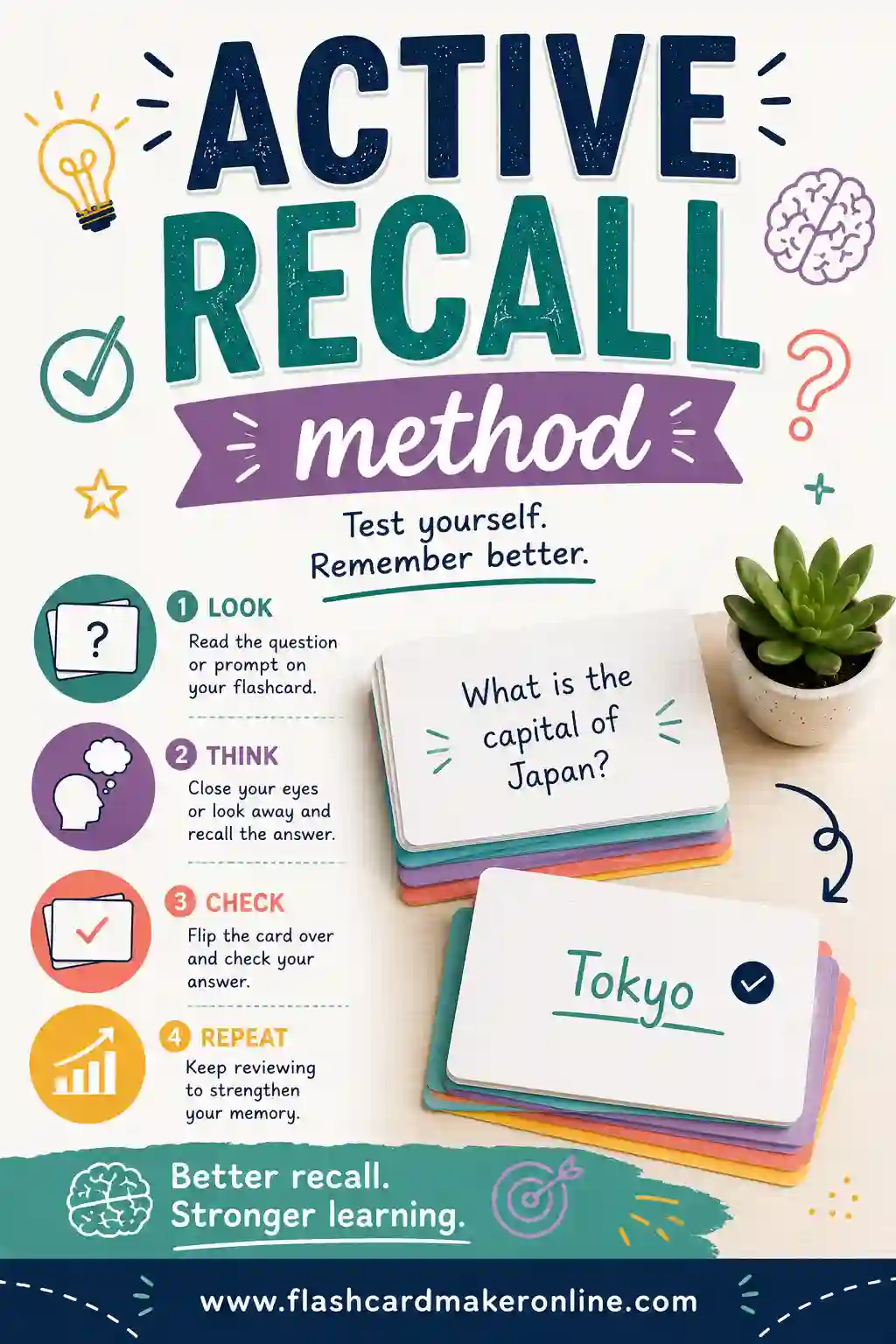
This is the step that makes SQ3R work. Look away and answer your question out loud, or jot a short answer from memory. Then check the book. If you can't explain it, reread just that part. This is a form of active recall, one of the best-tested study habits there is.
5. Review: go over it again, spaced out
After the chapter, answer all your questions again without notes. Then do a quick review the next day and a few days later. Turning your questions into flashcards makes this step easy: the question goes on the front, your answer on the back.
An SQ3R example (one textbook section)
| Step | What it looks like for "The Water Cycle" |
|---|---|
| Survey | Headings: Evaporation, Condensation, Precipitation, Collection. There's a diagram with arrows and a summary box. |
| Question | What is evaporation? What makes clouds form? What counts as precipitation? Where does water go after it falls? |
| Read | Read the Evaporation part and find: water heated by the sun turns into vapor and rises. |
| Recite | Book closed: "The sun heats water in oceans and lakes, and it rises as water vapor." Check: correct. |
| Review | Next day, flashcards: "What is condensation?" / "Water vapor cools and turns into droplets, forming clouds." |
SQ3R notes template
Set up your page like this before you start reading. It works on paper or in a notes app.
| Question (from the heading) | Answer (in my own words, after reciting) | Page |
|---|---|---|
| What is evaporation? | Sun heats water, it turns to vapor and rises | 112 |
| What makes clouds form? | Vapor cools high up and condenses into droplets | 113 |
| What counts as precipitation? | Rain, snow, sleet, hail | 114 |
This layout is close to the Cornell note-taking method, which also puts questions in a side column so you can cover the answers and quiz yourself.
SQ3R vs SQ4R and other reading methods
- SQ4R adds a step, usually "wRite" or "Reflect," after Recite.
- PQ4R (Preview, Question, Read, Reflect, Recite, Review) is a close cousin.
- Blurting is a fast review method: write everything you remember on a blank page, then check. It's a great way to do the Review step. See our blurting method guide.
Common SQ3R mistakes
- Skipping Recite. Reading and then rereading feels productive, but it builds what researchers call an illusion of competence.
- Writing too many questions. One per heading is plenty.
- Doing Review only once. Spread it out: same day, next day, a few days later.
- Using it for everything. SQ3R shines on textbooks and articles with headings. For novels or math problem sets, other methods fit better.
Turn your SQ3R questions into a review deck in the free flashcard maker, and you'll have a ready-made quiz for the test.
Frequently Asked Questions
What does SQ3R stand for?
Survey, Question, Read, Recite and Review: the five steps of a textbook reading method introduced by Francis P. Robinson in 1946.
Is the SQ3R method effective?
Yes, especially the Recite and Review steps, which make you recall information instead of just rereading it. It works best for textbooks and articles with clear headings.
How long does the SQ3R reading method take?
A bit longer than a single read at first, often 10 to 20 extra minutes per chapter. You usually save time later because you need less rereading before a test.
What is the difference between SQ3R and SQ4R?
SQ4R adds a fourth R, usually wRite or Reflect, so you write or connect what you learned before reviewing.
Can I use SQ3R with flashcards?
Yes. Your Question-step questions become card fronts, and your Recite-step answers become the backs, which makes the Review step quick.