US States & Capitals Flashcards: Free to Make & Print
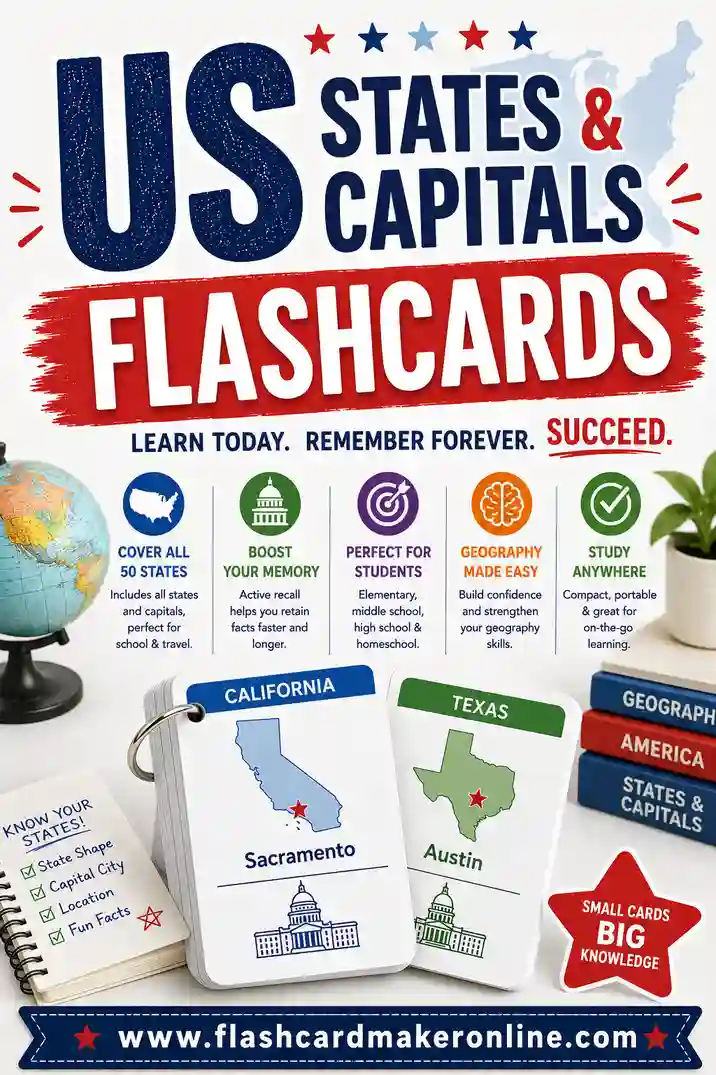
US states and capitals flashcards are two-sided study cards that pair each state with its capital city — "Texas" on the front, "Austin" on the back. You read the state, try to recall its capital, then flip to check. The fastest way to build a set is a free flashcard maker that lets you type the full list, flip through it on screen, and print a clean deck whenever you need one.
Want to start right now? Open the free tool, paste in all 50 states and capitals (the complete list is below), and you'll be flipping through your own cards in under a minute. No sign-up, no app to download, nothing to pay.
What Are States and Capitals Flashcards?
A states and capitals flashcard is about as simple as study tools get. The front holds a state name. The back holds its capital city. You look at "Nevada," say "Carson City," then flip to see if you were right. That's the whole game, and it's remarkably effective.
That small act of flipping does the real teaching. When you force yourself to recall a capital before you check it, your brain works to retrieve it, and retrieval is what makes it stick. This is active recall, and it beats reading the list over and over or singing along to a song once. Flashcards build the recall in by design.
The 50 states and capitals are a classic memorization task, and you can run the deck a few ways:
- State to capital. See "Maine," recall "Augusta." The most common direction.
- Capital to state. See "Pierre," recall "South Dakota." Harder, and great for mastery.
- Find it on a map. Pair each state with its location for a geography boost.
- Capital plus a fact. Add a hook, like "Frankfort, Kentucky — not Louisville."
Why Flashcards Beat a Wall Map
There are plenty of ways to learn the states and capitals, and most of them feel productive while doing almost nothing. Staring at a classroom map, reading the list, listening to the capitals song — these are fine for a first pass but barely move the needle alone. Flashcards work because they make you do the one thing that builds memory: retrieve.
The other half of the secret is timing. You won't lock in all 50 after one look. You need to meet each pair again and again, with growing gaps between reviews. Seeing a state right before you'd forget its capital — spaced repetition — is the most efficient way to move it into long-term memory. A digital deck handles this naturally: flip through, set aside the states you know, and keep drilling the ones you miss.
Five minutes in the morning and five at night will out-teach an hour of staring at a map. The spacing matters more than the total time, and 50 pairs is a perfect size for steady daily review.
The Complete US States and Capitals List
Here's all 50 states with their capitals, ready to drop straight onto cards. Copy any rows — or the whole table — into the flashcard maker to get going.
| State | Capital |
|---|---|
| Alabama | Montgomery |
| Alaska | Juneau |
| Arizona | Phoenix |
| Arkansas | Little Rock |
| California | Sacramento |
| Colorado | Denver |
| Connecticut | Hartford |
| Delaware | Dover |
| Florida | Tallahassee |
| Georgia | Atlanta |
| Hawaii | Honolulu |
| Idaho | Boise |
| Illinois | Springfield |
| Indiana | Indianapolis |
| Iowa | Des Moines |
| Kansas | Topeka |
| Kentucky | Frankfort |
| Louisiana | Baton Rouge |
| Maine | Augusta |
| Maryland | Annapolis |
| Massachusetts | Boston |
| Michigan | Lansing |
| Minnesota | St. Paul |
| Mississippi | Jackson |
| Missouri | Jefferson City |
| Montana | Helena |
| Nebraska | Lincoln |
| Nevada | Carson City |
| New Hampshire | Concord |
| New Jersey | Trenton |
| New Mexico | Santa Fe |
| New York | Albany |
| North Carolina | Raleigh |
| North Dakota | Bismarck |
| Ohio | Columbus |
| Oklahoma | Oklahoma City |
| Oregon | Salem |
| Pennsylvania | Harrisburg |
| Rhode Island | Providence |
| South Carolina | Columbia |
| South Dakota | Pierre |
| Tennessee | Nashville |
| Texas | Austin |
| Utah | Salt Lake City |
| Vermont | Montpelier |
| Virginia | Richmond |
| Washington | Olympia |
| West Virginia | Charleston |
| Wisconsin | Madison |
| Wyoming | Cheyenne |
That's the full set. The trick is that many capitals aren't the biggest or most famous city — Austin, not Houston; Albany, not New York City; Sacramento, not Los Angeles. Those are the pairs to drill the hardest.
Make stronger cards
The back of the card can do more than name the capital. Add a hook for the tricky ones:
- A "not the obvious one" note — "New York → Albany, not NYC."
- A region — group the New England or Mountain states together.
- A memory trick — "Frankfort sounds fancy, like Kentucky's capital."
- A fun fact — the year it became a state or what it's known for.
A card for Nevada might read: "Carson City — the small capital, not Las Vegas or Reno."
How to Make States and Capitals Flashcards in 4 Steps
No special skills needed. Here's the whole process.
- Open the tool. Go to the flashcard maker. Nothing to install.
- Add the pairs. Put the state on the front, the capital on the back. Paste the full 50-row list above in one go.
- Flip and study. Click through your deck, shuffle so you don't memorize the order, and mark the states you miss.
- Print when you want. Print on cardstock for a portable set you can quiz yourself with in the car, before a test, or with a study buddy.
If you learn better on a screen, just keep flipping in the browser. If you like paper, print and cut. The same deck works both ways.
Smart Ways to Study Your States Cards
Making the deck is easy. Studying it well is where the capitals actually stick. A few habits make a big difference.
Study by region
Tackle the 50 in chunks — New England first, then the South, then the Midwest, and so on. Regional batches are easier to hold in your head than a random run through all 50, and they double as a geography lesson.
Flip the direction
Once state-to-capital feels easy, switch to capital-to-state. Seeing "Annapolis" and recalling "Maryland" is harder, and mastering both directions means you truly know the pair, not just the order.
Try the Leitner system
The Leitner system is a structured way to space your reviews using a few boxes or piles:
| Box | What's in it | How often you review |
|---|---|---|
| Box 1 | New and missed states | Every day |
| Box 2 | States you got right once | Every few days |
| Box 3 | States you know cold | Once a week |
Get a card right and it moves up a box; miss it and it drops back to Box 1. The tricky capitals get drilled often, the easy ones get a light touch, and nothing slips through the cracks.
Keep sessions short and frequent
Short daily reps beat long weekly crams every time. Your brain files the pairs away during the gaps between sessions, so spacing your study is doing quiet work even when the cards are closed.
States and Capitals Flashcards for Different Learners
Build your deck around who's studying.
Elementary students
Keep it light and game-like. Start with the home state and a handful of well-known ones, add a map so capitals connect to places, and grow the deck a few states at a time. Small wins keep young learners going.
Middle school and quiz prep
This is the classic "memorize all 50" assignment. Use the full deck, drill state-to-capital daily for a couple of weeks, and put the sneaky pairs — Albany, Sacramento, Pierre — into heavy rotation.
Adults and trivia buffs
Brushing up for a quiz night or just for fun? Run the capital-to-state direction and add a fact to each card. It turns rote memorization into something you'll actually remember at the table.
Building broader knowledge? Pair this with our geography flashcards guide for countries and landforms, presidents flashcards for US leaders, and history dates flashcards for the timeline.
Printable vs. Digital States Cards
Both formats teach the same 50 pairs, so pick the one that fits your routine.
Printable cards are great for screen breaks and for studying anywhere — in the car, in a waiting room, or at the kitchen table with a parent quizzing along. You can hand a stack to a study partner, sort them into "know it" and "don't" piles, and scribble a memory hook on the back as a capital clicks. Print on cardstock so they survive weeks of shuffling.
Digital cards win for fast daily reps. You can shuffle in a tap, mark missed states instantly, and run through all 50 in minutes without spreading paper everywhere. They're perfect for the quick five-minute sessions that actually build memory.
The best plan uses both. Build your deck once in the tool, drill it on screen all week, then print it for a focused review before the test. Same pairs, two formats, zero extra effort.
Common States and Capitals Flashcard Mistakes
A few habits quietly waste your study time. Avoid these and your deck works much harder.
- Assuming the biggest city is the capital. Many aren't. Drill the "not the obvious one" pairs hardest.
- Studying in the same order. Memorizing the sequence isn't learning the pairs. Shuffle every session.
- Taking on all 50 at once. A flood of new cards leads to forgetting. Learn a region, master it, then add the next.
- Only going one direction. State-to-capital alone leaves gaps. Flip to capital-to-state to lock it in.
- Cramming the night before. Pairs crammed in one session fade fast. Spread reviews across the week so they stick.
Frequently Asked Questions
What should I put on a states and capitals flashcard?
Put the state on the front and the capital on the back. For the tricky pairs, add a quick note like "not the biggest city" or a memory hook. A card that shows "New York → Albany, not NYC" saves you from the most common mix-up.
Are these states and capitals flashcards really free to make and print?
Yes. You build and print them yourself at no cost. There's no sign-up and no watermark, so you can make all 50 cards and print a full set on the same free tool.
How many states should I study at once?
Learn them by region — about 6 to 12 states at a time — and review each batch daily before adding the next. Tackling all 50 in one sitting leads to overwhelm. Regional chunks stick far better.
Which states and capitals are hardest to remember?
The ones where the capital isn't the famous city: Austin (not Houston), Albany (not NYC), Sacramento (not LA), Pierre, Carson City, and Frankfort. Put these in heavy rotation and add a memory hook to each.
Should I make my own cards or use a pre-made deck?
Making your own is quick with the full list above, and typing the pairs is itself a first study pass. Pre-made decks save a step, but you'll remember the capitals more deeply when you build the cards yourself. The free tool makes it fast either way.
Ready to Build Your States and Capitals Deck?
Grab the full list above, open the free flashcard maker, and you'll have all 50 states and capitals ready to flip in minutes. It's free, there's no sign-up, and you can study on screen or print a stack to carry with you. Pick a region, start flipping, and you'll have the whole map in your head before you know it.