Christmas Around the World Cards for a Homeschool Unit: Country, Tradition, Greeting
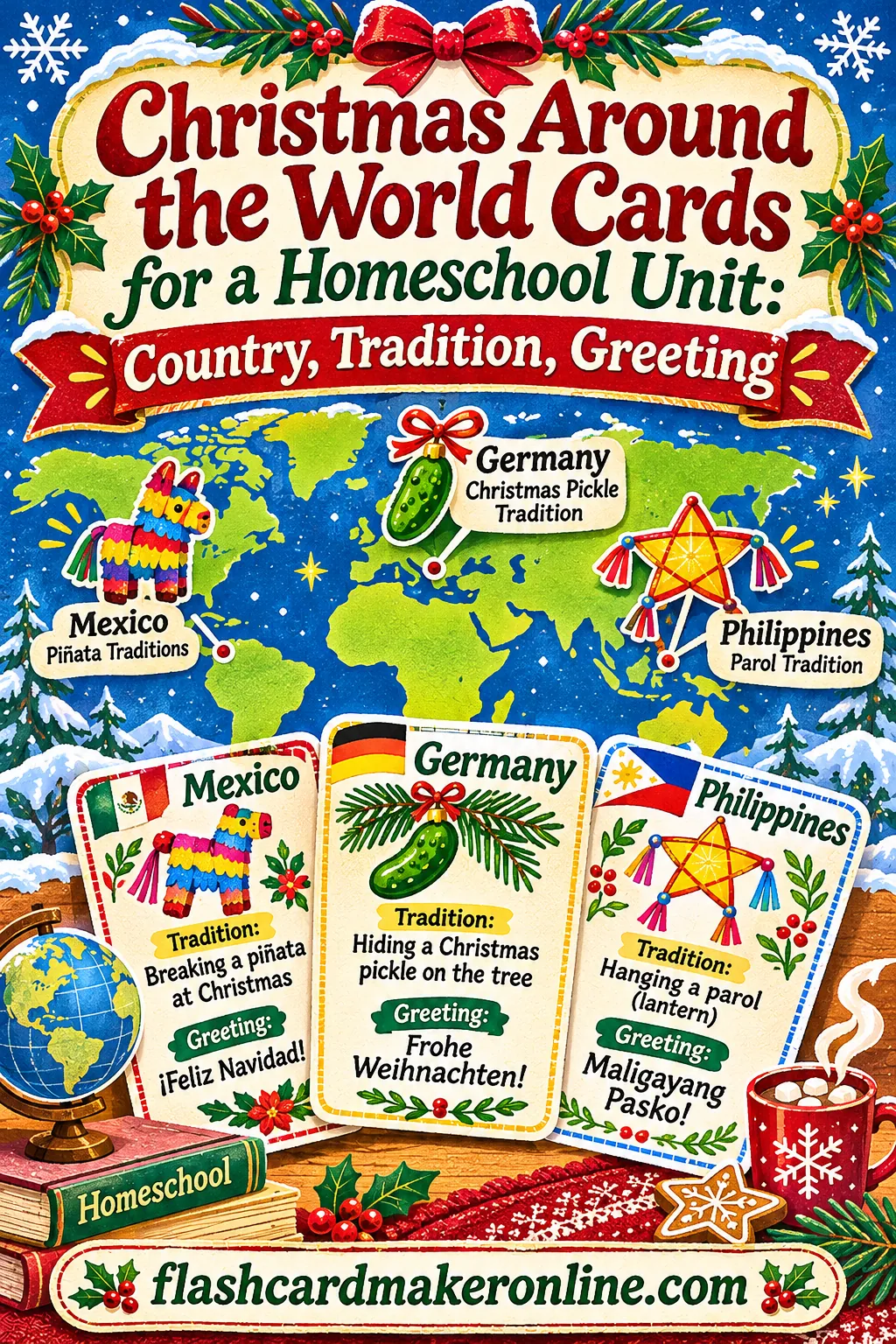
The simplest Christmas around the world activity for a homeschool unit is a set of 10 cards with the country on the front and one tradition plus the local Christmas greeting on the back: study them on screen, then print and cut them into a matching game. You don't need a paid bundle. You can type or paste the whole set into our free flashcard maker in about 10 minutes, quiz your kids by flipping cards on a tablet, and print a matching set on regular paper or card stock.
Below you'll find all 10 countries with a kid-friendly tradition, the greeting and an easy pronunciation guide, exact settings to build and print the deck, a two-week December unit plan, a handful of games that use the same cards, and ways to adjust everything from kindergarten to middle school.
🃏 Quiz yourself: 10 cards from this page
Read the front, say your answer, then tap the card to check.
Make, study & print this deck → Opens the free flashcard maker with all 10 cards ready to edit or print.▶ Open this deck in the flashcard maker
What Goes on a Christmas Around the World Card
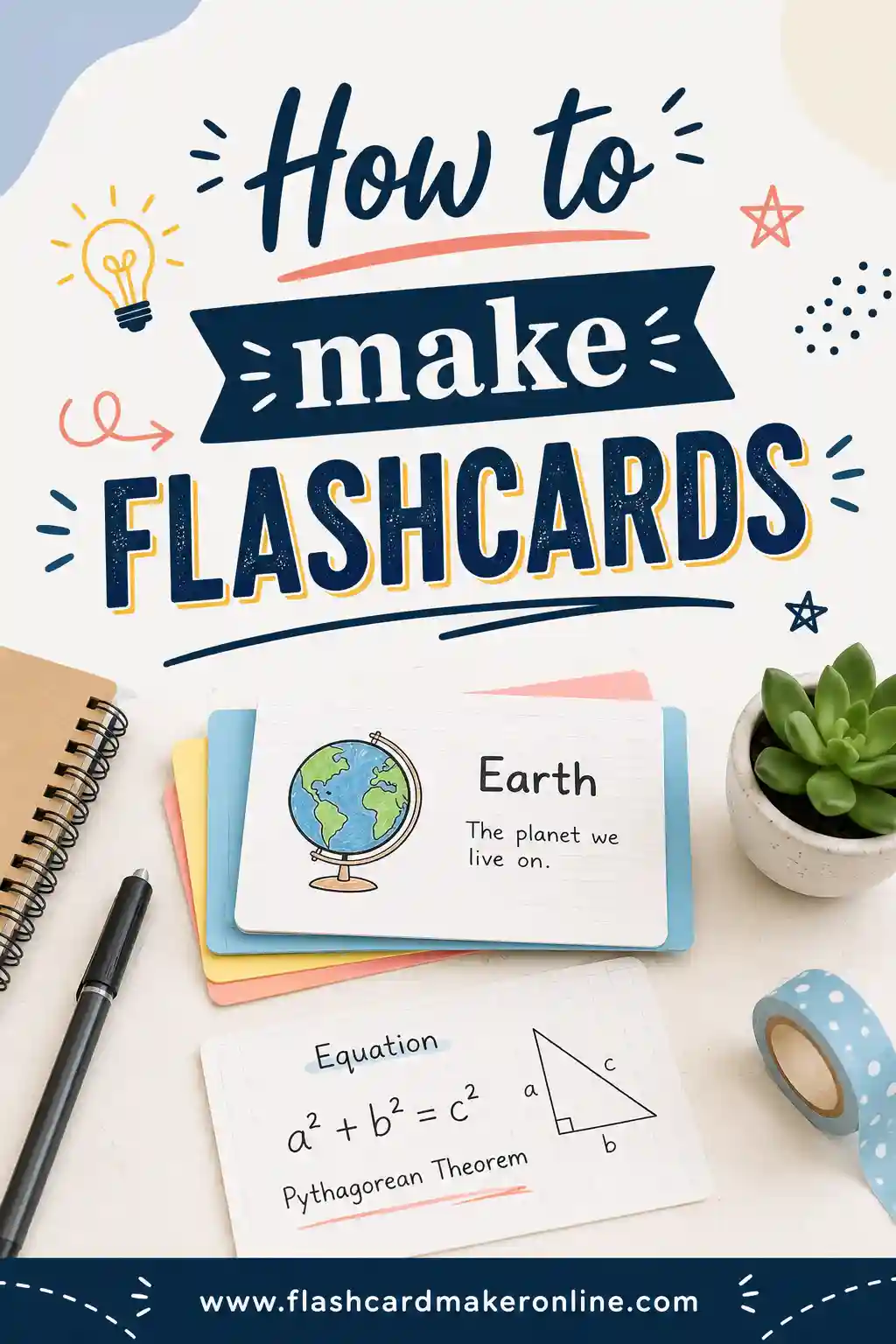
Each card answers three questions: Where? What do they do? What do they say?
- Front: the country name. Add a small flag or map outline if your child is a picture learner.
- Back: one tradition in a single sentence, then the greeting for "Merry Christmas" in that country's main language.
That's it. One tradition per card, not five. A card that tries to cover the food, the decorations, the gift-giver and the church service turns into a paragraph, and kids stop reading paragraphs on flashcards. If you want to teach more about a country, give it a second card (say, "Mexico, food") rather than packing the first one.
Why a three-part card works for a unit study
A unit study lives or dies on connections. When the card links a place to a picture-able tradition and a word kids can say out loud, all three help each other. A child who remembers "the one with the candle crown" can usually get to "Sweden" and "God jul" from there. That's the same reason picture-and-word cards work for vocabulary: two kinds of cues are easier to find than one.
Cards also do double duty. On screen, they're a quick quiz. Printed and cut, the same set becomes a matching game, a "passport" activity, a map activity and a lunch-table conversation starter. Make it once and you'll use it all month.
Pick 8 to 10 countries, not 25
It's tempting to cover the whole globe. Resist it, especially with younger kids. Eight to ten countries is enough to see real variety (summer Christmas, January Christmas, gift-givers who aren't Santa, traditions that start in November) while still being few enough that kids actually remember them. The set below covers four continents, gift-bringers who come on several different dates, and a country that celebrates on January 7.
The 10 Countries: Traditions and Greetings
Here's the full set. Pronunciations are friendly approximations for English speakers, written with the stressed part in capitals. They're close enough for kids to be understood and to have fun with. If you have a native speaker in your life, let them correct you; kids love hearing the real thing.
| Country | Tradition (back of card) | Greeting | Say it like |
|---|---|---|---|
| Mexico | Las Posadas: nine nights of processions, December 16 to 24, acting out Mary and Joseph's search for a place to stay | Feliz Navidad | feh-LEES nah-vee-DAHD |
| Philippines | Simbang Gabi: nine early-morning church services, December 16 to 24, plus glowing star lanterns called parols | Maligayang Pasko | mah-lee-GAH-yahng PAHS-koh |
| Italy | La Befana, a kind old woman on a broomstick, fills children's stockings on the night of January 5 | Buon Natale | bwohn nah-TAH-leh |
| Germany | Advent calendars, an Advent wreath with four candles and outdoor Christmas markets | Frohe Weihnachten | FROH-uh VY-nahkh-ten |
| Netherlands | Sinterklaas brings gifts on the evening of December 5; children leave a shoe out with a carrot for his horse | Vrolijk kerstfeest | VROH-luk KEHRST-fayst |
| Sweden | St. Lucia Day, December 13: a girl in a white gown with a crown of candles brings saffron buns and songs | God jul | goo YOOL |
| Iceland | Thirteen playful Yule Lads visit one at a time on the 13 nights before Christmas; children put a shoe on the windowsill | Gleðileg jól | GLETH-ih-lekh YOHL |
| Poland | Wigilia, the Christmas Eve supper, begins when the first star appears; families share a thin wafer and set an extra place | Wesołych Świąt | veh-SWAH-wikh SHFYONT |
| Ethiopia | Genna is celebrated on January 7; many people wear white and go to church services, some very early in the morning | Melkam Genna | MEL-kahm GEH-nah |
| Japan | Christmas Eve is a fun evening with friends, lights and a strawberry sponge cake; New Year's is the big family holiday | Meri Kurisumasu | meh-ree koo-ree-soo-MAH-soo |
A few notes for the grown-up teaching it:
- "Main language" is a simplification. Many of these countries have more than one language. The Philippines has many regional languages; Maligayang Pasko is Filipino (Tagalog-based). Ethiopia has dozens of languages; Melkam Genna is in Amharic. That's a great talking point for older kids.
- Traditions vary inside every country. These are widely known traditions, not rules everyone follows. Some families in each place celebrate differently or don't celebrate Christmas at all. Saying "many families in Sweden..." keeps it accurate.
- Dates on the Orthodox calendar. Ethiopia's January 7 date comes from the church calendar it follows. Other places, such as many families in Eastern Europe, also celebrate on January 7. You don't have to explain the calendar math to a 6-year-old; "they celebrate later than we do" is plenty.
- Polish spellings. The full greeting is Wesołych Świąt Bożego Narodzenia (Merry Christmas holidays). Kids can learn just the first two words.
Short notes for each card (read-aloud version)
Use these when you introduce a country. Each takes under a minute to read aloud.
Mexico. For nine nights before Christmas, neighbors walk from house to house, often carrying candles, singing and asking for shelter, the way Mary and Joseph did. They're turned away until the last house, where everyone is welcomed in for food and often a piñata.
Philippines. Christmas season in the Philippines is famously long, with decorations going up as early as September. Parols, star-shaped lanterns once made from bamboo and paper, hang in windows and streets. Many families attend nine dawn church services leading up to Christmas.
Italy. Besides Christmas Day, Italian children look forward to Epiphany. The story says La Befana, an old woman with a broom, flies around on the night of January 5 leaving sweets for good children and, as a joke, a lump of "coal" for naughty ones. Many homes also set up a detailed nativity scene called a presepe.
Germany. Many traditions English-speaking families know started or became popular in Germany, including the Advent calendar and the decorated evergreen tree. Towns set up Christmas markets with wooden stalls, lights, ornaments and warm snacks. Many families open gifts on Christmas Eve.
Netherlands. Sinterklaas, a bishop with a red robe and a long white beard, is the big gift-giver here. Children put out a shoe at night with a carrot or hay for his horse, and on the evening of December 5 families exchange gifts, often with funny poems attached.
Sweden. On December 13, in the dark of a northern winter, a girl dressed as Lucia wears a white gown, a red sash and a crown of candles. She leads a procession, singing and handing out saffron buns. Schools and towns hold Lucia processions too.
Iceland. Instead of one Santa, Iceland has 13 Yule Lads, mischievous characters with names that describe their tricks, like the one who licks spoons or the one who slams doors. One arrives each night for the 13 nights before Christmas. Children put a shoe on the windowsill and find a small treat in it, or a potato if they've misbehaved. Many families also give books on Christmas Eve and spend the night reading.
Poland. On Christmas Eve, children watch the sky for the first star, which is the signal that supper can begin. Before eating, family members break and share a thin wafer and wish each other well. An extra place is set at the table for an unexpected guest or a traveler.
Ethiopia. Genna falls on January 7. Many people dress in white, often a traditional thin cotton wrap, and attend church services that can start very early or run through the night. Genna is also the name of a traditional stick-and-ball game played around the holiday.
Japan. Christmas isn't a national holiday in Japan, and most people work or go to school as usual. But cities are full of lights, and Christmas Eve is a popular evening to spend with friends. A white sponge cake topped with strawberries and whipped cream is a favorite Christmas treat. The big family gathering comes a week later, at New Year's.
How to Build the Cards with the Free Flashcard Maker
Here's the exact setup in the free flashcard maker. It runs in your browser, with no account or signup, and your cards save automatically in that browser. That means you can build the deck after the kids are in bed and it'll still be there in the morning.
- Name the deck. In Deck title, type "Christmas Around the World." A clear title helps you tell it apart if you keep several December decks.
- Stay on Make cards. That's the tab that opens first. Each card has a Front and a Back box.
- Click Paste a list. Paste one card per line with a colon between front and back. Here's the whole set, ready to copy:
Mexico : Las Posadas, nine nights of processions from December 16 to 24. Say Feliz Navidad
Philippines : Simbang Gabi dawn church services and parol star lanterns. Say Maligayang Pasko
Italy : La Befana brings gifts on the night of January 5. Say Buon Natale
Germany : Advent calendars, Advent wreaths and Christmas markets. Say Frohe Weihnachten
Netherlands : Sinterklaas brings gifts on the evening of December 5. Say Vrolijk kerstfeest
Sweden : St. Lucia Day on December 13, with candle crowns and saffron buns. Say God jul
Iceland : 13 Yule Lads visit, one each night before Christmas. Say Gleðileg jól
Poland : Wigilia supper starts when the first star appears. Say Wesołych Świąt
Ethiopia : Genna on January 7, and many people dress in white. Say Melkam Genna
Japan : Christmas Eve with friends and a strawberry sponge cake. Say Meri Kurisumasu
- Click Add to deck. You'll get 10 cards. The counter should say 10.
- Check the backs. The paste box splits each line at the first colon (a tab, an equals sign, an en dash, or a hyphen with spaces around it also works as the divider). Because the first divider wins, a colon later in the back text is fine, but a colon or spaced dash inside the front (for example, "Mexico - food") would split the card too early. Keep the front to the plain country name and nothing goes wrong.
Add pictures for younger kids
For pre-readers and early readers, a picture on the front does a lot of the work. Click the Image button on a card's front and add a photo or drawing from your device: a flag, a map outline with the country shaded, or a picture your child drew of the tradition. Images are resized and kept in your browser, never uploaded, and they print with the card. A fun twist is to let your child draw the tradition after you read the note, photograph the drawing, and put it on the back.
Quiz on screen
Open the Study tab. Tap a card to flip it, or use Flip, and move with ‹ Prev and Next ›. Turn on Shuffle once the kids have seen each country once, so they can't just remember the order. The 🔊 Read aloud button speaks the side that's showing, using your device's built-in voice. It's a nice touch for a non-reader working alone. Keep in mind that a device voice won't pronounce every foreign greeting perfectly, so do the greetings out loud together too.
Share it with a co-op or another parent
If you're teaching this in a co-op or swapping lessons with a friend, click Get share link, then Copy link, and send it. Anyone who opens the link gets their own copy to edit. Download .csv saves a backup you can open in a spreadsheet, and Import a file brings a .csv, .tsv or .txt list back in.
Printing a Matching Set
Printing is where these cards really earn their keep in a homeschool. You'll get one set for quizzing and, if you like, one set to cut apart for games.
For flip-and-quiz cards (two-sided)
- Open the Print tab.
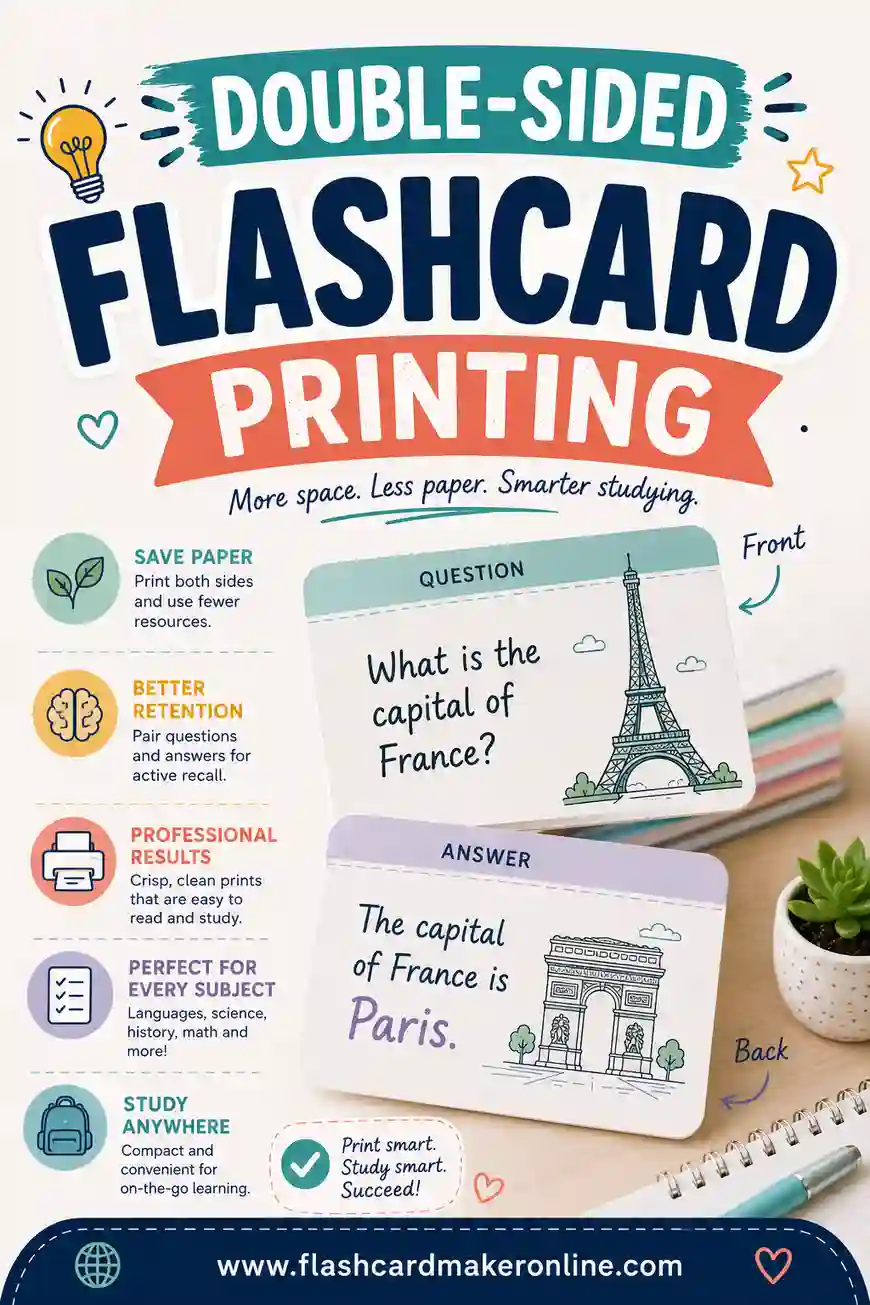
- Under Print layout, choose Double-sided (fronts and mirrored backs for duplex printing).
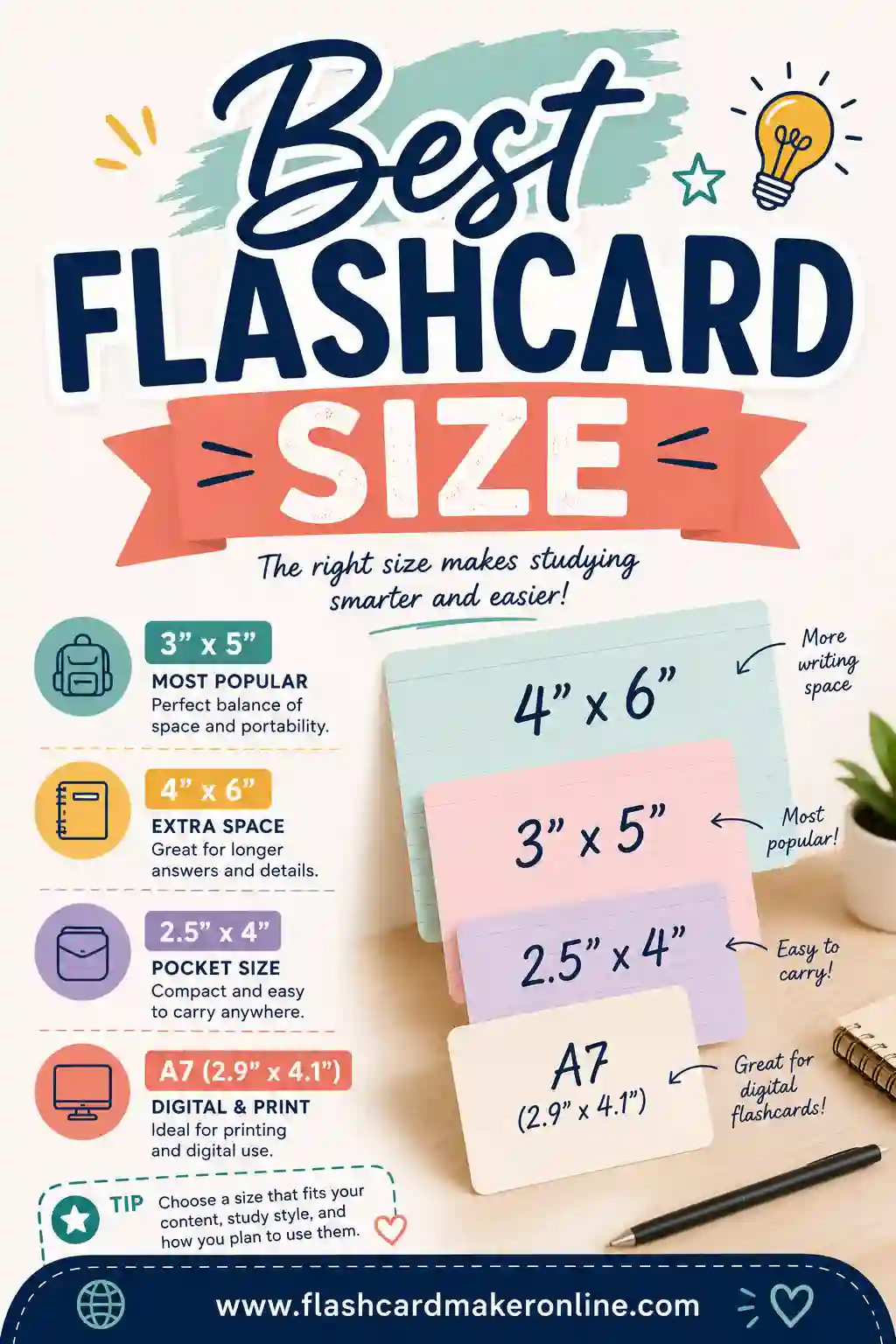
- Under Card size, choose Big (4 per page) for younger kids or Standard (8 per page) for older ones.
- Click Print. Set scale to 100% / Actual size, not "Fit to page."
- Turn on duplex and flip on the long edge. New printer? Use Print a test page first, which prints a two-page check showing which edge to flip on.
The layout mirrors each row of backs, so every tradition lands behind its country when you print duplex. If your printer doesn't do duplex, our guide to double-sided flashcard printing covers manual flipping.
For matching games (one-sided pieces)
- In the Print tab, choose Cut-out grid. This prints the front and back side by side in a bordered grid.
- Pick Standard or Big card size.
- Print, then cut along the light dashed lines. For a matching game, cut each cell down the middle too, so the country and its tradition become two separate pieces.
You now have 20 pieces: 10 countries and 10 tradition-plus-greeting pieces. That's the classic matching activity, made in minutes. Card stock or heavier paper keeps the answers from showing through, and it holds up to small hands for the whole month. Choose Save as PDF in the print dialog if you want to print another set for a sibling or friend later.
How many pages you'll print
| Layout | Card size | Cards per page | Pages for 10 cards |
|---|---|---|---|
| Double-sided | Big | 4 | 3 fronts + 3 backs |
| Double-sided | Standard | 8 | 2 fronts + 2 backs |
| Double-sided | Jumbo | 2 | 5 fronts + 5 backs |
| Cut-out grid | Standard | 8 | 2 to 3 pages |
| Fronts only (country posters) | Jumbo | 2 | 5 |
The Jumbo fronts-only option makes nice country signs for a wall map or for a "station" activity around the house.
A Two-Week December Unit Plan
Here's a plan for 10 school days, about 20 to 30 minutes a day, one country per day. It assumes you introduce the card, read the note, do a quick activity, and review the cards you've already met. Swap days around to fit your calendar; if you want to land on the actual dates, Sweden on December 13 and the Netherlands on December 5 are nice to time on the day itself.
| Day | Country | Introduce | Quick activity (10 to 15 min) | Review |
|---|---|---|---|---|
| 1 | Germany | Card + note | Make a paper Advent wreath or count the days on a homemade Advent calendar | Germany card |
| 2 | Netherlands | Card + note | Write a short, silly rhyming poem to tuck in a gift, Sinterklaas style | Shuffle 2 cards |
| 3 | Sweden | Card + note | Make a paper candle crown; bake or shape simple S-shaped buns with play dough | Shuffle 3 cards |
| 4 | Iceland | Card + note | Invent your own Yule Lad and name him after a trick | Shuffle 4 cards |
| 5 | Poland | Card + note | Look for the first star after dark; set an extra place at dinner and talk about who might need it | Matching game with 5 pairs |
| 6 | Italy | Card + note | Draw La Befana's route on a map of Italy | Shuffle 6 cards |
| 7 | Mexico | Card + note | Act out a short posada: one child knocks and asks, another answers | Shuffle 7 cards |
| 8 | Philippines | Card + note | Make a paper star lantern (parol) from craft sticks or paper | Shuffle 8 cards |
| 9 | Ethiopia | Card + note | Find Ethiopia on the map; talk about why some places celebrate on January 7 | Shuffle 9 cards |
| 10 | Japan | Card + note | Decorate a simple strawberry cake or a paper cake drawing | Full matching game with all 10 pairs |
What a day looks like (25 minutes)
- Review (5 minutes). Shuffle the cards you've already met and flip through them on screen. Kids say the country's greeting before you flip.
- New country (5 minutes). Show the front. Ask what they already know. Flip and read the back. Read the short note aloud.
- Find it (3 minutes). Point it out on a globe or a printed world map. Older kids can name the continent and a neighboring country.
- Do something (10 to 15 minutes). The activity from the table.
- Say it (2 minutes). Everyone practices the greeting three times, then uses it once at lunch or dinner.
If you're also running a geography thread in your homeschool, our geography flashcards pair well with this unit, especially for continents and capitals.
Games and Activities That Use the Same Cards
One printed set can carry the whole unit. Here are activities that work with the cards you just made, most with no extra prep.
Matching (memory) game
Lay the 20 cut pieces face down in a grid. Players take turns flipping two. A country and its own tradition is a match; the player keeps the pair and says the greeting out loud to claim it. Start with 4 or 5 pairs for little ones and work up to all 10.
Passport stamps
Fold a sheet of paper into a small booklet and call it a passport. Each day, after the new country, your child "travels" there: they draw the tradition on a page, write the greeting, and get a stamp or sticker. By day 10, they have a booklet with 10 stamped pages and a souvenir of the unit to show grandparents.
Greeting walk
Spread the country cards (fronts only, or Jumbo fronts) around the house. Call out a greeting, like "God jul!" Kids walk or run to the right country card. Then switch: you point to a country and they shout its greeting. It's a good way to burn energy on a cold day indoors.
Map pin-up
Tape a world map to the wall. As you meet each country, tape its card next to it and draw a string or line from the card to the country. By the end, kids can see that Christmas is celebrated in summer in some places and in deep winter in others, and that the dates don't all line up.
Who brings the gifts?
Sort the cards into two piles: countries with a special gift-giver (the Netherlands' Sinterklaas, Italy's La Befana, Iceland's Yule Lads) and countries where the card is about something else (processions, food, church services, lights). Then line the gift-givers up by date: December 5, the 13 nights before Christmas, and January 5. It's a simple sorting and sequencing activity that sneaks in some calendar practice.
Quick quiz, two directions
On screen, quiz front to back: "What happens in Sweden?" Then flip the deck around in your head and quiz back to front: read a tradition and ask which country it is. Kids who can go both ways really know the material. More ideas like these are in our list of games using flashcards.
Adapting the Unit by Age
The same 10 cards work from kindergarten through middle school. What changes is how much goes on the card and what you ask kids to do with it.
| Age / grade | Card front | Card back | What they do | Unit length |
|---|---|---|---|---|
| Pre-K to K (4 to 6) | Flag or picture + country name | Picture of the tradition + greeting | Matching game with 4 to 5 pairs, say the greeting, color a picture | 5 countries, 1 week |
| Grades 1 to 2 (6 to 8) | Country name + flag | One short sentence + greeting | Full matching game, passport booklet, find on a map | 8 to 10 countries, 2 weeks |
| Grades 3 to 5 (8 to 11) | Country name | Tradition + greeting + date | Quiz both directions, sort gift-givers by date, write a postcard "from" each country | 10 countries, 2 weeks |
| Grades 6 to 8 (11 to 14) | Country name | Tradition + greeting + language name | Research one more tradition per country, compare southern and northern hemisphere Christmas, make a 2-card set per country | 10 to 15 countries, 2 to 3 weeks |
| Mixed ages together | Country name + flag | Tradition + greeting | Older kids read the notes aloud and run the games; younger ones match and shout greetings | 10 countries, 2 weeks |
For older kids: make a second card per country
Middle schoolers can turn the unit into a research project. Each student picks two or three countries and adds a second card for each: food, decorations, or the history behind the tradition. Then they teach their cards to the family. Writing cards in their own words is a learning step in itself, and it gives you a bigger deck for next year.
For multiple kids at different levels
Make one deck for everyone, and change the job, not the cards. The 5-year-old matches pictures, the 8-year-old reads the backs aloud, and the 12-year-old leads the quiz and adds the "date" detail. Everyone is working with the same 10 countries, so dinner conversation can include the whole family. Our page on flashcards for homeschool has more on running one deck across several grades.
Adding More Countries
Once your kids know the first 10, it's easy to add more. Here are well-known traditions you can turn into cards. As always, describe them as "many families" or "in some places," since no tradition is universal.
| Country | Tradition idea for the back | Greeting |
|---|---|---|
| France | A log-shaped cake called a bûche de Noël is a classic Christmas dessert | Joyeux Noël |
| Spain | Three Kings Day on January 6 is a big day for gifts, with parades the evening before | Feliz Navidad |
| Ukraine | Some families hang spider-web ornaments, from a folk story about a spider decorating a poor family's tree | Veselykh Svyat (Merry holidays) |
| Australia | Christmas comes in summer, so many families eat outdoors or head to the beach | Merry Christmas |
| Norway | An old tradition says to hide brooms on Christmas Eve | God jul |
| Brazil | Christmas comes in summer here too, often with a late-night family meal on Christmas Eve | Feliz Natal |
| France (Provence) | Some families serve thirteen small desserts after the Christmas Eve meal | Joyeux Noël |
Southern hemisphere countries like Australia and Brazil are especially useful, because they surprise kids who picture Christmas as snowy. You can make that the theme of a bonus day: "Christmas in summer."
If you want December vocabulary to go with the unit, our Christmas flashcards cover words like ornament, wreath and candle, which are handy for younger kids and English learners.
Common Problems and Quick Fixes
| Problem | Likely cause | Fix |
|---|---|---|
| Part of the country name ended up on the back | The front had a spaced dash or colon, so the paste box split there | Keep the front to the plain country name and paste that line again, or fix the card directly in Make cards |
| Backs print behind the wrong fronts | Printer flipped on the short edge | Flip on the long edge; use Print a test page first to check your printer |
| Cards print smaller than expected | Print dialog set to "Fit to page" | Set scale to 100% / Actual size |
| Kids remember the order, not the countries | Studying in the same order every day | Turn on Shuffle in Study, or shuffle the printed set |
| Little ones can't read the backs | Too much text | Shorten the back to a picture plus the greeting, using the Image button |
| The greeting sounds odd when read aloud | The device voice reads it with English sounds | Practice greetings together using the "say it like" column; let the voice handle the English parts |
| The deck is missing on the tablet | Cards save in the browser they were made in | Open the share link on the tablet to get a copy there |
| Pieces show through the paper | Thin printer paper | Print on card stock, or glue pieces onto index cards |
A note on accuracy
Christmas traditions are living customs, and they vary by region, family and faith. Present the cards as "here's something many people in this country do," not "everyone in this country does this." If your child asks something you're not sure about, look it up together in a library book or an encyclopedia. That's a good research habit, and it's part of a unit study anyway.
Make Your Set Tonight
You don't need a bundle or a printer full of color pages to teach Christmas around the world. Ten good cards, a map and a few greetings to shout at dinner will carry a two-week unit. Open the free flashcard maker, paste in the list above, flip through it once on screen, and print a matching set for tomorrow's lesson. If you'd rather start from your own country list, the same steps work for any set of places, and you can build your next unit in the free flashcard maker the same way.
▶ Open this deck in the flashcard maker
Frequently Asked Questions
What are good Christmas around the world activities for kids?
A matching game with country cards and tradition cards is the easiest place to start. Add a passport booklet with a stamp for each country, a map where kids pin each card to its country, and a greeting game where they shout "Merry Christmas" in each language. One printed card set can run all of them.
How many countries should a homeschool Christmas unit cover?
Eight to ten is a good range for most ages. It's enough to show real variety, including summer Christmases, January celebrations and different gift-givers, while staying small enough to remember. For kindergarten, start with five.
How long should a Christmas around the world unit last?
Two weeks at one country a day works well, with 20 to 30 minutes per day. For little ones, a one-week, five-country version is plenty. Older kids can stretch it to three weeks by researching a second card for each country.
How do I make a printable matching set?
Add your cards in the flashcard maker, open the Print tab, choose the Cut-out grid layout, and print at 100% / Actual size. Cut along the dashed lines, then cut each cell down the middle so countries and traditions become separate pieces.
Are the greetings accurate?
They're the common "Merry Christmas" greetings in each country's main language, with easy pronunciation guides for English speakers. Many countries have more than one language, so other greetings are used too. If you know a native speaker, have them check the pronunciation with your kids.
Can my kids quiz themselves on a tablet?
Yes. The Study tab lets them tap to flip each card, move with Prev and Next, and turn on Shuffle so the order changes. Read aloud speaks the card's text using the device's voice, which helps non-readers.
Do I need to sign up or pay to save the deck?
No. There's no account or signup, and cards save automatically in the browser you made them in. To move the deck to another device, use the share link, or save a PDF from the Print tab.
Which countries celebrate Christmas on January 7?
In this set, Ethiopia celebrates Genna on January 7. Many Orthodox Christians in other countries also celebrate on that date because they follow an older church calendar. It's a good card to include, because it shows kids that not everyone celebrates on December 25.