How to Make Flashcards in Word (and a Faster Free Way)
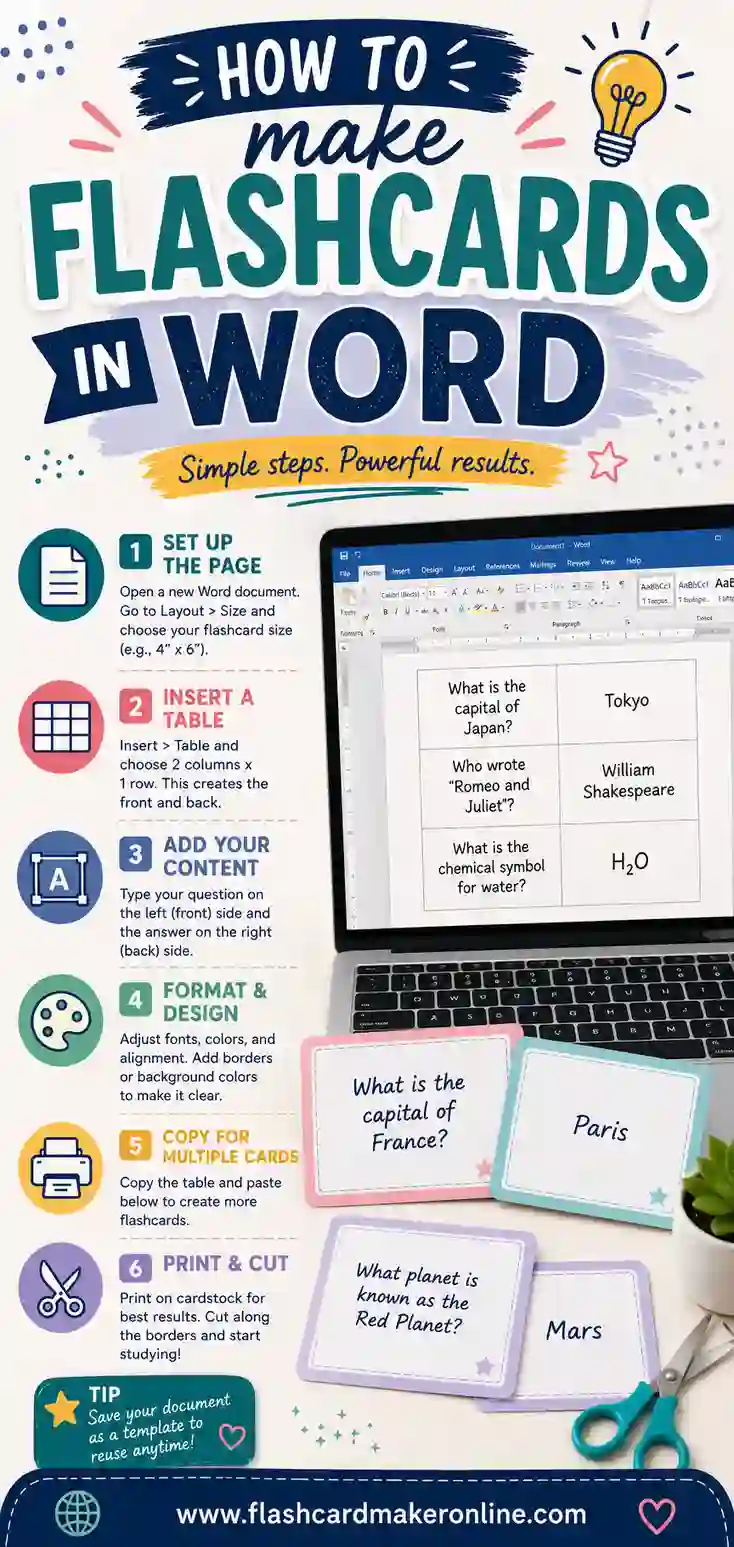
To make flashcards in Microsoft Word, insert a table with cells sized to your card dimensions, type one term per cell, and print. For double-sided cards, use Word's label templates or a second matching table for the answers. It works, but it's fiddly. If you'd rather skip the table wrestling, a free flashcard maker lays out clean, evenly sized cards for you in a fraction of the time.
Short on patience for tables and margins? Open the free flashcard maker, type your terms, and print a tidy, ready-to-cut sheet. No sign-up, no formatting battles.
Can You Make Flashcards in Word?
Yes, Word can make flashcards, and plenty of people do it. The program has tables, label templates, and even mail merge, which are all you need to lay out a deck. If Word is already open and you only need a few cards, it's a perfectly reasonable choice.
The honest catch is that Word wasn't built for this. You'll spend time sizing cells, fixing rows that won't stay put, and lining up backs for double-sided printing. For a handful of cards it's fine. For a big, polished deck, a purpose-built flashcard maker saves real time. We'll show you both paths so you can pick.
Method 1: Make Flashcards with a Table
This is the most common way. You build a grid where each cell is one card.
- Open a new document and set your page to Letter (8.5 x 11) with narrow margins.
- Insert a table. Go to Insert > Table and pick a grid, for example 2 columns by 4 rows, which gives you eight cards at roughly 3 x 5 size.
- Set the cell size. Right-click the table, choose Table Properties, and set a fixed row height and column width to match your card size. Turn off "Automatically resize to fit contents" so cells stay put.
- Type one term per cell. Center the text and bump the font up so it's readable.
- Add cell padding so text doesn't crowd the edges. Table Properties > Options > set the cell margins.
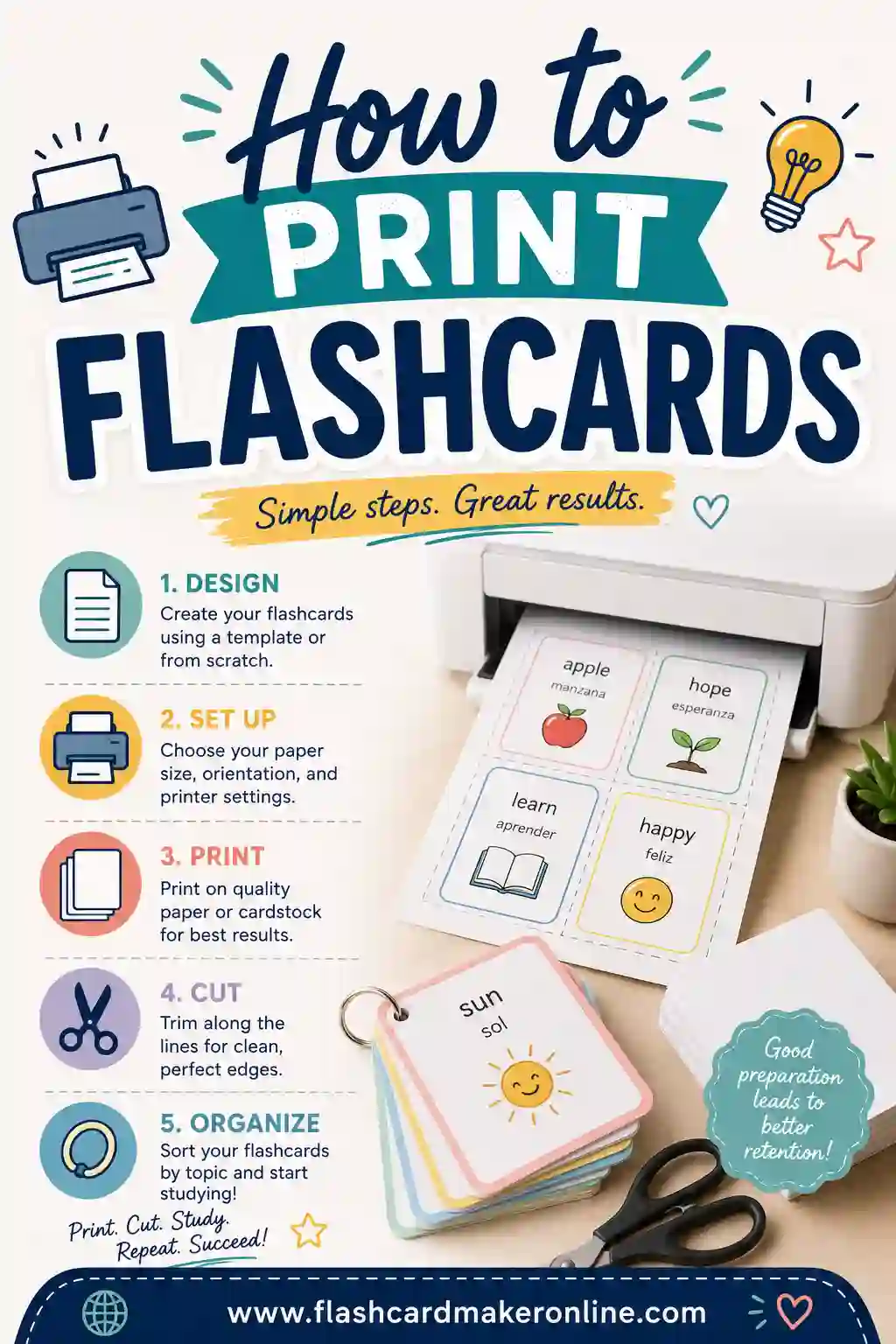
- Print, then cut along the cell borders.
That's a single-sided deck. The font, alignment, and padding are all yours to control, which is the upside. The downside is that every adjustment is manual.
Method 2: Use Word's Label Templates
If you have perforated index-card sheets or label stock, Word's label templates align to them automatically.
- Go to Mailings > Labels (or Mailings > Start Mail Merge > Labels).
- Pick a product number that matches your card or label sheet. Avery makes several card-size templates Word recognizes.
- Word builds a table sized to that product. Now you just type into each card slot.
- Print onto the matching sheet.
This is cleaner than building a table from scratch because the spacing is pre-set. The catch is that you need label stock whose product number Word knows, which not everyone has on hand.
Method 3: Double-Sided Cards in Word
Getting answers on the back is the trickiest part in Word. Here's the reliable approach:
- Build the front table with your terms.
- Add a second page with an identical table for the answers.
- Mirror the order carefully. The top-left answer must match the top-left term, and so on. Many people reverse the column order on the back so it lines up after the flip.
- Print double-sided, choosing "Flip on long edge" for portrait pages.
- Run a test page first to confirm each back sits behind its front.
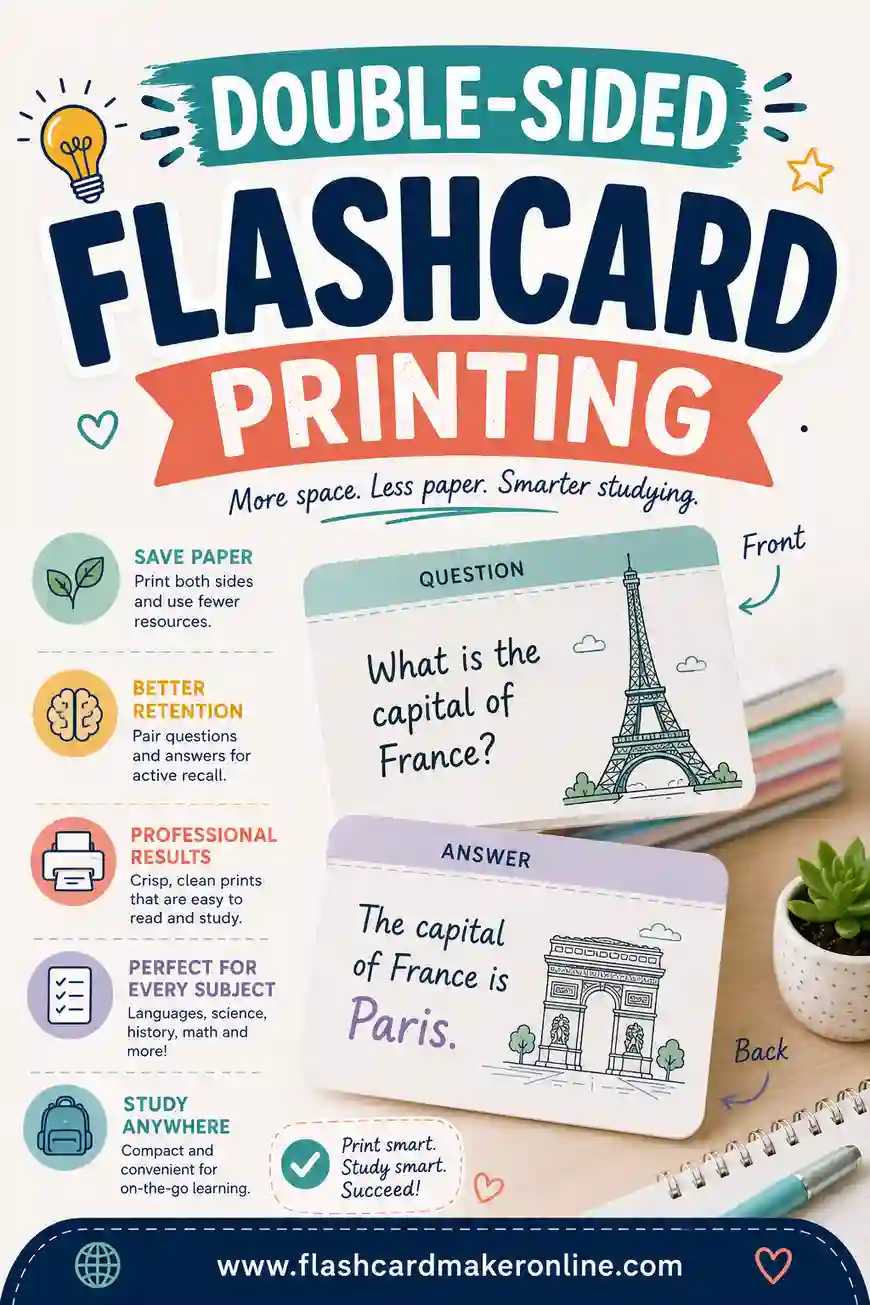
This takes patience and usually a test page or two. If double-sided cards are your main goal, our dedicated guide on double-sided flashcard printing walks through the alignment in depth, and a flashcard maker handles the front-to-back matching for you.
Method 4: Mail Merge for Big Decks
If you already have your terms in a spreadsheet, mail merge can pour them into cards in one move.
- Put your terms and definitions in a spreadsheet, one column each.
- In Word, start a label mail merge and pick a card-size template.
- Insert merge fields for the term (and definition, if you want both on one side).
- Finish the merge to generate a full sheet of cards.
- Print and cut.
Mail merge is powerful for large sets because you don't retype anything. The setup has a learning curve, though, so it's best when you're making hundreds of cards and already keep your list in a spreadsheet.
Word vs. a Dedicated Flashcard Maker
Both get you a printed deck. Here's an honest comparison so you can choose.
| Microsoft Word | Free flashcard maker | |
|---|---|---|
| Setup time | Slow (build and size tables) | Fast (type and go) |
| Even card sizes | Manual, easy to break | Automatic |
| Double-sided alignment | Fiddly, needs test pages | Handled for you |
| Cost | Needs Word | Free, in your browser |
| Best for | A few cards, full font control | Clean decks of any size, fast |
Word makes sense when you want total control over fonts and design, or you only need a handful of cards. A flashcard maker wins when you want a clean, even deck quickly and don't want to babysit a table. Many people use Word once, hit the formatting pain, and switch.
Sample Deck: A 20-Card Set to Build
Here's a science vocabulary set you can drop into either Word or the tool.
| Term | Definition |
|---|---|
| Atom | The smallest unit of an element |
| Molecule | Two or more atoms bonded together |
| Cell | The basic unit of life |
| Photosynthesis | How plants turn light into energy |
| Gravity | The force that pulls objects together |
| Energy | The capacity to do work |
| Element | A pure substance made of one kind of atom |
| Compound | A substance made of two or more elements |
| Ecosystem | A community of living things and its environment |
| Evolution | Change in species over generations |
| Mitosis | Cell division that makes two identical cells |
| DNA | The molecule that carries genetic code |
| Force | A push or pull on an object |
| Mass | The amount of matter in an object |
| Velocity | Speed in a given direction |
| Density | Mass divided by volume |
| Acid | A substance with a pH below 7 |
| Base | A substance with a pH above 7 |
| Friction | The force that resists motion between surfaces |
| Inertia | An object's resistance to a change in motion |
| Atom number | The count of protons in an atom |
| Solute | The substance that dissolves in a solution |
| Solvent | The substance that does the dissolving |
| Catalyst | A substance that speeds up a reaction |
Twenty-four cards like these fit on a few pages. In Word, you'd build a table and type each one in; in the tool, you paste the list and it lays them out for you.
Tips for Better Word Flashcards
If you stick with Word, a few tweaks make the result cleaner:
- Turn off auto-resize. Lock your row height and column width so cells don't grow as you type.
- Center everything. Center text horizontally and vertically in each cell for a tidy look.
- Use a big, simple font. Something like 18–24 pt Arial reads well across the room.
- Add light cell borders as cut guides, or turn borders off and use the table gridlines just on screen.
- Save a template. Once you size one table nicely, save it so you don't rebuild it next time.
These cut down the busywork, though they won't fully erase the formatting fiddliness that comes with the territory.
The Word Headaches Nobody Warns You About
If you've made cards in Word before, some of these will sound familiar. Knowing them ahead of time saves a lot of frustration.
- Rows that grow on their own. Type a long definition and the cell stretches, shoving every card below it out of alignment. The fix is locking row height, but it's easy to forget until the page is a mess.
- The table that won't break cleanly across pages. A row can split awkwardly at a page edge, leaving half a card at the bottom and half at the top. You end up nudging spacing by hand.
- Backs that drift on the second page. Your front table and answer table look identical on screen, but tiny margin differences mean they don't line up once printed.
- Fonts that shift between computers. Open the file on another machine and the spacing changes, throwing off your sizes. This bites people who build at home and print at school.
None of these are dealbreakers, but together they're why a quick "I'll just use Word" can turn into an hour of fiddling. A flashcard maker sidesteps all four because the layout is fixed for you.
When Word Really Is the Right Tool
This guide is honest about Word's friction, but it genuinely shines in a few cases, and it's worth knowing them.
You need heavy custom design
If you want a specific font, a logo, colored headers, or a particular layout per card, Word gives you full control that a simple maker doesn't. For a polished classroom handout where look matters, that control is the point.
You're only making a handful
For five or ten cards, the table setup is quick and you skip learning any new tool. When the deck is tiny, Word's overhead barely registers.
Your content already lives in Word
If your terms are already typed up in a Word document, building the table right there saves a copy-paste step. Sometimes the fastest path is the one that's already open.
The rule of thumb: Word wins for small, design-heavy, one-off decks. A dedicated maker wins the moment you want a clean, even deck of any real size, fast.
A Faster Word Workflow: Build Once, Reuse Forever
If you're committed to Word, the single best time-saver is to stop rebuilding from scratch. Set up one table exactly the way you like it: right card size, locked rows, centered text, your chosen font and padding. Then save that document as a template.
Next time you need cards, open the template, clear the old text, and type the new terms straight into the ready-made grid. All the sizing and alignment work is already done. You go from a blank page and twenty minutes of setup to just typing your content. It's the closest Word gets to the type-and-go speed of a dedicated tool, and it pays off every deck after the first.
Frequently Asked Questions
How do I make flashcards in Microsoft Word?
Insert a table sized to your card dimensions (for example 2 columns by 4 rows for 3 x 5 cards), turn off auto-resize so cells stay fixed, type one term per cell, add cell padding, and print. For double-sided cards, build a matching answer table on a second page and print with "Flip on long edge."
Is there a flashcard template in Word?
Yes. Word's label templates (Mailings > Labels) include card-size options, and Avery sells card stock with product numbers Word recognizes. You can also search Word's online template gallery for flashcard templates, then type your terms into the preset layout.
How do I make double-sided flashcards in Word?
Create one table for the terms and a matching table on a second page for the answers, keeping the order aligned (often reversing the column order on the back so it lines up after the flip). Print double-sided with "Flip on long edge," and run a test page first to check alignment.
What is the easiest way to make flashcards?
The fastest way is a free flashcard maker: you type your terms and definitions, choose a size, and it lays out clean, evenly sized cards ready to print and cut. It skips the table sizing, padding, and back-alignment work that makes Word slow.
Can I make a lot of flashcards at once in Word?
Yes, using mail merge. Put your terms and definitions in a spreadsheet, start a label mail merge in Word, insert the merge fields, and generate a full sheet of cards in one step. It has a setup curve but saves retyping for large decks.
Why do my flashcard cells keep resizing in Word?
By default, Word tables auto-resize to fit their contents, so a long definition stretches the cell and pushes everything out of alignment. To fix it, right-click the table, open Table Properties, and turn off "Automatically resize to fit contents," then set a fixed row height and column width. That locks every cell to your card size.
Can I save a flashcard template in Word to reuse?
Yes, and you should. Set up one table with your size, locked rows, font, and padding exactly right, then save the document as a template. Next time, open it, clear the text, and type new terms into the ready-made grid. You skip all the setup and only type your content, which is the biggest time-saver in Word.
Ready to Make Flashcards the Fast Way?
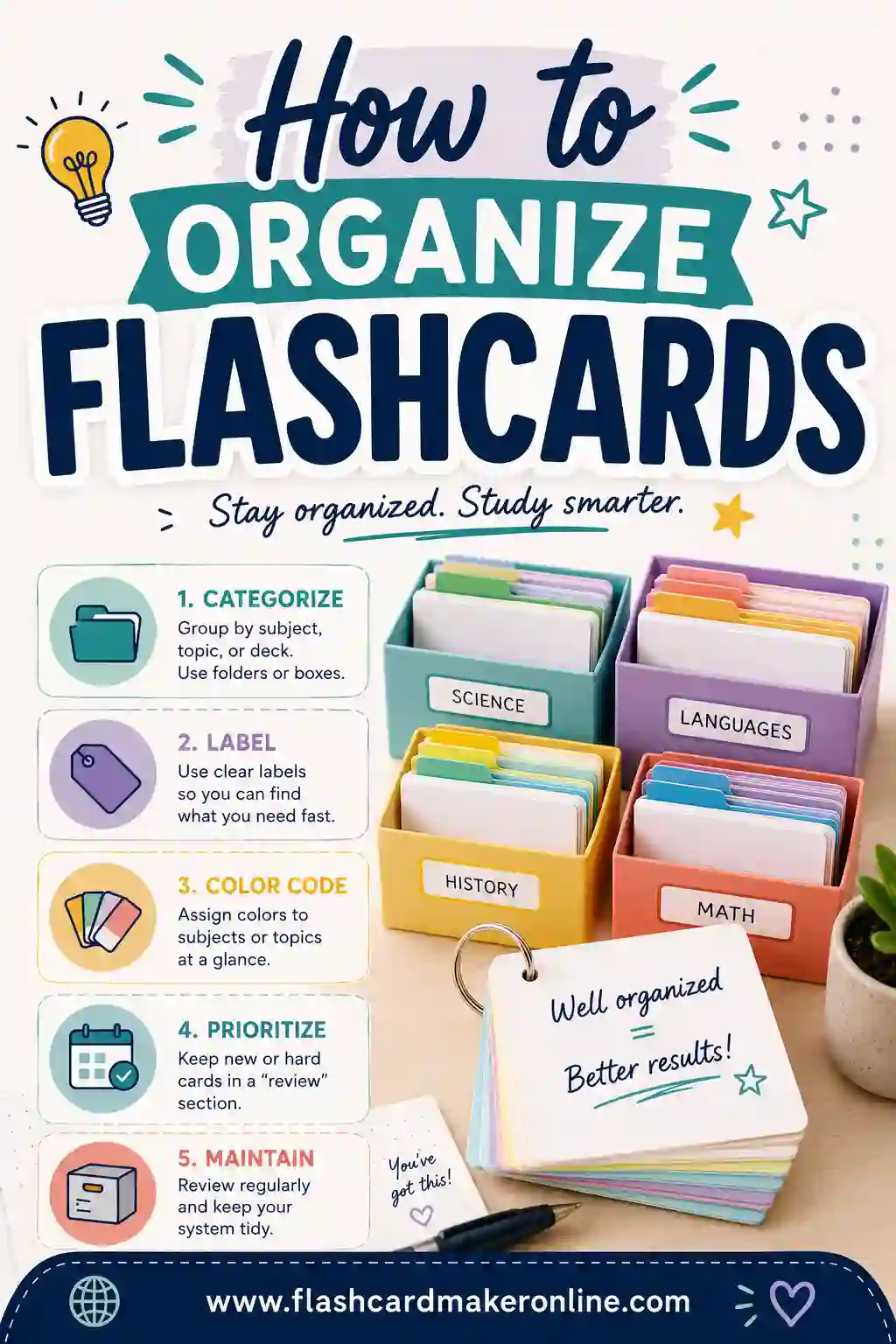
Word can absolutely make flashcards with tables, label templates, or mail merge, and it's worth knowing if you want full control over the design. But if you'd rather skip the sizing, padding, and back-alignment work, there's a quicker path. Open the free flashcard maker, type your terms, pick a size, and print a clean, ready-to-cut deck in minutes. It's free, there's no sign-up, and you can reprint anytime. For more, see our guides on how to print flashcards and how to organize flashcards.