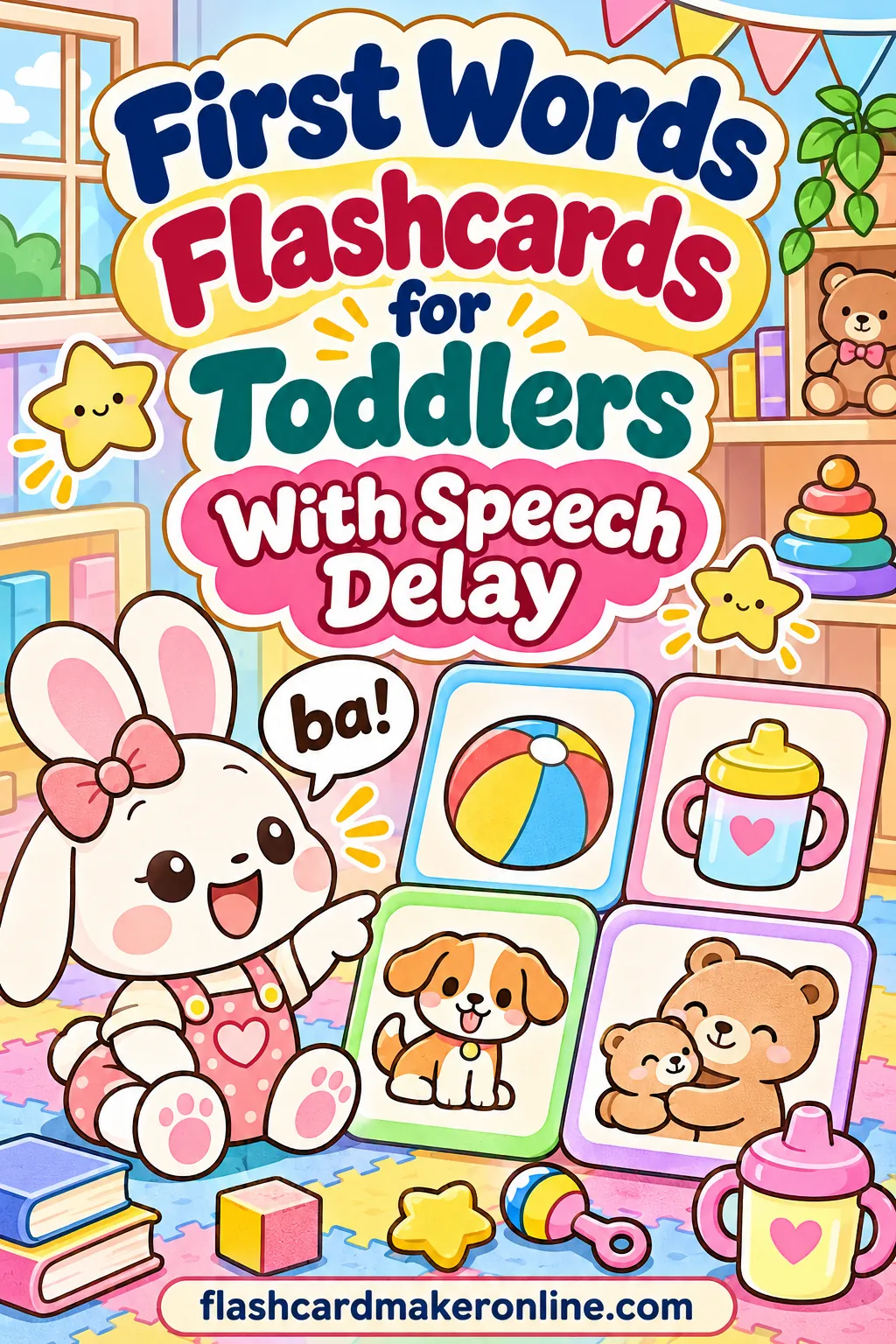
First Words Flashcards for Toddlers With Speech Delay
The best first words flashcards for a late talker show real photos of things from your child's own day, like their cup, their dog, and Grandma, and you use just 3 to 5 cards at a time inside play, not as a quiz. Pick words your toddler already cares about, favor easy early sounds like m, b, p and d, and mix in a few action words such as up, go and more. You can build and print a deck like that in a few minutes with our free flashcard maker, no account needed.
This guide walks you through which words to choose, how to photograph them, how to run short, playful card sessions, and how to print sturdy cards little hands can grab. You'll also find a full 60-word starter list you can paste straight into the maker.
One note before we start. Flashcards are a support, not a treatment. If you're worried about your child's speech, talk with your pediatrician and ask about an evaluation with a speech-language pathologist (SLP). If your child already sees an SLP, follow their plan first and use this guide to make practice at home easier. Bring your cards to a session and ask how they'd like you to use them.
🃏 Quiz yourself: 12 cards from this page
Read the front, say your answer, then tap the card to check.
Make, study & print this deck → Opens the free flashcard maker with all 12 cards ready to edit or print.▶ Open this deck in the flashcard maker
Why First Words Flashcards Can Help a Late Talker
A toddler who isn't talking much yet still understands a lot. Many late talkers point, pull you by the hand, and know exactly where the snacks live. What they need is lots of chances to hear a word at the moment it matters to them, and a low-pressure way to try saying it.
Good first-word cards give you that. Here's why they're useful at home:
- They slow you down. A card in your hand reminds you to say one clear word, then wait. That pause is where a lot of talking starts.
- They make words visible. A photo of the real object helps your child connect the sound "ball" to their own red ball, not a cartoon one.
- They travel. A small stack fits in a diaper bag, a car door pocket, or on the fridge, so practice happens in short bursts all day.
- They help everyone use the same words. When grandparents, sitters, and daycare staff see the cards, they can model the same simple words you do.
- They track progress. It's easy to see which cards your child now names, signs, or points to, and which ones are still new.
What cards won't do is replace everyday talk. The magic is in the back-and-forth, not the card itself. Think of each card as a reason to play for a minute and say one word many times.
What "late talker" usually means
People use "late talker" in different ways. In general, it describes a toddler whose spoken words are behind what's typical for their age, often while other skills like play and understanding seem on track. Only a professional can tell you whether your child has a speech or language delay and what kind. Use the word list here as a starting point, not as a checklist your child has to pass.
How to Choose Your Child's First Words
The words on a typical "first 50 words" list are popular for a reason: kids say them early because they're useful, they come up every day, and many are easy to pronounce. But the best list for your child is the one built from their life.
Use these five filters when you pick words.
1. Pick words your child wants
Motivation beats everything. If your toddler lights up for trains, "train" and "choo choo" belong in the deck. If they ask for bubbles with their whole body, "bubbles" goes in. A word your child wants to use is a word they'll try to say.
2. Pick words that happen every day
Words tied to daily routines get practiced without extra effort. Think about meals, bath, diaper changes, getting dressed, going outside, and bedtime. Each routine gives you a handful of natural word chances.
3. Favor early, easy sounds
Many toddlers find some sounds easier than others early on. Sounds made with the lips, like m, b, p and w, are often among the first. Sounds like d, n, t and h often show up early too. Short words with simple shapes, like "ma," "bye," "up," or "bubba," are easier to try than long words with tricky blends.
That doesn't mean you have to skip harder words. "Dog" is fine even if it comes out "da" for now. Your SLP can tell you which sounds to target for your child.
4. Mix in a few action words
Toddlers need more than names of things. Words like "up," "go," "more," "open," "eat," and "help" let your child ask for something and make things happen. These little power words often get used more than nouns because they work in so many places.
5. Include social words and people
"Hi," "bye-bye," "mama," "dada," a sibling's name, and the family pet's name are often among the first words kids say. They're connected to the people your child loves, which makes them extra motivating.
A quick way to build your list
Grab a notebook for one day and write down:
- Every food or drink your child asks for (by pointing or reaching).
- Every toy they choose on their own.
- Every person and pet they see.
- Every routine you do together.
- Every time they want something to happen again, like a song, a tickle, or a push on the swing.
By bedtime you'll have far more than enough words. Circle the 20 that come up most. That's your first deck.
The starter first words list (60 words by category)
Here's a starter list grouped the way many early-word handouts are: people, food, toys, animals, body parts, clothing, actions, and social words. Swap in your family's own words wherever you can. If your child calls milk "baba," your card says "baba."
| Category | Words |
|---|---|
| People | mama, dada, baby, (sibling's name), (grandparent's name), (pet's name) |
| Food and drink | milk, water, juice, cracker, banana, apple, cookie, cheese |
| Toys and play | ball, bubbles, car, book, block, baby doll, train, blanket |
| Animals | dog, cat, cow, duck, fish, bird, pig, horse |
| Body parts | nose, eyes, mouth, feet, hands, belly |
| Clothing | shoe, sock, hat, coat |
| Actions and requests | up, down, go, more, open, eat, help, all done, stop, push |
| Social words | hi, bye-bye, yes, no, uh-oh, night-night |
| Places and things | bath, bed, cup, spoon |
That's 60 words, enough to cover the most common "first 50 words" ideas plus room for personal swaps. You won't use all of them at once. Start with 10 to 20 and keep the rest in a backup pile.
Sounds to watch for
If you'd like to lean on early sounds, this table groups starter words by the first sound. It's a handy way to spot easy wins.
| Starting sound | Example words |
|---|---|
| m | mama, milk, more, mouth |
| b | ball, baby, bubbles, bath, banana, bye-bye, book, bed |
| p | push, pig, up (ends in p), apple |
| d | dada, dog, duck, down, done |
| n | nose, no, night-night |
| h | hi, hat, help, horse |
| w | water, wave |
Notice how many of the best early words start with b or m. That's one reason "ball," "baby," "bubbles," and "more" show up on so many first-word lists.
Use Real Photos, Not Clip Art
For toddlers, especially late talkers, real photos of real things usually make the clearest cards. A cartoon dog with a giant head and purple fur doesn't look much like the dog that sleeps on your couch. A photo of your actual dog does.
Here's how to get good card photos with just your phone.
Photo tips for clear cards
- One thing per photo. Put the cup on a plain table or floor. Clear away other toys so your child knows exactly what the card means.
- Plain background. A white sheet, a blank wall, or a solid-color rug works great.
- Fill the frame. Get close so the object takes up most of the picture.
- Good light. Daylight near a window beats a dim lamp. Turn off the flash if it causes glare.
- Use your child's own stuff. Their sippy cup, their shoes, their stuffed bunny.
- Take people photos at face level. A smiling close-up of Grandma is easier to recognize than a group shot.
When to use a stock picture
Some words are hard to photograph at home, like "cow" or "horse" if you live in the city. For those, use a clear, realistic picture. Our animal flash cards and farm animal flash cards pages cover picture decks for exactly these words, and the maker's Animals with Pictures and Farm Animals presets give you a quick head start.
Action words need action photos
Verbs are trickier to show in a still photo. A few ideas:
- Up: your child with arms raised, or a photo taken from the floor looking up at a ball in the air.
- Go: a toy car on a ramp, or your child at the top of a slide.
- Eat: your child with a spoon at their mouth.
- Open: a hand on a half-open snack container or door.
- More: two crackers next to one cracker, or the sign for "more" if your family uses it.
- All done: an empty plate, or hands up and out in the "all done" sign.
Photos of your own child doing the action are often the most motivating of all. Kids love seeing themselves.
How to Build This Deck in the Free Flashcard Maker
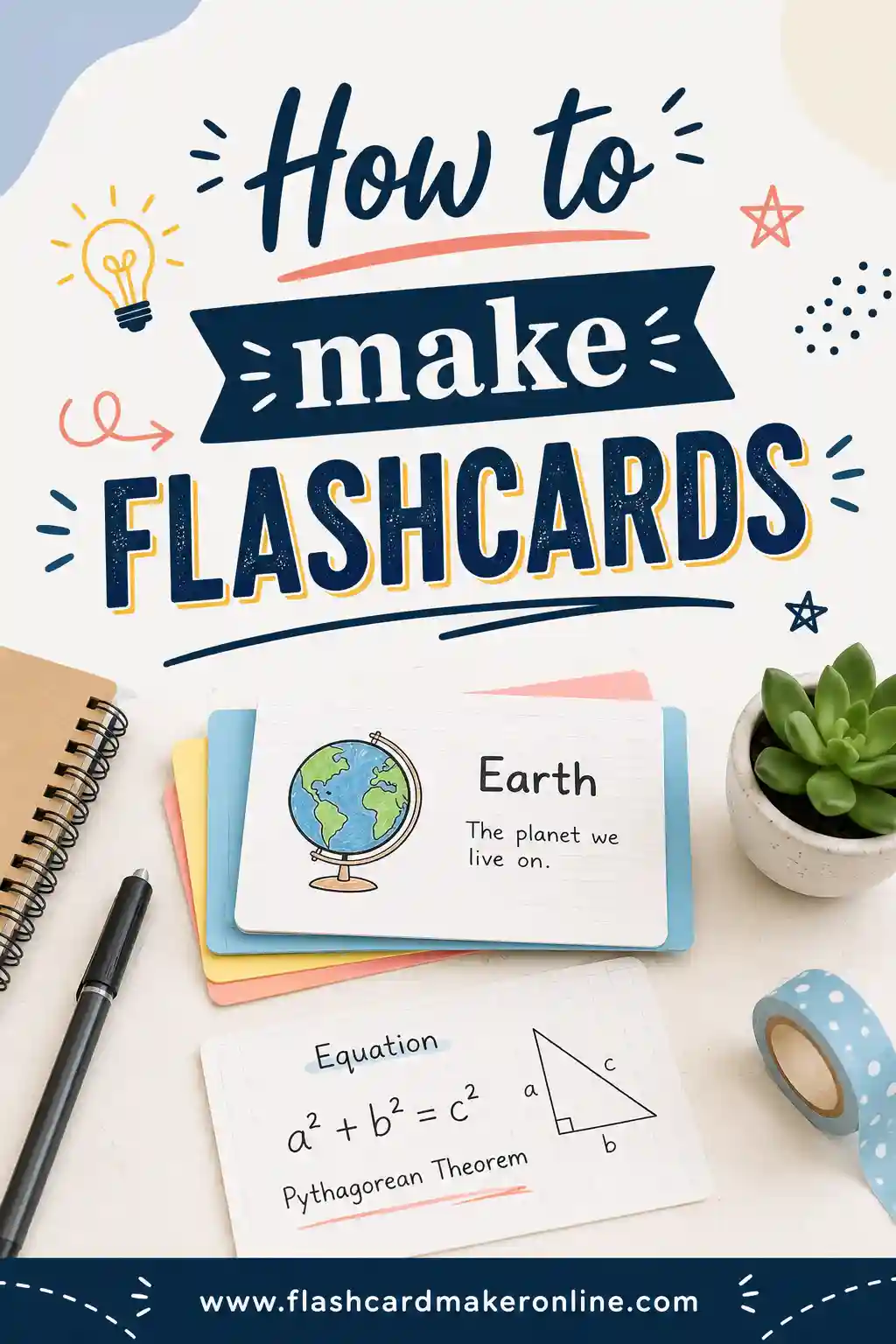
You can make a full first-words deck in one sitting with the flashcard maker on our homepage. It's free and there's no account to set up. Here's the exact process.
Step 1: Start a deck
Open the maker and type a deck title, like "Leo's First Words" or "Breakfast Words." Small, themed decks are easier to manage than one huge pile, so you may end up with a few: "Snack Words," "Bath Words," "People We Love."
Step 2: Load a preset or paste your list
You have two quick options:
- Use a preset. Under "Start from a preset," choose First Words. It loads a ready-made set of common early words you can edit. The Animals with Pictures and Farm Animals presets are handy for animal cards, and Colors & Shapes works later when your child is ready for describing words.
- Paste a list. Click Paste a list and type one card per line in
front : backformat. For toddler cards, the front is the word your child sees and hears, and the back can hold a play tip for the grown-up. Then choose Add to deck (keeps what's there) or Replace deck (starts fresh).
Here's a sample you can paste as-is:
ball : Roll it back and forth. Say ball each time.
more : Give one bite at a time. Say more before the next.
up : Arms up, pause, then say up as you lift.
bubbles : Blow once, pause, wait for any try.
mama : Point to Mom in a photo and say mama.
dog : Show your dog. Add woof woof.
bye-bye : Wave at the door. Wave first, then say it.
milk : Hold up the cup. Say milk, then hand it over.
go : Ready, set... pause for go.
shoe : Name it as it goes on and as it comes off.
If you'd rather keep the back side simple, just repeat the word, like ball : ball. Then both sides show the word and you can print fronts only.
Step 3: Add your photos
This is the step that makes your deck feel like your child's own. Add a picture to each card using the photos you took. Put the photo on the front so your child sees the object and the word together. Keep the word short and in lowercase letters, which tends to match how kids see words in books later.
Use + Add card for any extra words that pop up, like a new favorite toy or a cousin's name.
Step 4: Try it in Study mode
Before you print, flip through the deck in Study mode. You can Shuffle, move with Prev and Next, and Flip to see the back. The 🔊 Read aloud button says the card text out loud, which is a nice way for a toddler to hear a word in a different voice. Just keep it short. Your own voice, face, and excitement still matter most.
Study mode on a tablet or laptop can also be a quick "look at the picture" game on the couch. Hold the screen at your child's eye level, show one card, say the word, and wait.
Step 5: Print sturdy cards
Toddler cards get grabbed, bent, chewed, and dropped in the bath. Big cards and thick paper help a lot. In the Print options:
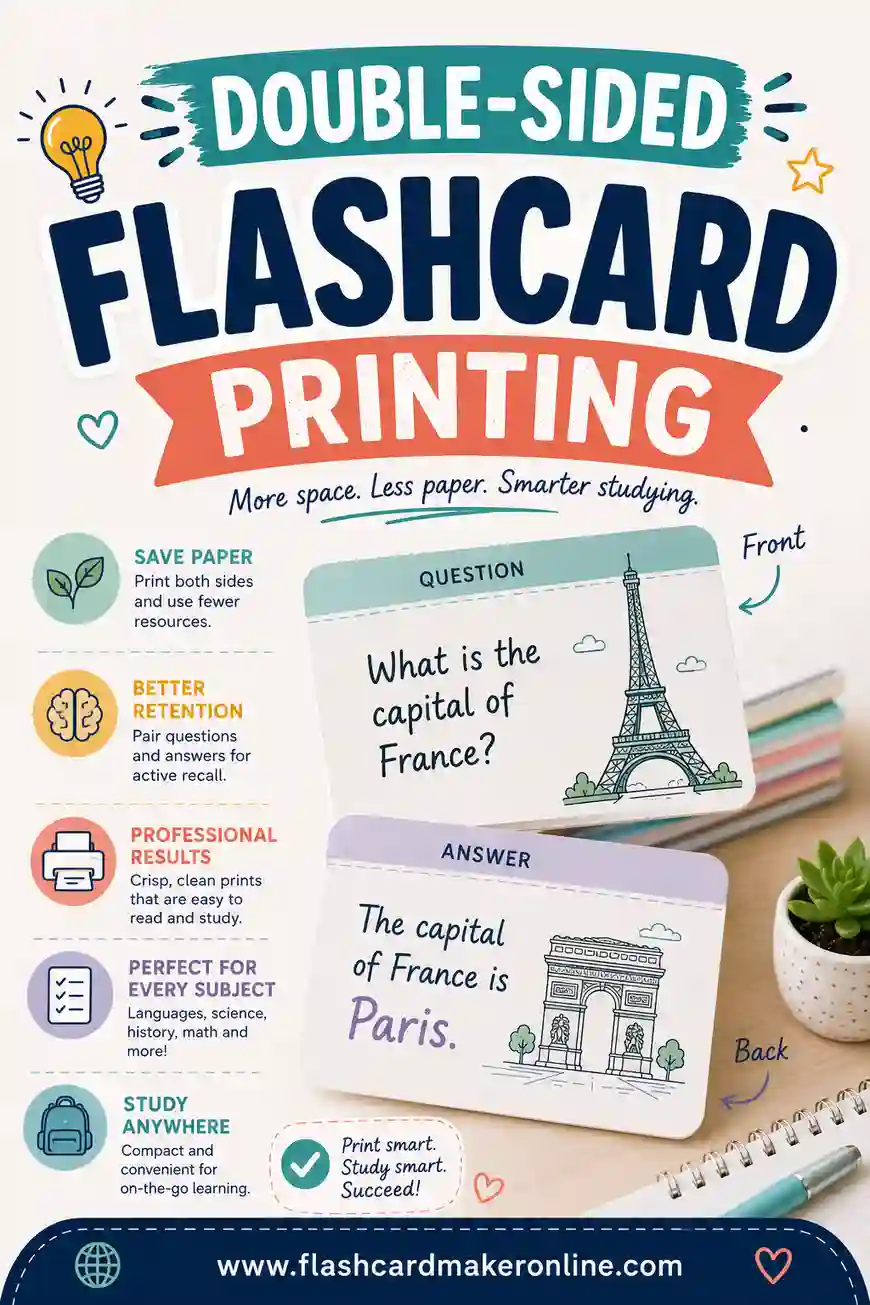
- Layout: Choose Fronts only if you just want the picture and word. Choose Double-sided if you wrote play tips on the back. Double-sided lines up the front and back so they match when you flip the page.
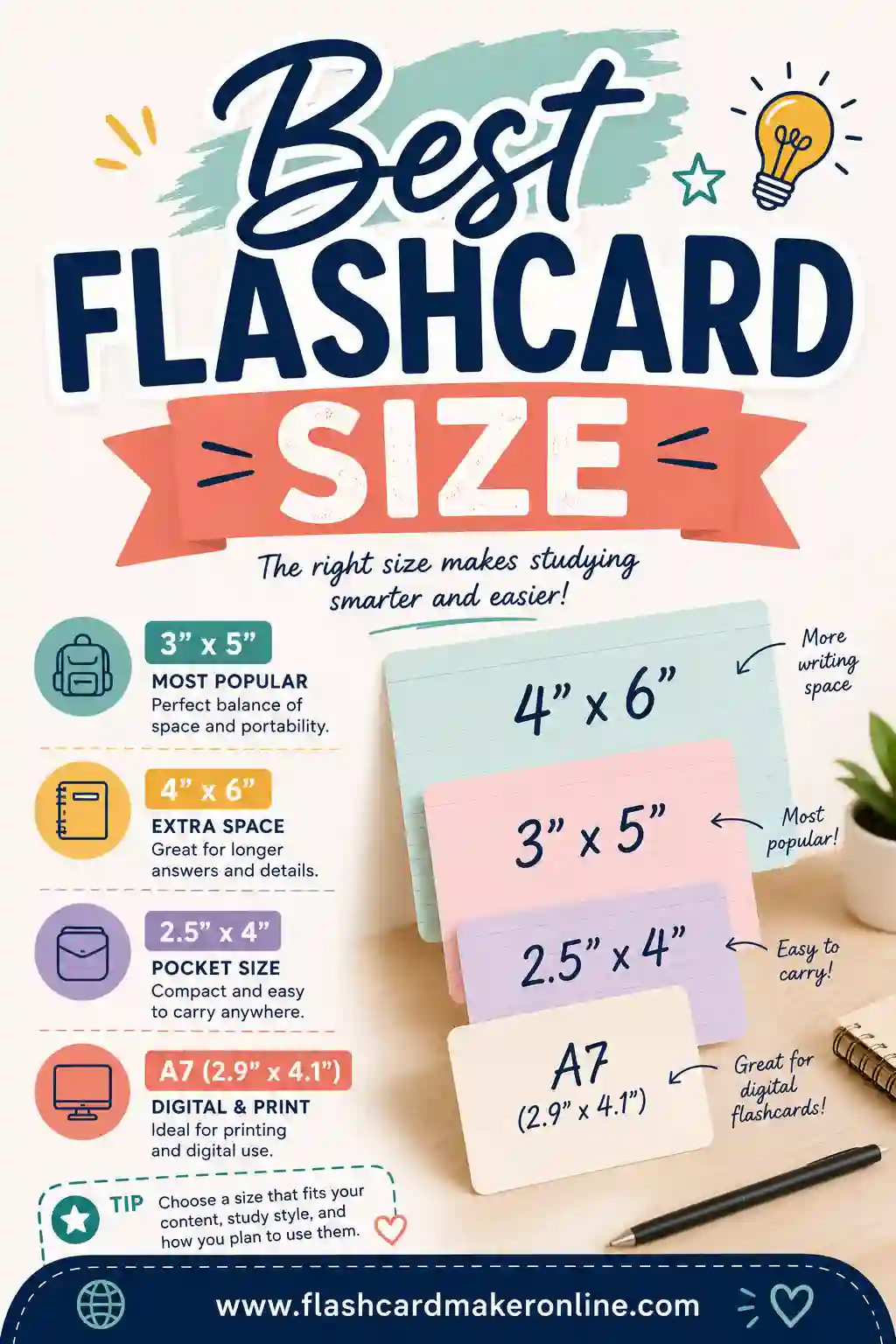
- Size: Jumbo or Big cards are easiest for little hands and easy to see across a table. The 4×6 index card size is a good middle ground for a stack you keep in a bag.
- Test page: Click Print a test page first so you can check that front and back line up on your printer before using a lot of paper.
- Save as PDF: You can save the deck as a PDF so you can reprint cards later when one inevitably goes missing under the couch.
Print on card stock if you have it. Cover cards in clear packing tape or laminate them for a wipe-clean finish. Round the corners with scissors so they're kinder to small fingers. Our guide on how to print flashcards has more tips on paper and layouts.
Step 6: Save and share
Click Download .csv to keep a copy of your list. You can bring it back later with Import a file when it's time to add words. Use Get share link to send the deck to Grandma, your sitter, or daycare. Anyone who opens the link gets their own copy of the deck, so they can print the same cards and use the same words you do.
How to Use the Cards: 3 to 5 Cards Per Session
This is where most of the progress happens, and it's simpler than it sounds. Keep sessions short, playful, and tied to real things.
Start with only a few cards
Pick 3 to 5 cards for a session. That's plenty. A big stack can overwhelm a toddler and turn into a game of throwing cards on the floor (fun, but not a talking game). Choose a mix of one or two words your child already understands well and one or two new ones.
A simple 5-step routine
- Get face to face. Sit on the floor or across a small table so your child can see your mouth.
- Show one card and say the word. Say it clearly, a little slower than usual, with lots of expression. "Ball!"
- Connect it to the real thing. Hold up the actual ball next to the card. Roll it. Say "ball" again.
- Pause and wait. Count to five in your head. Look expectant. Give your child a chance to try.
- Celebrate any try. A sound, a sign, a point, a look at the card. Smile, repeat the word, and keep playing.
Then move to the next card. A whole session might take two to five minutes. That's fine. Several tiny sessions spread through the day often work better than one long one.
What counts as a "try"
Late talkers often say parts of words before whole ones. All of these are wins worth celebrating:
| Your child does this | What you can do next |
|---|---|
| Looks at the card or the object | Say the word again and hand them the object. |
| Points to the card | "Yes! Ball!" Then roll the ball. |
| Makes any sound | Repeat the word clearly, as if they said it. "Ba! Ball!" |
| Says the first sound, like "b" | "Ball! You said b-b-ball!" |
| Says a word approximation, like "ba" | Model the full word once and keep playing. |
| Uses a sign or gesture | Say the word with the sign. "More!" |
| Says the word clearly | Add one more word. "Ball! Big ball!" |
Notice there's no "that's wrong, say it again." You model, you celebrate, you keep going. Correcting a toddler can make them stop trying. Hearing the clear word from you is the correction.
Don't quiz, model
It's tempting to hold up a card and ask "What's this? What's this? Say ball." Try not to. Rapid questions put pressure on a child who's still finding their words. Instead, comment and pause. "Ooh, ball." Wait. "Big ball." Wait. Your child will try when they feel ready, and the waiting itself is a gentle invitation.
Make the card do something
Toddlers learn best when a word gets them something. Turn cards into requests:
- Put three snack cards on the table. When your child touches "cracker," they get a cracker.
- Tape the "bubbles" card to the bubble jar. Wait for a look, a point, or a sound before you blow.
- Hide toys behind cards. Lift a card, find the toy, say its name.
When a word or a card leads straight to the thing your child wants, talking starts to feel worth the effort.
Playful card games for toddlers
Card time should feel like playtime. These games use a handful of cards and need almost no setup. For more ideas you can adapt for older kids later, see our list of games using flashcards.
- Peekaboo cards. Hold a card against your chest, then flip it around. "Peekaboo... dog!" Toddlers love the surprise, and the pause before the reveal is a natural moment for them to try the word.
- Mailbox. Cut a slot in a shoebox lid. Say the word, then let your child "post" the card. Each card gets a word and a satisfying drop.
- Feed the animal. Tape a picture of a big open mouth onto a box. Name each food card before it gets "eaten." "Banana. Yum!"
- Find it. Lay two cards on the floor. Say one word and see if your child touches the right one. This practices understanding, which often grows before speaking does.
- Card hunt. Hide cards around the room at your child's eye level. When they find one, name it together.
- Match the real thing. Put a card next to a basket with the matching object and a couple of others. Help your child find the real cup to go with the "cup" card.
- Sing it. Many songs have built-in pauses. "Old MacDonald had a farm... and on that farm he had a... (hold up the cow card)... cow!"
Keep each game short. Stop while your child is still having fun, so they want to come back next time.
A simple weekly plan
Here's one way to fit cards into a busy week without making it feel like homework. Change it to suit your family, and fit it around anything your SLP has asked you to practice.
| Day | Focus | What to do |
|---|---|---|
| Monday | Pick the week's cards | Choose 5 to 8 cards. Include a few known words and a few new ones. |
| Tuesday | Snack time | Use food and "more" cards at one meal. 3 to 5 cards, a few minutes. |
| Wednesday | Play time | Peekaboo or mailbox game with toy and animal cards. |
| Thursday | Routines | Tape cards where they happen: "bath" by the tub, "shoe" by the door. |
| Friday | Books and songs | Match cards to pictures in a favorite book. Sing with animal cards. |
| Saturday | Family day | Share the deck with whoever is around. Everyone models the same words. |
| Sunday | Notice and note | Jot down new words, signs, or sounds your child tried this week. |
A week is just a rhythm, not a deadline. Some cards will "click" in days. Others may take weeks. That's normal. Keep the cards your child loves in rotation and quietly retire ones that never catch their interest.
Keep a tiny progress log
A notebook or a note on your phone works well. Write the date, the word, and what your child did: looked, pointed, signed, made a sound, said part of the word, or said the word. Over a month or two, this log shows you real progress you might not notice day to day. It's also useful to share with your pediatrician or SLP.
Adjusting the Deck as Your Child Grows
Your deck should change as your child's words do. Here's a rough way to think about stages. Every child moves at their own pace, so use what fits and ignore what doesn't.
| Where your child is now | Card ideas | What to model |
|---|---|---|
| Few or no words yet, uses gestures | 5 to 10 photo cards of favorite foods, toys, people | Single words, sounds like "moo" and "vroom," and signs |
| Saying a few words or sounds | Add action words: up, go, more, open, eat | Single words, repeated often, with lots of pauses |
| Using 20 or more words | Add body parts, clothing, places, and feelings like happy and sad | Two-word phrases: "more milk," "big ball," "dog go" |
| Starting to combine words | Pair cards side by side: "mama" plus "shoe" | Short phrases: "Mama's shoe," "Daddy go car" |
| Talking more in phrases | Describing words with the Colors & Shapes preset | Questions and comments: "Where's the red ball?" |
When your child is ready for two-word phrases, try laying two cards next to each other. "More" and "bubbles" side by side become "more bubbles." Later on, our guide to flashcards for toddlers covers colors, shapes, numbers, and letters when your little one is ready for them.
Bilingual families
If your family speaks two languages, it's generally fine to make cards in both. Use the language each caregiver speaks most naturally, and ask your SLP how they'd like you to handle two languages for your child. One easy setup: put one language on the front and the other on the back, or make two small decks so each caregiver has their own.
Signs and gestures
Many families use simple signs like "more," "all done," "eat," and "help" alongside spoken words. If your SLP suggests signs, you can photograph your own hands making each sign and add those pictures to the back of the cards. Always say the word out loud while you sign it.
Common Mistakes and Easy Fixes
Even with great cards, a few habits can get in the way. Here are the ones that come up most, and what to do instead.
Using too many cards at once. A stack of 30 can feel like a wall. Fix: use 3 to 5 cards a session and keep the rest out of sight.
Drilling instead of playing. Long sit-down sessions with "say it" over and over can make a toddler shut down. Fix: two to five minutes, lots of play, stop while it's fun.
Picking words your child doesn't care about. "Zebra" may be on a list, but if your child has never seen one, it's a hard sell. Fix: lead with words from their own life and interests.
Cartoon pictures that don't look like the real thing. Fix: use real photos, ideally of your child's own things.
Asking questions with no pause. Fix: say the word, then wait a full five seconds. Silence is your friend here.
Only practicing at "card time." Fix: tape cards where words happen during the day, and use the real objects as much as the cards.
Correcting pronunciation. Fix: celebrate the try, then say the word clearly yourself. Leave the sound work to your SLP's plan.
Comparing to other kids. Every child's path looks different. Fix: compare your child to how they were last month, using your progress log.
Working With Your Child's Speech-Language Pathologist
If your child sees an SLP, your cards can be a great bridge between sessions. A few ideas to make the most of that partnership:
- Bring your deck. Show your SLP the words you've chosen and ask if they'd swap any.
- Ask for target words and sounds. Your SLP may have specific words or sounds they want to work on. Add those cards first.
- Ask how to prompt. Some SLPs want you to wait silently, some want you to offer a choice ("ball or car?"), and some use specific cues. Follow their method.
- Share your log. Your notes on what your child tried at home can help your SLP plan.
- Share the deck link. Use the share link so your SLP, daycare teacher, or early intervention provider can have their own copy.
If your child isn't seeing anyone yet and you're worried, it's okay to ask your pediatrician for a referral. In the US, many families also contact their state's early intervention program for children under three. A professional can tell you what's going on and what kind of support makes sense. For families already working with specialists, our page on flashcards for special education has more ideas for adapting cards to different needs.
Make Your First Words Deck Today
You don't need a fancy kit or a big stack of store-bought cards. Pick 10 to 20 words from your child's world, snap a few photos, and use 3 to 5 cards at a time during play. Say the word, wait, celebrate any try, and keep it fun.
When you're ready, open the free flashcard maker and choose the First Words preset or paste your own list. Add your photos, print Jumbo or Big cards, and share the link with everyone who spends time with your child. It takes a few minutes, and you'll have a deck that looks just like your toddler's life.
▶ Open this deck in the flashcard maker
Frequently Asked Questions
How many first words flashcards should I use at once?
Start with 3 to 5 cards per session. That's enough to keep it interesting without overwhelming your toddler. You can have a bigger deck of 10 to 20 cards and rotate which ones you use each day.
What age can I start using first words flashcards?
Many parents start around the time babies show interest in pictures and books. With a toddler who's a late talker, you can start right away, as long as you keep it playful and short. If you're unsure, ask your pediatrician or speech-language pathologist what fits your child.
Should I use real photos or drawings?
Real photos are usually the clearer choice for toddlers, especially photos of your child's own cup, toys, and family. Realistic pictures work well for things you can't photograph at home, like farm animals. Simple, clear images with one object and a plain background are easiest to understand.
What should I do if my child won't look at the cards?
Take a break and try again later with fewer cards and a game, like peekaboo or a mailbox. Use cards tied to things your child really wants, such as a favorite snack or bubbles. Some kids respond better to the real object, so hold the card and the object together.
Do flashcards fix a speech delay?
No. Flashcards are a tool for practicing words at home, not a treatment. If you're concerned about your child's speech, talk with your pediatrician and ask about an evaluation with a speech-language pathologist, then follow their plan.
Which words should come first on a late talker's deck?
Choose words your child wants and hears every day: family names, favorite foods, favorite toys, and pets. Add a few action words like up, go, more, and open. Words with early sounds such as m, b, p, and d are often easier to try first.
Can I make flashcards in two languages?
Yes. Many bilingual families make cards in both home languages, either with one language on each side or as two separate decks. Ask your SLP how they'd like you to handle two languages for your child.
How do I print toddler flashcards that last?
Print Jumbo or Big cards on card stock, then laminate them or cover them with clear packing tape. Round the corners with scissors. Save the deck as a PDF so you can reprint any card that gets lost or chewed.