The FSRS Algorithm Explained: How Modern Flashcard Scheduling Works
The FSRS algorithm (short for Free Spaced Repetition Scheduler) is an open-source method for deciding when you should review each flashcard. It estimates how likely you are to remember a card on any given day, then schedules the next review for roughly the moment that chance drops to a target you choose, often 90%. It tracks three numbers for every card, called difficulty, stability and retrievability, and it learns its settings from your own review history instead of using one fixed formula for everyone.
This guide explains how FSRS works in plain language, with the actual formulas and worked numbers, where it came from, how it compares with the older SM-2 algorithm and the Leitner box system, what the public benchmark data shows, and what it means for how you press the buttons when you study. No hype, just how it works.
What the FSRS algorithm does
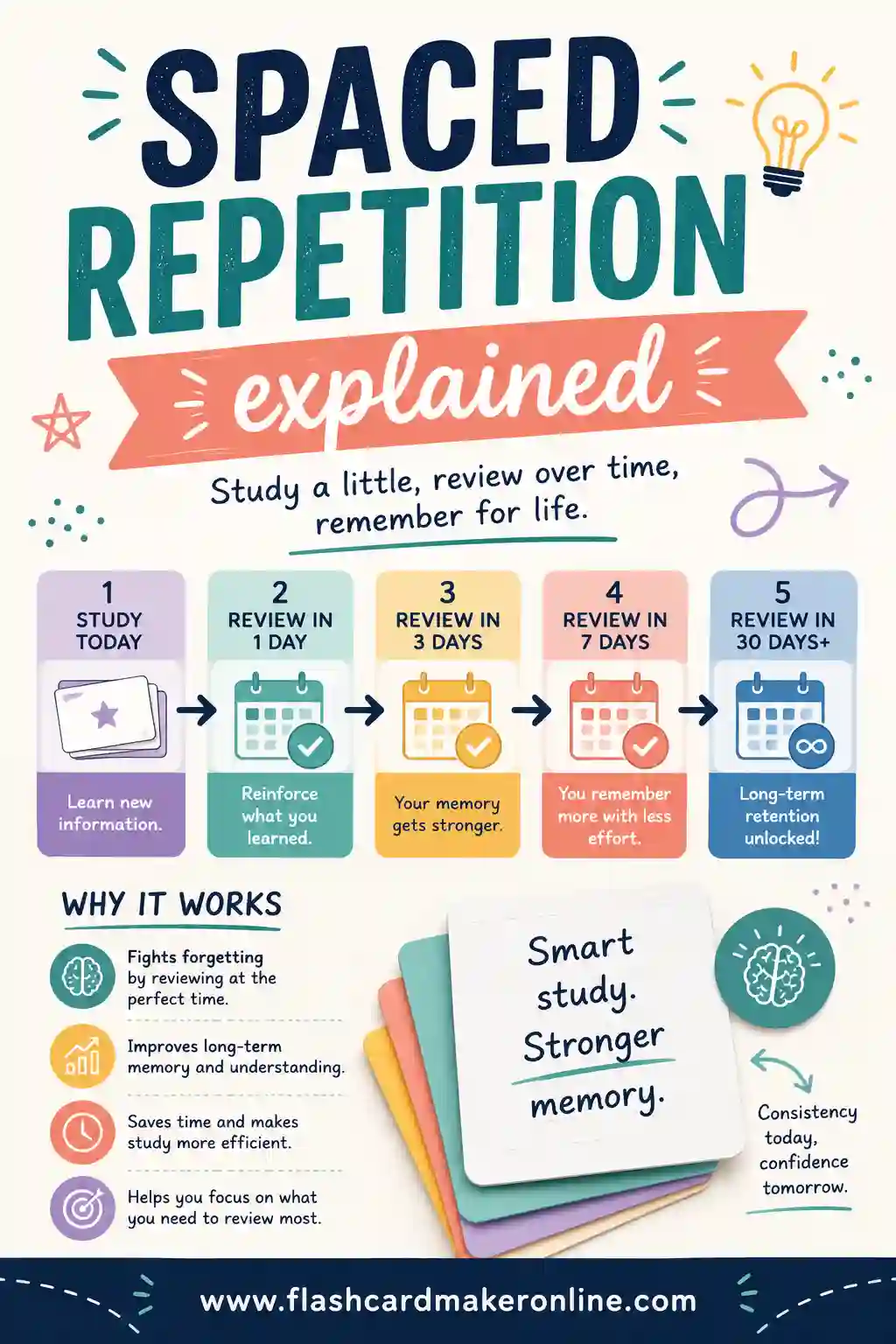
Every spaced repetition system has to answer one question for every card: when should you see this again? Review too soon, and you waste time on something you'd have remembered anyway. Review too late, and you've forgotten it and have to relearn it. The best time is somewhere in between, and it's different for every card and every person. (If spacing is new to you, start with our guide to spaced repetition.)
Older schedulers answer that question with rules of thumb: multiply the last interval by a number, or move the card to the next box. FSRS answers it with a memory model, a set of equations that predicts the probability you'll recall a card after a certain amount of time. Once you can predict that probability, scheduling is simple: pick the day when the predicted chance of recall falls to your target.
The fsrs4anki project on GitHub describes FSRS as the Free Spaced Repetition Scheduler and says its research follows the path pioneered by MaiMemo, a language-learning company. The flashcard app Anki offers FSRS as an alternative to its older SM-2 scheduler, according to the Anki manual, and other apps have adopted it as well.
Where FSRS came from: the published research
FSRS grew out of two peer-reviewed papers by researchers connected to MaiMemo and the Harbin Institute of Technology.
The 2022 KDD paper
Junyao Ye, Jingyong Su and Yilong Cao presented "A Stochastic Shortest Path Algorithm for Optimizing Spaced Repetition Scheduling" at KDD 2022, a major data-mining conference run by the Association for Computing Machinery. They collected 220 million memory behavior logs from students, built a memory model with the Markov property (meaning the model's next state depends only on its current state, not the full history of how it got there), and designed a scheduler meant to minimize the total cost of reviewing. They reported a 12.6% performance improvement over the best methods they compared against, and said the scheduler had been deployed in the MaiMemo app. The code and dataset are public.
The 2023 journal paper
A longer version, "Optimizing Spaced Repetition Schedule by Capturing the Dynamics of Memory," by Jingyong Su, Junyao Ye, Liqiang Nie, Yilong Cao and Yongyong Chen, appeared in IEEE Transactions on Knowledge and Data Engineering in 2023. It framed scheduling as a stochastic shortest path problem, a math problem about finding the cheapest route through a series of uncertain steps, and solved it with a method called value iteration. The authors reported that, compared with several baselines, their approach cut error in predicting recall by 64% and cut review cost by 17%.
Those numbers come from the papers' own experiments on their data and simulations. They don't mean any particular student will study 17% less. They show that a model built from real review logs can predict memory better than simpler rules.
From papers to an open-source scheduler
The open-source FSRS algorithm is based on a memory model from that line of work. The project's algorithm documentation says it derives from MaiMemo's DHP model, which is a variant of the DSR model. It has gone through several versions, from early ones up to FSRS-6. The number of trainable parameters has grown over time: the documentation lists 7 for v1, 17 for v4 and FSRS-4.5, 19 for FSRS-5 and 21 for FSRS-6.
The DSR model: difficulty, stability and retrievability
At the heart of FSRS are three numbers. Every card has its own set.
| Variable | What it means | Range or unit | When it changes |
|---|---|---|---|
| Retrievability (R) | The probability you can recall the card right now | 0% to 100% | Every day; it falls as time passes since your last review |
| Stability (S) | How long the memory lasts: the number of days it takes for R to fall from 100% to 90% | Days | Only when you review the card |
| Difficulty (D) | How hard this card is for you; harder cards gain stability more slowly | 1 to 10 | Only when you review the card |
These definitions come from the project's introductory guide and its algorithm documentation. Here's how to think about each one.
Retrievability: your odds today
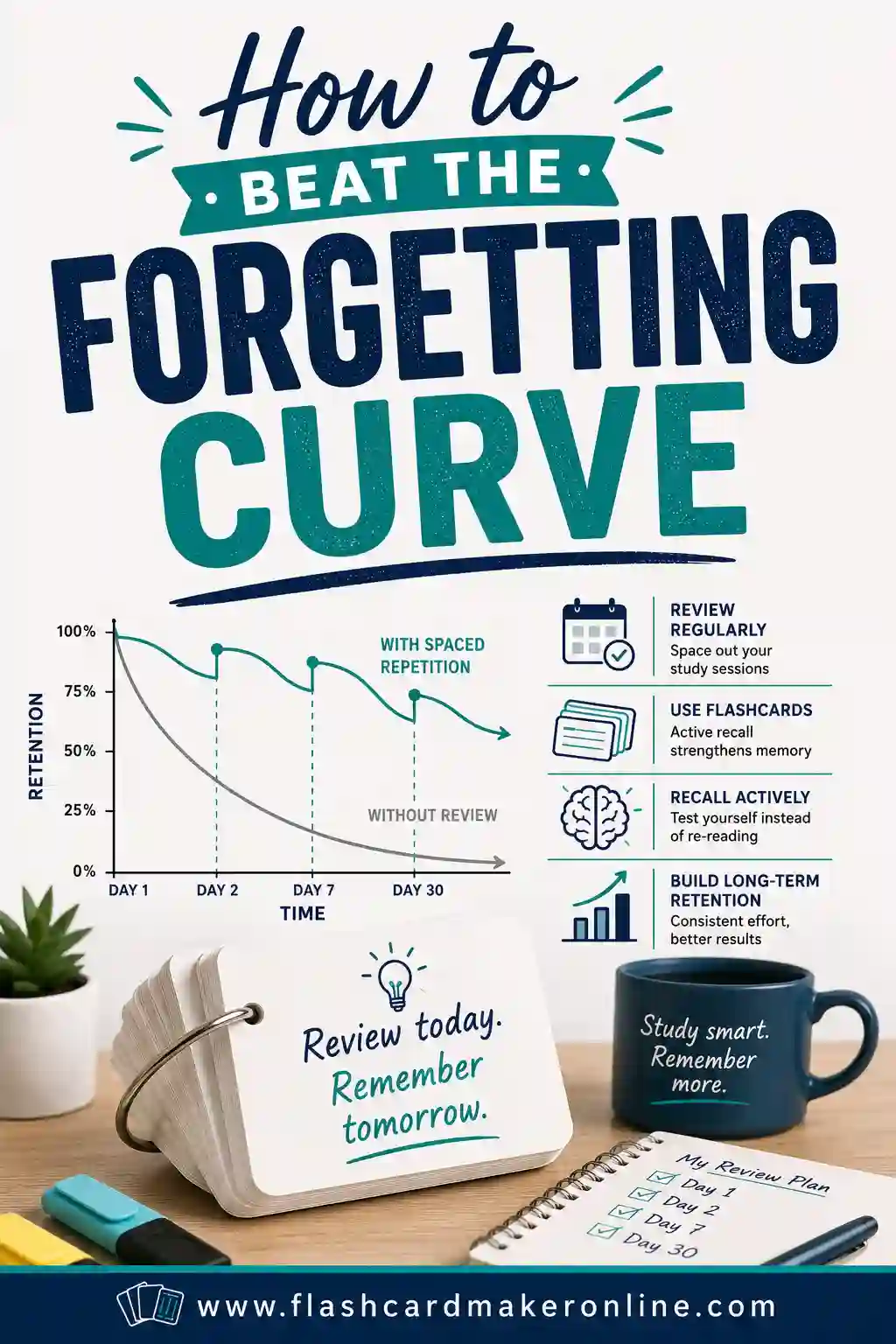
Right after a successful review, retrievability is close to 100%. Each day that passes, it drops a little. This is the familiar forgetting curve that we cover in our guide to beating the forgetting curve. FSRS doesn't need to store retrievability, because it can calculate it any time from stability and the number of days since the last review.
Stability: how slowly you forget
Stability is the speed of forgetting, expressed in days. A card with a stability of 10 days will be at 90% retrievability 10 days after the last review. A card with a stability of 100 days will take 100 days to fall to 90%. Higher stability means a flatter forgetting curve. The whole goal of reviewing is to raise stability.
Difficulty: how much each review helps
Some cards are just harder for you than others. FSRS captures that with difficulty on a 1 to 10 scale. The main effect of difficulty is on how much stability grows after each successful review: the higher the difficulty, the smaller the increase.
The FSRS forgetting curve, with worked numbers
FSRS uses a specific equation for how retrievability falls over time. In FSRS-4.5, the documentation gives it as:
R(t, S) = (1 + FACTOR × t ÷ S) raised to the power DECAY, with DECAY = −0.5 and FACTOR = 19/81
Here t is the number of days since the last review and S is stability. The constants are chosen so that when t equals S, retrievability is exactly 90%. You can check that: 19/81 is about 0.2346, so at t = S you get (1 + 0.2346) to the power −0.5, which is 1 ÷ √1.2346, or 1 ÷ 1.1111, which is 0.90.
Here's what the curve looks like for a card at different points, written as multiples of its stability:
- t = 1 × S: R = 90.0%
- t = 2 × S: 1 + 2 × 0.2346 = 1.469, and 1 ÷ √1.469 = 0.825, so R is about 82.5%
- t = 3 × S: R is about 76.6%
- t = 5 × S: R is about 67.8%
- t = 10 × S: R is about 54.7%
So a card with a stability of 20 days would be at about 90% after 20 days, about 82.5% after 40 days and about 67.8% after 100 days. Notice that the curve falls quickly at first and then flattens out. That shape is called a power curve, and it's a key difference from schedulers that assume a simple exponential drop.
What changed in FSRS-6
In FSRS-6, the decay is no longer fixed at −0.5. It becomes a trainable parameter, called w20, that's fitted to your own data. The documentation writes the curve as R(t, S) = (1 + factor × t ÷ S) raised to the power −w20, where factor is set so that R still equals 90% when t equals S. The default parameter list ends with 0.1542 for w20. In practice, this lets the model fit forgetting curves that are flatter or steeper depending on the person and the material.
How FSRS chooses the next review date
Once you have a forgetting curve, scheduling is a matter of solving for time. You choose a desired retention: the probability of recall you want to have when a card comes due. FSRS then finds the number of days at which retrievability will fall to that level.
For FSRS-4.5, the documentation gives the interval formula as:
I(r, S) = (S ÷ FACTOR) × (r raised to the power 1/DECAY, minus 1)
where r is your desired retention. When r is 90%, the interval equals the stability. Here's what other targets do, using the same formula:
| Desired retention | Interval as a multiple of stability | Example with stability of 10 days | What it means for workload |
|---|---|---|---|
| 97% | 0.27 × S | about 3 days | Very frequent reviews |
| 95% | 0.46 × S | about 5 days | Frequent reviews |
| 90% | 1.00 × S | 10 days | Common default |
| 85% | 1.64 × S | about 16 days | Fewer reviews, more forgetting |
| 80% | 2.40 × S | about 24 days | Fewer reviews still |
| 70% | 4.44 × S | about 44 days | Lowest workload, much more forgetting |
To show the math for one row: at 80%, r to the power 1/DECAY is 0.8 to the power −2, which is 1 ÷ 0.64 = 1.5625. Subtract 1 to get 0.5625. Divide by FACTOR (0.2346) to get about 2.40.
This table explains a trade-off the Anki manual describes plainly: higher desired retention gives shorter intervals and more reviews per day, and lower desired retention gives fewer reviews but more forgotten cards. The manual's default is 90%, and it recommends being conservative and keeping desired retention below 97%, because workload climbs steeply at the high end. You can see why in the table: going from 90% to 97% shrinks a 10-day interval to about 3 days. The project's own guide calls values from 70% to 97% reasonable.
What happens when you press a button
After each review, you grade yourself. FSRS uses four grades: 1 = Again, 2 = Hard, 3 = Good and 4 = Easy. Your grade updates the card's difficulty and stability, which then sets the next interval.
Your first review of a card
For a new card, FSRS sets the starting stability from your first grade. In the version 4 documentation, each grade has its own trainable starting stability, so the starting stability for Again is w0, for Hard is w1 and so on. Starting difficulty also depends on the first grade; in FSRS-5 it's calculated with an exponential formula so that pressing Easy gives the lowest difficulty and Again the highest.
Updating difficulty
In FSRS-5, difficulty changes in two steps. First, the grade pushes difficulty up or down: Again and Hard raise it, Easy lowers it, and Good leaves it about the same. That change is scaled by linear damping, so the closer difficulty already is to 10, the smaller the increase. Second, a bit of mean reversion pulls difficulty slightly back toward a default value. Together, these keep difficulty from getting stuck at an extreme. The Anki manual notes that the SM-2 problem of cards getting trapped with very short intervals is not one FSRS suffers from.
Stability after a successful review
When you remember a card (Hard, Good or Easy), stability increases. The documentation describes three effects built into the formula:
- Higher difficulty means a smaller increase. Hard cards grow more slowly.
- Higher stability means a smaller increase. This is called stabilization saturation: the more stable a memory already is, the harder it is to make it even more stable.
- Lower retrievability means a bigger increase. If you remember a card when you were close to forgetting it, stability grows more. This is how FSRS builds in the spacing effect: a successful review after a longer wait counts for more.
The documentation also says that stability never goes down after a successful review, and that very overdue reviews raise stability more, but only up to a limit. Hard and Easy apply extra multipliers, so Hard grows stability less than Good and Easy grows it more.
Stability after you forget
When you press Again, FSRS calculates a new, lower post-lapse stability. It depends on the card's difficulty, its stability before you forgot, and its retrievability at the time. A card that was very stable before you forgot it usually keeps more stability than a card you barely knew. That's one reason relearning is faster than learning from scratch.
Reviews on the same day
FSRS-5 added a formula for stability after same-day reviews, and FSRS-6 changed it so stability rises faster when it's small and slower when it's large. The project's guide says FSRS-6 takes all reviews into account, not just the first one each day.
A worked example: one card's life under FSRS
To see how the pieces fit together, let's follow one card. The stability numbers here are made up for illustration; real values depend on your parameters and history. We'll use the FSRS-4.5 curve and a desired retention of 90%, so each interval equals the card's current stability.
- Day 0, first review: You learn the Spanish word "ventana" (window) and press Good. Suppose your starting stability for Good is 3 days. Next review: day 3.
- Day 3: Retrievability is predicted at 90%. You remember it and press Good. Because you succeeded, stability grows. Suppose it rises to 10 days. Next review: day 13.
- Day 13: You remember it again, pressing Good. Stability grows again, say to 30 days. Notice that the increase is getting bigger in days but smaller as a multiple, which is stabilization saturation at work. Next review: day 43.
- Day 43, a busy week: You don't get to the card until day 63, 50 days after the last review. Using the curve, 50 ÷ 30 is about 1.67, so 1 + 1.67 × 0.2346 = 1.391, and 1 ÷ √1.391 is about 0.85. Your predicted chance of recall had fallen to about 85%. You still remember it. Because retrievability was lower when you succeeded, the stability increase is bigger than it would have been on time, though overdue bonuses level off.
- Later, a lapse: Months later you blank on it and press Again. FSRS calculates a new post-lapse stability. Because the card had high stability before, the new value is lower but not back to the beginning, so it returns in a few days rather than starting over from scratch. Difficulty also rises a bit.
Compare that with SM-2, where a failed card restarts at a 1-day interval no matter how long you'd known it. The project's guide also says FSRS handles cards reviewed after long gaps, such as breaks of a few weeks or months, better than SM-2. That fits the design: because FSRS calculates retrievability from the actual time that passed, a late review isn't treated as a mistake. It's simply a review at a lower predicted recall, and the model adjusts stability accordingly. If you come back from a vacation to a pile of overdue cards, FSRS still has a sensible estimate for each one.
Key FSRS terms at a glance
- Desired retention: the probability of recall you want when a card comes due. It controls the trade-off between workload and forgetting.
- Interval: the number of days until the next review.
- Lapse: a review where you forgot the card and pressed Again.
- Parameters (w values): the numbers inside the formulas that can be fitted to your review history. FSRS-6 has 21.
- Optimizer: the program that fits the parameters to your history so predictions match what actually happened.
- Post-lapse stability: the new stability a card gets after you forget it.
- Stabilization saturation: the tendency for already-stable memories to gain stability more slowly.
- Same-day review: a second or later review of the same card on the same day, such as during learning steps.
- Benchmark: a public test that compares how well different models predict real review outcomes.
Training FSRS on your own reviews
The "learning" part of FSRS is in its parameters, the w values in the formulas. FSRS-6 has 21 of them. Instead of fixed numbers that are the same for everyone, these can be fitted to your review history with an optimizer, a program that adjusts the parameters until the model's predictions match how you actually did.
Some practical points from the project's guide and the Anki manual:
- Defaults come from lots of data. People with too few reviews get default parameters, which the project says were fitted on several hundred million reviews from about 10,000 users.
- You need enough history. The Anki manual lists a low number of reviews, less than a few hundred, as a common reason FSRS may perform poorly for someone.
- Don't edit the parameters by hand. Both the manual and the project guide advise against tweaking parameters manually or copying someone else's.
- Re-optimize occasionally. The manual says optimizing about once a month is enough.
- Different material, different settings. The manual notes that decks of very different difficulty may benefit from separate settings.
FSRS compared with SM-2 and the Leitner system
To understand what's new about FSRS, it helps to see what came before.
SM-2 in brief
SM-2 was described by Piotr Wozniak in 1990, based on his master's thesis, and it's published on the SuperMemo website. It works like this:
- The first interval is 1 day and the second is 6 days.
- After that, each interval is the previous one times the card's E-Factor (easiness factor), rounded up.
- Every card starts with an E-Factor of 2.5, and it can't go below 1.3.
- You grade each answer from 0 to 5. After each review, the E-Factor changes by 0.1 − (5 − q) × (0.08 + (5 − q) × 0.02), where q is your grade.
- If you grade below 3, the card starts over from the first interval.
Let's work it through. With grade 5, the E-Factor goes up by 0.10. With grade 4, it doesn't change (0.1 − 1 × 0.10 = 0). With grade 3, it drops by 0.14 (0.1 − 2 × 0.12). For a card that keeps its E-Factor at 2.5, the intervals run 1, 6, 15 (6 × 2.5), 38 (15 × 2.5 = 37.5, rounded up), 95 days, and so on.
SM-2 was a big step forward, and it's still widely used. But it doesn't predict a probability of recall, it treats every lapse as a full reset, and the E-Factor can drift down and stay low for cards you've since learned well.
The Leitner system in brief
The Leitner system uses physical boxes. A card you get right moves to the next box, which you review less often. A card you miss goes back to the first box. It's simple, needs no computer, and builds in spacing, which makes it great for paper flashcards. Our Leitner system guide walks through it.
| Feature | Leitner boxes | SM-2 | FSRS |
|---|---|---|---|
| Core idea | Move cards between boxes reviewed at different frequencies | Multiply the interval by a per-card easiness factor | Predict recall probability with a memory model |
| Tracks per card | Which box it's in | Interval, repetition count, E-Factor | Difficulty and stability (retrievability is calculated) |
| Grades | Right or wrong | 0 to 5 | Again, Hard, Good, Easy |
| After forgetting | Back to box 1 | Restart at 1 day | Calculate a new, lower stability based on the card's history |
| Personalized to you | No | Per card, through the E-Factor | Parameters can be fitted to your review history |
| You can set a retention target | No | No | Yes, through desired retention |
| Works on paper | Yes | Possible with a log, but tedious | Not practical without software |
What the open benchmark shows, and what it doesn't
The open-spaced-repetition project maintains a public SRS benchmark that compares how well different scheduling models predict real review outcomes. It's one of the few places where you can see these algorithms tested on the same large dataset.
How it works
The benchmark uses Anki review histories. The page describes the main dataset as about 10,000 users and roughly 727 million reviews, though another section mentions 20,000 users and about 1.7 billion reviews without explaining the difference. Models are trained on each user's older reviews and tested on newer ones, which is fair because it mimics predicting the future. Three measures are reported:
- Log loss: how far off the predicted probabilities are from what actually happened. Lower is better.
- RMSE (bins): a measure of calibration, meaning whether cards predicted at 80% are actually recalled about 80% of the time. Lower is better.
- AUC: how well the model separates cards you'll remember from cards you'll forget. Higher is better; 0.5 is no better than a coin flip.
What it found
Without counting same-day reviews, newer FSRS versions predicted better than older ones on all three measures: FSRS-6 had a log loss of 0.3460, FSRS-5 had 0.3561 and FSRS v4 had 0.3726. FSRS versions also outperformed older models like HLR and Ebisu on these measures. But FSRS wasn't the top performer overall. Some neural-network models, such as one called RWKV, scored better on log loss and AUC. The page notes these models can make unintuitive predictions and aren't trained per user the way FSRS is.
What to keep in mind
- SM-2 isn't in the results tables. The benchmark doesn't give a direct head-to-head score against SM-2 or Leitner. Claims comparing FSRS with SM-2 come from other sources, mainly simulations.
- Prediction isn't the same as learning. The benchmark measures how well a model predicts recall, not how much students learn.
- Differences can be small. The page reports 99% confidence intervals and many of the top FSRS variants are close together.
- Same-day reviews change the picture. In the table that includes same-day reviews, some results shift, and the page says the two tables aren't directly comparable.
The project's guide also states that, based on simulations, users need 20% to 30% fewer reviews than with SM-2 to reach the same retention. That's a reasonable claim to take seriously, but remember it comes from the project itself and from simulations, not from a controlled study of students.
How to study well with an FSRS scheduler
FSRS can only be as good as the data you give it. Your button presses are that data. These habits help it work the way it's designed to.
Grade honestly
- Again means you didn't remember it, or you got it wrong.
- Hard means you remembered, but with real struggle.
- Good means you remembered with normal effort. This should be your most common button.
- Easy means it was effortless.
The Anki manual specifically warns that pressing Hard when you actually forgot is a serious mistake, because it tells the model you remembered and makes intervals unreasonably long.
Answer before you flip
Say or write your answer before you look. If you just glance at the front and flip, you can't grade yourself honestly, and you lose the benefit of active recall.
Choose desired retention thoughtfully
For most learners, the common default of 90% is a sensible starting point. If you have an important exam soon and time to spare, a higher target means more reviews but fewer surprises. If you're overwhelmed, lowering it reduces your daily load at the cost of forgetting more. See our guide on how many flashcards to study per day for help with workload.
Give it time and data
With only a handful of reviews, FSRS uses default parameters. As your history grows into the hundreds and thousands of reviews, optimizing becomes more meaningful.
Keep cards simple
The model treats each card as one memory. A card that asks for five facts at once might be "remembered" or "forgotten" depending on which fact you missed, which makes your grades noisy. Small, focused cards give cleaner data and better scheduling. Our tips on reviewing flashcards efficiently cover this.
Common misunderstandings about FSRS
- "FSRS makes you remember more." Not by itself. It schedules reviews so that you're likely to hit your chosen retention level with fewer wasted reviews. You still have to do the reviews and grade honestly.
- "Higher desired retention is always better." Higher retention costs a lot more reviews, especially above 90%, as the interval table shows.
- "Stability means how well I know a card." It's more specific than that: it's the number of days until recall probability falls to 90%.
- "FSRS uses the same formula for everyone." It uses the same equations, but the parameters can be fitted to each person's review history.
- "The benchmark proves FSRS is the best possible algorithm." The benchmark shows FSRS predicts well compared with many models, but some neural models scored higher on certain measures, and prediction accuracy isn't the same as learning.
Using FSRS ideas with paper flashcards
FSRS needs software to do its calculations, so you can't run it on index cards. But you can borrow its key ideas for paper study.
- Expand intervals after success. Each time you get a card right, wait longer before the next review. This mirrors stability growing after a successful review.
- Give hard cards more time. Cards that keep giving you trouble should come back sooner, which mirrors high difficulty slowing stability growth.
- Don't fully reset well-known cards. If you miss a card you've known for months, bring it back soon but not all the way to the start. FSRS's post-lapse stability reflects that you forget well-known cards less badly.
- Accept some forgetting. FSRS is built on the idea that aiming for 100% retention is extremely expensive. Missing a card now and then means your intervals are doing their job.
A Leitner box system with growing gaps between boxes captures much of this in a way that's easy to manage by hand. Our guide to flashcards for spaced repetition has more ideas.
Make cards that schedule well
Whatever scheduler you use, from a box on your desk to FSRS in an app, the quality of your cards matters as much as the algorithm. Small, clear cards with one fact each give you honest, clean grades, and those are what any spacing system needs to work well.
Our free flashcard maker lets you add your own words and pictures, study with flip cards on screen, and then print your deck double-sided or as cut-out sheets. Make your cards focused and specific, and then review them on a spaced schedule, with paper boxes or with the scheduler of your choice.
What Moves a Card's Stability After You Review It
After each review, FSRS updates a card's stability. This table shows which factors make it grow more or less, according to the documentation the article describes.
| What happens | Effect on stability | Name or reason |
|---|---|---|
| The card has higher difficulty | Smaller increase | Hard cards grow more slowly |
| The card already has high stability | Smaller increase | Stabilization saturation: the more stable a memory is, the harder it is to make it more stable |
| You remember it when retrievability is low | Bigger increase | How FSRS builds in the spacing effect |
| You press Hard or Easy | Extra multipliers apply | Hard grows stability less than Good |
| You press Again | New, lower post-lapse stability | A card that was very stable before is lower but not back to the beginning |
Frequently Asked Questions
What does FSRS stand for?
FSRS stands for Free Spaced Repetition Scheduler. It's an open-source algorithm that decides when you should review each flashcard. The project's GitHub page describes it as a modern spaced repetition scheduler and says its research follows the path pioneered by MaiMemo, a language-learning company whose researchers published papers on memory modeling and scheduling at KDD 2022 and in IEEE Transactions on Knowledge and Data Engineering in 2023. FSRS is used in Anki as an alternative to the older SM-2 scheduler, and in some other apps.
How does the FSRS algorithm work?
FSRS keeps two numbers for each card, difficulty and stability, and uses them to calculate a third, retrievability, which is the chance you'll remember the card today. Retrievability falls along a forgetting curve as days pass. You set a desired retention, often 90%, and FSRS schedules the next review for the day retrievability is predicted to fall to that level. After each review, your grade of Again, Hard, Good or Easy updates difficulty and stability, which sets the next interval.
What are difficulty, stability and retrievability in FSRS?
Retrievability is the probability you can recall a card right now, and it drops every day after a review. Stability is how long the memory lasts, defined as the number of days for retrievability to fall from 100% to 90%. Difficulty is a number from 1 to 10 that reflects how hard the card is for you; harder cards gain stability more slowly after each successful review. Difficulty and stability only change when you review the card, while retrievability changes daily.
What desired retention should I use with FSRS?
A common default is 90%, and it's a sensible starting point for most people. Higher retention means shorter intervals and many more reviews, and the Anki manual recommends keeping it below 97% because the workload rises steeply. Using the FSRS-4.5 formula, moving from 90% to 97% shrinks an interval to about a quarter of its length. Lower retention, such as 80% to 85%, means fewer reviews but more forgotten cards. The project's guide calls values from 70% to 97% reasonable.
Is FSRS better than SM-2?
The FSRS project reports, based on simulations, that users need 20% to 30% fewer reviews than with SM-2 for the same retention. FSRS also predicts recall probability directly, adapts its parameters to your review history and doesn't fully reset cards you forget. However, the public SRS benchmark doesn't include SM-2 in its results tables, so there's no direct head-to-head score there. FSRS is a well-designed improvement on paper, but how much it helps any individual depends on their cards and habits.
How many reviews does FSRS need before optimizing?
There isn't a single magic number. The Anki manual lists a low number of reviews, less than a few hundred, as a common reason FSRS may perform poorly for someone. Before you have enough history, FSRS uses default parameters, which the project says were fitted on several hundred million reviews from about 10,000 users. As your review history grows, running the optimizer fits the parameters to your own memory. The manual suggests optimizing about once a month is enough.
Should I press Hard if I forgot a card?
No. Press Again whenever you forgot the card or got it wrong. Hard means you remembered it, but only with real difficulty. The Anki manual warns that pressing Hard after forgetting is a serious mistake, because it tells the model you succeeded and makes intervals unreasonably long. Since FSRS learns from your grades, honest grading is the most important thing you can do. Good should be your most common button, with Easy reserved for answers that were truly effortless.
What changed in FSRS-6?
According to the project's algorithm documentation, FSRS-6 has 21 trainable parameters, up from 19 in FSRS-5. Its biggest change is that the decay of the forgetting curve became a trainable parameter, so the curve's shape can be fitted to your data instead of being fixed. It also changed the formula for stability after same-day reviews, so stability rises faster when it's small and more slowly when it's large. On the public benchmark, FSRS-6 predicted recall better than FSRS-5 and FSRS v4.
Can I use FSRS with paper flashcards?
Not directly, because FSRS needs software to calculate each card's difficulty, stability and next review date. But you can borrow its ideas. Wait longer after each correct answer, bring hard cards back sooner, and when you miss a card you've known for a long time, review it soon without starting it completely over. A Leitner box system with growing gaps between boxes captures much of this and is easy to run by hand.
Sources
We checked every source below while writing this guide. Last reviewed October 30, 2026, by Joan Ramos.
- A Stochastic Shortest Path Algorithm for Optimizing Spaced Repetition Scheduling (Ye, Su & Cao, KDD 2022, pp. 4381-4390) (Harbin Institute of Technology research portal)
- Optimizing Spaced Repetition Schedule by Capturing the Dynamics of Memory (Su, Ye, Nie, Cao & Chen, 2023), IEEE Transactions on Knowledge and Data Engineering 35(10), 10085-10097 (Harbin Institute of Technology research portal)
- SSP-MMC: code and dataset for the KDD 2022 paper (MaiMemo on GitHub)
- fsrs4anki: Free Spaced Repetition Scheduler for Anki (open-spaced-repetition on GitHub)
- The Algorithm (FSRS versions and formulas) (open-spaced-repetition awesome-fsrs wiki)
- ABC of FSRS (open-spaced-repetition awesome-fsrs wiki)
- SRS Benchmark (open-spaced-repetition on GitHub)
- SM-2 algorithm description, from Piotr Wozniak's 1990 master's thesis, Optimization of learning (SuperMemo)
- Deck Options (FSRS section) (Anki Manual)