Ham Radio Technician Flashcards: Study the Question Pool and Pass
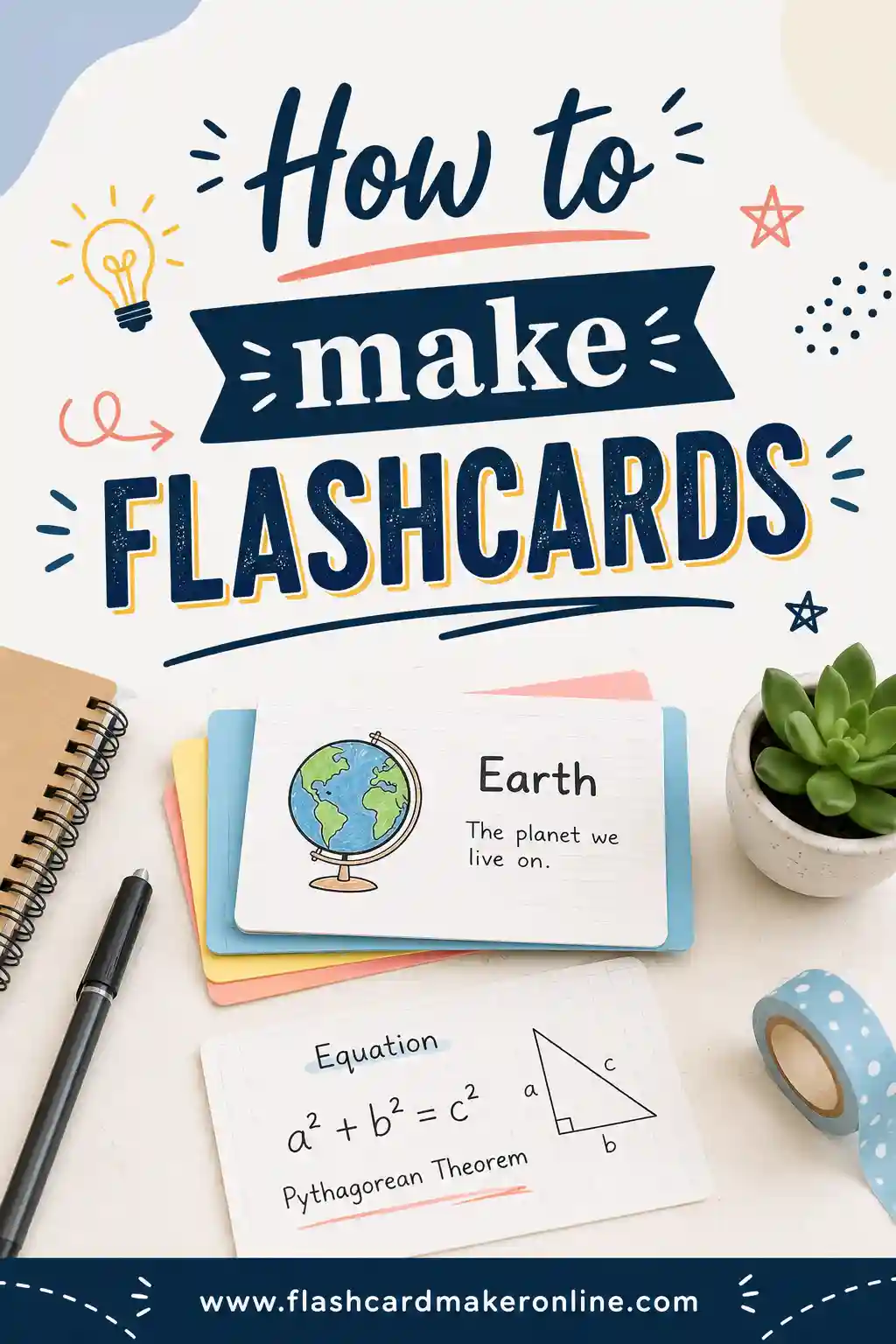
The fastest way to pass the Technician exam with flashcards is to build your own deck from the current question pool, one card per question idea, sorted by subelement (T1 through T0), and then drill your weakest subelements hardest. That way you never study an outdated pool, and every card matches the test you'll actually sit. You can build, study and print the whole deck in a free flashcard maker with no account.
Plenty of premade sets float around online, and many of them still carry questions from older pools. Making your own takes an evening or two, and it gives you something those sets can't: control. You decide which questions get a card, which get a formula card instead, and which you already know cold.
This guide walks through how the exam is built, how to turn pool questions into cards that stick, 60 sample cards you can paste straight in, a three-week schedule, and the mistakes that trip people up on test day.
🃏 Quiz yourself: 12 cards from this page
Read the front, say your answer, then tap the card to check.
Make, study & print this deck → Opens the free flashcard maker with all 12 cards ready to edit or print.▶ Open this deck in the flashcard maker
How the Technician Exam Is Built
The Technician license is the entry-level US amateur radio license. The written test is called Element 2. It's given by teams of Volunteer Examiners (VEs), not by the FCC directly, and you can take it in person at a local session or, with many VE teams, online with a remote proctor.
Here's the shape of the test:
- 35 multiple-choice questions. You need 26 correct to pass.
- Every question comes from a public pool. The pool is published by the National Conference of Volunteer Examiner Coordinators (NCVEC), with the exact wording, the four answer choices, and the correct answer.
- The pool is split into ten subelements, named T1 through T9 plus T0. Each subelement is split into groups (T1A, T1B, and so on), and each group holds a set of numbered questions like T1A01.
- Each exam draws one question from each group. So if a subelement has six groups, about six of your 35 questions come from it.
That last point is the key to smart flashcard work. The header of the pool file lists how many questions each subelement contributes. Check that list before you build your deck, because it tells you where the points are.
| Subelement | Topic area | What you'll see on cards |
|---|---|---|
| T1 | FCC rules, station license responsibilities | License terms, call sign rules, privileges, band edges, prohibited transmissions |
| T2 | Operating procedures | Repeaters, simplex, Q signals, emergency and public service work |
| T3 | Radio wave characteristics | Wavelength, frequency ranges, propagation, ionosphere, polarization |
| T4 | Amateur radio practices and station setup | Transceiver controls, mobile setups, power supplies |
| T5 | Electrical principles | Ohm's law, power, units, metric prefixes, decibels |
| T6 | Electronic and electrical components | Resistors, capacitors, inductors, diodes, transistors, schematic symbols |
| T7 | Station equipment | Meters, dummy loads, troubleshooting interference, transceiver basics |
| T8 | Modulation modes and special operations | FM, SSB, CW, satellites, digital modes |
| T9 | Antennas and feed lines | Dipoles, verticals, Yagis, coax, SWR, connectors |
| T0 | Safety | Electrical safety, RF exposure, tower and antenna safety |
The subelement names above are general descriptions. Use the exact titles and question counts printed in the pool you download.
Why Old Premade Sets Can Cost You Points
Question pools are revised on a regular cycle, roughly every four years. The 2022 to 2026 Technician pool expired on June 30, 2026, so any deck built from it is now out of date. Some questions carry over almost unchanged, but others get reworded, moved to a different group, renumbered, or dropped. New questions get added too.
That's a problem with premade decks for three reasons:
- Numbers don't match. If you study "T5A03" from an old pool, it might be a completely different question in the new one. That makes it hard to track weak spots.
- Answers can change. Rules and technical wording do get updated. A card with the old answer teaches you the wrong thing with total confidence.
- You can't see gaps. A random set doesn't tell you whether it covers every group. Your own deck, built group by group, does.
Before you build anything, download the current Technician pool from NCVEC and check the effective dates printed on it. Then build from that file only. If a friend hands you a printed deck, compare a dozen cards against the current pool before you trust it.
How to Turn Pool Questions Into Good Cards
The pool has hundreds of questions. You don't need hundreds of cards that look exactly like the test. You need cards that teach the idea behind each question so you can pick the right answer no matter how the choices are shuffled.
Card type 1: The question-to-answer card
This is the simplest card. The front is a short version of the question. The back is the correct answer, written out in words.
- Front: How often must an amateur station identify?
- Back: At least every 10 minutes during a contact and at the end of it
Never write "Answer: C" on the back. The answer letters can be shuffled on the real exam. Write the answer itself.
Card type 2: The concept card
Many pool questions test the same idea in slightly different ways. Ohm's law, for example, shows up as "find the current," "find the voltage," and "find the resistance." One concept card plus a few practice cards covers them all.
- Front: Ohm's law (three forms)
- Back: E = I x R, I = E / R, R = E / I
Card type 3: The worked-example card
For math questions, put a real calculation on the front and the solution steps on the back.
- Front: 12 volts across 24 ohms. Current?
- Back: I = E / R = 12 / 24 = 0.5 amps
These cards are where flashcards beat simple reading. Working one problem a day for two weeks makes the math automatic.
Card type 4: The "which one is it?" card
Some questions hinge on two terms that sound alike. Make a card that forces you to tell them apart.
- Front: QRM vs. QRN
- Back: QRM is interference from other stations. QRN is natural noise, such as static.
Card type 5: The reverse card
For band edges, units and abbreviations, make the card work in both directions. One card asks "144 to 148 MHz is which band?" and another asks "Edges of the 2 meter band?" Testing both directions catches the half-learned facts.
Tag every card with its group code
Start each card front with the group code in brackets, like "[T5A] Unit of electrical current." It takes two extra seconds per card and pays off later. When you miss a card, you'll know which group it belongs to, and you can see patterns. If half your misses start with T5 or T9, that's where your next study session goes.
60 Sample Technician Cards You Can Paste
These cards cover facts and formulas that appear across Technician study material. They're written as plain facts, not copies of pool questions, so they stay useful even as wording changes. Still, check each card against the current pool and keep the pool's answer wherever it differs. Each line below is ready for the maker's "Paste a list" box in front : back format.
Rules and privileges (T1)
| Front | Back |
|---|---|
| [T1] Which agency regulates US amateur radio? | The Federal Communications Commission (FCC) |
| [T1] Part of the FCC rules covering amateur radio | Part 97 |
| [T1] How long is an amateur license valid? | 10 years |
| [T1] Grace period to renew an expired license | 2 years |
| [T1] When must you give your call sign? | At least every 10 minutes during a contact and at the end of it |
| [T1] Maximum amateur transmitter power (general limit) | 1,500 watts PEP output |
| [T1] Technician power limit on the HF segments they may use | 200 watts PEP |
| [T1] Technician voice (SSB) segment on 10 meters | 28.300 to 28.500 MHz |
| [T1] Can you use codes to hide the meaning of a message? | No (narrow exception for control commands to space stations and radio control craft) |
| [T1] ITU region that includes the United States | Region 2 |
| [T1] 6 meter band edges (US) | 50 to 54 MHz |
| [T1] 2 meter band edges (US) | 144 to 148 MHz |
| [T1] 1.25 meter band edges (US) | 222 to 225 MHz |
| [T1] 70 centimeter band edges (US) | 420 to 450 MHz |
Operating (T2)
| Front | Back |
|---|---|
| [T2] National 2 meter FM simplex calling frequency | 146.520 MHz |
| [T2] Common repeater offset on 2 meters | 600 kHz |
| [T2] Common repeater offset on 70 centimeters | 5 MHz |
| [T2] What is simplex operation? | Transmitting and receiving on the same frequency |
| [T2] What is CTCSS? | A sub-audible tone sent with your signal to access a repeater |
| [T2] What does CQ mean? | Calling any station |
| [T2] QRM | Interference from other stations |
| [T2] QSY | Change frequency |
| [T2] QTH | Your location |
| [T2] RACES | Radio Amateur Civil Emergency Service |
| [T2] How should you spell out your call sign on voice? | Use the standard phonetic alphabet |
Radio waves (T3)
| Front | Back |
|---|---|
| [T3] Wavelength in meters from frequency in MHz | 300 divided by the frequency in MHz |
| [T3] Wavelength of a 146 MHz signal (about) | 2 meters |
| [T3] Frequency range of HF | 3 to 30 MHz |
| [T3] Frequency range of VHF | 30 to 300 MHz |
| [T3] Frequency range of UHF | 300 to 3,000 MHz |
| [T3] Speed of radio waves in free space | The speed of light, about 300,000,000 meters per second |
| [T3] Layer that makes long-distance HF contacts possible | The ionosphere |
| [T3] Picket fencing | Rapid flutter on a moving VHF or UHF signal caused by multipath |
| [T3] Tropospheric ducting | Long-range VHF and UHF paths created by temperature inversions |
Electrical principles (T5)
| Front | Back |
|---|---|
| [T5] Ohm's law | E = I x R (voltage = current x resistance) |
| [T5] Power formula | P = E x I (watts = volts x amps) |
| [T5] Unit of current | Ampere |
| [T5] Unit of resistance | Ohm |
| [T5] Unit of frequency | Hertz |
| [T5] 1 MHz equals how many kHz? | 1,000 kHz |
| [T5] Milli means... | One thousandth |
| [T5] Micro means... | One millionth |
| [T5] A 3 dB increase means power is... | About doubled |
| [T5] A 10 dB increase means power is... | 10 times greater |
| [T5] 12 volts, 2.5 amps. Power? | 12 x 2.5 = 30 watts |
| [T5] In a series circuit, what is the same everywhere? | The current |
| [T5] In a parallel circuit, what is the same across each branch? | The voltage |
Components and equipment (T6, T7)
| Front | Back |
|---|---|
| [T6] A capacitor stores energy in a... | Electric field |
| [T6] An inductor stores energy in a... | Magnetic field |
| [T6] What does a diode do? | Lets current flow in one direction only |
| [T6] What does a rectifier do? | Changes AC to DC |
| [T6] What does a transformer do? | Changes AC voltage from one level to another |
| [T7] Ammeter connection | In series with the circuit |
| [T7] Voltmeter connection | In parallel with the component |
| [T7] What does a dummy load do? | Lets you test a transmitter without radiating a signal |
Antennas, modes and safety (T8, T9, T0)
| Front | Back |
|---|---|
| [T8] Mode most used on VHF and UHF voice repeaters | FM |
| [T8] Voice mode for weak-signal and long-distance work | Single sideband (SSB) |
| [T9] Half-wave dipole length in feet | 468 divided by the frequency in MHz |
| [T9] Most common coax impedance in ham stations | 50 ohms |
| [T9] Ideal SWR | 1:1 |
| [T0] Never replace a blown fuse with... | A fuse of a higher rating |
That's 60 cards. A full deck that covers every group in the pool will usually land somewhere between 200 and 400 cards, depending on how many questions you combine into concept cards.
How to Build This Deck in the Flashcard Maker
Here's the exact process in the free flashcard maker on our homepage.
- Give the deck a title. Something like "Technician Pool, T1 to T0." If you'd rather keep subelements separate, make one deck per subelement, such as "Tech T5 Electrical."
- Skip the presets. There's no ham radio preset, so you'll start from a blank deck. (If you want a warm-up, the Physics Formulas preset is a decent refresher on units.)
- Open "Paste a list." Type or paste one card per line in
front : backformat. For example:[T5] Ohm's law : E = I x R. Paste a whole subelement at once. - Choose "Add to deck." This adds the new cards to what's already there. Use "Replace deck" only when you want to start over.
- Add pictures where they help. A schematic symbol card is much easier with a picture. Draw the symbol, snap a photo, and add the picture to the card. Do the same for antenna types and connector shapes.
- Save a backup. Click "Download .csv" so you have a copy of the deck file. Later you can bring it back with "Import a file."
- Study on screen. Open Study mode, hit Shuffle, and go through with Prev, Next and Flip. Use Read aloud if you like hearing the card, which helps on a walk or commute review.
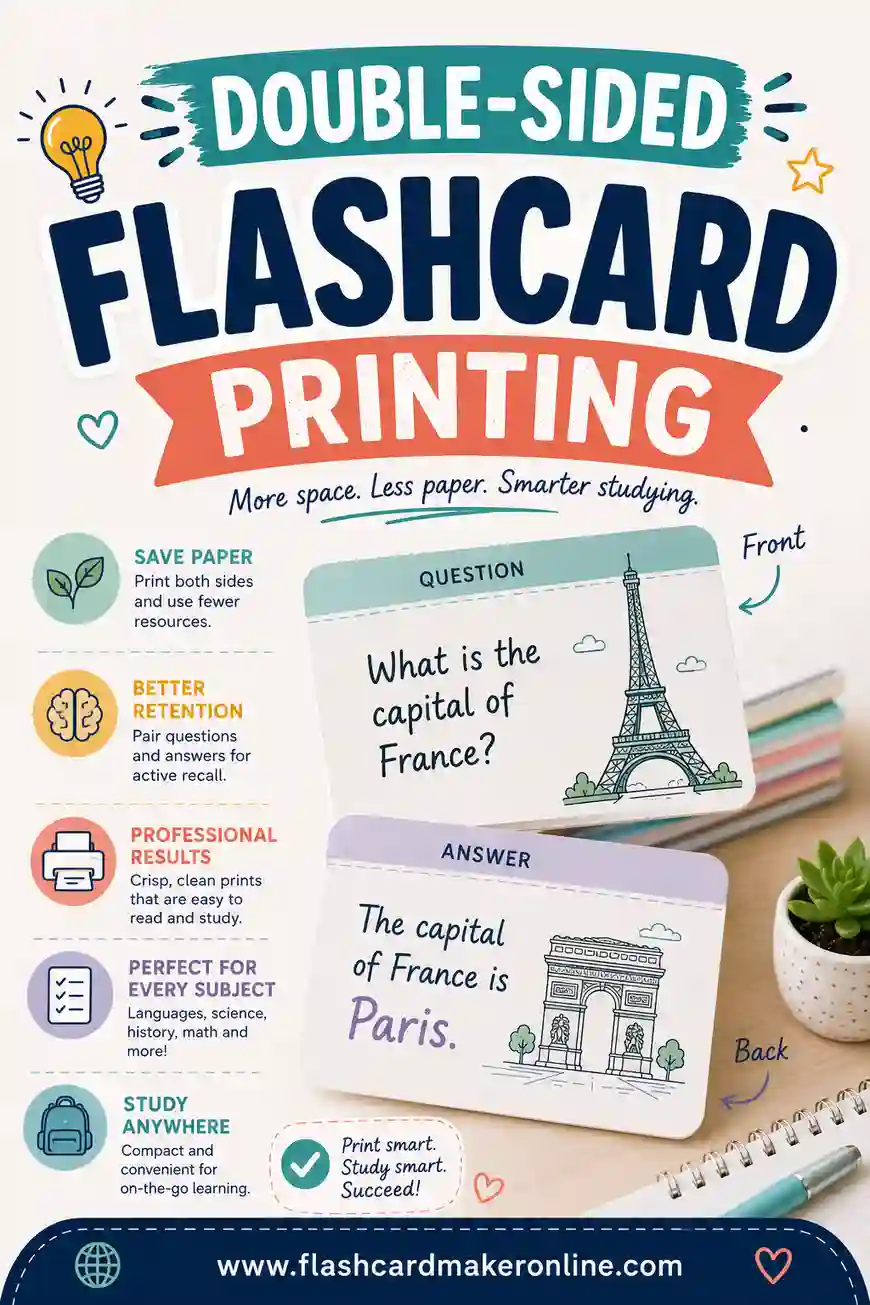
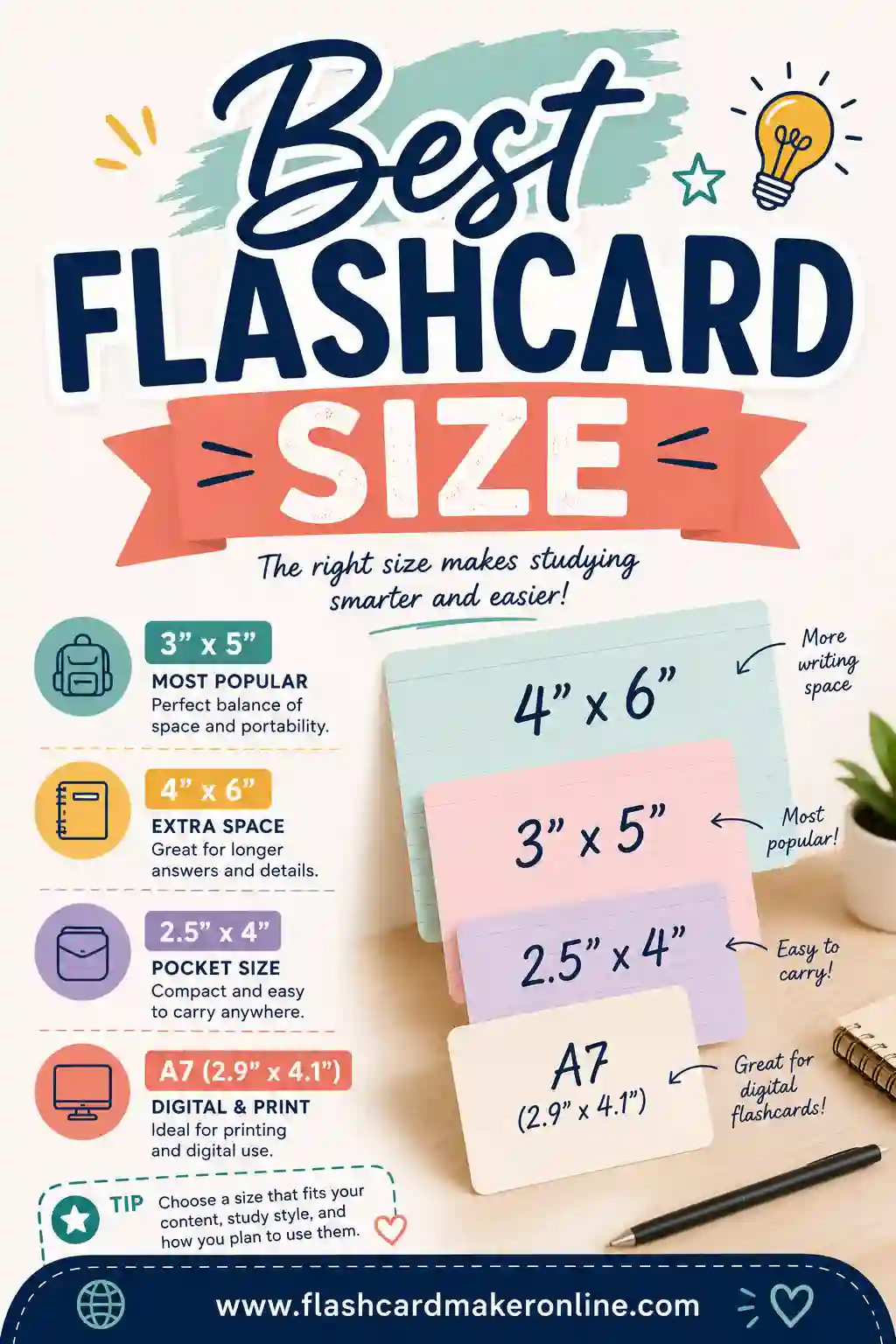
- Print a pocket deck. Choose Print, pick "Double-sided" so fronts and backs line up, and choose the 3×5 index card size. Click "Print a test page first" to check the alignment on your printer, then print or save as a PDF.
If a study partner or club member is testing at the same session, click "Get share link." Anyone with the link gets their own copy of the deck, so they can edit it without touching yours.
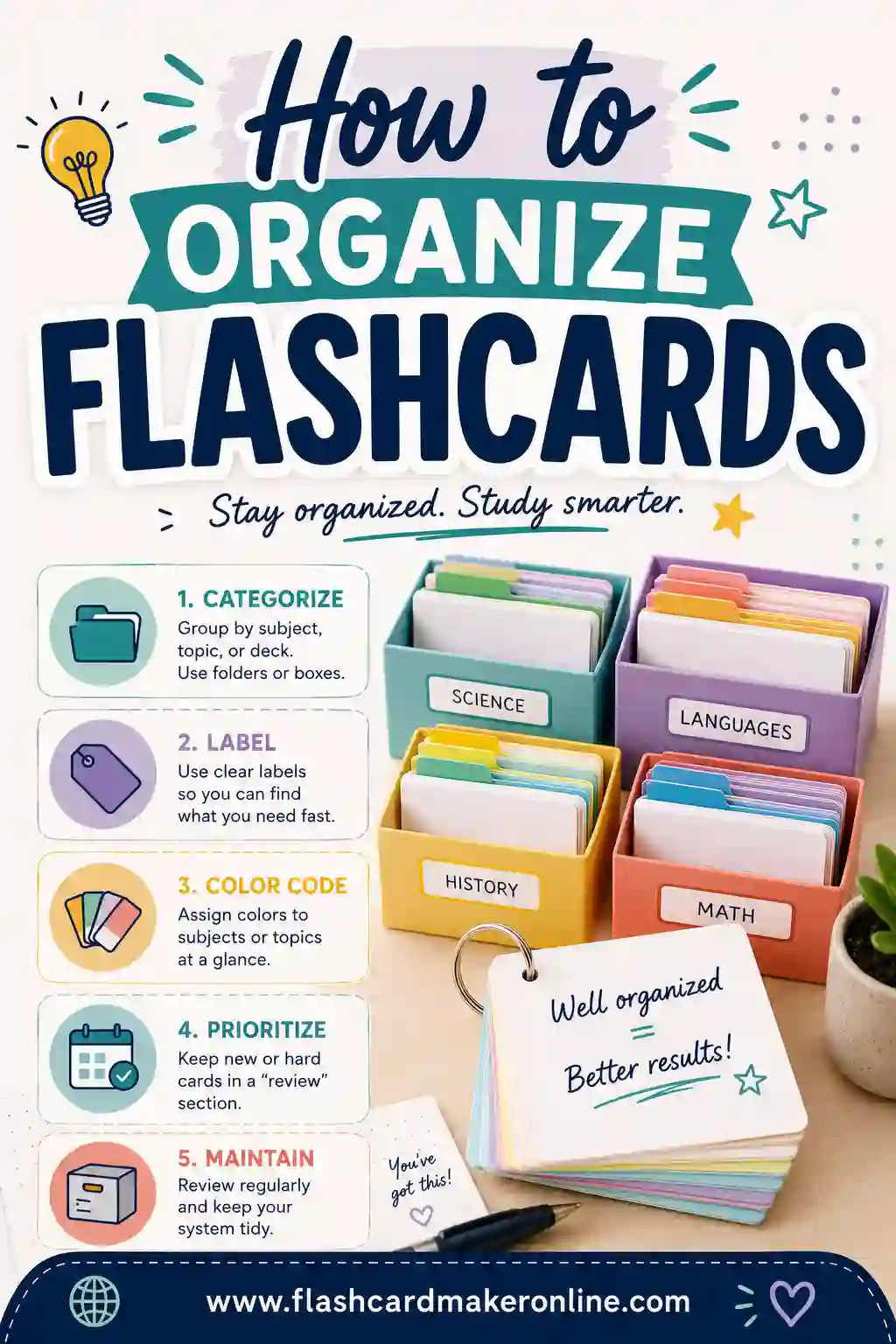
Printing tip: Print each subelement on a different color of cardstock. When you pull your weak piles later, you'll see at a glance whether they're mostly T5 math or T9 antennas. Our guide to double-sided flashcard printing covers paper choice and flipping settings if your first test page comes out crooked.
A Three-Week Technician Study Plan
Three weeks is a comfortable pace for most people studying 30 to 45 minutes a day. If you're testing sooner, compress the build days. If you have more time, stretch the review weeks.
| Days | Build | Review |
|---|---|---|
| 1–2 | Download the current pool. Build T1 (rules). | Study T1 twice a day. |
| 3–4 | Build T2 and T3. | Review T1 misses, then T2 and T3. |
| 5–6 | Build T5 (math) with worked-example cards. | One math problem card per session, every day from now on. |
| 7–8 | Build T6 and T7. | Mixed review of everything built so far. |
| 9–10 | Build T4, T8, T9 and T0. | Full deck is done. Shuffle and sort into piles. |
| 11–14 | No new cards except fixes. | Daily: "still learning" pile first, then a shuffled sample of the rest. |
| 15–18 | Take full online practice exams. | Turn every missed question into a card or fix the old one. |
| 19–20 | Light build only. | Shuffle the whole deck once. Review the hard pile twice. |
| 21 | Exam day. | Quick flip of formula and band edge cards in the morning. |
Sort into piles
After your first full pass, sort the deck into three piles: "know it," "shaky," and "don't know." Review "don't know" every day, "shaky" every other day, and "know it" twice a week. When a card moves up, it gets reviewed less. When you miss it, it drops back down. This is the same idea behind the Leitner system, and it keeps your time focused on what you actually miss.
Mix practice exams with cards
Practice exams that draw from the current pool are the best check on your progress. They show you how questions are worded and which groups you keep missing. Flashcards build fast recall. Practice exams build test sense. Use both.
A reasonable target before booking: you pass several practice exams in a row with room to spare. One lucky pass doesn't tell you much.
Memory Tricks for the Math and the Band Edges
The math questions scare a lot of people, but there are only a handful of formulas. Learn them as patterns and the numbers fall into place.
The Ohm's law triangle
Draw a triangle with E on top and I and R on the bottom. Cover the letter you want. What's left shows the formula. Cover E and you see I next to R, so E = I x R. Cover I and you see E over R, so I = E / R.
Make a card with the triangle drawn on the back. Pictures make formula cards stick, and the maker lets you add a picture to any card.
The power triangle
Same idea: P on top, E and I on the bottom. P = E x I. I = P / E. E = P / I.
Wavelength and frequency
"300 over" is the phrase to remember. Wavelength in meters = 300 / frequency in MHz. And it works backward: frequency in MHz = 300 / wavelength in meters. That's why 146 MHz is about 2 meters, and 440 MHz is about 0.68 meters, close to 70 centimeters.
Practice cards for this one:
| Front | Back |
|---|---|
| Wavelength of 50 MHz? | 300 / 50 = 6 meters |
| Wavelength of 28 MHz? | 300 / 28 = about 10.7 meters (the 10 meter band) |
| Frequency for a 2 meter wavelength? | 300 / 2 = 150 MHz (near the 2 meter band) |
| Wavelength of 440 MHz? | 300 / 440 = about 0.68 meters (the 70 cm band) |
Antenna length shortcuts
A half-wave dipole is about 468 divided by the frequency in MHz, in feet. A quarter-wave vertical is half of that. For the 2 meter band, a quarter-wave vertical comes out to about 19 inches.
Metric prefixes
Make a ladder card: pico, nano, micro, milli, (base unit), kilo, mega, giga. Each step is a factor of 1,000. Then make a few conversion cards, such as "1,500 kHz in MHz? 1.5 MHz" and "0.002 amps in milliamps? 2 mA."
Decibels
Two cards cover most decibel questions. 3 dB is about double (or half) the power. 10 dB is 10 times the power. From those you can work out others: 6 dB is about four times, and 20 dB is 100 times.
Band edges
The band names give a hint. The 2 meter band is near 150 MHz (300 / 2) and runs 144 to 148. The 70 centimeter band is near 430 MHz (300 / 0.7) and runs 420 to 450. When you forget a band edge, the wavelength trick at least tells you the right neighborhood.
Mistakes That Cost People Points
Memorizing the answer letter. On test day, the choices may come in a different order. If your cards say "C," you'll be lost. Write out the answer.
Memorizing the right answer's look without the idea. Some people learn to spot "the long one" or "the one with 10 minutes." That works until a distractor also has those words. Concept cards protect you.
Studying an old pool. It's the most common mistake and the easiest to avoid. Check the effective dates first.
Skipping the math. Math questions are a reliable source of points because the method never changes. A handful of worked-example cards, done daily, turns these into easy wins.
One giant card. A card that lists every Q signal on one back is too much to recall. One signal per card.
Ignoring safety questions. T0 can feel like common sense, so people skip it. The pool asks specific things about RF exposure, grounding and tower work. Give it real cards.
Only reviewing what you know. It feels good to flip through cards you get right. It doesn't add points. Start every session with your "don't know" pile.
No timeline. Book your exam session once you're passing practice tests regularly. A date on the calendar keeps the daily reviews happening.
For more ways to keep reviews short and focused, our guide to flashcards for exams covers how to mix recall practice with full-length tests, and the general certification exam flashcards guide has deck-building tips that apply to any licensing test.
After You Pass: Keep the Deck Working
Your Technician deck doesn't have to retire on exam day.
Turn it into an operating deck. Keep the cards you'll use on the air: repeater offsets, Q signals, phonetics, the simplex calling frequency, and band edges. Print them at 3×5 and keep them near your radio.
Start a General deck. If you plan to move up to the General license (Element 3), the same method works. Download that pool, build by subelement, and add the new math and HF rules. Many Technician concepts carry over, so you'll have a head start.
Share it with your club. If you help run a licensing class, the share link gives each student a personal copy of your deck. They can add their own notes without changing your master version. Remind them to check the pool dates if they use it in a later year.
Update it when the pool changes. When the next pool comes out, compare it with your deck. Keep the concept cards (Ohm's law doesn't change), and rewrite any rules cards that did.
▶ Open this deck in the flashcard maker
Frequently Asked Questions
How many questions are on the Technician exam?
The Technician exam (Element 2) has 35 multiple-choice questions, and you need 26 correct to pass. Every question comes from the public question pool, with one question drawn from each group. Check the current pool for the exact group list.
Where do I get the current Technician question pool?
The pool is published by the National Conference of Volunteer Examiner Coordinators (NCVEC). Download it from their site and look at the effective dates printed on the file. Build your flashcards from that version only.
How many ham radio technician flashcards do I need?
A full deck that covers every group usually runs a few hundred cards. You can bring that number down by combining similar questions into concept cards, like one Ohm's law card plus a few worked examples. Practice exam misses are the best guide to where you need more cards.
Should I memorize the questions or learn the material?
Do both, but lean toward the idea behind each question. Write the full answer on each card rather than a letter, and use concept cards for formulas and rules. That way you can handle any order of answer choices and you'll understand your radio better once you're licensed.
Can I use an old Quizlet set or printed deck?
Only after checking it against the current pool. Pools are revised every few years, and questions can be reworded, renumbered, changed or removed. If many cards don't match, you're better off building a fresh deck.
How long does it take to study for the Technician license?
Many people prepare in two to four weeks with daily study, but it depends on your background. Someone with electronics experience may move faster through the math and components sections. Use practice exams to decide when you're ready rather than a fixed number of days.
What's the best card size for a ham radio deck?
A 3×5 index card size is easy to carry and holds a short question and answer. Use the Big or Jumbo size for formula cards with drawings, like the Ohm's law triangle. Print a test page first to check that the fronts and backs line up.
Do I need to know Morse code for the Technician license?
No. The FCC dropped the Morse code requirement for all amateur license classes in 2007. Technicians can still use CW (Morse) on their allowed frequencies, and some pool questions ask about CW as a mode.
Can I take the exam online?
Many Volunteer Examiner teams offer remote exam sessions with a video proctor, and in-person sessions are common too. Requirements, like a webcam setup or ID, vary by team. Check with the VE team you plan to test with for their current rules.
Ready to start? Download the current pool, open the free flashcard maker, and paste in your first subelement tonight. One subelement a day gets you a complete deck in under two weeks.