Pocket Flashcards for Your Commute: Print Wallet-Size Cards

The easiest way to make pocket flashcards is to keep each card to one short fact, print the deck double-sided at the smallest index-card size on card stock, then trim, punch, and carry 20 to 30 cards on a ring. That gives you a stack you can pull out on the bus, in a waiting room, or in line, and put away again in seconds. You can type and print the whole deck in the free flashcard maker with no account, and small cards force short answers, which makes them faster to review.
This guide covers which size to pick, how to write cards that fit a small space, a full 40-card pocket deck you can paste in, the paper and rings that hold up in a pocket, and a commute routine that fits a ten-minute ride.
🃏 Quiz yourself: 12 cards from this page
Read the front, say your answer, then tap the card to check.
Make, study & print this deck → Opens the free flashcard maker with all 12 cards ready to edit or print.▶ Open this deck in the flashcard maker
Why Pocket Flashcards Work for Short Study Moments
Most days have small gaps in them. Five minutes on a platform. Eight minutes waiting for a coffee order. A quarter hour on the bus. None of those feel like "study time," so they usually go to scrolling. A small stack of cards turns them into short review sessions without any setup.
Here's why a pocket deck fits those gaps so well:
No startup cost. You don't open a laptop, find a file, or sign in. You pull out a ring and look at the top card.
Short sessions suit flashcards. Reviewing a card takes a few seconds. In five minutes you can go through a 20-card ring once or twice. Several short reviews spread across a day are a good fit for how memory works, because each one makes you pull the answer back up after a little forgetting has set in. Our guide on how to review flashcards efficiently goes into why spacing reviews out helps.
Paper doesn't distract you. A phone can hold flashcards too, but it also holds every notification you get. A paper stack only does one thing.
Small cards keep you honest. You can't fit a paragraph on a wallet-size card, so you won't write one. One fact per card is exactly what makes cards easy to review and easy to grade yourself on.
You can sort by hand. Move a card you missed to the front of the ring, or flip it upside down. By the end of the ride, the stack shows you which cards still need work.
A pocket deck isn't meant to replace your main study sessions. It's the extra five to fifteen minutes a day that add up over a few weeks, and it's a natural way to keep older material fresh while you learn new things at your desk.
Which Card Size to Pick for Your Pocket
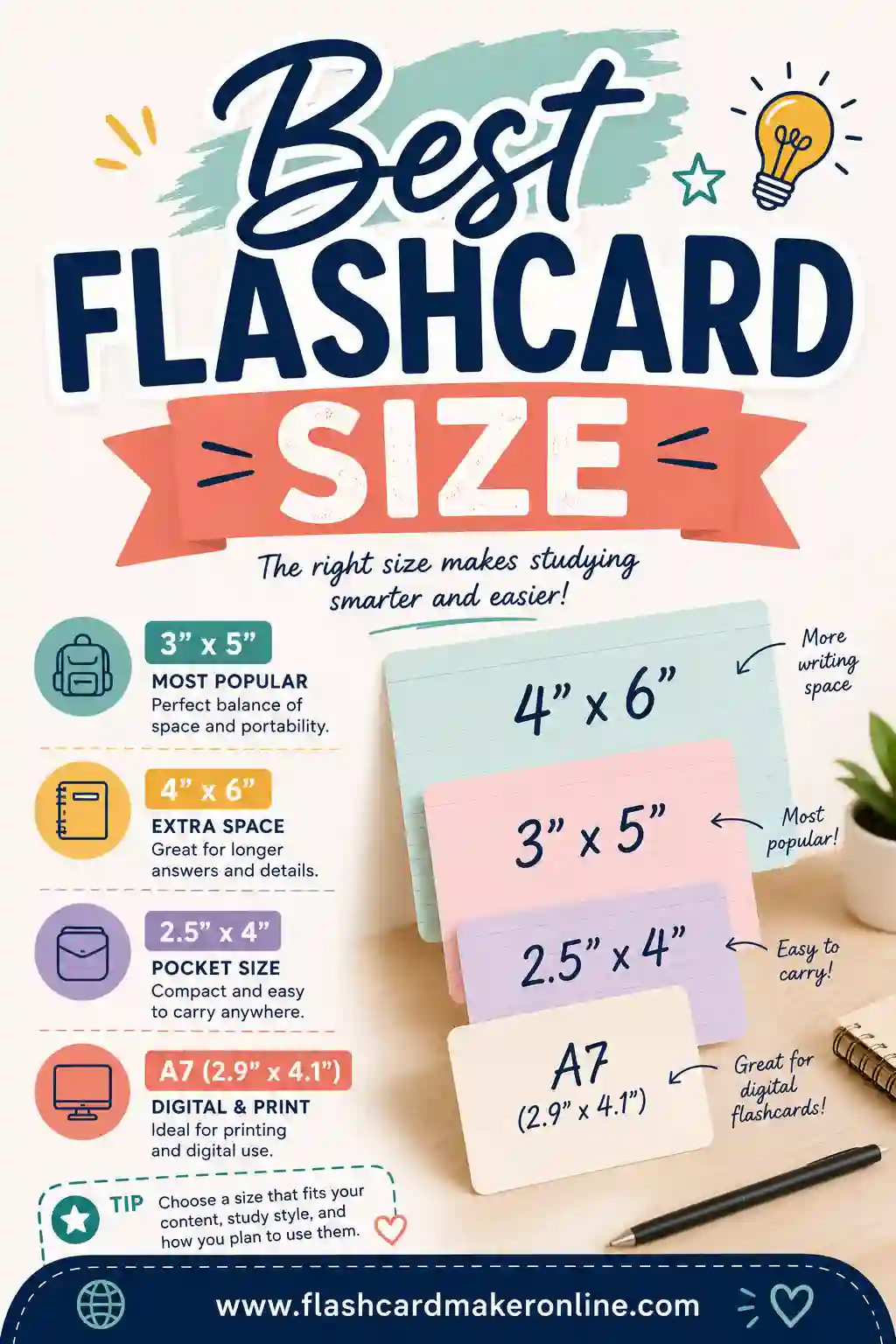
The maker prints five card sizes: Jumbo, Big, Standard, 4×6 index card, and 3×5 index card. For pocket cards, you want the small end of that list.
| Size in the maker | Good for pockets? | Where it fits | Best use |
|---|---|---|---|
| 3×5 index card | Yes, the top pick | Jacket pocket, bag pocket, many back pants pockets | Commute decks, rings, on-the-go review |
| Standard | Often, depending on your printer and trimming | Bag pocket or jacket pocket | Everyday decks you also use at a desk |
| 4×6 index card | Not really | Bag or binder | Desk study with more room for detail |
| Big | No | Desk or classroom | Group review, younger learners |
| Jumbo | No | Wall or whiteboard | Showing cards to a whole room |
3×5 is the classic pocket card. It's the size of a standard small index card, it fits in most jacket pockets and many pants pockets, and it's sturdy enough to flip with one hand.
Want something closer to wallet size? A typical wallet card, like a credit card, is about 3.4 by 2.1 inches, and a business card is about 3.5 by 2 inches. You can get close to that by printing at 3×5 and trimming the long side shorter, as long as you keep your text to the middle of the card. More on trimming in the printing steps below.
Always print a test page first. Printers handle margins and scaling a little differently, so the actual size of the cards on your paper can vary slightly. The Print a test page first option shows you exactly what you'll get before you use up card stock.
For a deeper comparison of sizes and what each one is good for, see our guide to the best flashcard size.
What Fits on a Small Card
The size of the card sets the rules for what you write. On a 3×5 card, and especially on one trimmed toward wallet size, you have room for a few words on the front and a short line or two on the back. That's a good thing. It pushes you toward cards that take two or three seconds each.
Rules for writing pocket cards
- Front: one cue. A word, a short question, a symbol, a formula with a blank. Aim for under ten words.
- Back: one answer. A word, a number, a short phrase. If it needs more than about fifteen words, split it into two cards.
- No lists on one card. "Name all 12 cranial nerves" won't fit and won't review well. Make one card per item instead.
- Abbreviate carefully. Shorten common words if you'll recognize them later, but don't abbreviate the thing you're trying to learn.
- Skip pictures unless they're the point. A small picture on a small card can be hard to see. Use them for cards where the image is the question, like a sign, a flag, or a single letter.
- Make the front stand alone. On the bus, you won't have your notes to remind you what "the second one" means. Put enough context on the front to know what's being asked.
Here's how long cards shrink into pocket cards:
| Too long for a pocket card | Pocket-ready version |
|---|---|
| What are the three branches of the US government and what does each do? | Branch that makes federal laws : Legislative (Congress) |
| Explain the difference between affect and effect with examples | Usually a verb, affect or effect? : Affect |
| List the steps of the scientific method | First step of the scientific method : Ask a question (make an observation) |
| Translate the following travel phrases into Spanish... | Where is the bathroom? : ¿Dónde está el baño? |
| Describe the quadratic formula and when to use it | Quadratic formula, x = ? : (−b ± √(b² − 4ac)) / 2a |
Each long card became one short card. The rest of the original material becomes more short cards, one per piece. You end up with more cards, but each one takes a few seconds, and the whole ring moves fast.
Notice the format on the right: front, then " : ", then back. That's exactly how you'll type them into the maker's Paste a list box, one card per line.
Sample Pocket Deck: 40 Everyday Spanish Phrases
Language phrases are one of the best uses for a pocket deck. They're short, you'll use them out loud, and practicing them on the go is natural. Here's a 40-card set of everyday Spanish phrases. Split it into two rings of 20 so each ride covers one ring.
| Front (English) | Back (Spanish) |
|---|---|
| Hello | Hola |
| Good morning | Buenos días |
| Good afternoon | Buenas tardes |
| Good evening / Good night | Buenas noches |
| How are you? (informal) | ¿Cómo estás? |
| How are you? (formal) | ¿Cómo está usted? |
| I'm fine, thanks. | Estoy bien, gracias. |
| Nice to meet you. | Mucho gusto. |
| What's your name? (informal) | ¿Cómo te llamas? |
| My name is... | Me llamo... |
| Please | Por favor |
| Thank you very much. | Muchas gracias. |
| You're welcome. | De nada. |
| Excuse me (to get attention) | Disculpe. |
| Excuse me (to get past someone) | Con permiso. |
| I'm sorry. | Lo siento. |
| Yes / No | Sí / No |
| I don't understand. | No entiendo. |
| Do you speak English? | ¿Habla inglés? |
| Could you speak more slowly? | ¿Puede hablar más despacio? |
| Could you repeat that? | ¿Puede repetir? |
| How do you say... in Spanish? | ¿Cómo se dice... en español? |
| Where is the bathroom? | ¿Dónde está el baño? |
| Where is the station? | ¿Dónde está la estación? |
| How much does it cost? | ¿Cuánto cuesta? |
| I would like... (polite) | Quisiera... |
| The check, please. | La cuenta, por favor. |
| A table for two, please. | Una mesa para dos, por favor. |
| Water | Agua |
| What time is it? | ¿Qué hora es? |
| Today | Hoy |
| Tomorrow | Mañana |
| Yesterday | Ayer |
| Left | Izquierda |
| Right (direction) | Derecha |
| Straight ahead | Todo recto (also: derecho, common in Latin America) |
| I need help. | Necesito ayuda. |
| Where is...? | ¿Dónde está...? |
| See you later. | Hasta luego. |
| Goodbye | Adiós |
To paste this deck, type each row as one line with " : " between the English and the Spanish, like this:
Hello : Hola
Good morning : Buenos días
Good afternoon : Buenas tardes
Make a second ring in the other direction. Paste the list again with the sides swapped (Spanish on the front, English on the back). Recognizing a phrase and producing it are two different skills, and the English-front ring is the one that trains you to say things.
Say the answers out loud when you can. On a quiet walk or in the car as a passenger, whisper or mouth the answer. Speaking a phrase helps it come out more easily later than just thinking it.
If you'd like a bigger Spanish deck to carry, the maker has a Spanish vocabulary preset, and our page on Spanish flashcards has more ideas for building one.
How to Build and Print Your Pocket Deck
Here are the exact steps in the flashcard maker, from typing to a ring in your pocket.
Step 1: Make the deck
- Give the deck a short title, like "Spanish phrases, ring 1."
- Start from a preset or paste your own. If your topic has a preset, such as Spanish, Medical Terminology, Nursing Abbreviations, Periodic Table, or US States & Capitals, pick it under Start from a preset and edit or delete cards until it's the deck you want. Otherwise, open Paste a list and paste your lines in
front : backformat, one per line. - Choose Add to deck or Replace deck. Use Add to deck to combine a preset with your own lines.
- Trim long cards. Read through and shorten anything that won't fit a small card. Split long ones into two.
- Add a picture only where it is the question. On small cards, a picture works best when it's the whole front, like a road sign, a flag, or a letter.
Step 2: Check it on screen
Go to Study mode and run through the deck with Shuffle, Flip, and Next. This catches typos and cards that are too long before you print. Read aloud is handy for language decks, since you'll hear each card.
Step 3: Print it small and double-sided
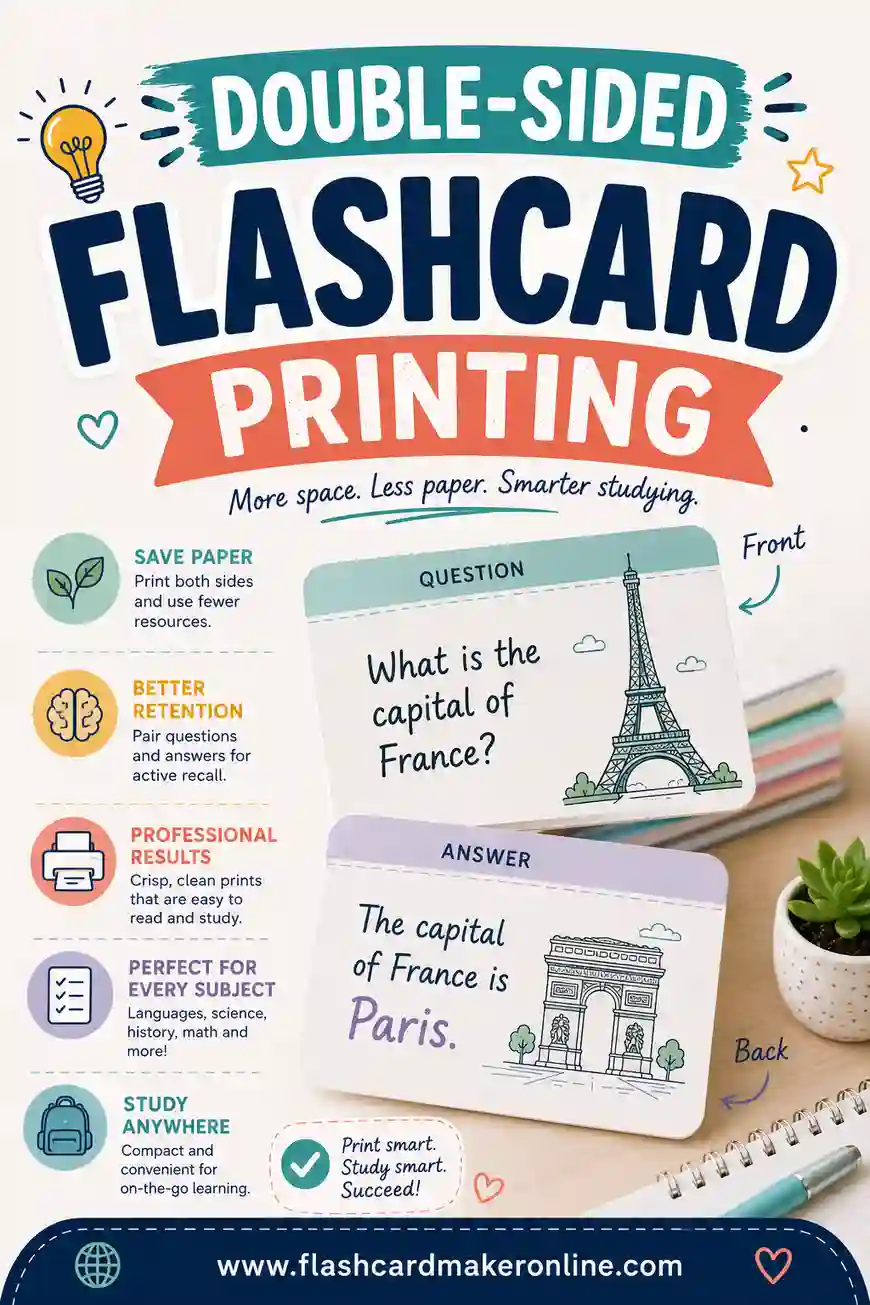
- Open Print and choose Double-sided, so each answer lines up on the back of its question.
- Choose the 3×5 index card size (or Standard, if your test page shows that it suits your pocket better).
- Click Print a test page first and print it on plain paper. Hold it up to a light to check that the fronts and backs line up. If they don't, check your printer's double-sided setting, especially whether it flips on the long edge or the short edge.
- Load your card stock and print, or save as PDF if you'd like to print at a library or copy shop.
If your printer can't print on both sides, print the fronts, put the sheets back in the tray, and print the backs, using the test page to figure out which way to reload the paper. Our guide to double-sided flashcard printing walks through manual duplex printing on common printers.
Fronts only is another option. Print just the fronts and write the answers on the back by hand. It's a little slower, but writing the answers is good practice in itself.
Step 4: Cut, trim, and punch
- Cut along the lines with a paper trimmer if you have one. Scissors work, but a trimmer gives straighter edges that stack neatly.
- Trim to wallet size if you want. For a smaller card, trim the 3×5 card down toward about 3.5 by 2 inches, roughly business-card size, by cutting a little off each end and off one long edge. Do this only if your text sits well inside the edges; trim one card first to check.
- Round the corners if you like. Rounded corners don't catch on pocket linings as much. A small corner rounder punch does this quickly, but it's optional.
- Punch one hole in the top-left corner of every card, about a quarter inch in from both edges. Punch the same corner on every card so they all face the same way on the ring.
Step 5: Put it on a ring
Slide the cards onto a binder ring. A one-inch ring holds roughly a few dozen card-stock cards comfortably, which is about the right size for a pocket. Put a blank card on the front as a cover so the first card doesn't get worn.
Paper, Rings, and Gear That Survive a Pocket
Plain printer paper is fine for a test page, but it won't last a week in a pocket. Cards get bent, damp, and soft at the corners. A little thought about materials makes a deck that lasts a whole term.
| Item | What to look for | Why it matters |
|---|---|---|
| Card stock | A medium-weight card stock your printer can feed; check your printer's manual for its maximum paper weight | Stiff enough to flip with one hand, thin enough to print and punch |
| Paper trimmer | Any small guillotine or rotary trimmer | Straight edges stack neatly and flip smoothly |
| Hole punch | A single-hole punch | Lets you put cards on a ring in a consistent spot |
| Binder rings | One-inch rings for a pocket deck; bigger rings for desk decks | Keeps cards together and in order when you drop them |
| Small zip bag or card case | Something that fits your bag pocket | Protects cards from rain and spills |
| Rubber band or clip | For cards you don't want on a ring | A loose stack is easier to shuffle |
| Colored card stock (optional) | Different colors for different subjects | Grab the right ring without reading it |
Card stock tips. Card stock is sold by weight, and heavier isn't always better. Very heavy stock may jam or refuse to feed through a home printer, especially for double-sided printing. Start with a medium weight that your printer lists as supported, and try one sheet before loading a stack. Feed it through the manual or rear tray if your printer has one, since the straighter paper path helps with stiff sheets.
Matte, not glossy. Glossy stock can smudge with some printers and makes writing on the back with a pen harder. Plain matte card stock is easier to work with.
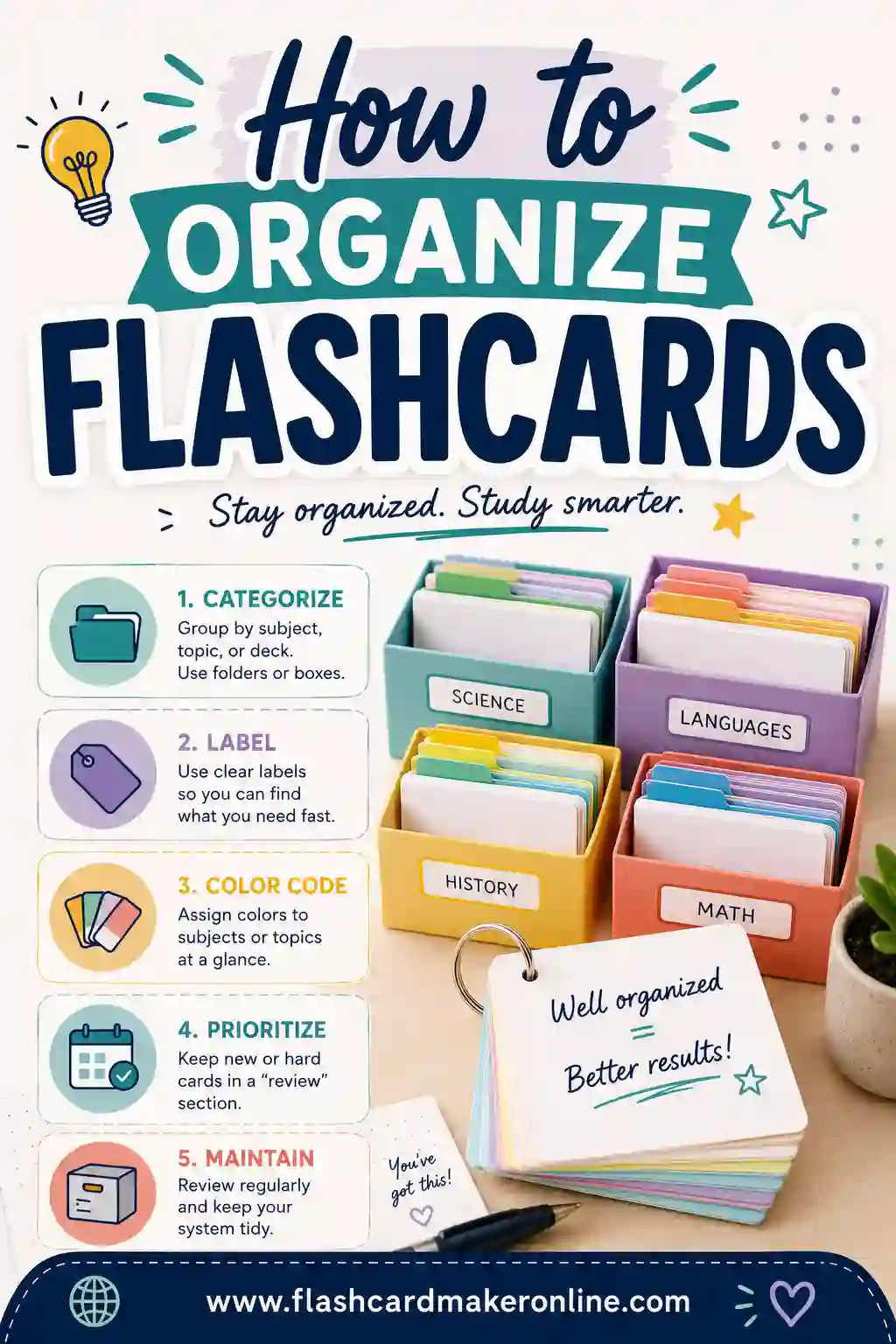
Ring or loose stack? Each has a place. A ring keeps cards in order and won't scatter if you drop it on a train platform. A loose stack is easier to shuffle. A good compromise is to keep the deck on a ring and simply move missed cards to the front of the ring as you go. For a closer look at the pros and cons of paper cards, our guide to physical flashcards covers handling, storage, and sorting in more detail.
Label your rings. Write the deck name on the blank cover card: "Spanish 1," "Pharm, cardiac," "Chem ions." When you've got three rings in a bag, you'll want to grab the right one without looking through it.
A Commute Study Routine That Actually Fits
A pocket deck works best with a simple routine. You don't need a plan for every minute. You need a rule for what to pull out and what to do with the cards you miss.
The basic loop
- Pull out today's ring. One ring of about 20 cards per day is plenty for short gaps.
- Look at the front and answer before you flip. Say it, whisper it, or think it clearly. Don't just glance at the front and flip right away; the effort of remembering is what makes the card stick.
- Sort as you go. If you got it, move the card to the back of the ring. If you missed it or hesitated, move it to the front, or flip it upside down so it stands out.
- Go around again if you have time. On the second pass, you'll hit the missed cards first.
- At the end of the day, check the missed cards. Those are the ones to study at your desk tonight, or to rewrite if the card itself is confusing.
A sample week
Here's how a week might look for someone with about a 15-minute commute each way, plus a few waits during the day.
| Time | Morning ride | Midday waits | Evening ride | At home |
|---|---|---|---|---|
| Monday | Ring A, first pass | Ring A missed cards | Ring A, second pass | Print or fix any cards that are unclear |
| Tuesday | Ring B, first pass | Ring B missed cards | Ring A, quick pass | None |
| Wednesday | Ring A, missed cards only | Ring B missed cards | Ring B, second pass | Add 5–10 new cards to whichever ring is easiest |
| Thursday | Ring A and B mixed | Whatever's in your pocket | Missed cards from both | None |
| Friday | Ring B, first pass | Ring A missed cards | Both rings, fast | Move cards you know cold to a "review later" ring |
| Weekend | Optional | Optional | Optional | Print the next ring if you're ready |
You don't have to follow it exactly. The pattern is what matters: a first pass, a focus on misses, and a mixed review before the week ends.
Rotating cards in and out
A pocket ring should stay small. When it gets too easy, it's time to rotate.
- Retire cards you've gotten right many times in a row. Move them to a "review later" ring that you only flip through once a week.
- Add new cards in small batches. Five to ten at a time is plenty for a ring you're carrying around.
- Keep the ring around 20 to 30 cards. Much more than that and you won't get through it in one ride.
- Bring old cards back now and then. Pull a handful from the "review later" ring every week or two and slip them into today's ring. If you miss one, it goes back into rotation.
If a ring starts to feel heavy, that's your signal to add fewer new cards for a few days until your misses shrink.
A note on safety
Study on the bus or train, not behind the wheel. If you drive to work, save the deck for after you've parked, or for waits once you've arrived. And on a crowded platform or a busy sidewalk, look up between cards; the deck will still be there.
Pocket Deck Ideas by Subject
Almost any subject can have a pocket deck, but some fit small cards better than others. The best ones are made of short, separate facts.
| Subject | What to put on pocket cards | Sample card |
|---|---|---|
| Foreign language | Phrases, vocabulary, verb forms | Tomorrow : Mañana |
| Medical and nursing | Abbreviations, prefixes and suffixes, normal ranges from your course | Prefix brady- means... : Slow |
| Chemistry | Element symbols, common ions, key constants | Symbol for sodium : Na |
| Math | Formulas with a blank, key identities | Area of a triangle : ½ × base × height |
| History | Dates, people, and events | Year the Declaration of Independence was adopted : 1776 |
| Geography | Capitals, countries, landmarks | Capital of Canada : Ottawa |
| Music | Note names, key signatures, terms | Tempo marking that means very slow : Largo |
| Coding | Terms and short definitions | What does API stand for? : Application Programming Interface |
| Test prep | Vocabulary, key rules, formulas from your outline | Meaning of ubiquitous : Found everywhere |
| Work and licensing | Terms, codes, and short rules from your official materials | (Copy terms straight from your official study guide) |
For exam or licensing decks, copy facts straight from your official study materials or the current outline from the testing organization, not from memory or an old book. Rules and numbers change, and a pocket deck you review every day will make a wrong fact stick just as well as a right one.
Pocket decks for different people and situations
Students with long commutes. Make one ring per class and carry the ring for whichever class has the next quiz. On the ride home, review the cards from that day's lecture while it's still fresh.
Parents with young kids. A ring of sight words, letters, or numbers fits in a diaper bag or glove box and turns a doctor's waiting room into a few minutes of easy practice. Keep sessions short and playful, stop while your child is still enjoying it, and try the Big size so the text is easy for young eyes to read, even if the ring rides in a bag instead of a pocket.
Adults learning on lunch breaks. A language ring or a work-terms ring fits in a jacket pocket or a desk drawer. Ten minutes at lunch, a few cards while the kettle boils, and you've had a solid review without carving out a study block.
Health care and trade students. Abbreviations, prefixes, and short terms are a great fit for a ring that rides in a scrub or work-jacket pocket between classes. Keep anything clinical or safety-related exactly as your course or official materials give it, and don't rely on a pocket card in place of your official references on the job.
Travelers. A ring of 30 phrases in the local language, made in the week before a trip, gets real use in lines and on trains. Put the most urgent phrases, like asking for help or directions, on brightly colored card stock so they're easy to find fast.
Subjects that fit pocket cards less well: long proofs, essay outlines, multi-step math problems, and anything that needs a big diagram. Keep those for desk study, and put just the key steps or terms on pocket cards.
Common Mistakes With Pocket Flashcards (and Fixes)
| Mistake | What happens | Fix |
|---|---|---|
| Writing desk-size cards for a pocket | Text is tiny or cut off | Keep fronts under ten words and backs to one short answer |
| Printing on plain paper | Cards bend and wear out in days | Print on card stock your printer supports |
| Skipping the test page | Fronts and backs don't line up | Use Print a test page first and check it against a light |
| Carrying the whole deck | You never get through it, so the same cards get all the attention | Carry one ring of 20 to 30 cards |
| Flipping without answering | The deck feels familiar but recall doesn't improve | Answer before you flip, every time |
| Never rotating cards | You keep reviewing cards you know | Retire easy cards and add new ones weekly |
| Punching different corners | Cards face different ways on the ring | Punch the same corner on every card |
| Tiny pictures | You can't tell what's in the picture | Use pictures only when the picture is the whole question |
| No backup of the deck | A lost ring means retyping | Use Download .csv to keep the deck as a file |
That last point is easy to overlook. A ring of cards can slip out of a pocket. If you've saved the deck with Download .csv, you can bring it back with Import a file and reprint in a few minutes. You can also use Get share link to keep a copy you can open from another device.
Ready to try it? Pick one short topic, type 20 cards, and print them double-sided at 3×5 in the free flashcard maker. By the end of the week, you'll know whether the ring lives in your pocket or your bag, and you'll have a few dozen facts you didn't have before.
▶ Open this deck in the flashcard maker
Frequently Asked Questions
What size are pocket flashcards?
Most pocket flashcards are 3×5 inches, the size of a small index card, which fits in most jacket pockets and many pants pockets. For something closer to wallet size, you can print at 3×5 and trim down toward about 3.5 by 2 inches, roughly the size of a business card. Print a test page first to see the exact size your printer produces.
Can I print small flashcards double-sided at home?
Yes. Choose Double-sided in the maker's Print options, and the backs line up behind the fronts. Print a test page first on plain paper and hold it up to a light to make sure your printer is flipping the paper the right way.
What paper should I use for pocket flashcards?
Use a medium-weight matte card stock that your printer lists as supported. It's stiff enough to flip with one hand and survives a pocket much better than plain paper. Very heavy stock can jam home printers, so test one sheet before printing a full deck.
How many cards should I carry at once?
A ring of about 20 to 30 cards is a good size for a commute. That's enough for one or two passes in a 10- to 15-minute ride. Keep the rest at home and rotate cards in and out each week.
Are paper pocket cards better than studying on my phone?
They each have strengths. Paper cards don't come with notifications, they're easy to sort by hand, and they don't need a battery. A phone is handy when you didn't bring a ring. Many people use both: a printed ring for the commute and the on-screen Study mode at home.
How do I make ring flashcards?
Print your deck on card stock, cut the cards apart, and punch one hole in the same corner of every card. Slide them onto a binder ring, with a blank card on top as a cover. A one-inch ring holds enough cards for a pocket deck.
Can I add pictures to small flashcards?
Yes, but use them sparingly on small cards. A picture works best when it's the whole question, like a flag, a sign, or a single letter. A small picture next to text can be hard to see at pocket size.
What subjects work best for pocket flashcards?
Subjects made of short, separate facts work best: language phrases and vocabulary, abbreviations, element symbols, dates, capitals, formulas, and key terms. Long explanations, proofs, and big diagrams are better studied at a desk, with just the key terms on pocket cards.
Can I use the same deck on screen and on paper?
Yes. Build the deck once in the maker, study it in Study mode at home, and print it for your pocket. If you change a card, reprint just that page, and keep a copy of the deck with Download .csv.