Winter Break Learning Loss: A 15-Minute Daily Flashcard Routine
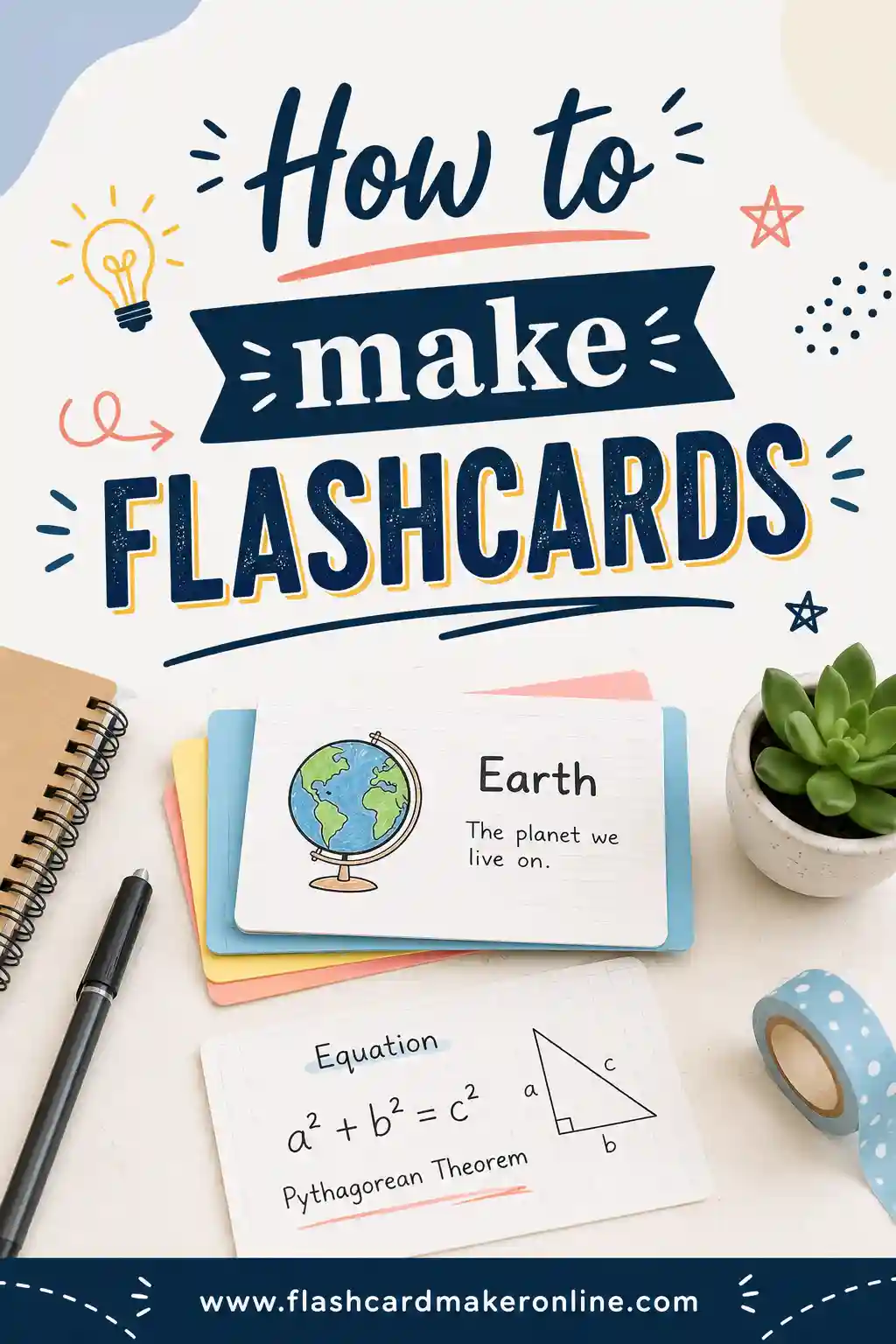
The easiest way to protect winter break learning is to build one 15-card deck from things your child learned this fall, and review it for 15 minutes a day, most days of the break. That's it. No workbooks, no worksheets to fight over, no plan that collapses the day the cousins arrive. You can make the deck in about ten minutes with our free flashcard maker, and print it or study it on screen.
The routine below works because it's small. Fifteen cards is few enough to finish every time, and fifteen minutes is short enough to fit between breakfast and whatever the day holds. You'll find how to pick the cards, ready-to-paste sample decks for kindergarten through middle school, a day-by-day calendar for a two-week break, and what to do on the days the plan falls apart (because some days will).
🃏 Quiz yourself: 10 cards from this page
Read the front, say your answer, then tap the card to check.
Make, study & print this deck → Opens the free flashcard maker with all 10 cards ready to edit or print.▶ Open this deck in the flashcard maker
Why Kids Slip Over Winter Break
Most parents have seen it. School lets out in December, and in January your kid stares at 7 × 8 like it's a new language. Teachers often spend the first days back reviewing, and the kids who kept a little practice going tend to settle back in faster.
The reason is simple. Memory fades when it isn't used. A fact your child pulled up every day in class, like a spelling pattern or a times table, gets pulled up zero times over two weeks of holiday. When that happens, the fact doesn't vanish, but it gets harder to reach. Teachers call it "rust." Researchers call it forgetting. Either way, the fix is the same: bring the fact back to mind every so often, so it never goes fully cold.
That's what a flashcard does better than almost anything else. A card asks a question and makes your child answer from memory before seeing the back. That act of pulling the answer out, called retrieval or active recall, is what keeps a memory strong. Reading over notes or watching a video doesn't do the same job, because the answer is already sitting in front of you. If you want the longer version of why this works, our page on how to beat the forgetting curve walks through it.
One thing to keep in mind: you're not trying to teach new material. Winter break is for keeping what your child already learned, in small, steady doses, while still leaving plenty of room for real rest.
The 15-Card, 15-Minute Routine at a Glance
Here's the whole thing in one table. Print it, stick it on the fridge, and you're set.
| Minute | What you do | Why |
|---|---|---|
| 0–1 | Shuffle the deck. Set a timer for 15 minutes. | Shuffling stops your child from memorizing the order instead of the facts. |
| 1–6 | First pass: go through all 15 cards. Your child answers out loud before flipping. | Saying it out loud forces a real answer, not "I kind of knew it." |
| 6–7 | Sort into two piles: "got it fast" and "missed or slow." | Slow answers count as misses. The goal is quick, sure recall. |
| 7–12 | Second pass: only the "missed or slow" pile, two or three times through. | Extra reps go where they're needed. |
| 12–14 | Quick game round with the whole deck (ideas below). | Ends on a fun, easy note so tomorrow isn't a battle. |
| 14–15 | Pick 1–3 cards that were easy all week to swap out. Note the trouble cards. | Keeps the deck fresh and pointed at the right facts. |
It moves fast. After two or three sessions, the first pass takes three minutes or less.
Two rules make this work:
- The timer ends the session. When it rings, you stop, even mid-card, even if it's going great. Stopping while it's still fine is what makes tomorrow easy to start.
- Answers come before the flip. If your child says "I know this one" and flips, it doesn't count. They have to say the answer first. That's the whole point of a flashcard.
Why 15 Cards (and Not 50)
It's tempting to make a big deck. There's so much your child could review. But a big deck over a holiday tends to go the same way: day one is fine, day two is long, and by day four nobody wants to open the box.
Fifteen cards does a few things for you:
- Your child can finish it. Every session ends with "done," not "we'll do the rest tomorrow." That feeling matters to a seven-year-old, and honestly it matters to a fourteen-year-old too.
- Each card gets seen often. In a 15-minute session with 15 cards, every card comes up at least once and the hard ones come up four or five times. With 50 cards, the hard ones barely get a second look.
- You can actually choose well. Picking 15 cards forces you to choose the facts that matter most, the ones your child will need in the first week back.
- It's easy to swap. When a card gets easy, retire it and add a new one. The deck stays at 15, but over two weeks your child might work through 25 or 30 different facts.
If your child is older or loves the cards, you can go up to 20 or 25. For little ones, kindergarten and younger, you can go down to 8 or 10. For a holiday routine, small wins.
How to Choose the 15 Cards
This is the most important ten minutes of the whole plan. The right 15 cards make the routine worth it. The wrong ones (too easy, too hard, or too random) make it feel like busywork.
Step 1: Look at what came home
Dig through the backpack. Graded tests, homework, the reading log, the spelling list, the math packet from the last unit. You're looking for two things:
- What they studied most recently. The last unit before break is the one the teacher will build on in January.
- What they got wrong. Missed test questions and marked-up homework are a gold mine. Each mistake is a card waiting to be written.
If you have access to a class website or a teacher's newsletter, check what's coming up after break. A card that previews a skill they'll need in week one (like knowing their 6s before division starts) is a smart pick.
Step 2: Split the deck into a simple mix
A good 15-card deck for most elementary kids looks something like this:
| Part of the deck | Cards | Examples |
|---|---|---|
| Math facts | 6–7 | The times tables or addition facts they're slowest on |
| Words | 4–5 | Spelling words, sight words, or vocabulary from reading |
| One "big idea" topic | 2–3 | A science term, a state capital, a grammar rule |
| A stretch card | 1 | Something a little harder that previews next unit |
For middle schoolers, swap the math facts for formulas or steps (like the order of operations or how to find the area of a triangle), and the words for vocabulary from their current English or science unit.
You don't have to follow this mix exactly. If your child's teacher says math facts are the big gap, make it 12 math cards and 3 others. If reading is the worry, flip it. The mix just keeps things varied, which helps attention.
Step 3: Ask your child
Kids usually know which facts trip them up. Ask, "Which times table is the worst?" or "Which spelling words always get you?" You'll get honest answers, and a child who helped choose the cards fights the routine a lot less. Some kids like to pick one "fun card" too, a fact about their favorite animal or a trivia question, and that's fine. One fun card in fifteen keeps things light.
Step 4: Check every card
Before you print, read each card and ask two questions. Is it one fact? And is the answer on the back correct and short? A card that says "Explain photosynthesis" is a paragraph, not a flashcard. Break it into smaller cards like "What gas do plants take in for photosynthesis?" with "Carbon dioxide" on the back. One question, one short answer.
Sample Winter Break Decks by Grade
Below are ready-made decks for different ages. Each one is written in the front : back format, one card per line, so you can copy a block and drop it straight into the maker's Paste a list box. Change any card that doesn't match what your child is learning. These are starting points, not a curriculum.
Kindergarten (10 cards)
Little ones do better with fewer cards and more pictures. Keep sessions closer to 10 minutes and make it playful.
the : the
and : and
is : is
see : see
can : can
How many? (draw 5 dots) : 5
What comes after 7? : 8
What sound does B make? : /b/ as in ball
What sound does M make? : /m/ as in moon
Circle, square, or triangle? (draw a triangle) : Triangle
For the sight word cards, the front and back look the same on purpose. Your child reads the front out loud, then flips to check. If you'd rather, put a picture or a short sentence on the back, like "I see a dog." You can add pictures to any card in the maker, which helps a lot at this age. The sight word flashcards page has longer lists if you want to swap in different words.
1st and 2nd Grade (15 cards)
8 + 7 : 15
9 + 6 : 15
6 + 6 : 12
13 - 5 : 8
15 - 8 : 7
10 more than 46 : 56
What is 4 tens and 3 ones? : 43
said : s-a-i-d
because : b-e-c-a-u-s-e
friend : f-r-i-e-n-d
What do you call a word that names an action? : A verb
What punctuation ends a question? : A question mark
How many days are in a week? : 7
What season comes after winter? : Spring
Which is more, 3 tens or 28 ones? : 3 tens (30 is more than 28)
At this age, addition and subtraction facts within 20 matter a lot. If your child counts on fingers for every one, put the slowest facts on cards and leave the easy ones off. A first grader who knows 5 + 5 cold doesn't need that card.
3rd and 4th Grade (15 cards)
This is the big multiplication stretch. Most of the deck should be the facts your child is slowest on.
7 x 8 : 56
6 x 7 : 42
8 x 6 : 48
9 x 7 : 63
6 x 9 : 54
8 x 8 : 64
56 ÷ 7 : 8
36 ÷ 4 : 9
Which is bigger, 3/4 or 2/3? : 3/4 (9/12 vs. 8/12)
What is the perimeter of a 5 by 3 rectangle? : 16 units
What does a noun name? : A person, place, thing, or idea
What is a synonym for big? : Large (or huge, giant)
What are the three states of matter? : Solid, liquid, gas
Capital of Texas : Austin
Round 467 to the nearest hundred : 500
If you want more times-table cards to rotate in, the multiplication flashcards page lists the full set, and the maker has a Multiplication preset you can start from and trim down to the hard ones.
5th and 6th Grade (15 cards)
3/4 as a decimal : 0.75
0.6 as a fraction in lowest terms : 3/5
1/2 + 1/3 : 5/6
What is 25% of 80? : 20
Order of operations (memory phrase) : PEMDAS, parentheses, exponents, multiply/divide, add/subtract
Area of a triangle : 1/2 x base x height
What is a prime number? : A whole number greater than 1 with exactly two factors, 1 and itself
Volume of a rectangular prism : length x width x height
What does a verb do? : Shows an action or a state of being
What is a theme in a story? : The message or lesson the author wants you to take away
Simile or metaphor? Her voice was music. : Metaphor (no like or as)
What do plants need for photosynthesis? : Sunlight, water, and carbon dioxide
What layer of Earth do we live on? : The crust
Capital of New York : Albany
Who was the first US president? : George Washington
Notice that none of these fronts has a colon in it. That matters, because the maker splits each line at the colon. Keep colons out of the front side of your own cards, and you'll be fine.
7th and 8th Grade (15 cards)
Middle schoolers often have several classes going at once, so their deck usually works best focused on the one or two classes with a test or project right after break.
Solve 3x + 5 = 20 : x = 5
Slope formula : (y2 - y1) / (x2 - x1)
Area of a circle : pi x r squared
Circumference of a circle : 2 x pi x r (or pi x d)
Pythagorean theorem : a squared + b squared = c squared (right triangles)
-4 x -6 : 24
What is an integer? : A whole number, positive, negative, or zero
What does the mitochondria do? : Releases energy from food for the cell
Difference between weather and climate : Weather is day to day; climate is the long-term pattern
Newton's first law : An object keeps doing what it's doing unless a force acts on it
What is an independent variable? : The thing you change on purpose in an experiment
What is a thesis statement? : One sentence that states the main argument of an essay
Year the Declaration of Independence was signed : 1776
What are the three branches of US government? : Legislative, executive, judicial
What does the prefix bio- mean? : Life
Teens push back on parent-made decks. Let them write their own cards. It works better anyway, because writing the card is part of the learning. Your part is to check that the answers are right and that the deck stays at about 15.
How to Build This Deck in the Free Flashcard Maker
This whole setup takes about ten minutes. Here are the exact steps in the free flashcard maker.
- Name the deck. Type a title like "Maya's Winter Break Deck." A name helps a lot when you have more than one kid doing this.
- Start from a preset or paste your list.
- If most of the deck is one kind of fact, choose Start from a preset (for example Multiplication, Addition, Sight Words, Fractions, or US States & Capitals). Then delete the cards your child already knows cold until you're down to the hard ones.
- If you're mixing subjects, click Paste a list and paste one card per line in
front : backformat, like7 x 8 : 56. Pick Add to deck to add the cards, or Replace deck to start fresh. - Add pictures where they help. For younger kids, add a picture to sight word cards or shape cards. A picture of a dog on the back of "dog" turns a reading card into a reading-and-meaning card.
- Use + Add card for one-offs. Thought of a card later? Click + Add card and type it in.
- Try it in Study mode. Hit Shuffle, then use Flip and Next to run through it once with your child on screen. The 🔊 Read aloud button reads the card out loud, which helps pre-readers and kids practicing pronunciation in a new language.
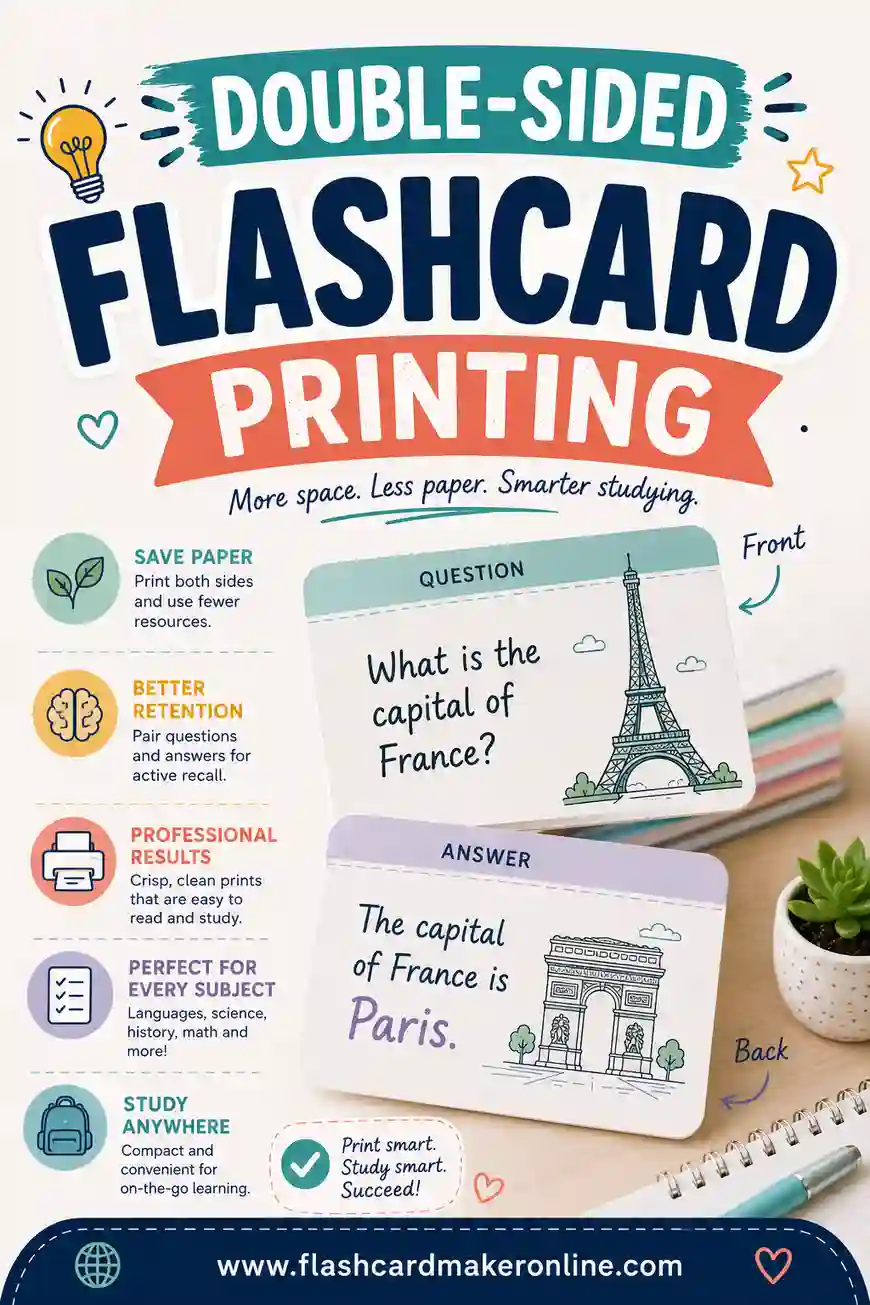
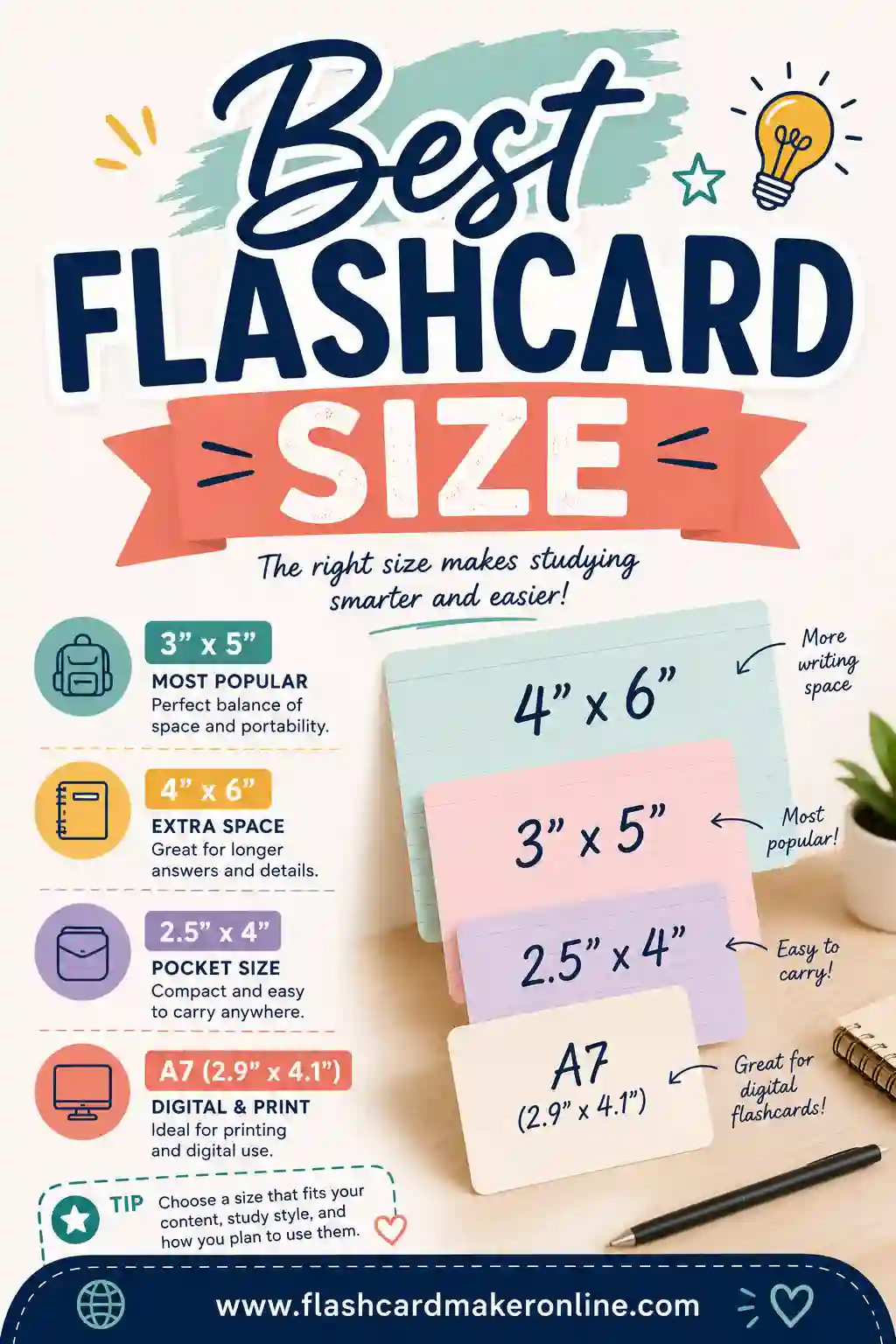
- Print it. Choose Double-sided so the fronts and backs line up, then pick a size. Big or Jumbo work well for little kids who like holding the cards, Standard works for most ages, and 3×5 index card or 4×6 index card fit a recipe box or a ring. Click Print a test page first so you can check that the backs line up with the fronts on your printer before you print the whole deck. You can also save it as a PDF and print it later.
- Save a copy. Click Download .csv so you can bring the deck back later with Import a file, or click Get share link if you want a grandparent or the other parent to have their own copy for a visit.
If you'd rather skip double-sided printing, choose Fronts only and read the answers from the screen, or use the Cut-out grid layout and fold or glue the cards. Our step-by-step guide on double-sided flashcard printing covers the printer settings if your backs don't line up.
Paper or screen?
Both work. Here's a quick way to decide.
| Paper cards | Screen (Study mode) |
|---|---|
| Easy for little hands to sort into piles | Nothing to lose or bend |
| No screen time, which many families like over break | Read aloud helps with sounds and pronunciation |
| Great for games like hiding cards around the room | Shuffle is one tap |
| Travel well in a zip bag or on a ring | Works on a phone in the car |
Many families do both: printed cards at home and the screen version on travel days.
A Day-by-Day Plan for a Two-Week Break
Winter breaks run about two weeks for many schools, though yours might be shorter or longer. This calendar assumes 16 days off, from the last day of school to the first day back. Shift it to fit your dates.
Notice that it doesn't run every single day. Holidays, travel, and plain lazy days are built in. Ten or eleven sessions over the break is a great result.
| Day | Plan | Notes |
|---|---|---|
| 1 | Rest day | First day off. Let it be a real break. |
| 2 | Build the deck together (10 min) + first session | Go through the backpack, pick 15 cards, print or open them. |
| 3 | Session | Expect lots of "slow" cards. That's normal. |
| 4 | Session | Already faster. Point that out. |
| 5 | Session + swap 1–3 easy cards | First swap. New cards keep it interesting. |
| 6 | Holiday or family day: skip, or 3-minute "lightning round" | Just the trouble pile, standing up, done. |
| 7 | Holiday or family day: skip | No guilt. |
| 8 | Session | Restarting is easy because the deck is small. |
| 9 | Session | Try a new game round (ideas below). |
| 10 | Session + swap 1–3 cards | Add a stretch card that previews the next unit. |
| 11 | Travel or visiting day: screen version or skip | A share link means grandparents can run it too. |
| 12 | Session | Check the trouble pile. Is it shrinking? |
| 13 | Session + swap | Last swap of the break. |
| 14 | Rest day | Enjoy it. |
| 15 | "Back to school" review: every card used during break, shuffled | Bring back the retired cards too. |
| 16 | Light 5-minute warm-up, then pack the cards | Some kids like to keep a few in their backpack. |
On the day-15 review, you'll likely have 25 to 30 cards if you've been swapping. That's fine for one longer session. It's a nice moment, too. Your child sees a pile of cards that were hard two weeks ago and are easy now. That's proof the routine worked, and kids remember that feeling.
Shorter break? Drop the extra rest days and aim for six or seven sessions. Longer one? Keep the rhythm and add a full-deck review each week.
Quick Game Rounds That Keep It Fun
The game round at minutes 12 to 14 is the part kids look forward to. It also gives the brain one more round of recall without feeling like work. Rotate these so it doesn't get stale.
- Beat the timer. Time how long it takes to answer all 15 cards. Write it down. Tomorrow, try to beat it. Kids love watching the number drop, and speed shows the facts are getting automatic.
- Teacher swap. Your child holds the cards and quizzes you. Get a couple wrong on purpose. Kids light up when they get to correct a parent, and checking your answer means they have to know it too.
- Card hunt. Hide the cards around a room. Your child has to answer each one when they find it before grabbing the next.
- Three in a row. Get three cards right in a row and earn a small reward, like picking the next family movie or an extra story at bedtime.
- Snowball toss. Crumple a sheet of paper into a "snowball." Every right answer earns a toss into a laundry basket. It fits the season, and it burns off a bit of energy.
- Reverse it. Read the back and have your child give the front. "56" means "7 × 8" (or "8 × 7"). This works especially well for vocabulary.
For more ideas, our list of games using flashcards has plenty that work with any deck.
Fitting It Into a Holiday Week
The best time for most kids is right after breakfast, before the day's plans start. Their brains are fresh, and it gets done before anything else can crowd it out. Some families like it right before a favorite show, which gives the session a natural end point. Others do it in the car on the way to visit family, with one parent driving and the other running cards.
A few small habits help:
- Keep the cards somewhere visible. A zip bag on the kitchen counter gets used. A box in a closet gets forgotten.
- Tie it to something that already happens. "Cards after breakfast" is easier to stick to than "cards sometime today."
- Bring the cards when you travel. A ring of index cards or the screen version on your phone makes a long drive or a wait at the airport easier.
- Let other adults help. If your child spends a few days with grandparents, send the share link. Grandparents often love being the quiz master, and the link gives them their own copy of the deck in the maker.
If your family celebrates Christmas, you can make one or two cards holiday themed for fun, or build a separate just-for-fun deck. Words like snow, mitten, sled, and gift make easy, cheerful cards for younger kids.
Adjusting the Routine by Age
The 15-and-15 rule is a good default, but kids aren't all the same. Here's how to tune it.
| Age or grade | Cards | Minutes | What helps most |
|---|---|---|---|
| Preschool and kindergarten | 6–10 | 5–10 | Pictures on cards, Read aloud, lots of praise, sitting on the floor |
| Grades 1–2 | 10–15 | 10–15 | Big cards, short game round, a sticker chart for sessions done |
| Grades 3–5 | 15 | 15 | Beat the timer, letting them choose a fun card |
| Grades 6–8 | 15–20 | 15 | Student writes the cards, parent checks answers |
| High school | 15–25 | 15–20 | Student runs it alone; parent only asks "did you do your cards?" |
A few more things to keep in mind:
- Kids who struggle with attention often do better with two 7-minute sessions than one 15-minute one. Keep the cards the same and just split the time.
- Kids with an IEP or learning plan may have goals the teacher is already working on. If you know the goals, those make great cards. If you're not sure, a quick email to the teacher before break can point you in the right direction.
- Siblings each get their own deck. Sharing one deck across ages means it's too easy for one kid and too hard for the other. You can still run sessions back to back.
Common Mistakes (and How to Fix Them)
Most routines fall apart for the same few reasons. Here's what to watch for.
| Mistake | What happens | Fix |
|---|---|---|
| Deck too big | Sessions run long, kids dread them | Cut back to 15. Keep only the slowest facts. |
| Cards too easy | Bored kid, no real practice | Swap out any card answered fast three days in a row. |
| Cards too hard | Frustration and tears | Hard means "slow but gettable," not brand new. Leave new material for the teacher. |
| Flipping before answering | Feels like studying, isn't | Answer out loud first, every time. |
| Skipping the timer | Sessions drift to 30 minutes, then stop entirely | Set the timer. Stop when it rings. |
| Missing a few days, then quitting | The whole plan dies by New Year's | Missed days are expected. Just pick back up. The deck is still there. |
| Making it a punishment | "No screens until you do your cards" builds resentment | Pair it with something nice, like hot cocoa or a favorite show afterward. |
| Same order every time | Kid memorizes the sequence, not the facts | Shuffle before every session. |
The biggest one is the "missed days" problem. Every family has a day where the plan falls apart: a cousin's sleepover, a long car ride, a sick day. That's fine. A small deck makes restarting easy, because there's no backlog. Day 8 looks just like day 3.
Getting Ready for the First Week Back
The last two days of break set up the first week of school. Here's how to use them well.
- Do the full review on day 15. Shuffle every card your child studied over break, including the ones you retired. This shows you what stuck and what needs one more push.
- Pull out the trouble cards. Any card your child still missed or answered slowly goes into a small "first week" pile.
- Keep the first-week pile going. Five minutes a day during the first week of school, just those cards. Once they're easy, you're done.
- Tell the teacher what you noticed, if it's useful. A short note like "We worked on the 7s and 8s over break, and the 7s are still slow" helps a teacher know where your child stands.
- Save the deck. Download the .csv so you can reuse it. The same routine works for spring break and summer, and you'll have a head start next time.
Once school is back, the habit you built can keep going in a lighter form. A few minutes of cards a couple of times a week, with a deck that follows what the class is learning, is plenty for most kids.
Start Your Winter Break Deck Today
You don't need a curriculum or a pile of workbooks to keep winter break learning on track. You need 15 good cards, a timer, and a few minutes most mornings. Pick the facts your child is slowest on, set up the deck, and let the routine do the rest.
Open the free flashcard maker, paste one of the sample decks above or start from a preset, and print it double-sided in a size your child likes holding. Spend ten minutes tonight, and the routine can start tomorrow morning.
▶ Open this deck in the flashcard maker
Frequently Asked Questions
How much should kids study over winter break?
A short daily routine is plenty for most kids. About 15 minutes a day, most days of the break, keeps important facts fresh without eating into rest and family time. Younger children can do 5 to 10 minutes. The goal is keeping what they know, not getting ahead.
What should be on a winter break flashcard deck?
Focus on what your child learned right before break and what they got wrong on recent tests or homework. A good mix for elementary kids is mostly math facts, a few spelling or sight words, and two or three cards from science or social studies. Middle and high schoolers should build cards from the study guide for their first test after break.
Is 15 cards really enough?
Yes, for a holiday routine. Fifteen cards means every card gets seen often and the hard ones get extra turns. You'll swap easy cards out every few days, so your child may work through 25 or 30 facts over the whole break.
What if we miss a few days?
That's normal and fine. Just pick back up the next day with the same deck. Because the deck is small, there's no pile of catch-up work, and a missed day or two over the holidays won't undo the progress.
My child hates flashcards. What can I do?
Make the sessions shorter, more playful, and more in your child's control. Let them pick some of the cards, quiz you instead, or play a game like beat the timer or card hunt. Ending each session on an easy, fun round makes the next day much easier to start.
Should I use printed cards or study on a screen?
Either works. Printed cards are nice for younger kids and for families cutting back on screens over break, while Study mode is handy for travel and has Read aloud. Many families print a set for home and use the screen version on the road.
Can I use the same deck for more than one child?
It usually works better to give each child their own deck. Kids at different ages need different facts, and a shared deck ends up too easy for one and too hard for the other. You can still run the sessions back to back.
Does this routine work for spring break and summer?
Yes. The same idea works for any break: pick the facts that matter most, keep the deck small, and review a little each day. For a long summer break, you might rotate in a fresh deck every couple of weeks to cover more ground.