Chunking Memory: How Grouping Information Stretches Your Working Memory
Chunking memory is the habit of grouping small pieces of information into bigger, meaningful units so your brain can hold more at once. You already do it with phone numbers: ten separate digits become three tidy groups. Your short-term memory can only juggle a handful of things at a time, but each "thing" can be a single letter or a whole familiar pattern. Make the patterns bigger and more meaningful, and you squeeze far more information through the same narrow window.
This guide explains where the idea came from, what the famous "seven plus or minus two" really means, why many researchers now say the limit is closer to four, how chess masters and memory champions use chunking, and how to apply it to your own flashcards. There are worked examples, a step-by-step method and a few exercises you can try in five minutes.
What a chunk actually is
A chunk is a group of items that your brain treats as one unit because the group already means something to you. The letters C, A and T are three items to a child learning to read and one item (the word "cat") to everyone else. The digits 1, 7, 7 and 6 are four items, unless you know US history, in which case they're one: 1776.
That last example shows the key point. Chunking isn't a trick you perform on the information alone. It depends on what's already in your long-term memory, the huge, durable store of everything you know. A chunk is a pattern you recognize. The more patterns you know in a subject, the bigger the chunks you can form.
Two more terms are worth defining:
- Short-term memory is the small store that holds information for a few seconds, like a number someone just read to you.
- Working memory is short-term memory plus the mental work you do on it, like holding a number in mind while you add another one to it. Most researchers today talk about working memory, and the two terms often overlap.
Chunking lives right at the meeting point of these systems. You use long-term knowledge to pack incoming information into fewer, richer units, so it fits in a working memory that has very little room.
Where it started: Miller's "magical number seven"
In 1956, the psychologist George A. Miller published one of the most quoted papers in psychology, "The Magical Number Seven, Plus or Minus Two" in Psychological Review. It's hosted today by York University's Classics in the History of Psychology collection, and it's surprisingly readable.
Miller was actually looking at two different limits:
- Absolute judgment: how many different levels of something (like pitch or loudness) people can tell apart reliably. Across the studies he reviewed, the answer clustered around six or seven categories.
- Immediate memory span: how many items people can repeat back right after hearing them. This is the limit that matters for studying.
For memory span, Miller noticed something surprising. The limit didn't depend much on how much information each item carried. People could recall about nine binary digits (0s and 1s) but only about five one-syllable words, even though each word carries far more information than a single 0 or 1. The limit was set by the number of items, not their size. Miller called those items chunks, describing the process as organizing the input "into familiar units or chunks."
He also gave the strategy its technical name. Packing many small items into fewer, richer ones is what communication engineers called recoding. His favorite example was a beginning telegraph operator. At first, each dot and dash is a separate chunk. With practice, the operator hears whole letters, then words, then phrases, and can hold far more of the message in mind.
The binary-digit experiment
Miller described an experiment by Sidney Smith that shows recoding beautifully. Smith started with long strings of binary digits, such as 101000100111001110. He then learned to rename small groups of digits with single new symbols, much as the pair "10" could be renamed "2" and the triple "101" could be renamed "5" in base eight. After drilling himself on these schemes, Smith's recall grew dramatically:
| Recoding scheme | Binary digits per new chunk | Binary digits Smith could recall (about) |
|---|---|---|
| No recoding | 1 | 9 |
| 2:1 (pairs renamed) | 2 | 24 |
| 3:1 (triples renamed) | 3 | 36 |
| 4:1 and 5:1 | 4 or 5 | 40 |
Look at the 3:1 row: 36 binary digits divided by 3 per chunk is 12 chunks. Smith wasn't holding 36 separate things. He was holding a manageable number of bigger things. Miller noted an important catch, though: other participants who had only a few minutes of training improved much less. Recoding pays off only after the new chunks become automatic. That's a lesson every flashcard user should remember.
Chunking memory and the "four, not seven" update
Miller's "seven" became famous, but he meant it loosely. Over the following decades, researchers noticed that when people can't use tricks like rehearsing or grouping, their limit looks smaller.
In 2001, Nelson Cowan pulled this evidence together in a major paper in Behavioral and Brain Sciences, "The magical number 4 in short-term memory". He argued for a central capacity limit "averaging about four chunks." The reason Miller's number came out higher, roughly, is that people in many older experiments were quietly grouping and rehearsing, so each of their "items" was really a small chunk.
Cowan returned to the question in a shorter, very readable 2010 article, "The Magical Mystery Four" in Current Directions in Psychological Science. There he describes a central store that holds about three to five meaningful items in young adults, while also noting that people differ and that the measured limit depends on the task.
| Estimate | Who proposed it | What it measures | What it means for you |
|---|---|---|---|
| About 7, plus or minus 2 | Miller (1956) | Items people can repeat back, often with grouping and rehearsal helping | A rough rule of thumb, not a precise law |
| About 4 chunks | Cowan (2001) | Chunks held when grouping and rehearsal are blocked | Your raw "slots" are fewer than you'd think |
| About 3 to 5 meaningful items | Cowan (2010) | Central working memory store in young adults | Plan study materials around small sets |
The good news hidden in that small number: a chunk can be almost any size, as long as it's one meaningful unit for you. Four slots holding four letters store very little. Four slots holding four familiar phrases store a lot.
Why chunking frees up room for other things
It's one thing to say chunking lets you remember the chunked material. A more useful question is whether it also helps with everything else you're holding in mind. Mirko Thalmann, Alessandra Souza and Klaus Oberauer tested exactly that. In "How does chunking help working memory?" (2019), four experiments showed that when part of a list could be chunked, people also remembered the other, non-chunked items in that list better.
Their explanation is that a chunk is pulled from long-term memory as one compact unit, which leaves more working memory free for whatever comes next. Two details are especially practical:
- Chunks that appeared early in a list helped people remember later material. Chunks at the end didn't help much, because there was nothing left to free up room for.
- The size of the chunk didn't matter much, as long as chunks didn't share overlapping parts that could get confused.
For studying, that suggests a simple order of operations: secure the familiar patterns first, then build on them. If the basic vocabulary of a subject is already chunked, your working memory is free to handle the new idea in front of you.
Experts think in bigger chunks
Chunking is one of the main ways scientists explain expertise. Chess is the classic case.
Building on earlier work by the Dutch psychologist Adriaan de Groot, William Chase and Herbert Simon proposed in 1973 that chess masters don't have better raw memory than beginners. Instead, after years of play, they've stored a huge library of familiar piece arrangements. When a master glances at a real game position, she sees a few meaningful clusters instead of dozens of separate pieces. Set up pieces at random, in patterns that wouldn't occur in a real game, and much of that advantage disappears, because there are no familiar clusters to recognize.
Fernand Gobet and Herbert Simon later refined this idea. In "Recall of random and distorted chess positions" (1996), their computer simulation and human experiment supported the common estimate that chess masters store about 50,000 chunks. They also found that recall dropped when positions were mirror-reflected, which suggests each chunk stores a specific arrangement in a specific place on the board. Their "template theory" extends the original chunking idea by proposing that very familiar chunks grow into larger templates with slots that can be filled in.
Gobet and colleagues summarize the wider research in "Chunking mechanisms in human learning" (2001) in Trends in Cognitive Sciences. They separate two kinds of chunking:
- Deliberate chunking: you choose to group things on purpose, like splitting a phone number into parts or turning a list into an acronym.
- Automatic chunking: your brain picks up recurring patterns on its own through repeated exposure, like a reader who no longer sees letters but whole words.
Both matter for students. Deliberate chunking helps you get started. Automatic chunking is what happens after enough practice, and it's the deep payoff of regular review.
Memory champions: chunking plus practice
The most dramatic chunking study involves one ordinary college student. In "Acquisition of a memory skill" (1980), published in Science, K. Anders Ericsson, William Chase and Steve Faloon reported that after more than 230 hours of practice in the lab, their participant's digit span grew from 7 digits to 79. On other digit tests, he performed like memory experts who had trained for a lifetime.
He didn't grow a bigger working memory. He built a system for turning groups of digits into meaningful chunks drawn from things he already knew well, then organized those chunks into larger structures. The authors concluded that, with a suitable mnemonic system, practice seems to have no clear ceiling on this kind of memory performance.
Two lessons stand out. First, chunking works best when the chunks connect to knowledge you already have. Second, it takes practice. That 230-plus hours is a reminder that chunking is a skill you build, not a switch you flip.
Everyday chunking you already do
Once you look for it, chunking is everywhere:
- Phone numbers and card numbers are printed in groups so you can read and copy them more easily.
- Acronyms like NASA or FBI pack several words into one pronounceable unit.
- Reading is chunking on autopilot. Skilled readers see words and short phrases, not letters.
- Music students learn scales and chord shapes so a passage becomes a few familiar patterns instead of dozens of separate notes.
- Driving directions turn into chunks like "take the highway to the mall exit" instead of a list of every turn.
- Math facts such as 7 × 8 = 56 become single chunks with practice, which frees working memory for multistep problems. That's a big reason multiplication flashcards still matter in an age of calculators.
How to chunk information you're studying, step by step
Here's a practical method you can use on almost any subject.
- Understand before you chunk. Chunks are built from meaning. If you don't understand how the parts relate, any grouping will be arbitrary and fragile. Read, ask questions and get the big picture first.
- Find the natural groups. Look for categories, steps in a process, causes and effects, or parts of a structure. Most material already has seams; your job is to find them.
- Keep each group small. Given the three-to-five estimate, aim for groups of about three to five items. If a group gets bigger, split it into subgroups.
- Name each chunk. Give every group a short label, an acronym, an image or a story. The label is the handle you'll use to pull the whole chunk out of memory.
- Link chunks into a bigger structure. Organize your labeled groups into an outline, a timeline or a diagram. This is the "chunks of chunks" idea that helped the digit-span participant.
- Practice retrieving the chunks. Turn each chunk into a set of flashcards and quiz yourself, so recognizing the pattern becomes automatic. Use active recall rather than rereading.
- Space your practice. Review over several days with spaced repetition. Automatic chunking comes from repeated exposure over time, not one long session.
Worked examples by subject
These examples show what chunking looks like in practice. They're illustrative and meant to model the method.
| Subject | Raw material | Chunked version |
|---|---|---|
| Biology | Eight separate organelles to learn | Group by job: "energy" (mitochondria, chloroplasts), "making proteins" (ribosomes, rough ER), "packaging and shipping" (Golgi, vesicles), "control and storage" (nucleus, vacuole) |
| Spanish | Six present-tense endings for -ar verbs | Learn one full verb, like "hablar," as a single pattern, then apply the pattern to new verbs |
| US history | A long list of events from 1763 to 1783 | Three chunks: "taxes and protests," "war breaks out," "independence and peace" |
| Chemistry | Element symbols one by one | Learn them by column groups on the periodic table, so each family becomes one chunk |
| Anatomy | The bones of the hand and wrist | Split into wrist bones, palm bones and finger bones, then learn each smaller set |
| Math | The steps for solving a quadratic by completing the square | Group into three moves: "set up," "complete the square," "solve and check" |
A closer look: chunking a timeline
Say you need to learn ten dates for a history quiz. Ten separate dates is well past a working memory limit of about four. Here's how chunking changes the job.
- Sort the dates into two or three eras, each with a name, like "causes," "war years" and "aftermath."
- Within each era, put the events in order and find a simple story that links them. Each event now leads to the next.
- Make one flashcard per event, plus one card per era that asks "What were the main events of the war years?"
- Practice the era cards until the names call up the right group, then practice the single-event cards.
Instead of ten loose facts, you're now working with three named chunks, each holding a short, connected story. For more ideas on dates specifically, see our page on history dates flashcards.
Turning chunks into flashcards
Chunking and flashcards fit together well, but there's a trap. People sometimes think "chunking" means cramming a big group onto one card. That's not it. The chunk is something you build in your head. The cards are the practice that builds it.
A good pattern looks like this:
- Small cards for the parts. Each card asks for one fact inside a chunk. "Which organelle makes most of the cell's ATP?" is a good card.
- Linking cards for the group. A few cards ask you to name a group by its label. "Name the two organelles in the 'energy' group" is a short, clear group card.
- Structure cards for the big picture. One card might ask you to list the four job groups. Keep lists short; if a list would need more than about four or five items, break it up.
- Labels and images on the front. Pictures can make a chunk easier to recall at a glance. A simple sketch of a power plant beside "mitochondria" turns the label into an image.
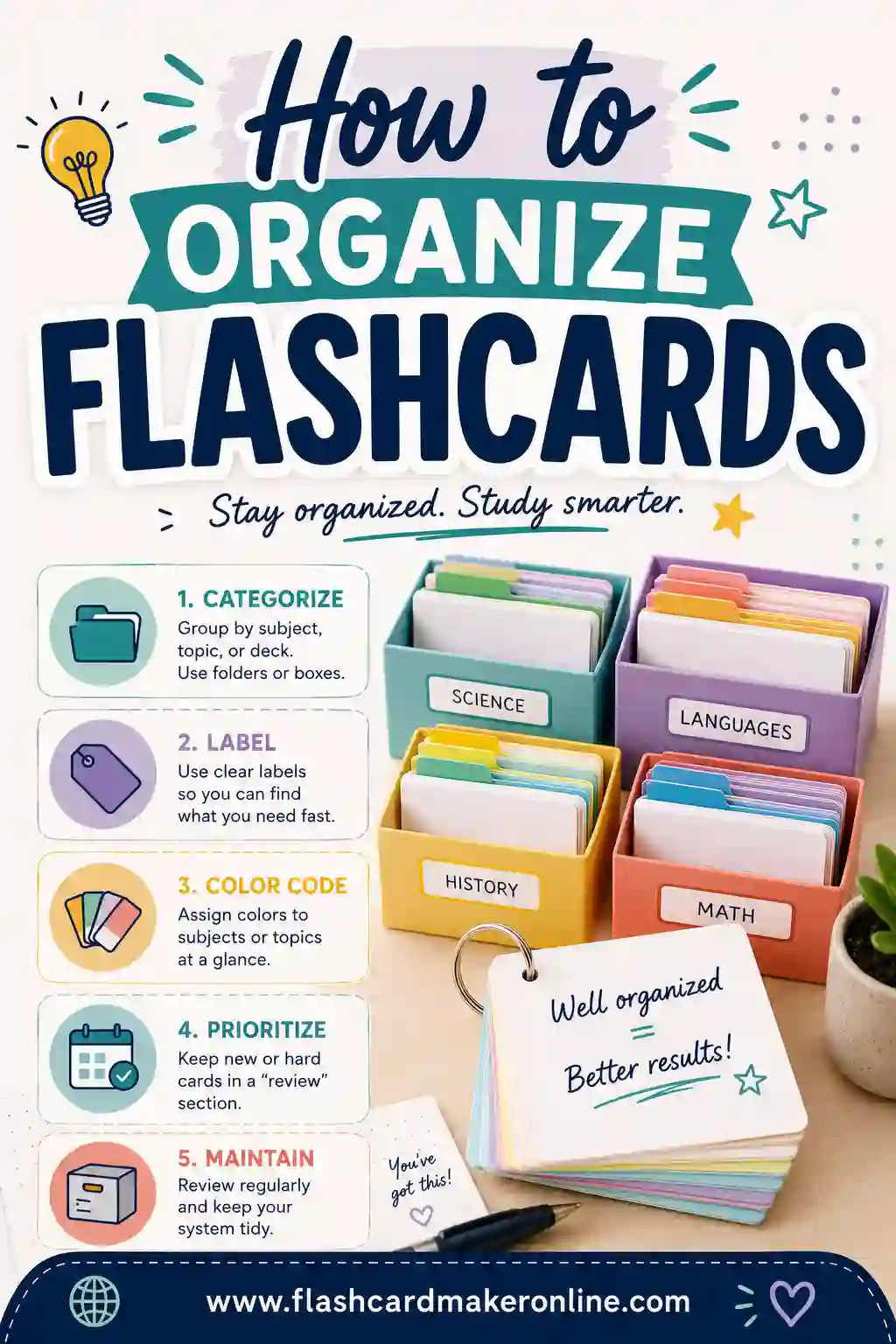
For more on structuring decks this way, see how to organize flashcards. Our sibling article on the minimum information principle covers why each single card should stay small.
How to tell whether you've formed a chunk
A group on paper isn't the same as a chunk in your head. Here are some practical signs that a set of facts has really become one unit for you:
- The label calls up the whole group fast. When you see "energy organelles," both members come to mind almost at once, without a search.
- Order stops being a struggle. If the group has a natural order, like steps in a process, you can run through it smoothly instead of hunting for the next item.
- You can use it while thinking about something else. This is the real test. If you can hold a chunk in mind while working through a new problem, it's freeing up working memory, which is exactly the benefit Thalmann and colleagues measured.
- Missing pieces feel wrong. When someone lists the group and leaves one out, you notice immediately. That "something's missing" feeling shows the group is stored as a whole.
- You can spot the pattern in new material. A chemistry student who has chunked an element family can predict how a new member behaves. Chunks aren't just storage; they're a way of seeing.
If a group fails these checks, it's still a set of separate items. Keep practicing it with short, spaced reviews, and check again in a few days.
Building chunks over a term: a sample plan
Here's an illustrative plan for a made-up student, Jordan, who's taking an introductory biology class. It shows how deliberate chunking at the start can turn into automatic chunking by the end.
| Week | What Jordan does | What it builds |
|---|---|---|
| 1 | Reads the chapter on cells, sorts organelles into four job groups, makes one small card per organelle plus one card per group | Deliberate chunks with clear labels |
| 2 | Reviews the cards every other day, mixing them in random order; adds a sketch to each group card | Faster recall of each group by its label |
| 3 | Learns cell transport, linking it to the "packaging and shipping" group from week 1 | New material attaches to an existing chunk |
| 4 to 6 | Keeps reviewing old cards at longer intervals while adding new chapters | Early chunks become automatic and free working memory for harder topics |
| 7 | Before the midterm, writes a one-page map of all groups from memory, then checks it | Chunks of chunks: the whole unit as one structure |
Notice the order. Jordan secures the basic groups early, which fits the Thalmann finding that early chunks help most with whatever comes later. By the time the hard topics arrive, the basics take up very little mental room.
Chunking in reading and math: a closer look
Two school subjects show how chunking quietly shapes learning from the very beginning.
Reading
A beginning reader sounds out each letter, one at a time. That's slow and takes up nearly all of working memory, which leaves little room to understand the sentence. As the reader practices, letter combinations like "sh" and "ing" become single chunks, then whole words do, then common phrases. Each step frees working memory for meaning. This is the same pattern Miller described in the telegraph operator: dots and dashes, then letters, then words, then phrases.
That's why phonics flashcards and sight-word practice matter so much in the early grades. They're not just about knowing the sounds; they're about making those sounds automatic so the child can think about the story.
Math
Math works the same way. A student who has to count on fingers to find 7 + 8 uses most of working memory on that single step, so a multistep word problem quickly overwhelms them. A student who knows 7 + 8 = 15 as an instant chunk has room left over to plan the next step. Later, whole procedures, like "find a common denominator," become chunks too.
Fact practice can look old-fashioned, but in chunking terms it's an investment. Every fact that becomes automatic is one less thing competing for a very small number of working memory slots.
Chunking compared with other ways to handle a long list
Students facing a long list usually try one of a few strategies. Here's how they compare.
| Strategy | How it works | Strength | Weakness |
|---|---|---|---|
| Rote repetition of the whole list | Read or say the full list over and over | Easy to start | Ignores meaning; items blur; easy to lose your place |
| Chunking by meaning | Sort items into small named groups, then learn the groups | Fits working memory limits; builds understanding | Takes thought up front to find good groups |
| Acronym or first-letter cue | Make a word or phrase from the first letters | Fast way to remember order | Doesn't teach what each item means |
| One card per item, no grouping | Learn each item on its own card | Each item gets focused practice | Hard to see the big picture without group cards |
| Chunking plus small cards | Group by meaning, then practice each item and each group with short cards | Combines structure with focused recall | Needs a little more setup |
The last row is the approach this article recommends. It uses grouping to respect working memory and flashcards to make the groups automatic.
Common mistakes with chunking
- Chunking things you don't understand. An acronym can help you list items, but if you don't know what each one means, you've memorized letters, not knowledge.
- Making chunks too big. A "chunk" of twelve items isn't a chunk unless the twelve items are already one familiar pattern to you. For new material, keep groups small.
- Overlapping chunks. Thalmann and colleagues found that the benefit held up best when chunks didn't share parts. If two groups contain similar items, they can blur together. Make each group distinct.
- Expecting instant results. Miller's account of Smith's experiment showed that people with only a few minutes of training gained much less than Smith did after drilling. Chunks have to become automatic before they free up space.
- Stopping after one session. Automatic chunking builds through repeated, spaced exposure. One evening of grouping won't make the groups stick.
Try it yourself: three five-minute exercises
1. The letter string test. Read this string once, cover it and write it down: F B I C I A N A S A U S A. Now notice it can be read as FBI, CIA, NASA, USA. Try again. Most people find the second attempt far easier, because 13 letters became 4 chunks.
2. Number grouping. Look at 1 4 9 2 1 7 7 6 1 9 6 9. Twelve digits is too many to hold. Now read it as three famous years: 1492, 1776, 1969. Three chunks, and you probably have it.
3. Your own notes. Take one page of class notes and do this:
- Count the separate facts on the page.
- Sort them into three to five groups and give each group a short name.
- Close your notes and write the group names from memory, then the facts under each.
- Check what you missed and turn those items into flashcards.
Most students are surprised how much easier step 3 is when they recall by group instead of trying to remember a flat list.
Chunking for different learners
Young children. Kids are building their first chunks: letters into sounds, sounds into words, and numbers into facts. Short sets of cards and lots of repetition help those first patterns become automatic. Phonics and sight-word practice are chunking in action.
Language learners. Learning whole phrases, like "How are you?" or "I would like," often works better than learning single words, because each phrase becomes a ready-made chunk you can use in conversation.
Adult professionals. Medical, legal and technical fields are full of acronyms and checklists for a reason: they're chunking tools. If you're studying for a certification, look for the field's standard groupings and learn them first.
Students who find working memory hard. Chunking can help anyone who feels overwhelmed by long lists. Keep groups especially small, use pictures as labels, and practice one chunk at a time. If attention or memory struggles are affecting school a lot, a teacher or school psychologist can suggest tailored support.
Chunking memory alongside other study methods
Chunking isn't a replacement for other techniques; it's a foundation that makes them work better.
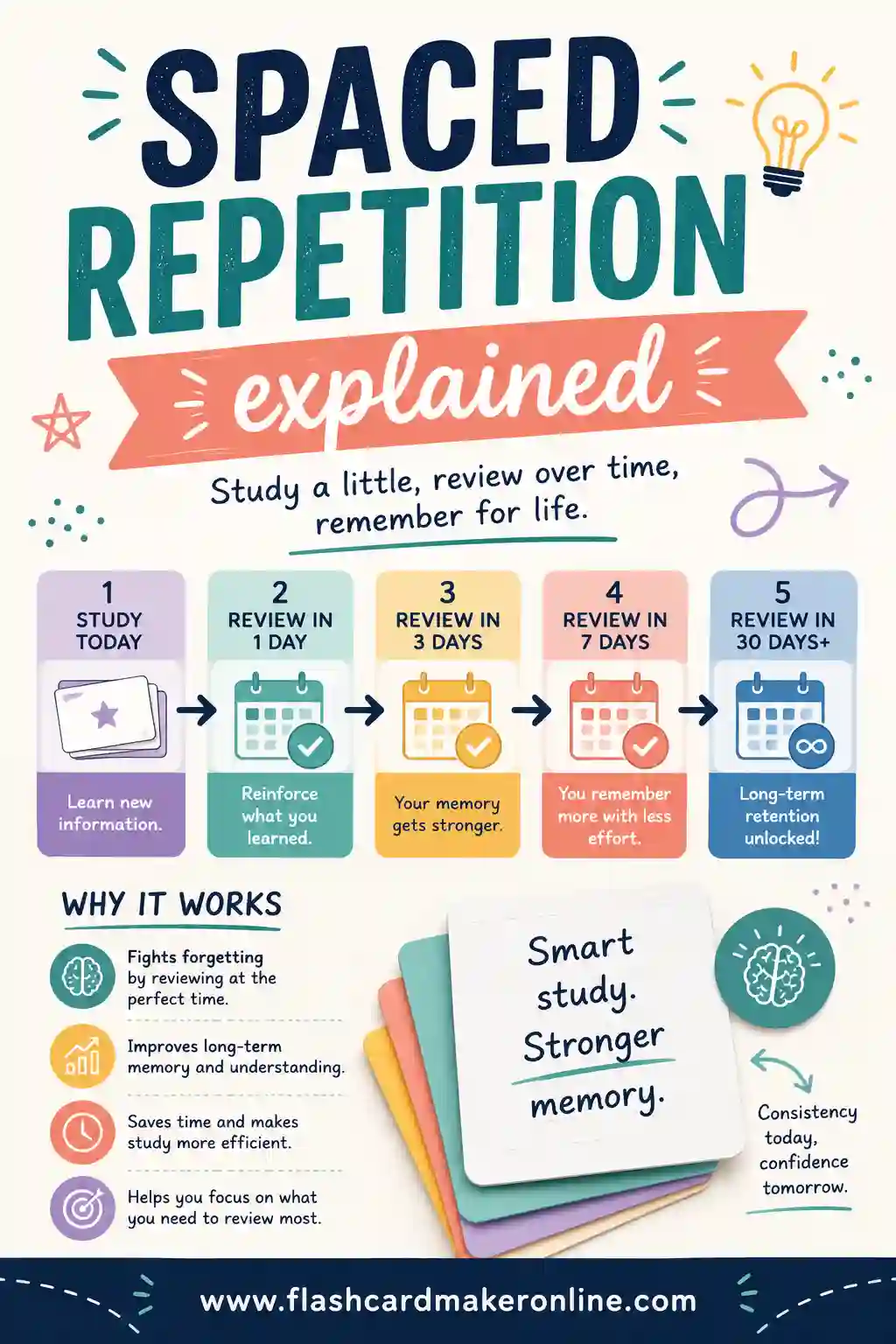
- Spaced repetition turns deliberate chunks into automatic ones through repeated, well-timed exposure.
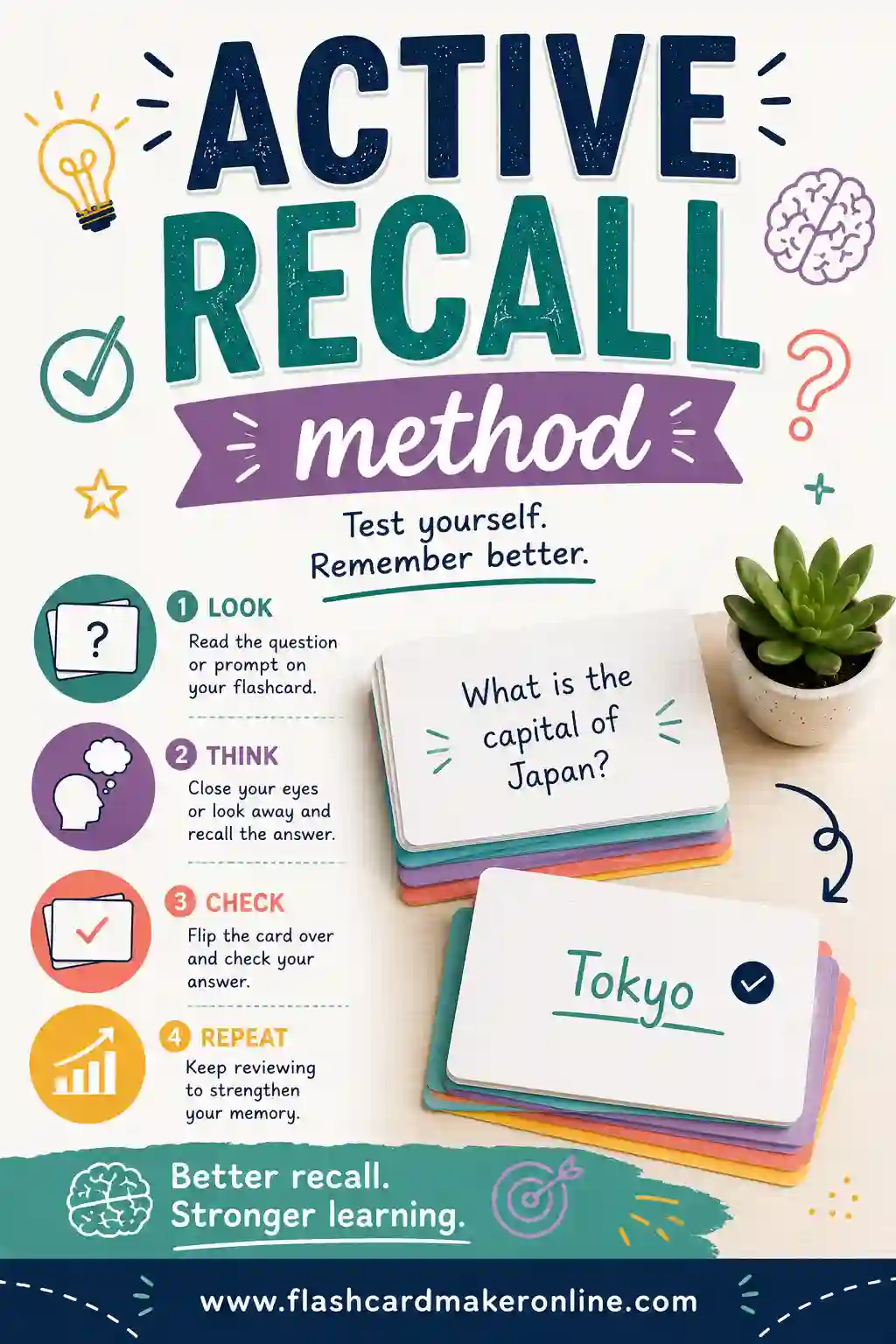
- Active recall tests whether a chunk label actually calls up its contents.
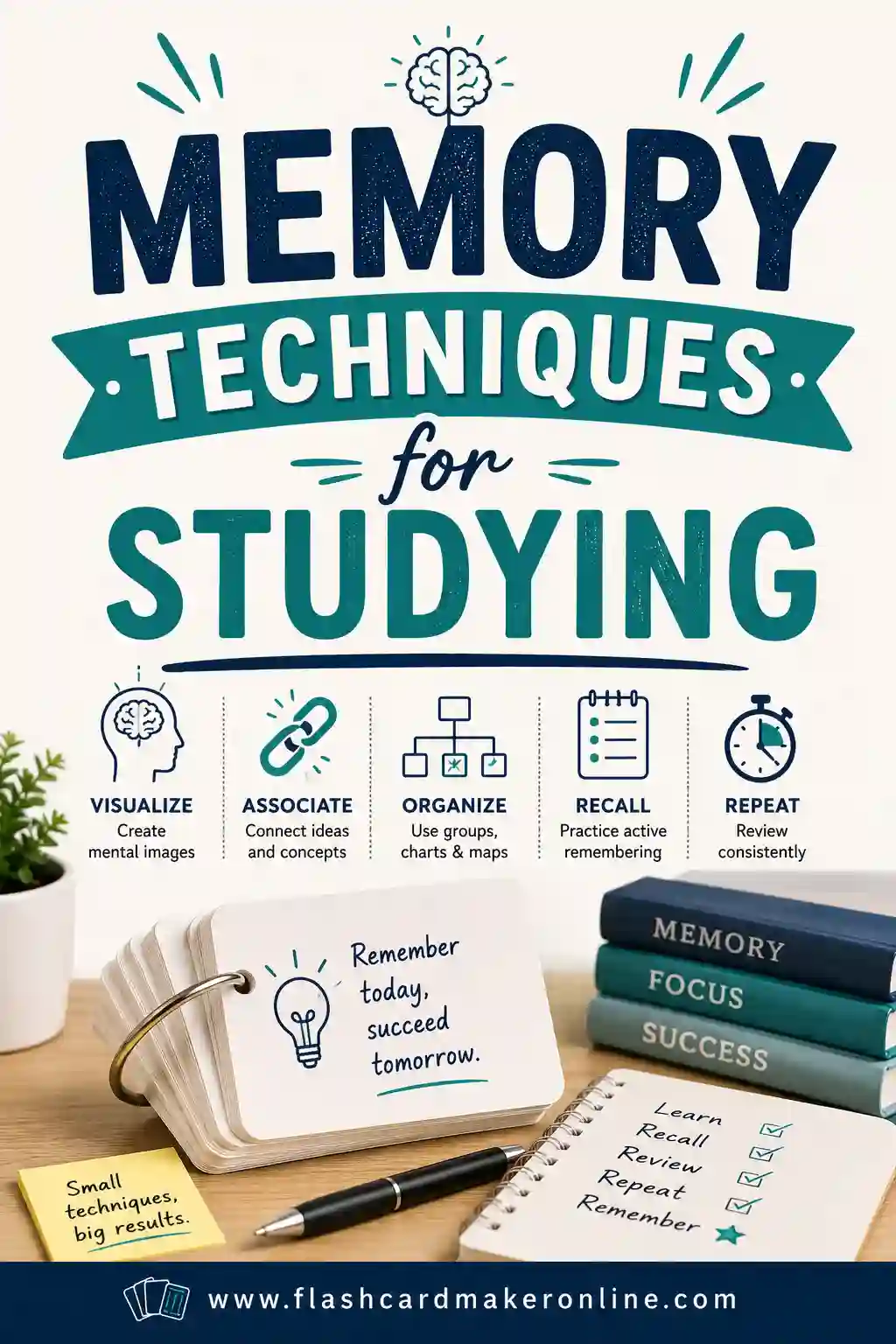
- Mnemonics such as acronyms and images give chunks memorable names. See our guide to memory techniques for studying for more.
- Pictures with words, an idea our sibling article on dual coding theory explores, give chunks a second, visual handle.
Start chunking with your next deck
Chunking memory comes down to a simple idea: you can't make your working memory much bigger, but you can make each thing in it carry more. Find the natural groups in your material, keep each group to about three to five items, give each one a name, and practice until the groups feel automatic. If you'd like to put this into practice right now, our free flashcard maker lets you add words and your own pictures, study with flip cards on screen, and print your deck double-sided or as cut-out sheets. Build one small set of cards per chunk, and let practice do the rest.
Chunking in Action: Four Learners Compared
This table puts side by side the people and groups the article uses to show how chunking works, and what each one teaches.
| Who | What they chunked | Kind of chunking | Lesson |
|---|---|---|---|
| Sidney Smith (Miller's example) | Binary digits, renamed in small groups with single new symbols | Deliberate recoding | He held a manageable number of bigger things instead of dozens of separate digits |
| Chess masters | Board positions, stored as patterns after years of play | Automatic, built through repeated exposure | Experts don't have better raw memory; they have bigger chunks |
| The college student in Ericsson's study | Groups of digits, turned into meaningful chunks from things he already knew | Deliberate, then organized into larger structures | It took more than 230 hours of practice, so chunking is a skill you build |
| Skilled readers | Letters, seen as whole words and short phrases | Automatic, on autopilot | Chunks come from what's already in your long-term memory |
Frequently Asked Questions
What is chunking in memory, in simple terms?
Chunking is grouping small pieces of information into larger units that mean something to you, so your brain can treat each group as one item. A phone number split into three parts, an acronym like NASA, or a famous year like 1776 are all chunks. Because short-term memory can only hold a few items at once, packing information into meaningful groups lets you hold much more. Chunks depend on what you already know, so the more familiar patterns you have in a subject, the bigger your chunks can be.
Is short-term memory really limited to seven items?
Seven is a rough rule of thumb, not a precise law. George Miller's famous 1956 paper described a span of about seven, plus or minus two, but Miller meant it loosely. Later work by Nelson Cowan argued that when people can't rehearse or group items, the central limit is closer to about four chunks, and his 2010 review describes about three to five meaningful items in young adults. The exact number depends on the task and the person. What matters most is that the limit counts chunks, and chunks can be big.
Who came up with the idea of chunking?
The term is most closely tied to the psychologist George A. Miller, whose 1956 paper in Psychological Review described organizing input into familiar units, or chunks, and called the process recoding. Gobet and colleagues note in their 2001 review that the concept traces back to research in the 1940s and 1950s. Later researchers, including William Chase and Herbert Simon in their 1973 work on chess, built chunking into a theory of expertise that is still being studied and refined today.
How do chess masters use chunking?
Chess masters recognize clusters of pieces as familiar patterns instead of seeing each piece separately. Work by Fernand Gobet and Herbert Simon supports the common estimate that masters store about 50,000 such chunks. When pieces are placed randomly, in arrangements that wouldn't happen in a real game, much of the master's memory advantage fades, because there are fewer familiar patterns to recognize. Gobet and Simon also found that recall dropped when positions were mirror-reflected, which suggests chunks are tied to specific places on the board.
Can you train your memory to hold more by chunking?
You can't make your raw working memory much larger, but you can make each item in it carry more. In a 1980 study in Science, a college student practiced for more than 230 hours and raised his digit span from 7 digits to 79 by turning groups of digits into meaningful chunks and organizing them into larger structures. His skill was specific to digits and took a lot of practice. For students, the lesson is that chunking pays off when chunks connect to knowledge you already have and when you practice them regularly.
How many items should go in one chunk when I study?
For new material, aim for small groups of about three to five items, which matches research estimates of working memory capacity. If a group grows bigger than that, split it into subgroups and give each one a name. Once a group becomes very familiar, you can treat it as a single unit and build larger structures from several groups. Experts can handle huge chunks because the patterns are automatic for them, but beginners should start small and let chunks grow with practice.
Does chunking work with flashcards?
Yes, as long as you use the cards to build chunks rather than cramming whole groups onto one card. Keep each card small and focused on one fact inside a group. Add a few short cards that ask you to name the members of a group by its label, and one card that asks for the overall structure. Review the deck over several days so the groups become automatic. Adding a simple picture to a group's label can also make the chunk easier to call up.
Why do experts remember so much more in their field?
Experts have built up a large library of familiar patterns through years of practice, so they can see complicated material as a few big chunks. A chess master looking at a real game sees meaningful clusters of pieces, and an experienced doctor reading a chart sees familiar groups of symptoms. Their basic working memory capacity isn't dramatically larger than anyone else's. The difference is in their long-term knowledge, which lets each slot of working memory hold much more. That's why experts lose much of their edge when material is random or unfamiliar.
Does chunking help with remembering other information at the same time?
Research suggests it does. In a 2019 set of four experiments, Thalmann, Souza and Oberauer found that when part of a list could be chunked, people also remembered the other, non-chunked items better. Their explanation is that a chunk is retrieved from long-term memory as one compact unit, which leaves more working memory free. Chunks that came early in the list helped most. For students, this means getting the basics of a subject well chunked early makes it easier to handle new, harder material later on.
What's the difference between chunking and mnemonics?
Chunking is the general process of grouping information into meaningful units. Mnemonics are specific memory aids, such as acronyms, rhymes, images or memory palaces, that give information a memorable form. Many mnemonics are chunking tools: an acronym packs several words into one pronounceable unit. But chunking also happens without any special trick, for example when a skilled reader sees whole words or a musician sees a familiar chord shape. Mnemonics are one way to create chunks deliberately, while practice creates them automatically.
Sources
We checked every source below while writing this guide. Last reviewed October 30, 2026, by Joan Ramos.
- The Magical Number Seven, Plus or Minus Two: Some Limits on Our Capacity for Processing Information (Miller, Psychological Review, 1956) (Classics in the History of Psychology, York University)
- The magical number 4 in short-term memory: a reconsideration of mental storage capacity (Cowan, Behavioral and Brain Sciences, 2001) (PubMed, National Library of Medicine)
- The Magical Mystery Four: How is Working Memory Capacity Limited, and Why? (Cowan, Current Directions in Psychological Science, 2010) (PubMed, National Library of Medicine)
- How does chunking help working memory? (Thalmann, Souza & Oberauer, Journal of Experimental Psychology: Learning, Memory, and Cognition, 2019) (PubMed, National Library of Medicine)
- Recall of random and distorted chess positions: implications for the theory of expertise (Gobet & Simon, Memory & Cognition, 1996) (PubMed, National Library of Medicine)
- Chunking mechanisms in human learning (Gobet et al., Trends in Cognitive Sciences, 2001) (PubMed, National Library of Medicine)
- Acquisition of a memory skill (Ericsson, Chase & Faloon, Science, 1980) (PubMed, National Library of Medicine)