Memorize Your Lines Fast: Script Flashcards for Actors

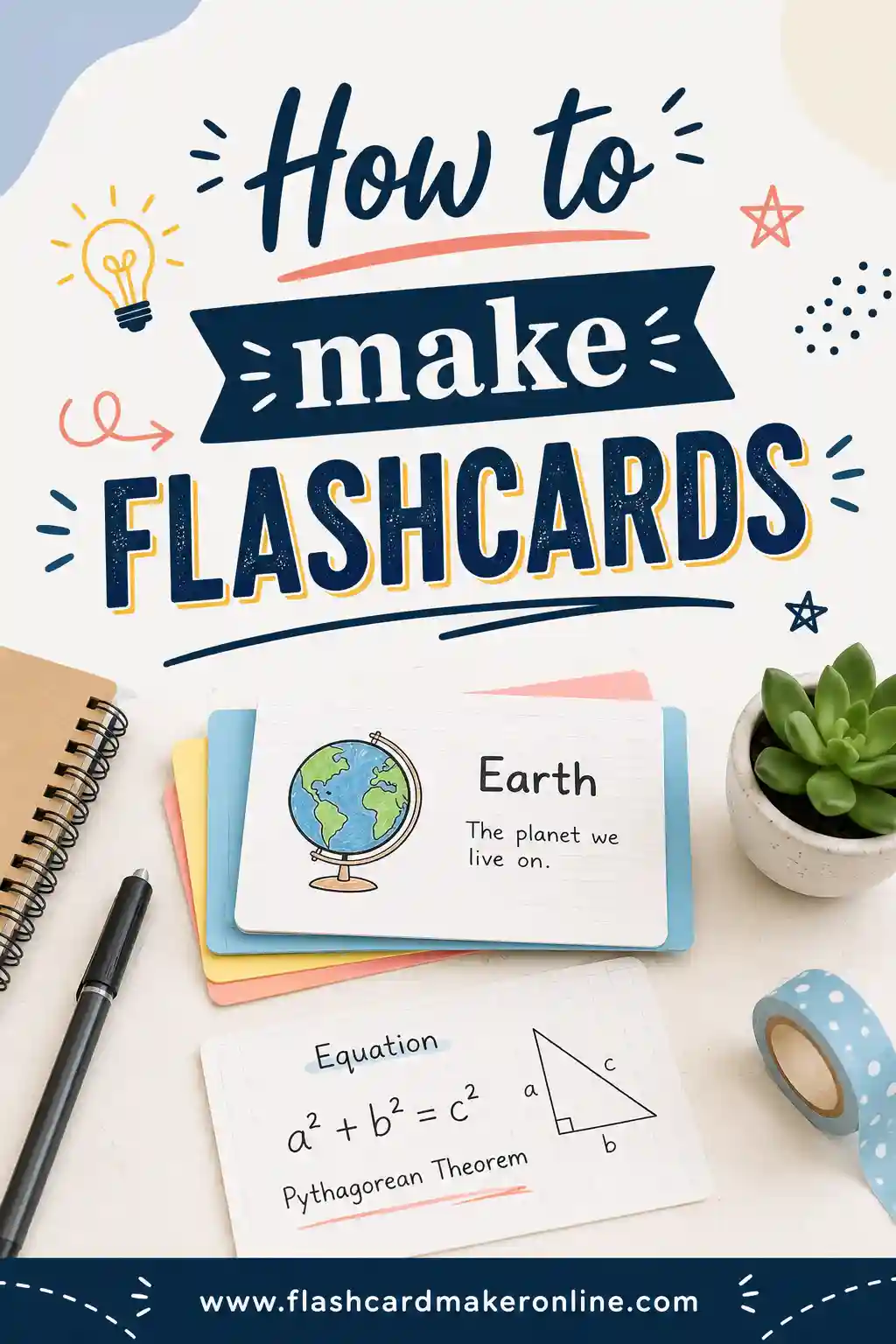
To memorize lines with flashcards, put the cue line on the front of each card and your line on the back, then drill the deck in script order until you can say every line from its cue without peeking. Once that's solid, shuffle the deck so you can jump in from any cue, which is exactly what a rehearsal or a dropped line demands. You can build the whole deck in a few minutes with our free flashcard maker, study it on screen, and print it for the bus or the green room.
This guide walks you through the full method: how to split a script into cards, what to do with long speeches, a complete sample deck you can paste straight in, a day-by-day schedule for the week before rehearsal, and the mistakes that make actors "know" their lines at home and lose them on stage.
🃏 Quiz yourself: 8 cards from this page
Read the front, say your answer, then tap the card to check.
Make, study & print this deck → Opens the free flashcard maker with all 8 cards ready to edit or print.▶ Open this deck in the flashcard maker
Why Cue Cards Work Better Than Rereading the Script
Most actors start by reading the script over and over. It feels productive. The words become familiar, you start to hear the rhythm, and you think you've got it. Then someone feeds you a cue and nothing comes out.
That gap happens because reading and recalling are different skills. When you reread, the words are in front of you, so your brain never has to produce them. On stage, the only thing in front of you is your scene partner's last line. You have to pull your line out of memory on that signal.
A cue card practices that exact moment. You see the cue, you try to say your line, then you flip and check. Every flip is a small test, and testing yourself is one of the most reliable ways to make memories stick. Our guide to the active recall method explains the idea in more detail, but for actors the short version is simple: practice the thing you'll actually have to do.
Cue cards also fix a problem that rereading hides. When you read a whole page, you skim the parts you know and feel good about the parts you half know. With cards, every line gets its own turn. The line you always fumble can't hide behind the ones around it.
There's one more benefit. Flashcards link your line to the cue, not to the line before it in your own part. Plenty of actors learn their speeches as one long chain and then freeze when a scene partner skips ahead or paraphrases. Cue-to-line cards build the connection that a real scene relies on.
What Goes on Each Card
The basic rule is one cue, one line, one card. Here's what that looks like in practice.
| Card part | What to write | Example |
|---|---|---|
| Front | The last few words of the line before yours, plus who says it | Cue (Bernardo) - Have you had quiet guard? |
| Back | Your full line, word for word, with the original punctuation | Not a mouse stirring. |
| Optional front note | Act and scene, or a page number, so you can find it in the script | 1.1, p. 3 |
| Optional back note | A stage direction or action tied to the line | (crosses to the door) |
Use the last few words, not the whole cue. In rehearsal, you won't wait for your partner's full speech to start thinking. You'll hear the last phrase. Training on the final five to ten words mirrors that. If the cue line is short, use all of it.
Write the speaker's name on the front. It helps in scenes with three or more people, where you need to know who's talking as well as what they said.
Copy your line exactly. Don't paraphrase on the card, even if you think the director won't care. You'll memorize whatever is on the card, so it has to match the script. For Shakespeare and other verse, copy the punctuation as printed in your edition. The commas and periods often tell you where to breathe.
Add a stage direction only if it's tied to the words. If you always sit on a particular line, a short note in parentheses can help you link the movement to the text. Don't fill the back with blocking notes, though. The card is for words first.
How to break long speeches into cards
Short back-and-forth scenes turn into cards easily. Monologues and long speeches need a different approach, because a single card with twelve lines on the back is too much to check in one flip.
The fix is to split the speech at natural break points and use your own previous chunk as the cue for the next one.
- Read the speech and mark the thought changes. A new idea, a new question, a shift in who you're talking to, or a change of mood usually marks a good split. In verse, the end of a sentence is often a better split than the end of a line.
- Aim for one to three sentences per card. That's small enough to check quickly and big enough to keep the meaning together. Small, meaningful groups are much easier to hold in memory than long strings.
- Make the first card from your scene partner's cue. The front is their last few words. The back is your first chunk.
- Make each later card from your own previous chunk. The front is the last few words of chunk one. The back is chunk two. Keep going to the end.
- Add one "whole speech" card at the end. The front says something like "Full speech from 'To be, or not to be'" and the back gives the first and last words. Use it once the chunks are solid, to practice the speech straight through.
A two-minute monologue usually breaks into eight to fifteen cards. That might sound like a lot, but each one takes seconds to drill, and you'll find the weak spots fast. Most people discover that the speech isn't hard all the way through. It's hard in two or three places, usually at the thought changes. Those are the cards you'll pull out and drill extra.
A tip for verse: if a chunk starts mid-line, write the whole verse line on the back anyway and underline or bracket your starting point in your printed script. Keeping the meter whole helps you hear when something is missing.
A Complete Sample Deck: Hamlet, Act 1, Scene 1
Here's a full working deck for a short role so you can see the method in action. It's the opening of Hamlet, which is in the public domain, and it covers every line spoken by Francisco, a guard who's being relieved from his watch. Wording follows a common modern edition; if you're working from a specific edition, check your script, since editions differ slightly in punctuation and spelling.
| # | Front (cue) | Back (Francisco's line) |
|---|---|---|
| 1 | Cue (Bernardo) - Who's there? | Nay, answer me. Stand, and unfold yourself. |
| 2 | Cue (Bernardo) - Long live the king! | Bernardo? |
| 3 | Cue (Bernardo) - He. | You come most carefully upon your hour. |
| 4 | Cue (Bernardo) - Get thee to bed, Francisco. | For this relief much thanks. 'Tis bitter cold, and I am sick at heart. |
| 5 | Cue (Bernardo) - Have you had quiet guard? | Not a mouse stirring. |
| 6 | Cue (Bernardo) - ...bid them make haste. | I think I hear them. Stand, ho! Who's there? |
| 7 | Cue (Marcellus) - And liegemen to the Dane. | Give you good night. |
| 8 | Cue (Marcellus) - Who hath relieved you? | Bernardo has my place. Give you good night. |
A few things to notice about this deck:
- Card 2 is a one-word line. Tiny lines are easy to drop because they feel unimportant. Giving each one its own card means you'll never miss "Bernardo?" just because it's short.
- Card 4 has two sentences. That's still small enough to check in one glance.
- Cards 7 and 8 come from a different speaker. Writing the speaker's name on the front reminds you that the scene has shifted and new people have arrived.
- In most editions, Francisco's first line reads "Nay, answer me: stand, and unfold yourself." The deck above uses a period instead of the colon only because colons are used as the divider when you paste a list (see the next section). On your own printed script, keep the original punctuation.
If you were playing Bernardo, you'd build the same scene the other way round. Francisco's lines would go on the fronts and Bernardo's on the backs. Every actor in the scene gets a different deck from the same pages.
How to Build This Deck in the Free Maker
You can type cards one by one, but the fastest way is to paste the whole scene in at once. Here's the exact process in the flashcard maker.
- Open the maker and name your deck. Use the show, your role, and the scene, like "Hamlet - Francisco - 1.1." If you're in several scenes, make a separate deck for each, so you can drill the scene you're rehearsing next.
- Skip the presets. The "Start from a preset" menu has ready-made decks for subjects like vocabulary and math. For a script, you'll start from a blank deck.
- Click Paste a list. Type or paste one card per line in the format
front : back, with the cue before the colon and your line after it. For the deck above, the first three lines would look like this:
Cue (Bernardo) - Who's there? : Nay, answer me. Stand, and unfold yourself.
Cue (Bernardo) - Long live the king! : Bernardo?
Cue (Bernardo) - He. : You come most carefully upon your hour.
- Choose Add to deck. Your lines appear as cards. If you're redoing a scene after script changes, use Replace deck instead so old versions don't linger.
- Fix any line that has its own colon. Because the colon splits front from back, a line like "Nay, answer me: stand" would get cut in the wrong place. For those lines, use "+ Add card" and type the front and back into their own boxes, or swap the colon for a period on the card.
- Open Study mode. Leave Shuffle off for your first passes so the cards run in script order. Read the front, say your line out loud, then click Flip to check. Use Next to move on and Prev to go back.
- Try Read aloud. The 🔊 button reads the card out loud. Use it on the front to hear the cue spoken instead of reading it, which feels a little closer to a scene partner feeding you lines.
- Turn on Shuffle once you know the order. Now you'll get cues from all over the scene. This is the step that saves you when someone skips a line in rehearsal.
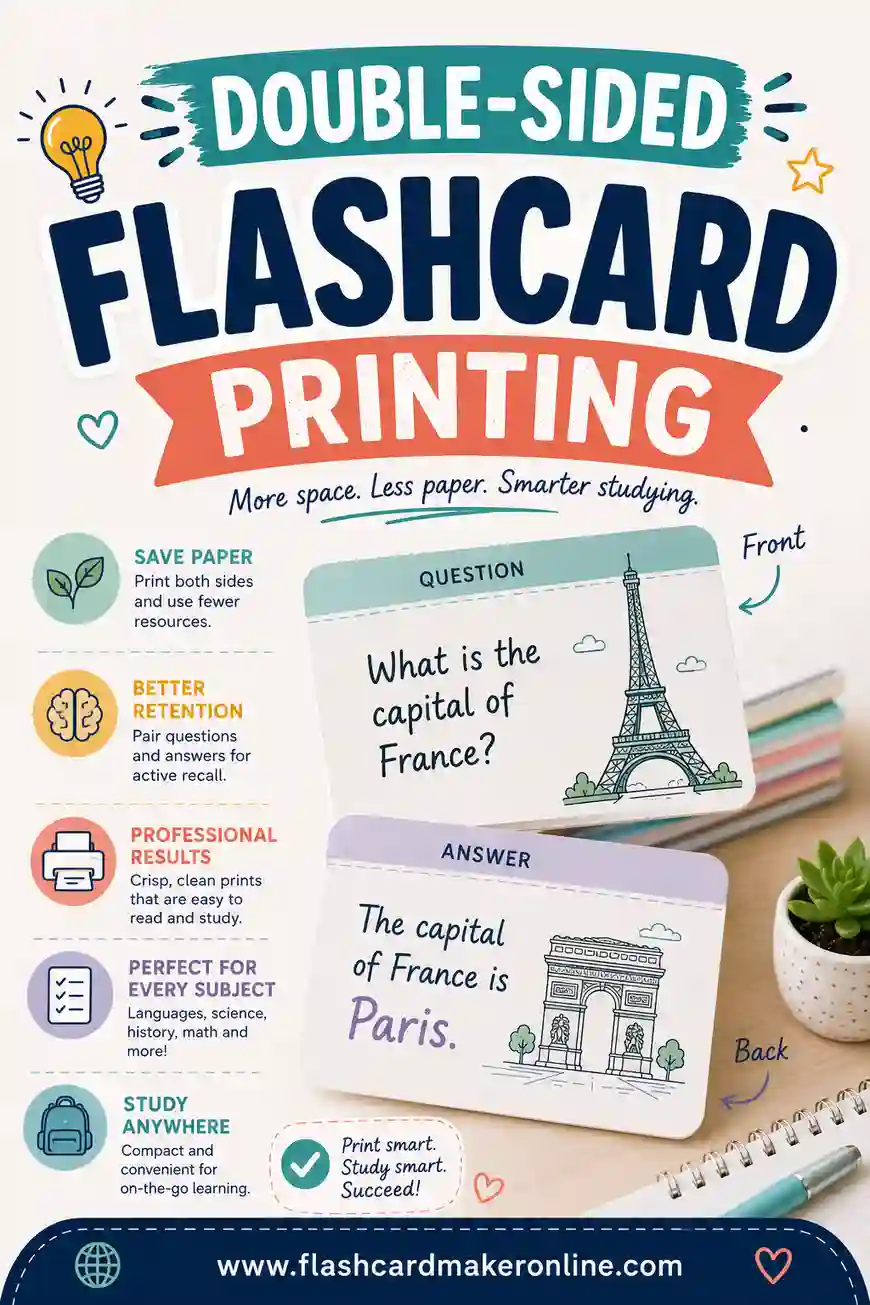
- Print a pocket set. In Print, choose Double-sided so each cue lines up with its line on the back. The 3×5 index card size fits in a pocket or script binder. Click "Print a test page first" to make sure your printer flips the pages the right way, then print or save as PDF. Our guide to double-sided flashcard printing helps if the backs come out upside down.
- Save a copy. Use Download .csv to keep the deck on your computer. If the director cuts or changes lines, you can edit the file and use Import a file to load the new version.
Share with your scene partners. Get share link gives anyone with the link their own copy of the deck. One person can type the scene, then everyone else flips the fronts and backs to fit their own part, or builds their own deck from the same text.
Your Schedule for the Week Before Rehearsal
Cramming lines the night before an off-book deadline works badly. The words feel solid at midnight and slip by morning. Spreading short sessions over several days works much better, because each night's sleep helps settle what you practiced. That overnight settling is one reason short sessions across a week work so well.
Here's a seven-day plan for a role of moderate size, around one to three scenes. Each session is short. Two or three sessions a day beat one long one.
| Day | Goal | What to do | Time |
|---|---|---|---|
| 1 | Understand the scene | Read the whole scene, not just your lines. Mark your cues. Build your deck. | 45 min |
| 2 | First pass in order | Study mode, Shuffle off. Say each line from its cue. Mark cards you miss. | 2 × 15 min |
| 3 | Fix the weak cards | Drill missed cards first, then the full deck in order. | 2 × 15 min |
| 4 | Break the chain | Turn Shuffle on. Go through the deck twice, then once in order. | 2 × 15 min |
| 5 | Add the body | Run lines in order while doing simple blocking or walking around. | 2 × 20 min |
| 6 | Run without cards | Speak the whole scene from memory. Use cards only to check. | 2 × 15 min |
| 7 | Pressure test | Have someone feed cues at random. Do a final shuffled pass before bed. | 20 min |
Smaller part? Squeeze the plan into three or four days. Day 1 and 2 merge, then do one shuffled day and one run-through day.
Big role or a full musical? Work scene by scene. Start the schedule for scene one, then begin scene two on Day 3 of the first one. Keep reviewing finished scenes a few times a week so they don't fade while you're busy with new ones.
Short notice? If you got the script this morning for a rehearsal tonight, focus on the scene you're rehearsing. Drill it in order twice, shuffled twice, then once more right before you leave. Accept that you'll still need the book in hand for parts of it. Directors generally prefer an actor who knows the structure and calls for line calmly over one who guesses.
Drills That Make Lines Stick
Basic flipping gets you most of the way. These drills add the rest.
First-letter cards
Some actors find it easier to learn long chunks from a hint. Make a second version of a tricky card where the back shows only the first letter of each word, such as "N, a m. S, a u y." for "Nay, answer me. Stand, and unfold yourself." You say the full line, using the letters as a nudge, then check the full card. Drop the hint cards once you no longer need them.
Reverse cards
Flip the deck around: your line on the front, the cue on the back. This sounds backwards, but it helps you know what comes before each of your lines. That's handy when a scene partner skips, and you need to work out where you are. It's also great prep for cue pickup, since you'll start listening for the right words.
Paraphrase check
Before you drill the exact words, say what each line means in your own words. If you can't, look it up or ask your director. Lines you understand stick far better than strings of sounds. This matters most with classical text, but it also helps with modern scripts full of half-sentences and interruptions.
Action cards
For lines tied to a specific movement, add the movement to the front: "Cue (Bernardo) - Have you had quiet guard? (you're turning away)." When you drill the card, actually turn away. Linking words to movement gives you two ways to remember each line.
The out-loud rule
Always say your lines out loud, even quietly. Silent recall skips the mouth and breath work that live performance needs. Lines that feel fine in your head often trip your tongue the first time you voice them. Say them at performance speed by Day 5, not slowly.
Mixed-scene shuffles
Once you've learned several scenes, put them in one combined deck and shuffle. You'll get a cue from Act 2 followed by one from Act 1. That trains you to find your place fast, which is what keeps you steady when something unexpected happens on stage.
Mistakes Actors Make With Line Cards
| Mistake | What goes wrong | Fix |
|---|---|---|
| Cards are too big | A whole speech on one back can't be checked in a glance, so you skim | Split at thought changes, one to three sentences per card |
| Paraphrased lines | You memorize your summary, not the script | Copy every line word for word from your edition |
| Always studying in order | You can only start from the top of the scene | Turn on Shuffle once the order is solid |
| Studying silently | Lines feel solid in your head but stall in your mouth | Say every line out loud |
| Skipping short lines | One-word lines get dropped in performance | Give every line its own card, even "Yes." |
| Learning only your lines | You don't know the scene, so you can't recover | Read the full scene first; know what your partners say |
| No date or version on the deck | You drill an old cut after script changes | Put the date in the deck title; use Replace deck for new versions |
| Last-minute cramming | Lines vanish overnight | Short sessions over several days, with sleep in between |
Using Cards for Auditions, Musicals, and Different Kinds of Scripts
The cue-and-line method fits almost any script, but a few situations need small changes.
Audition sides
Sides are short scenes handed out for an audition, sometimes with very little notice. You may not need to be fully off book, but knowing the lines well lets you look up and act instead of reading. Make a small deck of the sides only. Because the scene is short, drill it shuffled quickly. If you're reading with a casting reader, the cues you'll hear are fixed, so practice from exactly those words.
For a prepared monologue, use the speech-splitting method from earlier. Practice the first line extra, since nerves tend to hit right at the start. A card with the front "Monologue opening" and your first line on the back is worth drilling more than any other.
Musicals
For songs, lyrics follow the music, so the best practice is singing along to the track. Cards help with the spoken scenes between songs and with tricky verses where the words change but the tune repeats. For a repeating tune, make cards where the front says "Verse 2, starts after..." and the back gives the first line of that verse. Mixing up verse order is one of the most common lyric slips, and these cards target it directly.
Film and TV
On set, you may get changed pages close to shooting. Keep each scene as its own deck so you can swap one out with Replace deck without touching the others. Because scenes are often shot out of order, shuffled practice matters even more.
Class scenes and student plays
Students often learn lines while also juggling homework. Short sessions are the answer here too. Five minutes of shuffled cards before school does more than an hour of reading the night before. Teachers running a class play can build one deck per scene, then use Get share link so every cast member gets a copy without needing an account. Our page on flashcards for teachers has more ideas for class decks.
Speeches and presentations
The same method works when you have to deliver a toast or a talk, even without a scene partner. Use your previous sentence as the front and the next as the back. For general memorization tricks beyond scripts, see our guide on how to memorize flashcards, which covers ways to make any deck stick.
Running Lines and Getting Off Book
Once your deck is built and you've done a few solo passes, two things are left: practicing with another person and knowing when you're truly ready.
Run lines with a partner
Cards aren't only for solo study. They're also an easy way to get help from a friend, roommate, or family member who doesn't know the play.
- Hand them the deck in order. Printed cards work best here, since your helper can hold them without needing your screen.
- They read the front out loud. Ask them to read just the cue, in a normal voice. They don't need to act it.
- You say your line. Ask them to listen for exact wording, not just meaning.
- They flip and check. If you got it word for word, the card goes in a "done" pile. If you missed a word, added a word, or stalled, it goes in a "redo" pile.
- Run the redo pile again. Keep going until it's empty.
- Shuffle and repeat. On the second round, have them shuffle the deck.
Tell your helper what counts as a mistake. Actors usually want to hear about every dropped word, swapped word, or wrong order, even if the meaning is the same. A friendly helper who says "close enough" won't help you get off book.
If your partner is another cast member, you can each hold your own deck and trade cues back and forth. That turns into a quick, low-pressure line run.
How to know you're off book
"Off book" means you can perform the scene without holding the script. Here are some signs you're truly ready, not just ready at home.
- You can go through the deck shuffled with no misses, two days in a row.
- You can start the scene from any cue someone picks at random.
- You can say your lines at full speed, out loud, while moving.
- You know your partners' lines well enough to tell when someone skips one.
- You can do it tired. Try a quick shuffled run at the end of a long day. If it holds then, it'll hold on stage.
If you hit all five, you're ready. If not, pull the cards you miss into a small separate deck and drill those for a day or two. Most people find that ten or fewer cards cause nearly all the trouble.
Once you're off book, don't stop reviewing completely. A quick shuffled pass a few times a week keeps everything fresh through the run of a show, especially when you have days off between performances. The idea of returning to material at growing gaps is called spaced review, and our guide to beating the forgetting curve explains how it keeps lines from fading.
Start tonight
Lines don't stick because you've read them a lot. They stick because you've practiced pulling them out of memory on cue, over and over, across several days. Cue cards give you that practice in the smallest possible pieces. Open the free flashcard maker, paste in your first scene, and do one pass in order tonight. Tomorrow, do two. By the end of the week, the script will be in your head instead of in your hand.
▶ Open this deck in the flashcard maker
Frequently Asked Questions
How do I make flashcards to memorize lines?
Put your scene partner's cue on the front of each card and your line on the back. Use the last few words of their line as the cue, and copy your line exactly as written. Split long speeches into chunks of one to three sentences, using your own previous chunk as the cue for the next card.
How long does it take to memorize lines with flashcards?
It depends on the size of the role and how much time you have each day. Many actors can learn a scene or two in about a week with two or three short sessions a day. Spread the work out instead of cramming, since lines learned over several days hold up much better.
Should I memorize the cue lines too?
You don't need to memorize every word of your partners' lines, but you should know them well enough to recognize your cues and notice when something is skipped. Reading the full scene and using reverse cards, with your line on the front and the cue on the back, both help.
Is it better to study lines in order or shuffled?
Do both. Start in script order so you learn the flow of the scene, then switch to shuffled once the order feels solid. Shuffled practice prepares you to jump in from any point, which is what saves you when a scene partner drops or skips a line.
What should I do if a line has a colon in it?
When you use Paste a list, the colon separates the front from the back, so a line with its own colon would be split in the wrong place. Add that card with "+ Add card" and type the front and back into their own boxes. On your printed script, keep the original punctuation.
Can I share my line deck with the rest of the cast?
Yes. Get share link creates a link, and anyone who opens it gets their own copy of the deck. They don't need an account. Each actor can then rework the copy to put their own cues on the fronts.
What card size should I print for script flashcards?
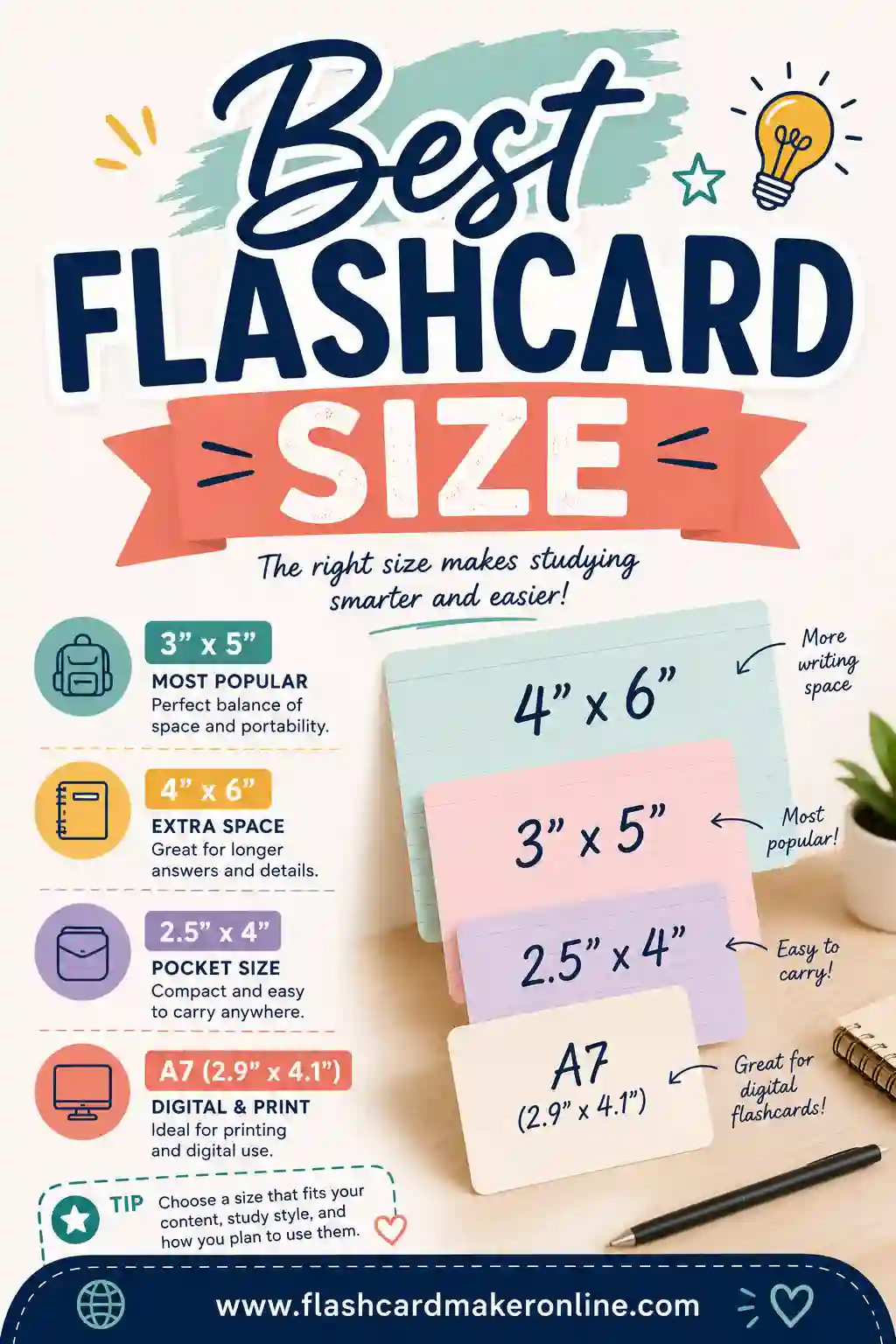
The 3×5 index card size fits in a pocket or a script binder, and the 4×6 size gives more room for longer chunks. Choose Double-sided printing so each cue lines up with its line on the back, and print a test page first.
Do flashcards work for monologues?
Yes, as long as you split the speech. One card per thought, with the end of your previous chunk on the front, lets you drill the speech piece by piece. Add one final card for running the whole speech once the chunks are solid.