How to Memorize Vocabulary for a Final in One Week: A 7-Day Flashcard Plan
To memorize vocabulary in one week, split your list into daily batches, learn 10 to 20 new words a day on flashcards, and review every older batch on a set schedule so each word comes back on days 1, 2, 4 and 7. Quiz yourself in both directions, put each word in a short sentence, and spend the last day taking a practice test made from your own cards. You can build the whole deck in a few minutes with the free flashcard maker, no account needed.
That's the short version. The rest of this page walks you through the full plan: how to sort a messy list into something you can actually finish, how to set up the deck, exactly what to do on each of the seven days, and how to adjust if your list is huge or you're starting with fewer days than you'd like.
One honest note: a week is enough time, but only if you study a little every single day. Two long sessions at the end won't do the same job as seven shorter ones.
The 7-Day Plan at a Glance
Here's the whole week on one screen. The idea is simple: new words come in early, and the second half of the week is mostly review. Each batch gets seen again at growing gaps, which is the core of spaced review.
| Day | New words | Review | Time (about) | Main goal |
|---|---|---|---|---|
| Day 1 | Batch A (15 to 20) | Batch A twice | 45 to 60 min | Sort the list, build the deck, learn Batch A |
| Day 2 | Batch B (15 to 20) | A | 45 to 60 min | Learn B, first review of A |
| Day 3 | Batch C (15 to 20) | B, A misses | 45 to 60 min | Learn C, keep A and B alive |
| Day 4 | Batch D (15 to 20) | C, A full | 60 min | Learn D, second full pass of A |
| Day 5 | Leftovers only | D, B full, all misses | 60 min | Stop adding, start mixing |
| Day 6 | None | Whole deck, mixed | 60 to 75 min | Shuffle everything, both directions |
| Day 7 | None | Practice test, then misses | 60 min | Test yourself, fix gaps, sleep well |
With four batches of 15 to 20 words, this covers roughly 60 to 80 words comfortably. If your list is longer, you'll still use this same shape, just with bigger batches or a split between "must know" and "nice to know" words. There's a section on bigger lists further down.
Why stop adding words on day 5? If you keep adding right up to the test, the newest words never get enough reviews.
Before Day 1: Sort Your List in 20 Minutes
Most people open their vocabulary list, see 150 words, and freeze. The fix is to sort before you study. Twenty minutes of sorting saves you hours of reviewing words you already know.
Step 1: Gather every source. Pull the words from your study guide, the unit lists, the bolded terms in your textbook chapters, old quizzes, and any review sheet your teacher handed out. Put them in one place, like a notes app or a plain document.
Step 2: Cross out the words you already know cold. Read each word and ask, "Could I explain this to a friend right now without looking?" If the answer is an instant yes, cross it out. Be honest. "I've seen it before" isn't the same as "I know it."
Step 3: Mark the words your teacher stressed. Words that showed up on quizzes, homework or the study guide are more likely to show up on the final. Put a star next to them.
Step 4: Split what's left into two groups.
- Must know: starred words, words from the units the final covers most, and words you've already missed on a quiz.
- Nice to know: words that came up once, or that sit in a unit the teacher said would be lightly tested.
Step 5: Count and divide. Count the must-know words and divide by four. That's your daily batch for days 1 to 4. If you get 15 to 20, great. If you get 30 or more, read the section on big lists before you start.
Here's what the sort looks like for a typical list.
| Starting list | Already known | Must know | Nice to know | Daily batch (days 1 to 4) |
|---|---|---|---|---|
| 60 words | 10 | 40 | 10 | 10 must know, add nice-to-know on day 5 |
| 100 words | 20 | 60 | 20 | 15 |
| 150 words | 30 | 80 | 40 | 20, nice-to-know only if time allows |
| 250 words | 40 | 120 | 90 | 30, see the big-list section |
The order of your batches matters too. Put the hardest words in Batch A. They'll get the most reviews by test day, simply because they arrived first. Words that are easy or that you half-know can go in Batch D.
Why This Schedule Works
You don't need the science to use the plan, but knowing why it works makes it easier to stick with on the days you're tired.
Spacing beats cramming. When you see a word, wait a while, and then pull it from memory again, it lasts longer than if you see it ten times in one sitting. That's why each batch comes back on day 2, around day 4, and again near the end of the week. Our page on spaced repetition explains the idea in more detail.
Recall beats rereading. Looking at a word list and nodding along feels productive, but it mostly tests whether you recognize the word. A flashcard makes you produce the answer before you see it. That small struggle is the point. If you want the longer explanation, read about the active recall method.
Both directions build both skills. A final might show you the word and ask for the meaning, or describe a meaning and ask for the word. Those are two different skills. Word-to-meaning is usually easier. Meaning-to-word is harder and closer to what you need when writing an essay or filling in a blank. You'll practice both.
Context makes words usable. Knowing that "mitigate" means "make less severe" is one thing. Recognizing it in a reading passage, or using it right in a sentence, is another. A short example sentence on each card helps with both, and many vocabulary finals include sentence-completion or context questions.
Small daily batches keep it doable. Ten to twenty new words a day is a range many study guides suggest for steady progress, with around 20 being a push. Above that, the review load in the second half of the week starts to pile up fast. For a broader look at daily limits, see how many flashcards per day you can realistically handle.
How to Build This Deck in the Free Flashcard Maker
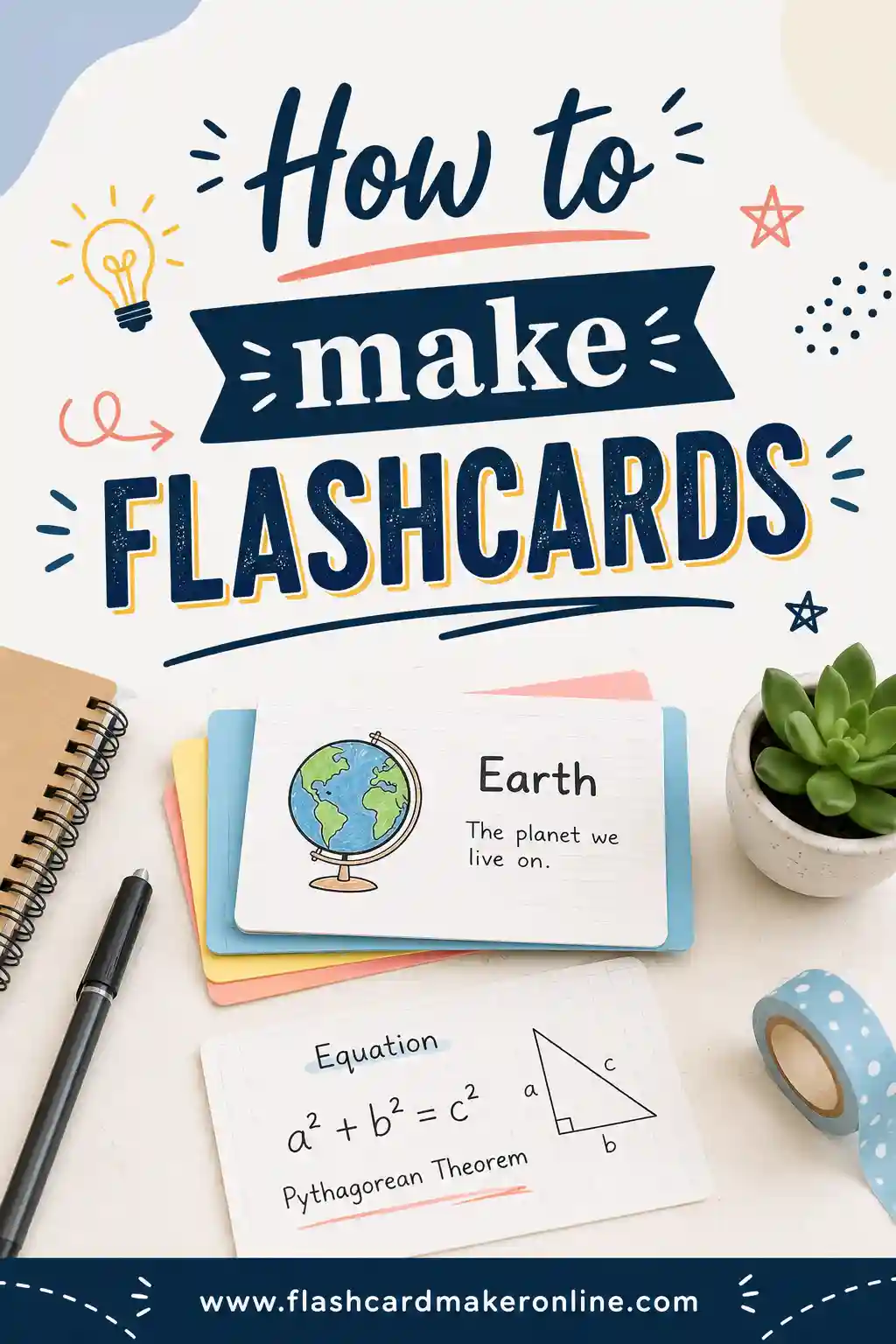
You can type cards one at a time, but for a vocabulary final, pasting a list is much faster. Here's the exact setup in the flashcard maker.
1. Name your deck. Type a deck title like "English Final, Units 1 to 6" or "Spanish 2 Final, Batch A." If you'd rather keep batches separate, make one deck per batch and give each a letter. If you'd rather keep one big deck, that works too; you'll just shuffle it later.
2. Check the presets. If your final covers a subject the maker already has a preset for, start there. The "Start from a preset" menu includes SAT Vocab and GRE Vocab, plus Spanish, French, German, Italian and Latin vocab sets, Medical Terminology, Biology, Chemistry and more. Load the preset, then delete the cards your class didn't cover and add the ones it did. For most class finals, though, your teacher's list won't match a preset, so the next step is the main one.
3. Use Paste a list. Open Paste a list and type or paste one card per line in this format:
word : meaning (short example sentence)
For example:
mitigate : to make less severe (Sandbags mitigate flood damage.)
ambivalent : having mixed feelings (She felt ambivalent about moving.)
pragmatic : practical, focused on what works (a pragmatic solution)
Then choose Add to deck to add the cards to what's already there, or Replace deck to start fresh. Each line becomes one card, with the word on the front and the meaning on the back.
4. Add your reverse cards. For the meaning-to-word direction, paste a second list where the two sides are flipped:
to make less severe : mitigate
having mixed feelings : ambivalent
practical, focused on what works : pragmatic
A quick way to make this list: copy your first list into a document, and for each line, swap what's before and after the colon. It takes a few minutes for 20 words, and it doubles the value of your deck.
5. Add pictures where they help. You can add a picture to any card. This is most useful for concrete nouns (a language final with food, clothing or household words) and for science terms you can draw (parts of a cell, landforms). For abstract words like "ambivalent," a picture usually isn't worth the time; a good sentence does more.
6. Study on screen. Open Study mode. Use Shuffle so the order changes each round, Flip to check your answer, and Prev/Next to move through the deck. For a language final, the Read aloud button (🔊) lets you hear each card, which helps when the test includes listening or when you need to say words out loud.
7. Save and print. Use Download .csv to keep a backup copy of your deck. When you're ready for paper cards, go to Print and pick a layout (more on that below). If you're studying with a classmate, Get share link gives them their own copy of the deck, so you can split the typing and both use the full set.
Setup for a 20-word batch takes about 15 minutes, and writing the sentences counts as studying.
Which print layout and card size to pick
Paper cards are handy for this plan because you'll be sorting cards into piles every day. Here's how the print options line up with a one-week vocabulary deck.
| Print option | Best use this week |
|---|---|
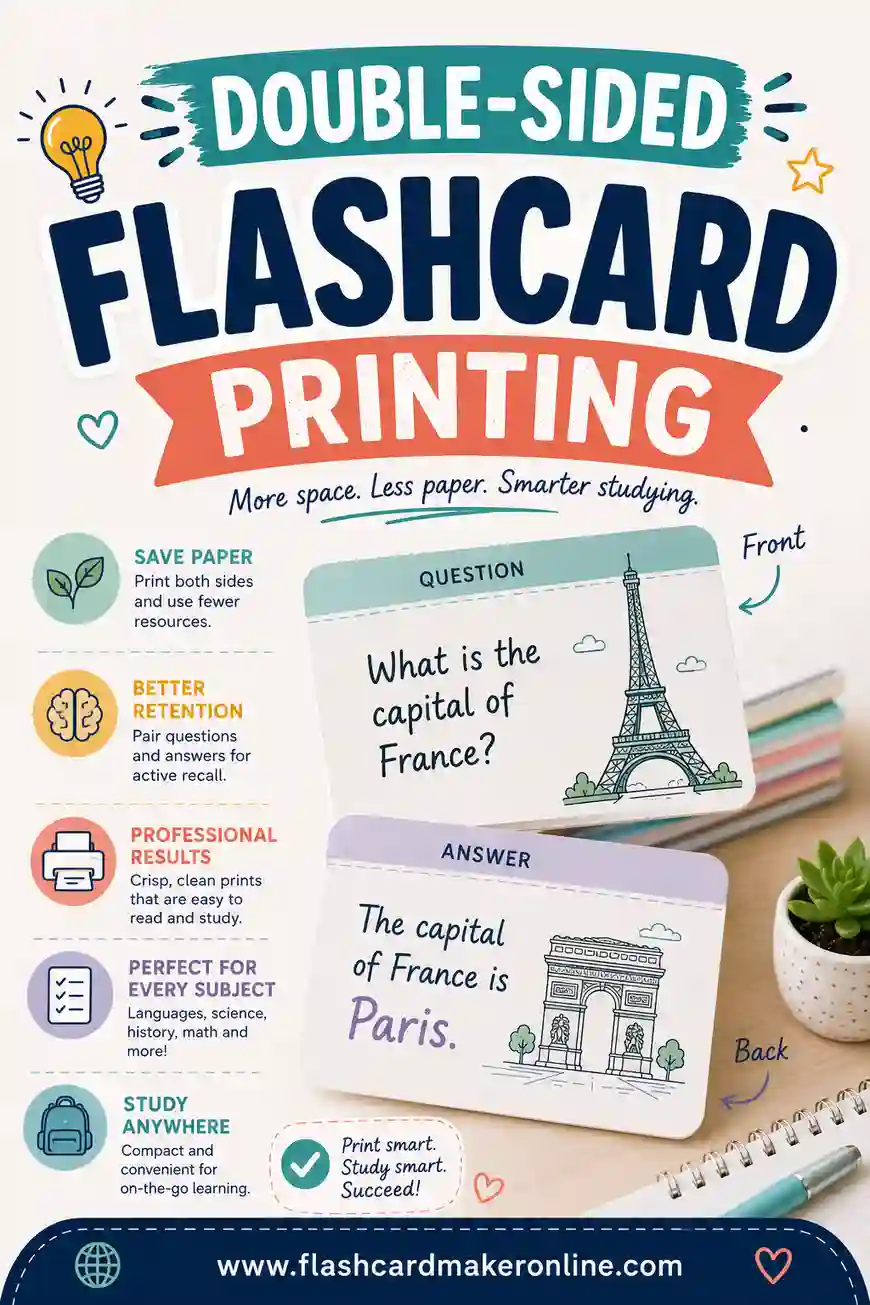
| Double-sided | Your main deck. Word on the front, meaning and sentence on the back, lined up so they match after cutting. |
| Fronts only | A quick self-test sheet. Print just the words, write the meanings from memory, then check. |
| Cut-out grid | Fast cutting when you're short on time; more cards per page. |
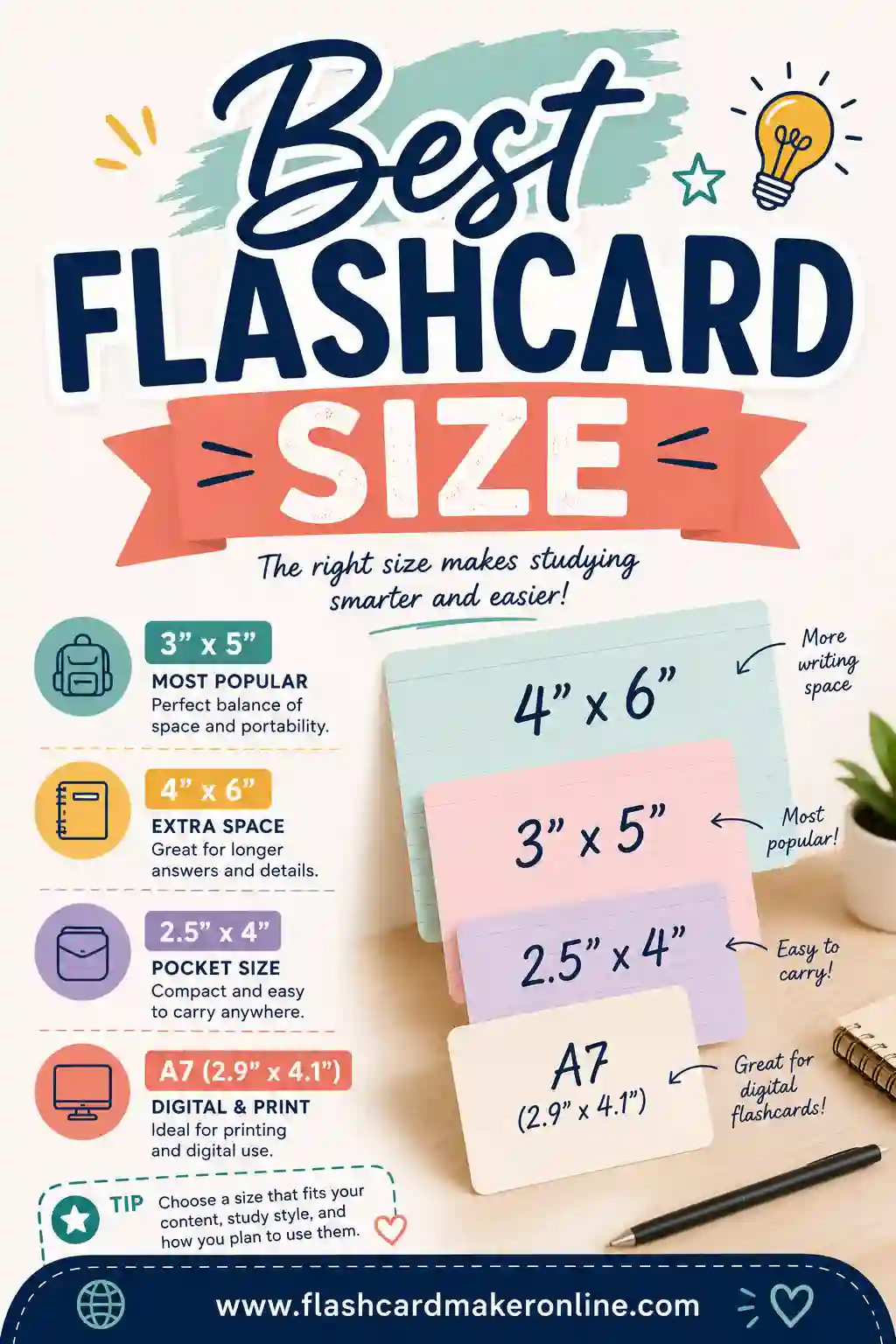
| Standard or 3×5 index card size | Good default for vocab. Small enough to carry, big enough for a sentence. |
| 4×6 index card size | Use for words with long definitions or two example sentences. |
| Big or Jumbo | Better for a group review or for younger students, less useful for a big final deck. |
Click Print a test page first before printing the whole deck, especially for double-sided. It shows you whether your printer flips pages the way the layout expects, so you don't waste a stack of cardstock. You can also save the print as a PDF and print it later, or study the PDF on a tablet. If double-sided printing gives you trouble, our guide to double-sided flashcard printing covers the common fixes.
The Day-by-Day Plan
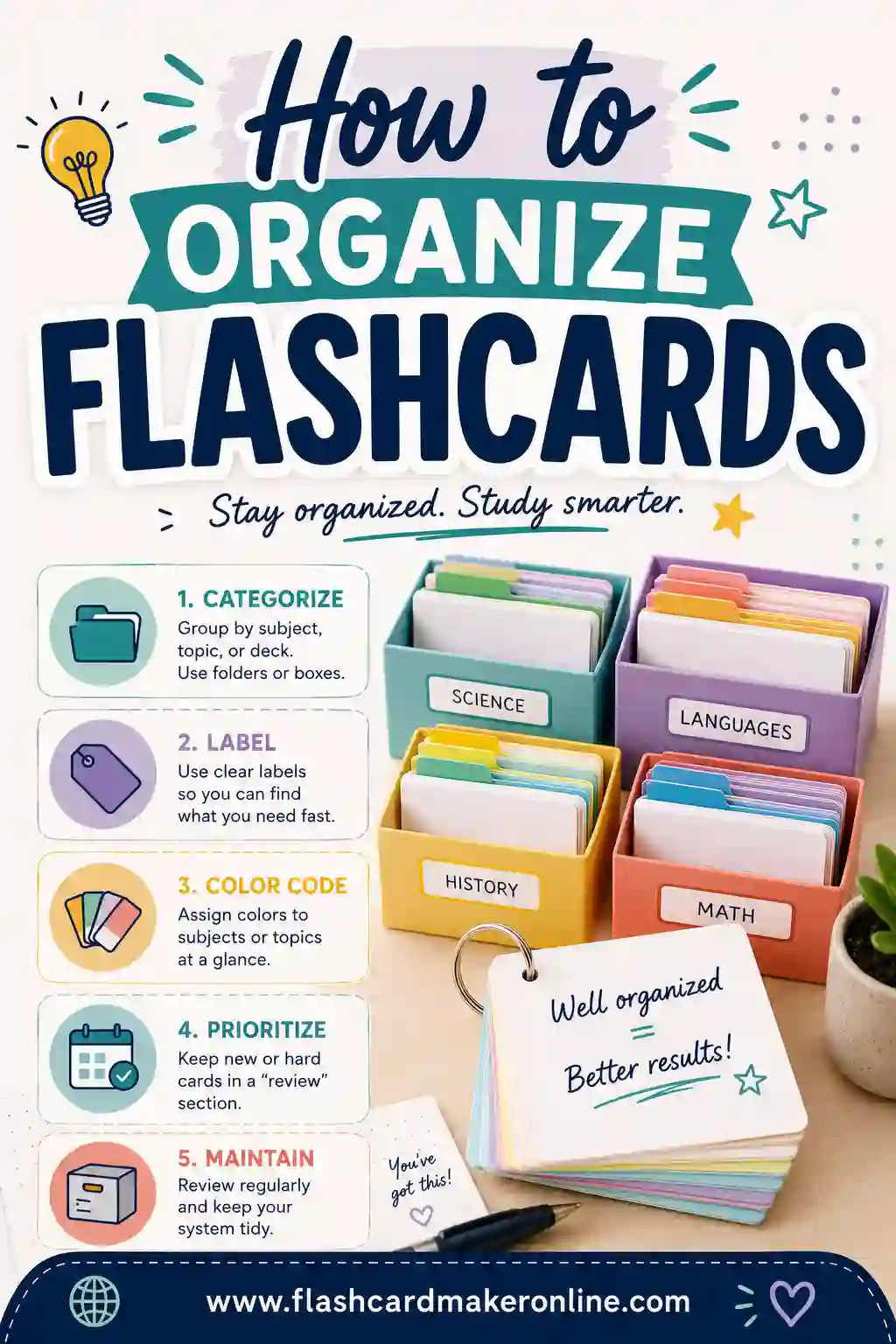
Each day below has the same three parts: new words (if any), review, and a quick check. Keep three piles, or three tabs in your notes if you study on screen:
- Got it: you knew it fast and sure.
- Shaky: you got it, but slowly or with a guess.
- Missed: you didn't get it.
The piles tell you where to spend time. "Missed" and "Shaky" cards always get looked at again before you end a session. "Got it" cards wait for their next scheduled review.
Day 1: Sort, build, and learn Batch A
Day 1 has the most setup, so give it a little extra time.
- Sort your list using the steps above (about 20 minutes).
- Build Batch A in the maker with Paste a list, front and reverse cards (about 15 minutes).
- First pass, word to meaning. Go through Batch A one card at a time. Read the word, say what you think it means out loud, then flip. Don't rush to flip. Give yourself three to five seconds of honest effort first.
- Sort into piles. On a first pass, most cards will land in Missed or Shaky. That's normal.
- Second pass, Missed and Shaky only. Go through them again. Then a third time if you have energy.
- Write one sentence of your own for each Missed word. Not the one on the card. Your own. This takes a few minutes and makes the word much easier to recall tomorrow.
- Short review before bed. Shuffle all of Batch A and go through it once, word to meaning. Five to ten minutes is enough.
Day 1 check: Can you get at least half of Batch A without hesitating? If yes, you're on track. If not, don't worry; day 2 reviews it again.
Day 2: Learn Batch B, first review of A
- Start with A, not B. Shuffle Batch A and run it word to meaning. This is the first spaced review, and it's the most important one of the week. Expect to have forgotten a few words since last night. That's the forgetting the plan is built to fix.
- Run A meaning to word. Now use the reverse cards. This will feel harder. Good.
- Build and learn Batch B the same way you did A on day 1: paste the list, add reverse cards, first pass, piles, second pass, your own sentences for misses.
- Evening review. Shuffle B, one quick pass. Then go through only the Missed cards from A.
Day 2 check: Batch A should be clearly better than yesterday's first pass. If a few words keep missing, look at those cards closely. Is the definition too long? Is the sentence confusing? Rewrite the card now. Fixing bad cards early is one of the best uses of your time.
Day 3: Learn Batch C, keep A and B alive
- Review B first, word to meaning, then meaning to word. This is B's first spaced review.
- Review A's Missed and Shaky cards only. Leave A's "Got it" cards alone today. They'll come back on day 4.
- Build and learn Batch C.
- Try a fill-in-the-blank round. Take five words from A and write a sentence with a blank for each, like "The new policy should ___ the risk of fires." Fill them in from memory. If you like this kind of card, add a few to the deck. They're close to the sentence-completion questions many vocabulary finals use.
- Evening review: Batch C, one pass.
Day 3 check: By now you've touched roughly half your must-know list. If you're behind, don't add a fourth batch on top of two days of catch-up. Instead, make tomorrow's new batch a little smaller and move the extra words into day 5.
Day 4: Learn Batch D, full pass on A
Day 4 is the busiest day for review, so plan for an hour.
- Full review of Batch A, both directions, every card. This is A's review at roughly the four-day mark. Words that are "Got it" today are in good shape for the test.
- Review C (first spaced review).
- Review B's Missed and Shaky cards.
- Build and learn Batch D. If you put your easiest words here, this should go faster than earlier batches.
- Evening review: Batch D, one pass.
Day 4 check: Count your Missed pile across all batches. Write the number down. You'll compare it with tomorrow's.
Day 5: Stop adding words, start mixing
From here on, no new batches. If you have leftover must-know words, add them today and make that the last of it. Nice-to-know words only go in if your Missed pile is small.
- Review D (first spaced review), both directions.
- Full review of Batch B, both directions.
- Pull every Missed and Shaky card from all four batches into one stack. Shuffle it and go through it twice.
- Make "confusable" cards. By now you'll notice pairs of words you mix up, like "affect" and "effect," or "ambivalent" and "ambiguous." Make one card per pair that asks you to tell them apart: front "ambivalent vs. ambiguous," back "ambivalent = mixed feelings; ambiguous = unclear, more than one meaning."
- Evening review: the combined Missed stack, one pass.
Day 5 check: Is your Missed count lower than yesterday's? It should be, even with Batch D in the mix.
Day 6: Shuffle the whole deck
Today the batches disappear. You're studying one mixed deck, the way the test will mix words together.
- Whole deck, word to meaning, shuffled. Use Shuffle in Study mode, or shuffle your paper stack. Sort into the three piles as you go.
- Whole deck, meaning to word, shuffled. This will take longer. Be patient with it.
- Missed and Shaky, three times. After each pass, cards you got right move to "Got it." Keep going until the Missed pile is small.
- Say or write a sentence for every card still in the Shaky pile.
- Evening: a short pass on the Missed pile only. Then stop. Don't push into the late night.
Day 6 check: Most of the deck should be in Got it. If a large chunk is still Missed, look at the cards, not just your memory. Long, vague or two-in-one definitions are the usual culprits. Shorten them now.
Day 7: Practice test, fix gaps, rest
The goal today is to find what you still don't know, fix it, and go into the final rested.
- Make a practice test from your deck. Print your deck with Fronts only. You get a sheet of words with no answers. Pick 20 to 30 words at random, write the meaning and a short sentence for each, then check against the backs. If your final asks for the word from the meaning, make a second sheet from your reverse cards the same way.
- Grade it honestly. A wrong or half-right answer goes in the Missed pile.
- Drill the misses. Go through them until you get each one twice in a row.
- One final shuffled pass of the whole deck, word to meaning only. Keep it quick.
- Stop early and sleep. If the final is the next morning, a full night's sleep will help you more than another hour with your cards. Our page on sleep and memory consolidation explains why.
Test morning: If you have a few spare minutes, flip through your Missed pile once. Don't try to learn anything new.
How to Write Vocabulary Cards That Hold Up on Test Day
A good plan with weak cards still struggles. These rules make each card do more work.
Keep the meaning short. Aim for a definition you could say in one breath. "To make less severe" beats "to lessen the gravity, intensity or painfulness of something." If your textbook's definition is long, rewrite it in your own words. You'll remember your own phrasing better anyway.
One meaning per card. Some words have two common meanings. "Novel" can be a book or something new. Make two cards, each with its own sentence, instead of cramming both onto one back.
Always add a sentence. Put a short example sentence in parentheses after the meaning. The best sentences are specific and a little vivid: "The sandbags mitigated the flood damage" sticks better than "This will mitigate the problem."
Add the part of speech when it matters. If your final asks you to use words in sentences, the part of speech saves you from errors like "She was very mitigate." A quick "(verb)" on the back is enough.
Use word families. If you learn "scrutinize," you're close to "scrutiny." Add the related form to the back: "scrutinize (verb); scrutiny (noun)." It's one card that covers two test words.
Write the reverse card with a clue, not just a definition. "Having mixed feelings" could point to "ambivalent" or "torn." If your teacher's list has near-synonyms, add a hint to the reverse front, like "having mixed feelings (starts with a)," so the card has only one right answer.
For a language final, include gender and a sample phrase. For Spanish or French nouns, put the article on the card ("la llave," not "llave"). For verbs, add one useful form or a short phrase. The 🔊 Read aloud button in Study mode helps you hear the word as you review.
Sample Batch: 30 Academic Vocabulary Cards
Here's a full sample deck you can use to try the plan, or to see how cards should look before you write your own. These are common academic words that show up in English, history and general vocabulary finals. To load them, type each row into Paste a list as word : meaning (sentence), one per line.
| Front | Back |
|---|---|
| ubiquitous | Found everywhere (Phones are ubiquitous on campus.) |
| mitigate | To make less severe (Sandbags mitigate flood damage.) |
| ambivalent | Having mixed feelings (She felt ambivalent about moving.) |
| ambiguous | Unclear, open to more than one meaning (an ambiguous answer) |
| pragmatic | Practical, focused on what works (a pragmatic plan) |
| corroborate | To confirm with evidence (The video corroborated her story.) |
| ephemeral | Lasting a very short time (Fame online can be ephemeral.) |
| tenuous | Weak or thin (a tenuous link between the two events) |
| scrutinize | To examine very closely (He scrutinized the contract.) |
| benevolent | Kind, wanting to do good (a benevolent ruler) |
| candid | Honest and direct (a candid interview) |
| diligent | Careful and hardworking (a diligent student) |
| frugal | Careful with money, not wasteful (a frugal shopper) |
| meticulous | Paying great attention to detail (meticulous notes) |
| obsolete | No longer used, out of date (Fax machines are nearly obsolete.) |
| inevitable | Certain to happen (Change was inevitable.) |
| skeptical | Doubtful, not easily convinced (skeptical of the claim) |
| verbose | Using more words than needed (a verbose essay) |
| concise | Brief and clear (a concise summary) |
| advocate | To publicly support (verb); a supporter (noun) |
| alleviate | To make pain or a problem easier to bear (to alleviate stress) |
| arbitrary | Based on chance or whim, not reason (an arbitrary rule) |
| coherent | Logical and clear (a coherent argument) |
| empathy | Ability to understand and share another's feelings |
| hypothesis | A testable explanation or prediction |
| inference | A conclusion drawn from evidence and reasoning |
| objective | Not influenced by personal feelings (an objective report) |
| subjective | Based on personal feelings or opinions (a subjective review) |
| resilient | Able to recover quickly from difficulty (a resilient community) |
| reluctant | Unwilling, hesitant (reluctant to speak up) |
Notice the built-in pairs: ambivalent and ambiguous, verbose and concise, objective and subjective. Pairs like these are common on finals because they're easy to mix up. Studying them close together, then making a "tell them apart" card for each pair, is one of the fastest ways to pick up extra points.
If your final is for an exam-style vocabulary list, the SAT Vocab and GRE Vocab presets in the maker give you a starting set you can trim to match your class.
Adjusting the Plan for Your Situation
The plan above assumes about 60 to 80 must-know words and seven full days. Real life is messier. Here's how to bend it without breaking it.
| Situation | What to change |
|---|---|
| 150 or more must-know words | Batches of 25 to 30 on days 1 to 4, add a fifth batch on day 5, and keep reverse cards only for the starred words |
| Only 4 or 5 days left | Two batches a day for the first two days, then go straight to mixed review; still keep the practice test on the last day |
| Language final (Spanish, French and so on) | Make reverse cards for every word, since you'll need to produce words in writing and speaking; use Read aloud daily |
| Science or history terms | Add a "why it matters" line or a quick example to the back; add pictures for terms you can draw |
| Several finals in the same week | Run two decks side by side, with separate batches; alternate which one you review first each day |
| You miss a day | Don't add the missed batch on top of the next one; do review only that day, then shift new batches back by one |
If your list is huge. Big lists are where sorting pays off most. Cut the already-known words without mercy. Then accept that your nice-to-know words may get only one or two passes. Spend your reviews where they count: starred words, words you've missed before, and words from the units your teacher said will be weighted most.
If you're starting late. With three or four days, you can still use spaced review; the gaps are just shorter. Learn everything over the first two days, review it all on day 3, and test yourself on the last day. You won't remember as much as you would with a full week, but you'll remember far more than with one long night.
For a language class. A language vocabulary final usually tests you in both directions and often in writing. Reverse cards aren't optional here. If your teacher grades accents or spelling, write the word out by hand on your Day 7 practice test instead of just saying it. If your class follows a common textbook word list, the Spanish, French, German, Italian or Latin preset in the maker can save you some typing.
For younger students. Middle schoolers can use the same plan with smaller batches, around 8 to 10 words a day, and shorter sessions of 20 to 30 minutes. A parent or older sibling can run the reverse cards out loud, which makes the meaning-to-word round feel more like a game than a drill.
Common Mistakes and How to Fix Them
| Mistake | Why it hurts | Fix |
|---|---|---|
| Making the whole deck on day 1 and studying it all at once | Too many new words; most fade by day 3 | Build in batches and add new words over four days |
| Only studying word to meaning | You recognize words but can't produce them on a fill-in or essay | Add reverse cards and run them every review |
| Long textbook definitions on the back | Hard to recall, easy to half-know | Rewrite in your own words, under about ten words |
| No sentences | You know the meaning but miss it in context questions | Add one short, specific sentence per card |
| Flipping the card too fast | You think you knew it when you only recognized it | Say the answer out loud before every flip |
| Reviewing only the cards you know | Feels good, does little | Start every session with the Missed pile |
| All-nighter on day 6 or 7 | Tired brain, weaker recall on test day | Stop early on day 7 and sleep |
| Skipping the practice test | You don't find your gaps until the real test | Print Fronts only on day 7 and test yourself |
Ready to start? Sort your list tonight, then open the free flashcard maker, paste your first 15 to 20 words as word : meaning (sentence), add the reverse cards, and run your first pass. Seven short sessions from now, you'll walk into your final having seen every must-know word at least four times, in both directions, in context. If you'd rather start from a ready set, load the SAT Vocab, GRE Vocab or language preset in the flashcard maker and trim it to match your class list.
Frequently Asked Questions
Can you really memorize vocabulary in one week?
Yes, for a typical class final. Learning around 60 to 100 words well enough for a test is realistic in a week if you study every day, use spaced review and test yourself instead of rereading. Very large lists are harder, so sort first and focus on the words most likely to be tested.
How many new words should I learn per day?
Ten to twenty new words a day is a steady pace, and around 20 is a push. Above that, the review load in the second half of the week gets heavy fast. If your list is bigger, raise the batch size only for the first few days, and never add new words in the last two days.
Should I make cards in both directions?
Yes, at least for the words you're most likely to be tested on. Word to meaning trains recognition, and meaning to word trains recall, which you need for fill-in-the-blank questions and writing. For a language final, make reverse cards for every word.
Is it better to use paper flashcards or study on screen?
Both work, and many students use both. Paper cards make it easy to sort into Got it, Shaky and Missed piles, while on-screen Study mode is handy for spare minutes and lets you hear words with Read aloud. You can build the deck once and print it double-sided for paper review.
What if I fall behind on the schedule?
Don't stack two days of new words on top of each other. Spend the day you missed on review only, then shift the remaining batches back by one day. Keep the practice test on the last day no matter what, since it shows you exactly where your gaps are.
How long should each study session be?
Plan on about 45 to 60 minutes a day, split into a main session and a short evening review if you can. Days 4 through 7 are heavier on review and may take closer to an hour. Short, focused sessions work better than long ones where your attention drifts.
Should I study the night before the final?
A short review of your Missed pile is fine, but stop early and get a full night's sleep. Sleep helps your brain hold on to what you learned during the week. Cramming late into the night usually costs more than it gains.
How do I make a practice test from my flashcards?
Print your deck with the Fronts only layout so you get a sheet of words with no answers. Write the meaning and a short sentence for each, then check against the backs. Do the same with your reverse cards if your final asks for the word from the meaning.