Praxis Flashcards: How to Study for Teacher Certification Exams
The best Praxis flashcards come from your own deck, built around the exact test you're registered for and split into the same content categories the official study companion lists. Make one card per term, formula or rule, sort the cards by test section, and drill the sections where your practice tests show the most misses. You can build, study and print the whole deck in a free flashcard maker with no account.
Premade sets are a fine starting point, but they rarely match your specific test. A card set for the old version of a subject test, or one written for a different grade band, can waste hours. Your own deck stays tied to the test you'll actually sit.
This guide covers how the Praxis tests are organized, what kind of cards each section needs, 60 sample cards you can paste right in, a six-week schedule, and the habits that turn a stack of cards into points on test day.
🃏 Quiz yourself: 12 cards from this page
Read the front, say your answer, then tap the card to check.
Make, study & print this deck → Opens the free flashcard maker with all 12 cards ready to edit or print.▶ Open this deck in the flashcard maker
Which Praxis Test Are You Taking?
"The Praxis" isn't one exam. It's a family of tests run by ETS, and states use different combinations of them for teacher licensing. Before you write a single card, pin down exactly which tests your state and program require.
Most future teachers run into two main groups:
| Test group | What it checks | Who usually takes it |
|---|---|---|
| Praxis Core Academic Skills for Educators | Reading, writing and math skills | Many students entering a teacher prep program |
| Praxis Subject Assessments | Content knowledge for a subject or grade band | Candidates seeking a license in a specific area |
| Principles of Learning and Teaching (PLT) | Teaching methods, learning theory, assessment, professional practice | Required by some states, by grade band |
| Other specialty tests | Reading instruction, special education, school leadership and more | Depends on the license and the state |
Praxis Core has three separate tests: Reading, Writing and Mathematics. You can take them one at a time or together. Subject Assessments cover everything from Elementary Education: Multiple Subjects to high school biology, English, social studies, music and dozens more.
A few things to confirm before you build your deck:
- The test name and code. Each Praxis test has a code. Write it at the top of your notes so you never study for the wrong version.
- The current study companion. ETS publishes a free study companion for each test with the content categories, the share of questions in each category and sample questions. This is your deck's table of contents.
- Your state's passing score. Each state sets its own qualifying scores. Look it up on the official state or ETS listing, not on a forum.
- Format details. Some sections include an essay or constructed-response questions, and some tests provide an on-screen calculator. Check the details for your test so you practice the right way.
Test content and formats get updated from time to time. Always build your deck from the current official outline, and check it again if your test date is months away.
Why Flashcards Work for Praxis Prep
The Praxis tests mix two kinds of questions. Some ask you to recall something directly: a term, a law, a formula, a grammar rule. Others give you a classroom scenario and ask what a teacher should do. Flashcards are excellent for the first kind and surprisingly useful for the second, if you write them well.
Here's why they fit so well:
- Lots of vocabulary. Education coursework is packed with terms like scaffolding, differentiation, formative assessment and least restrictive environment. You need to know each one fast and precisely, because answer choices often hinge on the difference between two similar terms.
- Names attached to ideas. Piaget, Vygotsky, Erikson, Bloom, Gardner and Maslow all show up in teacher prep. Matching the theorist to the theory is classic flashcard material.
- Formulas and rules. Praxis Core Math expects you to handle percent, ratios, area, probability and basic statistics. Writing tests expect grammar and usage rules to be automatic.
- Active recall. Pulling an answer out of memory strengthens it far more than rereading a chapter. Our guide to the active recall method explains why this beats highlighting.
What flashcards won't do on their own is build reading stamina or essay skills. You'll pair them with full practice tests and timed writing, which we'll cover in the schedule below.
How to Map Your Deck to the Test Outline
The study companion for your test lists content categories, and usually the approximate number or share of questions in each. Use that to decide how many cards each section gets.
Start with a simple worksheet:
- List each content category from the study companion.
- Note its share of the test. A category worth a large chunk of the questions deserves more cards.
- Rate yourself. After a diagnostic practice test, mark each category strong, okay or weak.
- Set a card target. Weak, heavily weighted categories get the most cards. Strong categories still get a review set.
Here's what that looks like for the three Praxis Core tests. The content areas below are described in general terms; your study companion has the official names and weights.
| Core test | General content areas | Card types that help most |
|---|---|---|
| Reading | Key ideas and details, craft and structure, integration of knowledge and ideas | Question-type cards, tone and purpose words, argument terms |
| Writing | Grammar and usage, sentence structure, revision, research skills, essays | Rule cards, error-spotting cards, transition words |
| Mathematics | Number and quantity, algebra and functions, geometry, statistics and probability | Formula cards, worked mini-problems, vocabulary |
And here's a typical layout for a pedagogy-focused test like the PLT:
| Section of your deck | What goes in it | Rough card count |
|---|---|---|
| Learners and development | Developmental stages, theorists, motivation, diverse learners | 30–40 |
| Instruction | Strategies, grouping, questioning, Bloom's levels, differentiation | 30–40 |
| Assessment | Formative vs. summative, validity, reliability, score types | 20–30 |
| Professional practice and law | IDEA, Section 504, FERPA, reflection, collaboration | 15–25 |
| Scenario cards | "What should the teacher do?" mini cases | 20–30 |
For a subject test, like a high school science or English test, the same process applies. Pull the content categories from the study companion, then split each into cards. A biology candidate might have sections for cell biology, genetics, evolution, ecology and lab safety. An English candidate might have literary terms, periods and authors, grammar, and composition.
Keep one deck per test. If you're taking Core and a subject test, build them separately. Mixing them makes it hard to see where your gaps are.
How to Write Praxis Cards That Actually Stick
A good card is small, clear and has one right answer. Most weak decks fail because cards are too big or too vague. These rules keep your Praxis flashcards sharp.
One idea per card
"Piaget's four stages" is a paragraph, not a card. Break it up:
- Front: Piaget stage for birth to about age 2. Back: Sensorimotor.
- Front: Piaget stage marked by object permanence developing. Back: Sensorimotor.
- Front: Piaget stage for about ages 2 to 7. Back: Preoperational.
Then add one "order" card that asks you to list all four stages in sequence. Small cards first, the big picture last.
Make both directions when it matters
Some terms show up on the test as the question, and some show up as the answer. For key terms, make a term-to-definition card and a definition-to-term card. "Scaffolding" on the front tests whether you can explain it. "Temporary support removed as the student gains skill" on the front tests whether you can recognize it among four answer choices.
Write compare cards for look-alike terms
Praxis answer choices love near-misses. Build cards that force you to tell close concepts apart:
- Formative vs. summative assessment
- Norm-referenced vs. criterion-referenced tests
- Validity vs. reliability
- Accommodation vs. modification
- IEP vs. Section 504 plan
- Assimilation vs. accommodation (Piaget)
On the back, give the one difference that matters most, plus a quick example.
Turn scenarios into cards
Pedagogy tests ask what a teacher should do next. You can drill that with short case cards. Front: "Several students finish early every day and seem bored. Best first step?" Back: "Check what they already know with a quick pre-assessment, then offer extension tasks that go deeper, not just more of the same work."
Keep scenario backs short and focused on the principle (here, pre-assessment and differentiation), so you learn the reasoning, not one memorized answer.
Show the steps on math cards
For Core Math, a formula card alone isn't enough. Pair each formula with a worked mini-problem:
- Front: A shirt drops from 40 to 30. Percent decrease? Back: (40 minus 30) divided by 40 = 0.25, so 25%.
- Front: Mean of 4, 8, 9, 15? Back: Sum is 36, divided by 4 = 9.
Saying the steps out loud before you flip is the best way to catch where you slip, whether it's setting up the fraction or dividing by the wrong number.
Keep grammar cards concrete
"Know subject-verb agreement" is not a card. A short sentence with a mistake is. Front: "The box of crayons are on the shelf. Fix it." Back: "The box of crayons is on the shelf. The subject is box, which is singular." Error-spotting cards train exactly what the Writing test asks you to do.
Add a picture where it helps
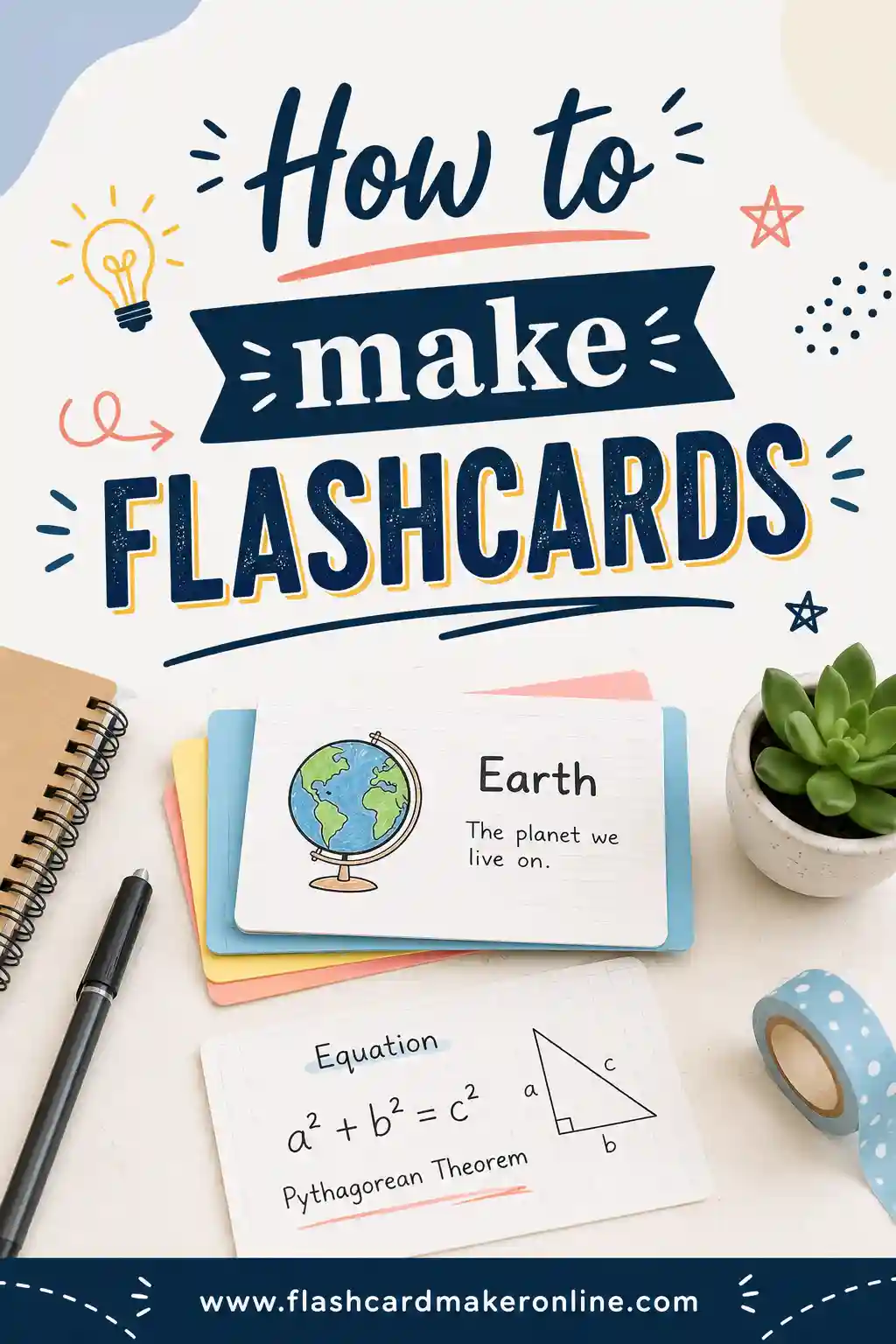
The maker lets you add pictures to cards. That's handy for geometry figures, a labeled diagram of Bloom's levels, or a quick sketch of a number line. You don't need pictures on vocabulary cards, but a shape on a geometry card can make a formula easier to recall.
60 Sample Praxis Cards You Can Paste
These cards cover terms and skills that come up across Praxis Core and common pedagogy tests. They're written in the front : back format, one card per line, so you can copy a whole block and drop it into Paste a list in the maker.
Treat these as a starter set. Check each one against your study companion and your coursework, cut anything your test doesn't cover, and add cards for your own weak spots.
Learning theory and development (14 cards)
Piaget stage, birth to about age 2 : Sensorimotor, learning through senses and movement
Piaget stage, about ages 2 to 7 : Preoperational, symbolic thinking and egocentrism
Piaget stage, about ages 7 to 11 : Concrete operational, logic about concrete objects
Piaget stage, about age 11 and up : Formal operational, abstract and hypothetical thinking
Conservation (Piaget) : Understanding that amount stays the same when shape changes
Zone of proximal development : What a learner can do with help but not yet alone
Scaffolding : Temporary support the teacher removes as the student gains skill
Erikson stage for school-age children : Industry vs. inferiority
Erikson stage for adolescents : Identity vs. role confusion
Kohlberg's three levels of moral reasoning : Preconventional, conventional, postconventional
Maslow's hierarchy, bottom to top : Physiological, safety, belonging, esteem, self-actualization
Gardner's theory : Multiple intelligences, such as linguistic, logical-mathematical and spatial
Bruner's spiral curriculum : Revisiting key ideas over time at increasing depth
Constructivism : Learners build understanding by connecting new ideas to what they know
Instruction and classroom practice (14 cards)
Revised Bloom's taxonomy, lowest to highest : Remember, understand, apply, analyze, evaluate, create
Differentiated instruction : Adjusting content, process or product to fit student needs
Wait time : Pausing a few seconds after a question before calling on a student
Think-pair-share : Students think alone, discuss with a partner, then share with the class
Jigsaw : Each group member learns one part and teaches it to the others
Direct instruction : Teacher-led, explicit teaching with modeling and guided practice
Gradual release model : I do, we do, you do
Inquiry-based learning : Students investigate questions and build answers through exploration
Metacognition : Thinking about your own thinking and learning
Positive reinforcement : Adding something pleasant to make a behavior more likely
Negative reinforcement : Removing something unpleasant to make a behavior more likely
Intrinsic motivation : Doing a task because it is interesting or satisfying in itself
Extrinsic motivation : Doing a task for an outside reward or to avoid a consequence
Open-ended question : A question with many possible answers that invites deeper thinking
Assessment (10 cards)
Formative assessment : Checks during learning used to adjust teaching
Summative assessment : Measures learning at the end of a unit or course
Diagnostic assessment : Given before instruction to find what students already know
Norm-referenced test : Compares a student's score to a larger group
Criterion-referenced test : Compares a student's score to a set standard or skill list
Validity : How well a test measures what it claims to measure
Reliability : How consistent a test's results are
Percentile rank of 70 : Scored as well as or better than about 70 percent of the norm group
Stanine : A score on a 1 to 9 scale, with 5 as the middle
Rubric : A scoring guide that lists criteria and levels of performance
Special education and school law (8 cards)
IDEA : Individuals with Disabilities Education Act
IEP : Individualized Education Program for an eligible student with a disability
Section 504 plan : Accommodations for a student with a disability under the Rehabilitation Act
LRE : Least restrictive environment, educating students with peers to the greatest extent appropriate
FAPE : Free appropriate public education
FERPA : Federal law protecting the privacy of student education records
Accommodation : Changes how a student learns or is tested, not what is expected
Modification : Changes what a student is expected to learn or show
Core Math (8 cards)
Percent change : (new minus old) divided by old, times 100
Area of a triangle : One half times base times height
Area of a circle : Pi times radius squared
Circumference of a circle : 2 times pi times radius
Pythagorean theorem : a squared plus b squared equals c squared, for right triangles
Slope between two points : (y2 minus y1) divided by (x2 minus x1)
Probability of an event : Favorable outcomes divided by total possible outcomes
Range of a data set : Largest value minus smallest value
Core Reading and Writing (6 cards)
Inference : A conclusion based on evidence in the text, not stated directly
Author's purpose, three common types : To inform, to persuade, to entertain
Comma splice : Two independent clauses joined only by a comma
Sentence fragment : A group of words missing a subject, a verb or a complete thought
Parallel structure : Using the same grammatical form for items in a list or pair
Its vs. it's : Its shows possession; it's means it is
That's 60 cards. Once you've pasted them in, the real work is making them yours. Cross out the ones that feel too easy after a few rounds, and add new ones every time a practice question surprises you.
How to Build This Deck in the Flashcard Maker
Here's the exact process in the free flashcard maker on our homepage. It takes about 15 minutes to get the 60 starter cards in and printed.
- Name the deck after your test. Type something like "Praxis Core Math" or "PLT Assessment" in the deck title box. One deck per section keeps things easy to find and easy to study.
- Skip the presets, or borrow one. There's no Praxis preset, so most of your cards will come from pasting. If you're taking a subject test, a preset can save time. For example, a biology or chemistry candidate can start from the Biology or Chemistry preset, and a world language candidate can start from one of the vocab presets, then edit and add cards.
- Open "Paste a list." Copy one block of cards from above (or from your own notes) with one card per line in
front : backformat. Choose Add to deck to add them to what's already there, or Replace deck to start fresh. - Add or fix single cards. Use + Add card for anything new, and edit any card that doesn't match your coursework. If a geometry card or a diagram card would be clearer with an image, add a picture to that card.
- Study on screen first. Open Study mode, turn on Shuffle, and go through the deck with Flip, Prev and Next. Say each answer out loud before you flip. Read aloud is useful if you like hearing terms while you review.
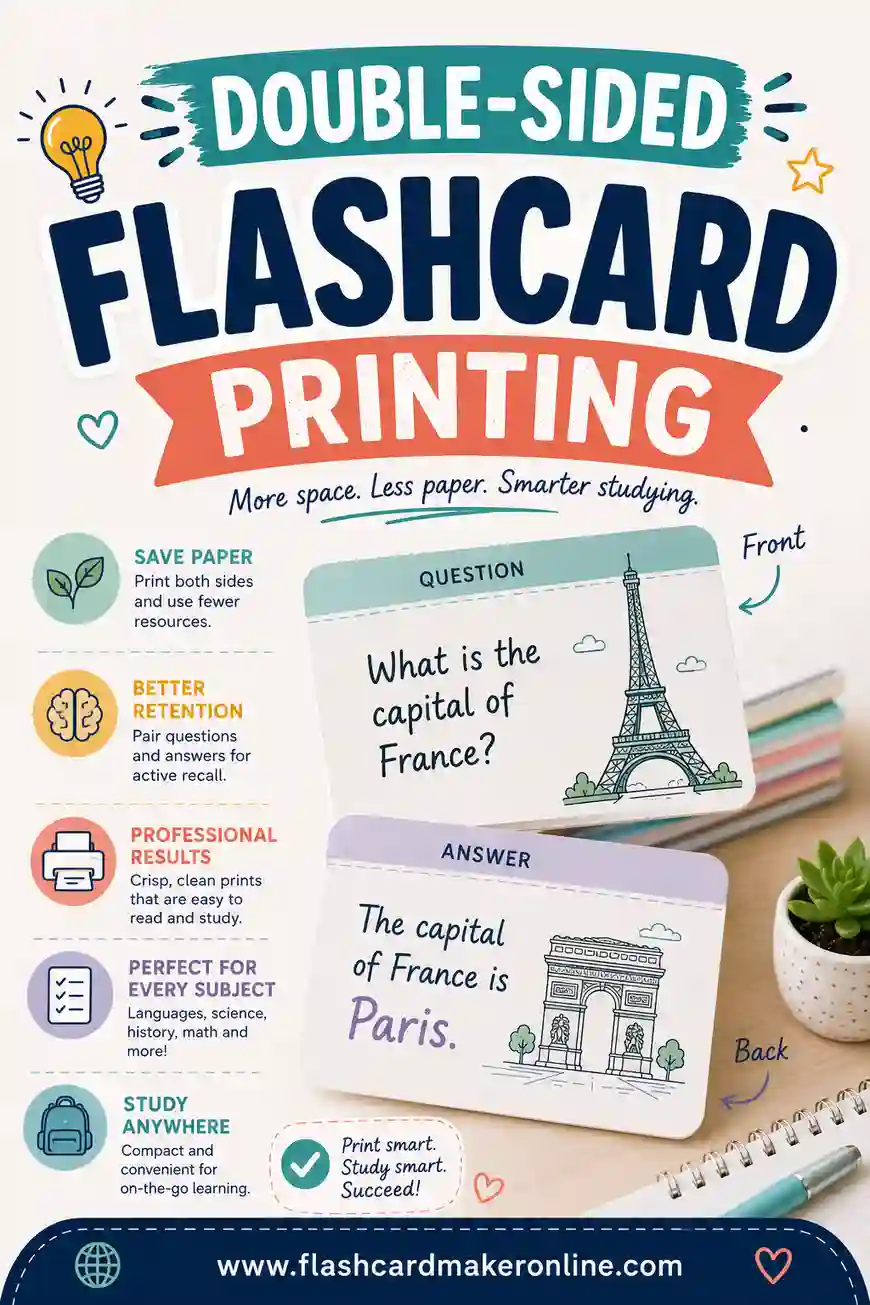
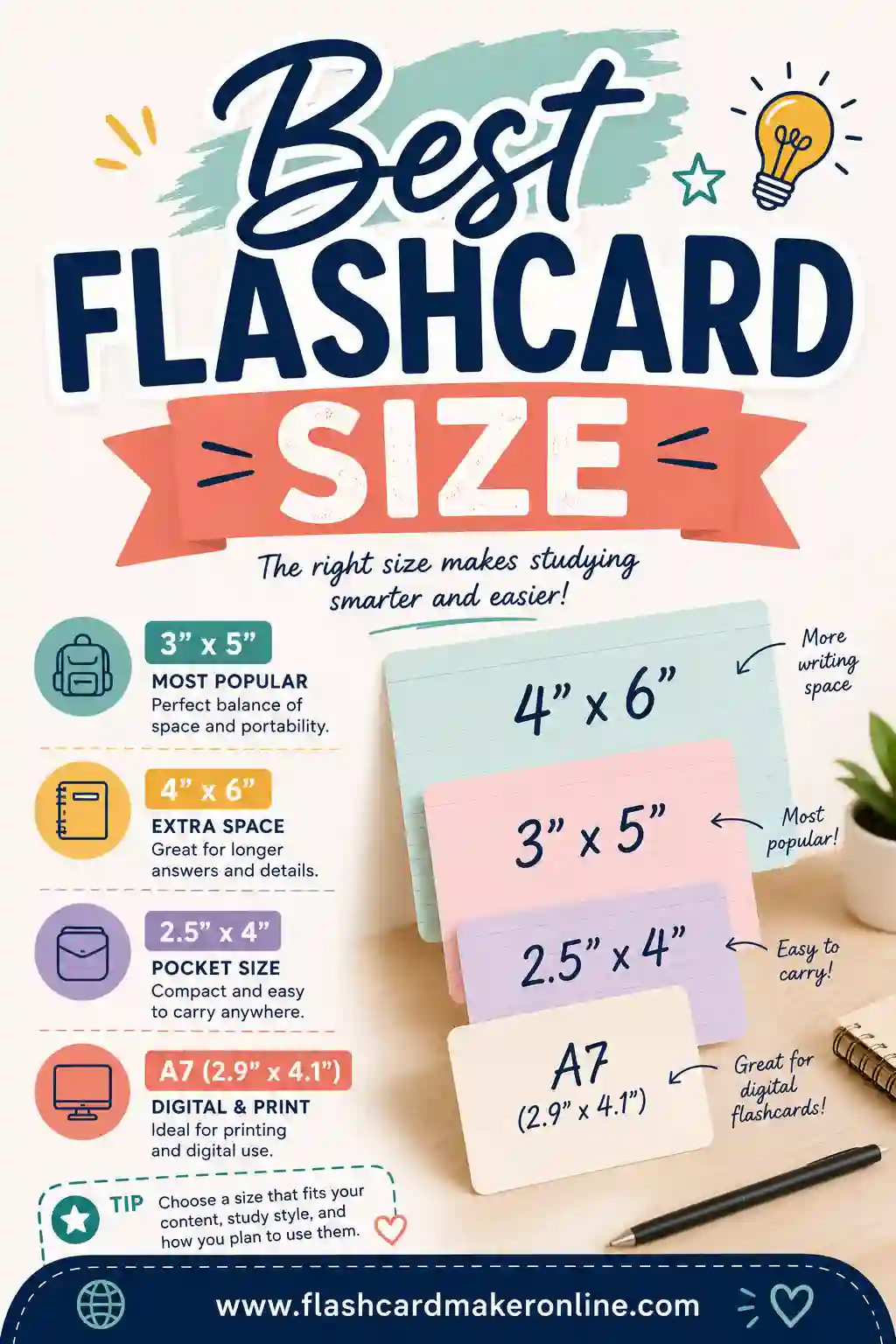
- Print the deck. In Print, pick Double-sided so each answer lines up behind its question. Standard or 3×5 index card size works well for term cards, while 4×6 index card gives scenario cards room to breathe. Use Print a test page first to check that fronts and backs line up on your printer, then print or save as PDF.
- Back it up. Use Download .csv to keep a copy of each deck on your computer. If you're in a study group or a cohort, Get share link lets classmates get their own copy to edit.
If you'd rather quiz yourself without the answers on the back, print Fronts only and keep the answers on screen. The Cut-out grid layout is handy for quick term sorts, where you lay out cards and group them by theorist or category.
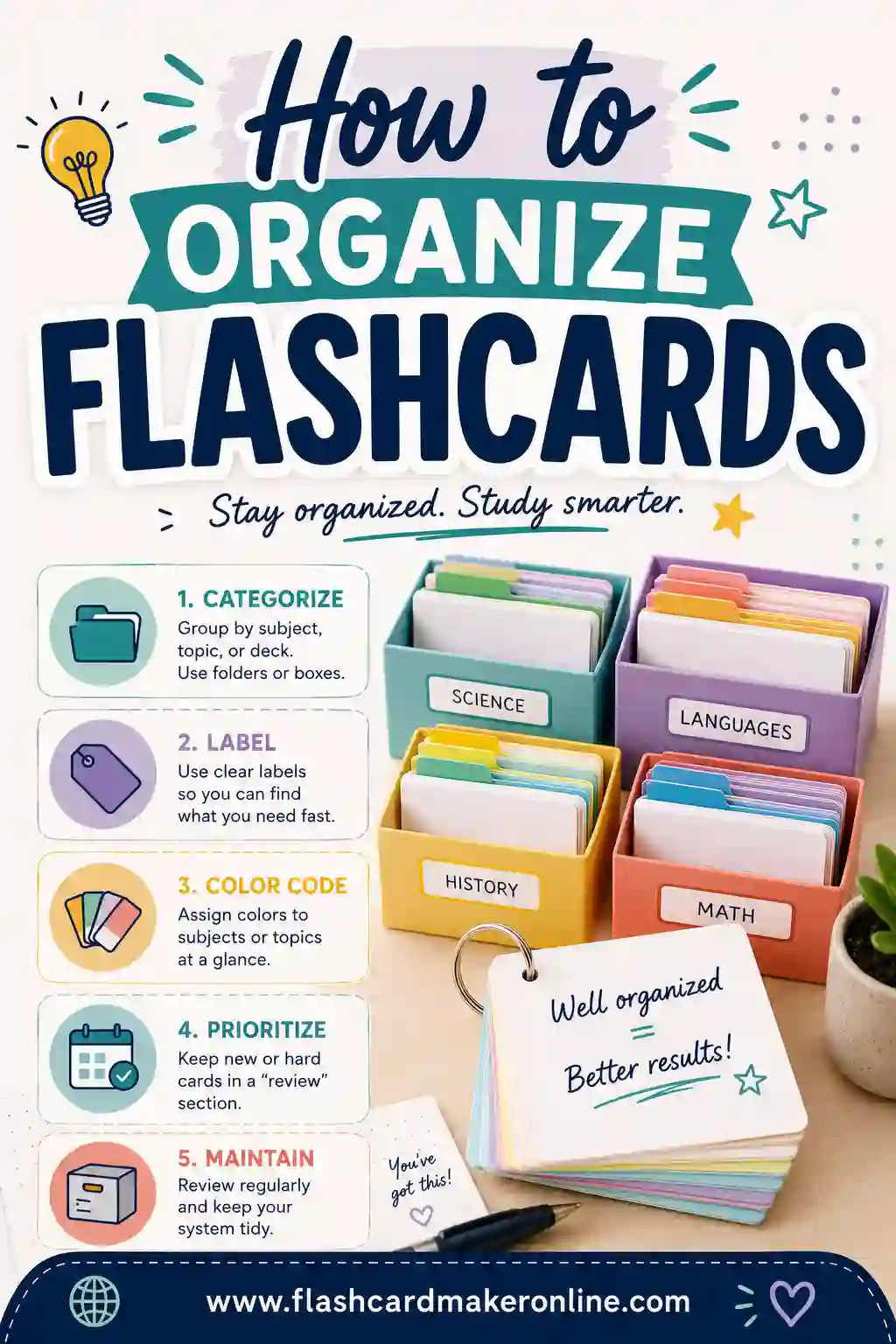
Printing tip: Print each section on a different color of cardstock. Blue for assessment, green for learning theory, yellow for math, and so on. When you pull your weak cards later, the colors show you at a glance which sections need the most work. Our guide to double-sided flashcard printing has more on paper choice and flip settings if your test page comes out crooked.
A Six-Week Praxis Study Plan
Six weeks is a comfortable runway for one Core test or one subject test with steady daily review. If you have less time, compress the first three weeks. If you have more, slow the pace of new cards and add more practice tests.
| Week | New cards | Daily review | Other practice |
|---|---|---|---|
| 1 | Take a diagnostic practice test, then build cards for your two weakest categories | 15–20 minutes | Read the study companion end to end |
| 2 | Add cards for the next two categories | 20 minutes | One timed set of practice questions |
| 3 | Finish the remaining categories; add scenario cards | 20–25 minutes | For writing tests, one timed essay |
| 4 | Add a card for every practice question you miss | 25 minutes, shuffled across all sections | Full-length practice test |
| 5 | Only add cards for new misses | 25 minutes, weak piles first | Second full-length practice test, review every miss |
| 6 | No new cards in the last few days | 15–20 minutes, light review | Rest, sleep, and confirm test-day details |
Sort your cards into piles
After your first full pass, sort cards into three piles: "know it," "shaky" and "don't know." Review "don't know" every day, "shaky" every other day, and "know it" about twice a week. When you get a card right, it moves up a pile. When you miss it, it drops back down. This is the same idea behind the Leitner system, and it keeps your study time on the cards you actually miss.
Mix sections once they're solid
In the first few weeks, study one section at a time. By week four, shuffle everything together. The real test jumps between topics, and mixing your review trains you to switch gears the same way.
Use practice tests to feed the deck
Practice tests show you what you don't know. Flashcards help you fix it. Every time you miss a question, ask why. Was it a term you didn't know, a formula you forgot, or a scenario where you picked the "nice" answer instead of the best one? Make a card for the exact gap, not for the whole question.
Practice the essay separately
If your test includes an essay or constructed response, flashcards can help with the parts, like transition words, essay structure and the key ideas you want to mention. They can't replace writing practice. Write timed responses using official sample prompts, and compare your work to the scoring guide in the study companion.
The night before and test day
Do a short, light review of your "shaky" pile, then stop. Get a full night's sleep. On test day, bring the ID and anything else your admission ticket requires, and check the testing rules ahead of time, since they differ between test center and at-home testing. Leave your cards at home or in the car.
Mistakes That Cost Praxis Points
These are the most common problems with Praxis decks, and how to fix each one.
| Mistake | Why it hurts | Fix |
|---|---|---|
| Studying a premade set for the wrong test | You learn content that won't appear and miss what will | Build from your test's current study companion |
| Paragraph-long cards | You can't recall a whole paragraph, so you skip the card | Split it into one idea per card |
| Only term-to-definition cards | Test questions often give the description and ask for the term | Make both directions for key terms |
| No scenario cards | Pedagogy questions test judgment, not just vocabulary | Add short "what should the teacher do?" cards |
| Formula cards with no examples | Knowing a formula isn't the same as using it | Add a worked mini-problem for each formula |
| Reviewing only the easy cards | It feels productive but doesn't raise your score | Start every session with your "don't know" pile |
| Cramming the last week | Facts fade quickly without spaced review | Start five or six weeks out with short daily sessions |
One more trap: picking the answer that sounds kindest instead of the one that's most effective. On scenario questions, the best choice usually puts student learning first, uses evidence like assessment data, and follows the law and school policy. When you write scenario cards, write the back to explain the principle, so you can apply it to new cases.
Adjusting the Deck for Your Situation
Not every Praxis candidate starts from the same place. Here's how to adjust your deck.
First-year education students taking Core
You're probably just starting your program, so the pedagogy terms aren't the focus yet. Put your energy into the three Core sections. For Math, build a formula deck and a set of worked problems from your weakest topics. For Writing, make error-spotting cards from your practice test misses. For Reading, make cards for question types, like main idea, inference and author's purpose, with a note on how to find each one.
Career changers and alternative-route candidates
You may already know your subject well but have less background in education theory. Spend extra time on the learning theory, assessment and law sections. Your subject knowledge cards can be fewer and aimed at gaps, such as an engineer who needs a quick review of statistics vocabulary before a math test.
Elementary education candidates
Multi-subject tests cover a lot of ground: reading and language arts, math, science and social studies. Build one deck per subject and keep each one tight. Focus on the concepts you'd teach, like place value, fractions, phonics terms and basic earth science, and how students typically learn them.
Retaking a test
Your score report breaks down performance by category. Use it to aim your deck. Rebuild cards for the lowest categories first, and review your old deck to see which kinds of questions still trip you up. You don't need to start over; you need to focus.
Studying with a cohort
Split the outline with classmates. Each person builds cards for one or two categories, then shares the deck with a link so everyone gets their own copy. Review each other's cards for accuracy before you trust them. Our page on flashcards for teachers has more ideas for using cards in a classroom once you're licensed, and our general guide to certification exam flashcards covers deck strategy that works for any licensing test.
Ready to start? Open the free flashcard maker, paste in your first block of Praxis cards, and study for 15 minutes tonight. One section a day gets you a full deck in under two weeks.
▶ Open this deck in the flashcard maker
Frequently Asked Questions
Are Praxis flashcards enough to pass?
Flashcards are great for terms, formulas, grammar rules and theorists, and they can help with scenario thinking too. They don't replace full practice tests or essay practice. Use your deck for daily recall and practice tests to build stamina and timing.
How many Praxis flashcards do I need?
It depends on your test and your gaps. Many candidates end up with somewhere between 100 and 250 cards for one test. Let your diagnostic practice test guide you: weak, heavily weighted categories get the most cards.
Should I make flashcards for Praxis Core Math?
Yes, but pair each formula card with a worked example. Knowing that percent change is the difference divided by the original value only helps if you can set it up quickly. Check your test's format to see whether an on-screen calculator is provided, and practice the same way.
What's on the Praxis PLT?
The Principles of Learning and Teaching tests generally cover students as learners, instructional strategies, assessment, and professional practice, along with case-based questions. There are separate versions for different grade bands. Check the current study companion for your version's exact categories and format.
Can I print my Praxis flashcards double-sided?
Yes. In the flashcard maker, choose the Double-sided print layout so each answer lines up behind its front. Print a test page first to check alignment on your printer, then print the full deck or save it as a PDF.
How far in advance should I start studying?
Five or six weeks of short daily sessions works well for one test. If you're taking several tests or working full time, give yourself more time. Starting early matters more than studying for hours at once.
Are free premade Praxis decks worth using?
They can be a useful starting point, but check them against your current study companion. Premade sets sometimes cover an older version or a different test. Building your own deck also makes you think through each card, which helps you remember it.
Do I need an account to make and save my deck?
No. The flashcard maker works without an account. Download your deck as a .csv file to keep a backup, and use the share link if you want to send a copy to classmates.