Get Ahead Over Winter Break: Pre-Learn Next Semester's Vocabulary
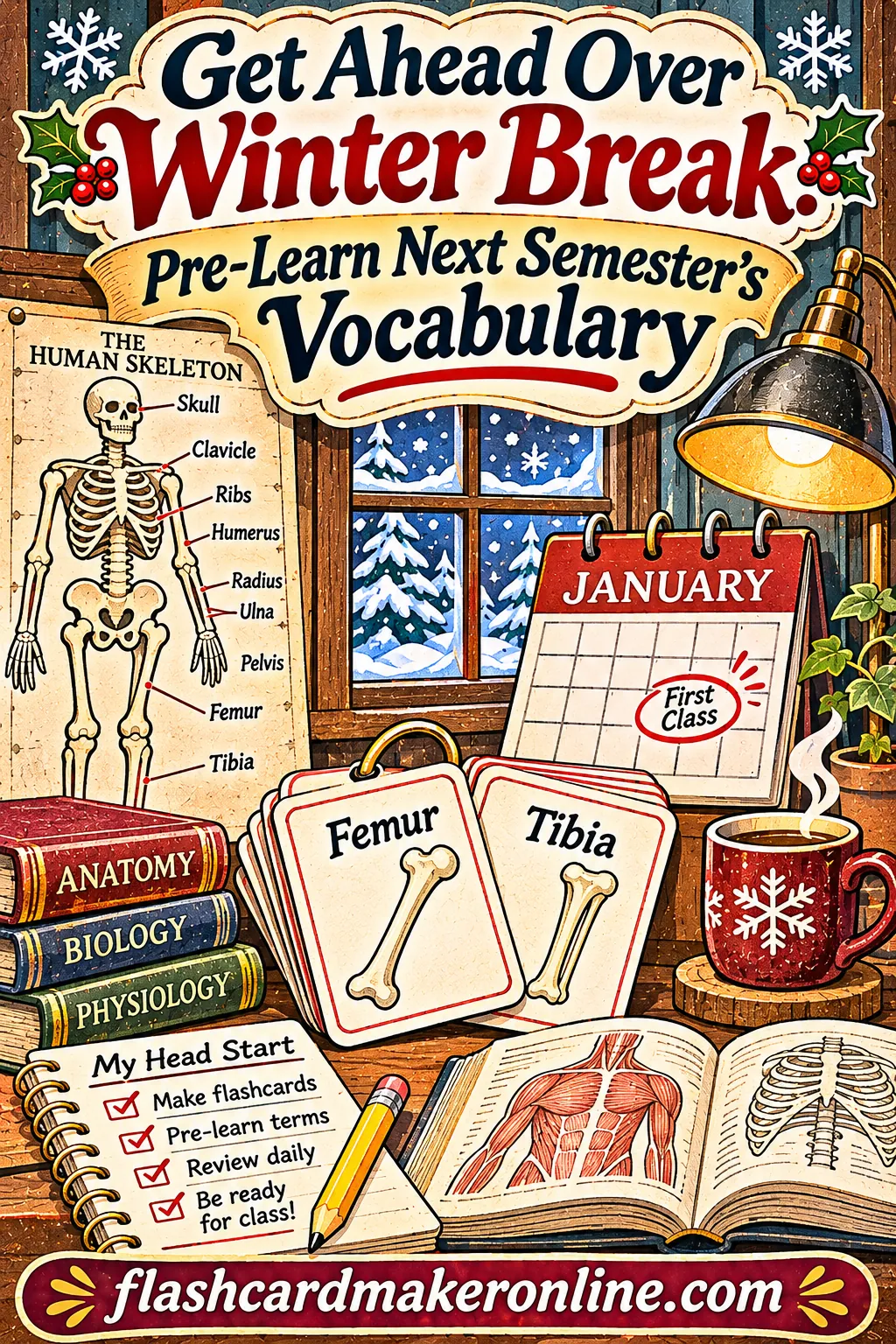
The low-stress way to get ahead before spring semester is to pull the term lists for your first three units from the syllabus, put them in one flashcard deck, and add just five new cards a day over break. That's about 15 minutes a day, and by the first lecture you already know the words the professor is using. You can build the deck in our free flashcard maker in one sitting, with no account, and study it on your phone or as printed cards.
This works best for courses where vocabulary is the first wall you hit: anatomy and physiology, pharmacology, medical terminology, microbiology, a new world language, intro psychology, or any class where the first two weeks feel like learning a new language. Below you'll find where to find the terms before the semester starts, the exact steps to build and print the deck, the five-a-day schedule worked out across a real winter break, sample cards for several courses, and the rules that keep it from turning into burnout.
🃏 Quiz yourself: 12 cards from this page
Read the front, say your answer, then tap the card to check.
Make, study & print this deck → Opens the free flashcard maker with all 12 cards ready to edit or print.▶ Open this deck in the flashcard maker
Why Pre-Learning Vocabulary Pays Off
In a vocabulary-heavy course, the early lectures move fast. The professor says "the proximal end of the humerus articulates with the scapula," and if three of those words are new, you're writing them down phonetically while the next slide goes by. You spend the lecture copying instead of understanding.
Pre-learning flips that. If you've already met "proximal," "humerus," "articulates" and "scapula" on flashcards, the sentence just makes sense. You can listen to the explanation instead of decoding it. That's the real goal of studying over break: not to finish the course early, but to walk into week one already speaking the language.
A few things make this approach work well:
- Terms are the easiest part to learn early. You don't need the lecture to learn what "anterior" means. You do need the lecture for how the heart's conduction system works. So you front-load the part that doesn't need a teacher.
- Small daily amounts stick better than a cram. Spreading reviews across many days, sometimes called spaced practice, is one of the most reliable ideas in study research. Five new cards a day with short reviews fits that pattern.
- It cuts the January panic. The first exam in many of these courses comes early. If the first unit's words are already familiar, that exam becomes a review instead of a sprint.
- It's small enough to survive the holidays. Fifteen minutes fits between family plans. A full study day doesn't.
What pre-learning is not
It's worth setting expectations so you don't overdo it:
- It isn't learning the whole course. You're learning words, not concepts in depth.
- It isn't doing homework early. Assignments, labs and problem sets wait for the semester.
- It isn't a reason to skip rest. Winter break is also for recovering from fall. If you're running on empty, take a full week off first and start the plan after.
Step 1: Find Your First-Unit Terms Before Classes Start
You can't pre-learn vocabulary you don't have. The good news is that most courses make their first-unit terms easy to find, even before the semester opens.
Where to look
| Source | How to get it | What it usually gives you |
|---|---|---|
| The course syllabus | Your school's course portal, the department website, or an email to the instructor | The unit schedule and textbook chapters for weeks 1 to 4 |
| The required textbook | Your library, a used copy, or the publisher's sample chapters | Bold terms, chapter glossaries, end-of-chapter key-term lists |
| Last semester's syllabus | Department sites often post past versions | The same unit order, since many courses change little year to year |
| A student who took the course | Ask a classmate or a friend a year ahead | Which terms showed up on the first exam |
| The instructor | A short, polite email | The first chapters and sometimes a term list |
If the syllabus isn't posted yet, an email to the instructor is perfectly normal. Something like this works:
Hi Professor Lee, I'm registered for BIO 210 this spring and would like to get familiar with the vocabulary over winter break. Could you tell me which textbook chapters the first unit covers? Thank you, Jordan
Keep it short. Most instructors are glad to see a student planning ahead, and the worst case is no reply, which costs you nothing.
Pick the first three units, not the whole course
The first three units are usually about the first four to six weeks of the semester. That's the right scope for winter break:
- It's enough to cover the first exam in most courses.
- It's small enough to finish with five cards a day.
- It's the material you'll meet while you're still adjusting to a new schedule, which is when a head start helps most.
If you can only find the first unit's terms, that's fine too. Start there and add more once the syllabus is out.
How to choose terms from a long glossary
A chapter glossary can list 60 or more terms. You won't need all of them right away, and copying every one is how break plans die. Use this filter:
- Bold terms in the chapter text come first. Textbooks bold the words they consider core.
- Terms in chapter headings and learning objectives come next.
- Terms on the end-of-chapter review list are usually the most-tested.
- Skip rare terms that appear once in a side box, unless your instructor's notes mention them.
Aim for 25 to 40 terms per unit. Three units gives you 75 to 120 cards, which matches the five-a-day pace across a typical break.
Step 2: Write Cards That Are Easy to Learn
The way you write a card decides how fast you learn it. A card that takes 30 seconds to read gets skipped. A card you can answer in five seconds gets reviewed every day.
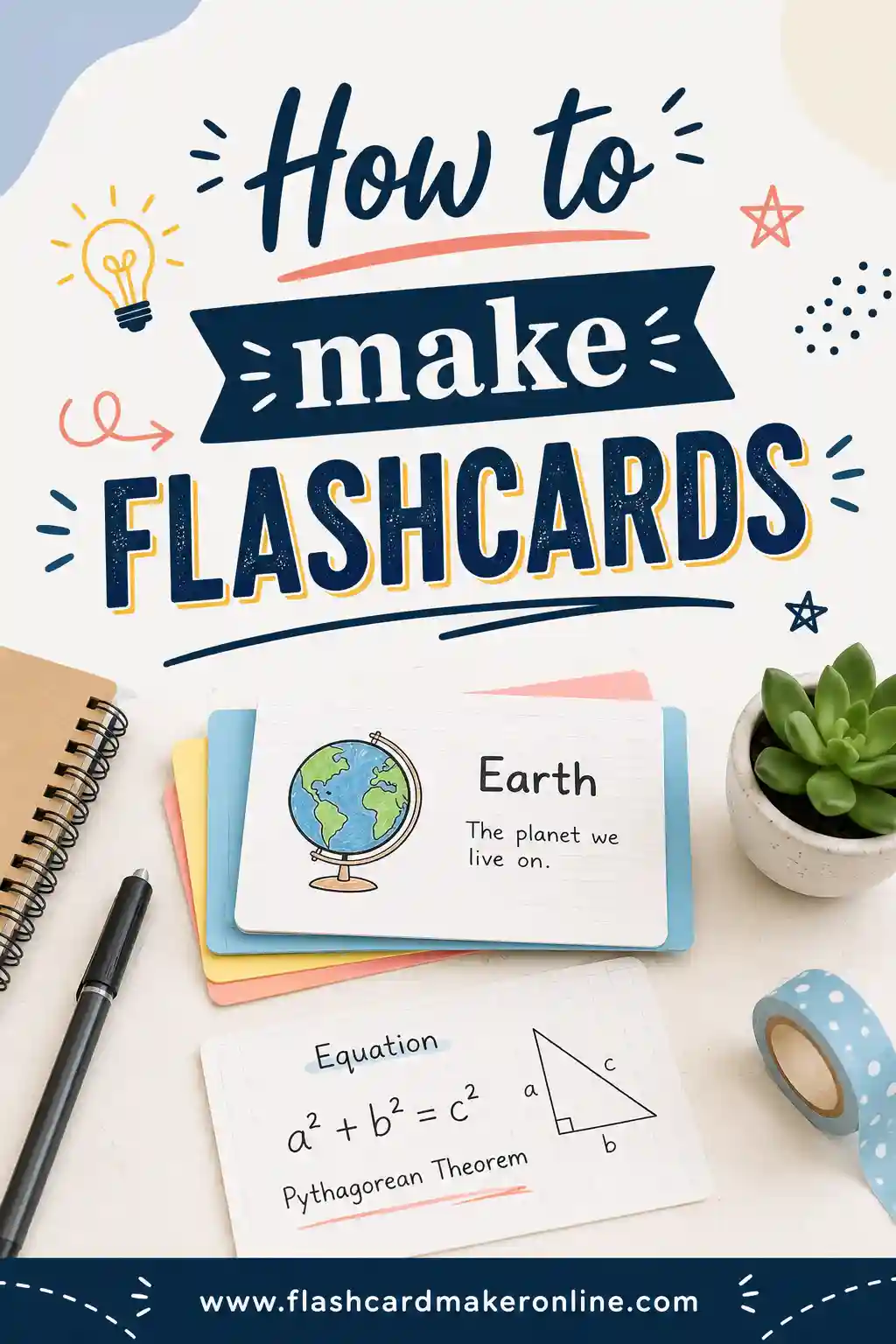
The three-part card: term, definition, chapter
Every card in this deck needs three things:
- Front: the term, alone.
Homeostasis - Back: a short definition in your textbook's words, one or two sentences.
- Chapter tag: a short tag at the end of the back, like
(Ch. 1)or(Unit 2).
The flashcard maker gives each card a front and a back, so the chapter tag goes at the end of the back. It looks like this:
- Front:
Homeostasis - Back:
The body keeping its internal conditions stable within a normal range (Ch. 1)
Why bother with the tag? When the semester starts and you're reviewing for the Unit 1 exam, you'll want to know which cards belong to it. The tag tells you at a glance, and it helps you match each card to the right section of your notes.
Rules for clean cards
- One term per card. Don't put "superior and inferior" on one card. Make two.
- Use your textbook's wording. Your instructor will likely test with that wording, so match it.
- Keep backs short. If a definition runs longer than two lines, trim it to the core meaning.
- Add a word part when it helps. For a term like "tachycardia," a note like
tachy- = fast, -cardia = hearton the back makes it easier to remember and helps with other words that share the parts. - Make opposite pairs separate cards. Medial and lateral, anterior and posterior, agonist and antagonist. Learning both directions on separate cards keeps you from mixing them up.
Step 3: Build the Deck in the Free Flashcard Maker
Once you have your term list, building the deck takes 20 to 30 minutes. Here's the exact process in the free flashcard maker. There's no sign-up, and your deck saves automatically in the browser you use.
Put your list in paste-ready form
The fastest way in is a pasted list. In a notes app or text file, write one card per line with the term, a colon, then the definition and chapter tag:
Anatomical position : Standing upright, facing forward, arms at the sides, palms facing forward (Ch. 1)
Homeostasis : The body keeping its internal conditions stable within a normal range (Ch. 1)
Superior : Toward the head or the upper part of the body (Ch. 1)
Inferior : Away from the head, toward the lower part of the body (Ch. 1)
Sagittal plane : A vertical plane that divides the body into left and right parts (Ch. 1)
If you keep your terms in a spreadsheet with columns for Term, Definition and Chapter, merge the definition and chapter into one column first (for example, a formula that joins the definition, a space and the chapter in parentheses). Then copy the Term column and the merged column together. Two copied columns paste with a tab between them, and the maker accepts a tab just like a colon.
Build it
- Open the maker on the Make cards tab.
- If an old deck is in there, click Download .csv to keep it, then click Clear all.
- In Deck title, type something clear, like
A&P 2 Unit 1 TermsorSpanish 102 Units 1-3. - Click Paste a list, paste your lines, and click Add to deck.
- Scroll through the cards on screen. Fix any card that split in the wrong place. That happens when the term itself contains a colon, so rewrite those fronts without one.
Want a preview of the format before you type your own? The Start from a preset menu includes ready-made decks such as Anatomy, Pharmacology and Medical Terminology, plus several language vocab decks. They're handy for seeing how cards look, but your own syllabus terms are what you should study, so clear the preset before you paste your list.
Add pictures where words aren't enough
Some terms are much easier to learn with an image. Each card has an Image button on the front and the back. Use it for:
- Body planes, bones or regions in anatomy, using a labeled diagram from your own notes
- Structures in microbiology or cell biology
- Objects for beginner vocabulary in a language course
Pictures stay on the device where you added them. They print and show in Study mode on that device, but a share link carries only the text.
Save your work
- Download .csv after every session where you add cards. It's your backup, and Import a file brings it back.
- Get share link and Copy link gives you a link that opens a copy of the deck on another device. Text it to yourself so you can study on your phone while you're away from your laptop.
One thing to know about switching devices: the share link opens a copy. If you add cards on your phone, download a .csv there or make a new share link, so you don't end up with two decks that don't match.
Print a pocket version for travel days
Break often includes long drives, airports or days at a relative's house where pulling out a laptop isn't practical. A printed deck helps:
- Go to the Print tab.
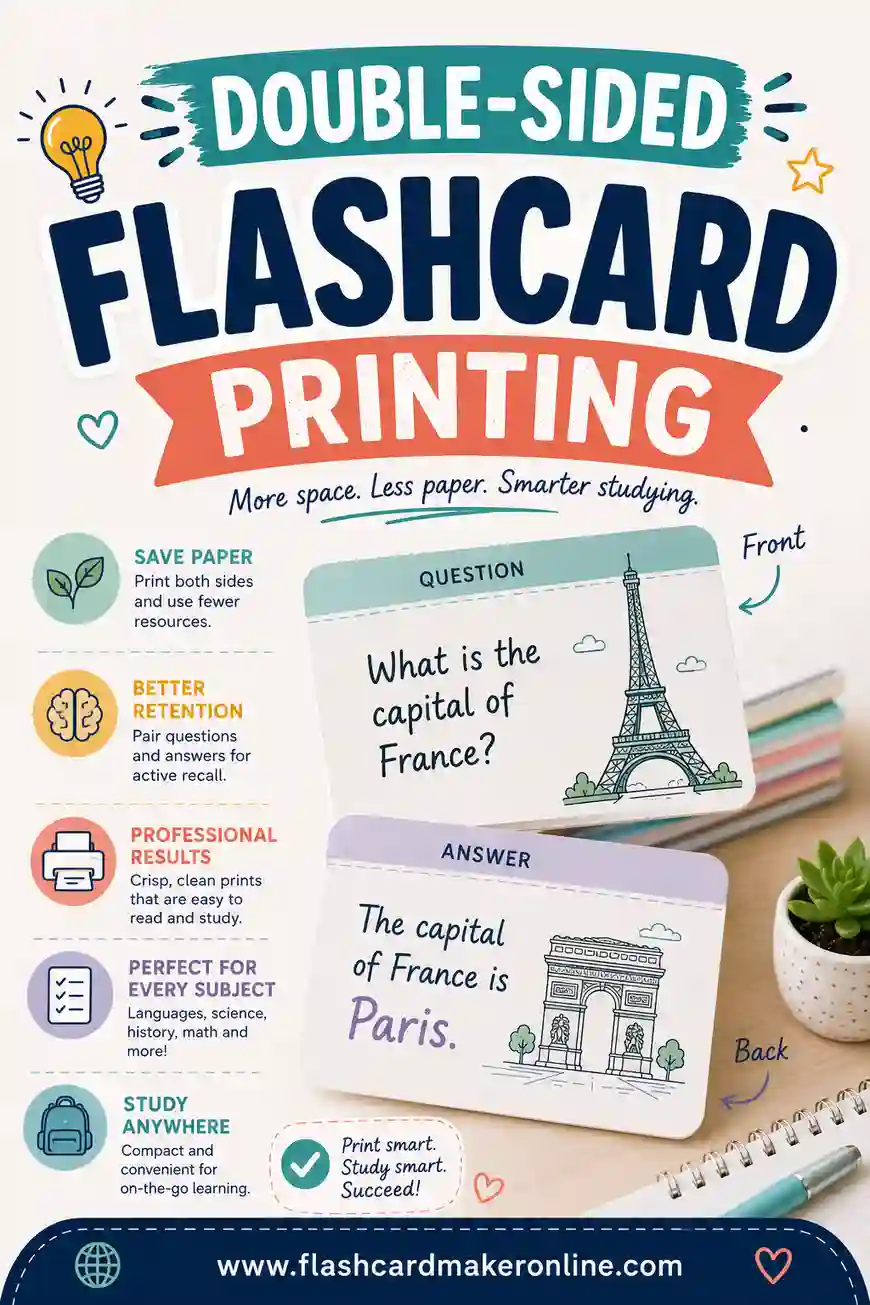
- Under Print layout, choose Double-sided if your printer prints on both sides, or Cut-out grid if it doesn't.
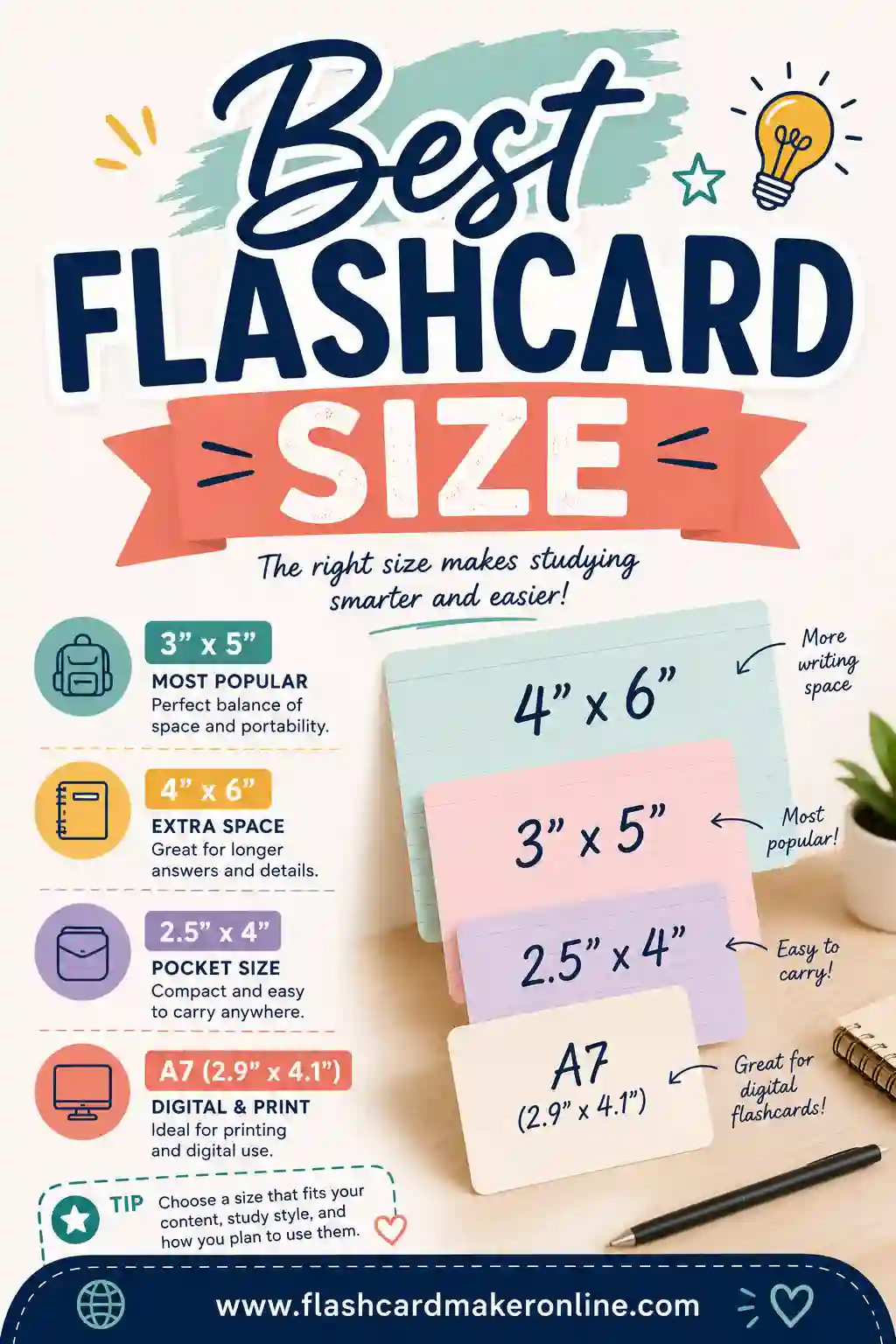
- Under Card size, choose 3×5 index card (3 per page) for a pocket deck, or Standard (8 per page) to save paper.
- Click Print a test page first to check which edge to flip.
- Click Print, with scale at 100 percent and duplex flipping on the long edge.
With the Standard size, 40 cards fit on five sheets printed on both sides. With 3×5 cards, the same 40 take 14 sheets. For more on getting the backs to line up, see our guide to double-sided flashcard printing.
Step 4: The Five-New-Cards-a-Day Plan
Here's the heart of the method. Instead of studying everything at once, you add five new cards each day and review the ones you've already met. Your deck grows slowly, your daily time stays small, and the reviews do the heavy lifting.
Why five?
Five is small on purpose. It's easy enough that you'll do it on a tired day, and it adds up fast:
| Days of studying | New cards learned | Daily time, roughly |
|---|---|---|
| 7 days | 35 cards | 10 minutes |
| 14 days | 70 cards | 12 to 15 minutes |
| 21 days | 105 cards | 15 minutes |
| 28 days | 140 cards | 15 to 20 minutes |
Most winter breaks run three to five weeks. If you study on 21 of those days, you'll have met 105 terms, which covers the first three units in many vocabulary-heavy courses. If your list is shorter, finish early and spend the last days reviewing. If it's longer, raise the pace to seven a day for a while, or cut the least important terms.
The daily session
Every session follows the same pattern, so there's nothing to plan:
- Review first (8 to 10 minutes). Go through the cards you've already added. Say the answer before you flip. If you get it right without hesitating, it goes in your "know it" pile. If you miss or hesitate, it goes in the "still learning" pile. Go through the "still learning" pile once more.
- Add five new cards (3 to 5 minutes). Read each new term and definition. Cover the back and say it. Do the five twice.
- Stop. Fifteen minutes is the whole day. Close the deck.
In the maker's Study tab, tick Shuffle so you don't learn the cards in order. 🔊 Read aloud reads the side you're looking at, which is handy for checking pronunciation of terms like "sphygmomanometer" or for vocabulary in a new language.
Keeping new cards separate from old ones
The maker holds one deck at a time and doesn't track which cards are new. Two simple ways to handle that:
- Add five at a time. Keep your full term list in a notes file. Each day, paste the next five lines into the maker with Paste a list and Add to deck. The deck in the maker is always exactly what you've met so far.
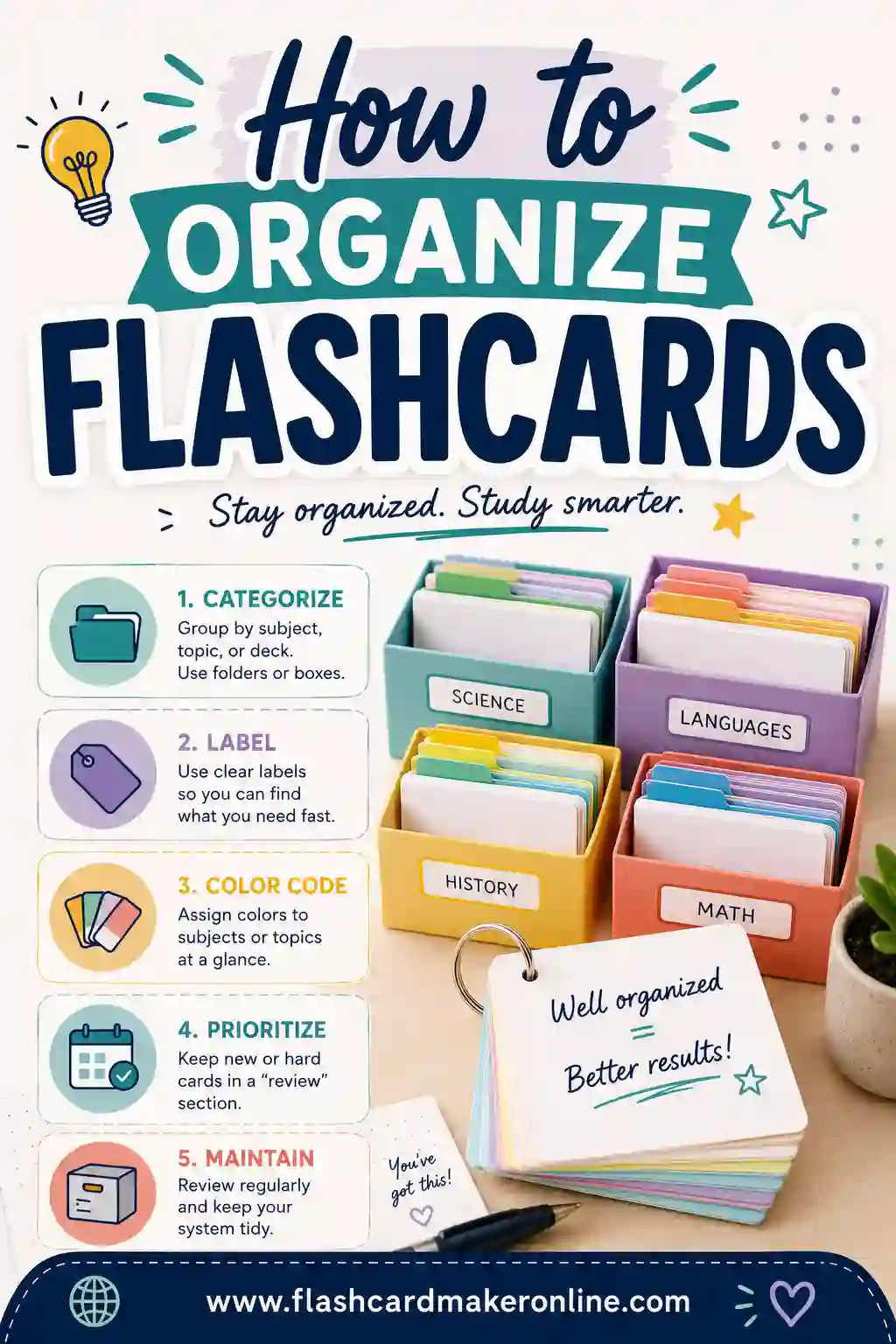
- Paper piles. If you're using the printed deck, keep three rubber-banded stacks: "not yet seen," "still learning" and "know it." Each day, move five cards from "not yet seen" into "still learning." This is a simple version of the Leitner box method, which our page on the Leitner system explained covers in more detail.
Easing up on known cards
Once your deck passes about 50 cards, reviewing every card every day starts to take too long. That's when to start spacing:
- Cards you've gotten right three days in a row: review every other day.
- Cards you've gotten right for a week: review twice a week.
- Any card you miss goes back to daily review.
With paper, this just means a fourth pile, "review twice a week." On screen, you can keep a second small deck of "still learning" cards and study that daily, then do a full pass of the whole deck twice a week. For the reasoning behind these widening gaps, see spaced repetition explained.
A sample winter break calendar
Here's what the plan can look like for a student whose break runs from mid-December to mid-January. The holidays themselves are light days or rest days, because a plan that ignores the holidays is a plan you'll drop.
| Dates | Day type | What you do |
|---|---|---|
| Dec 14 to 17 | Rest | No studying. Sleep, recover from finals |
| Dec 18 | Setup | Find the syllabus, choose terms for Unit 1, build the deck (about an hour) |
| Dec 19 to 23 | Normal | Review plus five new cards, about 15 minutes |
| Dec 24 | Light | Review only, about 10 minutes, no new cards |
| Dec 25 | Rest | Day off |
| Dec 26 to 30 | Normal | Review plus five new cards. Add Unit 2 terms to your list |
| Dec 31 and Jan 1 | Light | Review only on one day, rest the other |
| Jan 2 to 10 | Normal | Review plus five new cards. Add Unit 3 terms |
| Jan 11 to 13 | Review | No new cards. Full shuffled pass through the deck each day |
| Jan 14 | Rest | Day off before classes |
That's 19 "normal" days, so the student meets 95 new terms, and spends three days doing full reviews before week one. Total time across the whole break is roughly seven hours, setup included, spread so thin that no single day feels like work.
Adjusting for your break
- Short break (two to three weeks): Cover Unit 1 and Unit 2 only. Keep the rest days.
- Long break (five weeks or more): Take two rest weeks at the start, then follow the plan. Don't stretch the daily time.
- Working over break: Do the review on your commute or lunch break with the printed deck, and add new cards on days off.
- Traveling: Keep the share link on your phone and the printed deck in your bag. On travel days, review only.
Sample Starter Cards by Course
These examples show the format for a few common vocabulary-heavy courses. They're illustrations, not a study list. Build your real deck from your own syllabus and textbook, and match the wording your course uses.
Anatomy and physiology (Unit 1: body orientation)
| Front | Back |
|---|---|
| Anatomical position | Standing upright, facing forward, arms at the sides, palms facing forward (Ch. 1) |
| Medial | Toward the midline of the body (Ch. 1) |
| Lateral | Away from the midline of the body (Ch. 1) |
| Proximal | Closer to where a limb attaches to the trunk (Ch. 1) |
| Distal | Farther from where a limb attaches to the trunk (Ch. 1) |
| Negative feedback | A response that reverses a change and brings a value back toward its set point (Ch. 1) |
Directional terms come up in nearly every later unit, so they're the best place to start. Our anatomy flashcards page has more on wording cards for this course.
Pharmacology (drug class word endings)
Many drug names share endings that signal their class. Learning the endings first makes long drug lists much less scary.
| Front | Back |
|---|---|
| -olol (as in metoprolol) | Beta blocker (Unit 1) |
| -pril (as in lisinopril) | ACE inhibitor (Unit 1) |
| -sartan (as in losartan) | Angiotensin II receptor blocker, or ARB (Unit 1) |
| -statin (as in atorvastatin) | Lowers cholesterol by blocking an enzyme the liver uses to make it (Unit 1) |
| -prazole (as in omeprazole) | Proton pump inhibitor, lowers stomach acid (Unit 1) |
Endings are a memory aid, not a rule your instructor will accept as a full answer. Always learn the class, the main use and the key nursing or safety points your course teaches. These cards are study examples, not medical advice. See our pharmacology flashcards page for more ways to set up drug cards.
A world language (Unit 1 vocabulary)
| Front | Back |
|---|---|
| the library | la biblioteca (Unit 1) |
| the classroom | el salón de clases (Unit 1) |
| to study | estudiar (Unit 1) |
| the homework | la tarea (Unit 1) |
| Where is...? | ¿Dónde está...? (Unit 1) |
For a language, put English on the front and the new language on the back so you practice producing the word, not just recognizing it. Once you know a card well, try it the other way around too. Use 🔊 Read aloud to hear the side on screen, and check pronunciation against your course's audio.
Medical terminology (word parts)
| Front | Back |
|---|---|
| cardi/o | Heart (Ch. 2) |
| -itis | Inflammation (Ch. 2) |
| -ectomy | Surgical removal (Ch. 2) |
| brady- | Slow (Ch. 2) |
| hepat/o | Liver (Ch. 2) |
Word parts multiply. Once you know "-itis" and "hepat/o," you can work out "hepatitis" without a separate card.
How to Avoid Burnout Over Break
The biggest risk with a winter break plan isn't that it's too easy. It's that you start strong, do 40 cards on day one, feel exhausted by day four and quit. These rules keep that from happening.
- Cap new cards at five, even on good days. On a day you feel great, do an extra review pass, not extra new cards. New cards create tomorrow's review load.
- Keep the session to 15 minutes. Set a timer. Stopping while it still feels easy makes tomorrow easier to start.
- Take real rest days. The plan above has rest days built in. Don't feel guilty using them.
- Tie the session to something daily. Right after breakfast, or while your coffee cools. A fixed time beats "sometime today."
- Skip a day without restarting. If you miss a day, just do the normal session the next day. Don't double up.
- Don't preview concepts you find confusing. If a chapter's ideas feel overwhelming without a lecture, stick to the terms and leave the concepts for class.
If you notice you dread the session, that's a signal to cut back to review only for a few days. A plan you keep at ten minutes is worth more than one you drop at thirty.
Troubleshooting Your Pre-Study Deck
| Problem | Likely cause | Fix |
|---|---|---|
| Daily sessions creep past 20 minutes | Reviewing every card daily once the deck is large | Move well-known cards to twice-a-week review |
| You forget cards from the first week | Too few reviews early on | Keep a card in daily review until you get it right three days running |
| The syllabus isn't posted yet | It's often released close to the semester | Use last term's syllabus or the textbook's first chapters, and email the instructor |
| Cards split in the wrong place on paste | A colon inside the term | Rewrite the term without a colon, or paste with a tab |
| Your deck disappeared from the maker | Browser data was cleared or you're on another device | Use Import a file with your latest .csv, or open your saved share link |
| Pictures missing on your phone | Share links carry only text | Add key diagrams on the phone too, or keep the printed deck for those cards |
| Mixing up opposite pairs | Learning them together in order | Keep each on its own card and always study with Shuffle on |
| You can recognize terms but can't produce them | Only studying one direction | For language decks, put English on the front so you practice producing the word |
When Classes Start: Folding the Deck Into the Semester
Your winter break deck doesn't retire on day one. It becomes the base of your study system for the course.
- Bring the deck to week one. As the instructor covers each term, you'll recognize it. Add a short note to the back of any card where the lecture explained it better than the textbook.
- Add new cards from lectures. Each week, add the new terms your instructor stresses, with a chapter or unit tag.
- Use the tags for exam prep. Before the Unit 1 exam, pull every card tagged
(Ch. 1)or(Unit 1)into a review session. - Keep the daily habit. The same 15-minute routine works during the semester. You'll just add new cards from class instead of from the syllabus.
If you also have a large exam or licensing test later in your program, a deck you started over winter break can grow into the foundation for it.
Start your Unit 1 deck this week
You don't need a full study day to get ahead. Find the syllabus or the first chapters, pick 25 to 40 terms for Unit 1, and paste them into the free flashcard maker with a chapter tag on the back. Add five new cards a day, review the rest, rest on the holidays, and walk into the first lecture already knowing the words.
▶ Open this deck in the flashcard maker
Frequently Asked Questions
How can I get ahead before spring semester without burning out?
Focus on vocabulary only, and keep it small: five new terms a day and about 15 minutes of review. Build in rest days around the holidays and take a full week off after finals first. Leave concepts, labs and assignments for the semester itself.
What should I study over winter break for anatomy?
Start with the first unit's terms, which in most courses means anatomical position, directional terms, body planes, body regions and homeostasis. These words show up in every later unit. Check your syllabus for the exact chapter order before you pick terms.
How many new flashcards should I learn a day over break?
Five new cards a day is a good default. It adds up to about 105 terms over three weeks while keeping daily time near 15 minutes. If your list is longer, you can go up to seven or eight a day, but keep reviews as your first priority.
What if the syllabus isn't available yet?
Look for last semester's syllabus on the department site, check the required textbook's first chapters, or send the instructor a short email asking which chapters the first unit covers. Courses often keep the same opening units from year to year.
Should I put the chapter number on the card?
Yes. Add a short tag like (Ch. 1) at the end of the back. The maker has a front and a back, so the tag fits on the back side. It helps you pull the right cards together when you review for each unit's exam.
Is it better to study on screen or with printed cards?
Both work. On screen, the Study tab gives you Shuffle and Read aloud, and a share link lets you open the deck on your phone. Printed cards are better for travel days and for sorting into "know it" and "still learning" piles by hand.
Can I pre-learn vocabulary for a language course too?
Yes, and it works very well. Put English on the front and the new word on the back, use Read aloud to hear the words, and add five a day from the first units of your textbook. Check pronunciation against the course's own audio when classes begin.
What if I fall behind over the holidays?
Just pick up with the normal session the next day. Don't double the new cards to catch up, since that doubles tomorrow's review too. If you finish fewer terms than planned, you'll still walk into class knowing more than you would have otherwise.