Studying for a January Exam Over the Holidays: A Tiny Deck for Travel Days
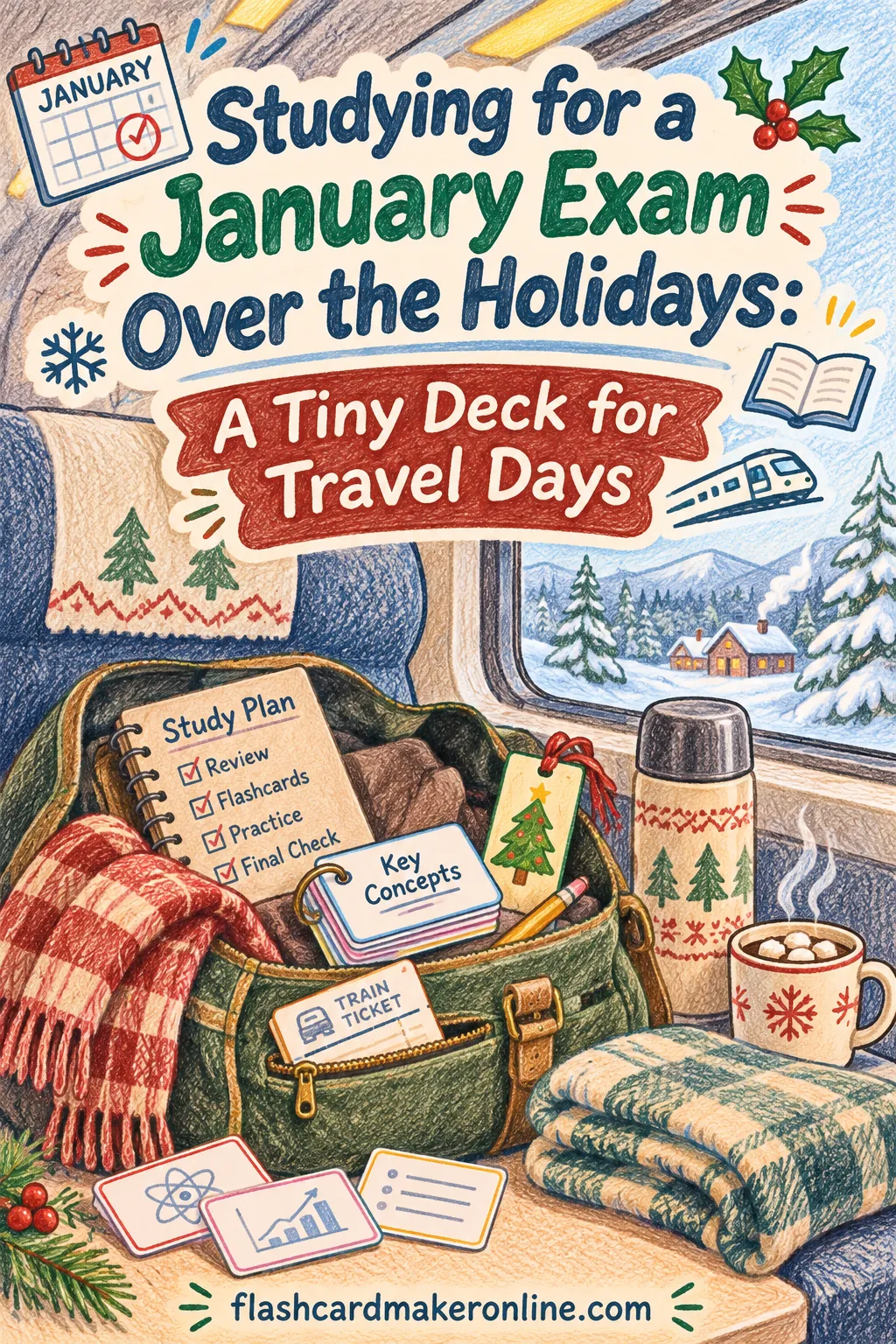
The way to study for an exam over the holidays is to stop treating busy days as zero days: build one small "Minimum Day" deck of your 30 highest-yield cards, and on every travel day or family day, do ten minutes with it instead of nothing. Your full study plan stays in place for the normal days. The tiny deck covers the rest. You can build it in about 20 minutes with our free flashcard maker, study it on your phone in a car or at a kitchen table, and print a pocket copy for the days your phone is busy being a camera.
This guide is for anyone with a test in January and a December full of other people's plans: bar takers, MCAT and board candidates, nursing students heading for licensure, and anyone sitting a certification exam right after New Year's. Below you'll find how to pick the 30 cards, exact steps and settings for building and printing the deck, a ten-minute session you can run almost anywhere, a sample holiday calendar, sample decks for several exams, and short scripts for telling family what you need.
🃏 Quiz yourself: 10 cards from this page
Read the front, say your answer, then tap the card to check.
Make, study & print this deck → Opens the free flashcard maker with all 10 cards ready to edit or print.▶ Open this deck in the flashcard maker
Why a Minimum Day Beats a Skipped Day
Most study plans are built around full days: a block in the morning, a block after lunch, practice questions in the evening. That works in October. It falls apart on December 23rd, when you're driving four hours to your parents' house, or on Christmas Day, when the morning is gifts and the afternoon is a long meal with people who haven't seen you in a year.
What usually happens next is the all-or-nothing trap. You can't do a real study day, so you do nothing. Then the next day feels like a lost cause too, because you're already behind. Two days off become four, and the guilt makes it harder to restart than the work itself.
A minimum day breaks that pattern. It isn't a smaller version of your whole plan. It's one fixed, tiny task you decide on in advance, so there's nothing to think about when the day gets crowded:
- One deck. The same 30 cards, kept separate from your big deck.
- One time box. Ten minutes. Not "as long as I can," which turns into zero.
- One rule. If the day can't hold a real session, it holds the ten minutes.
The point isn't that ten minutes will teach you new material. It won't, and it doesn't need to. The point is that ten minutes of retrieval keeps your most important facts warm, keeps the habit alive, and makes the next full day feel like a normal day instead of a restart. Pulling an answer out of memory is the part of studying that does the most work, and you can do it in a tiny window. If you want the background, our guide to how many flashcards to study per day explains how deck size and session length fit together.
What a minimum day is not
It's worth being clear about the limits, so you don't expect too much from it:
- It's not a replacement for practice tests, essays, or question banks. Those still happen on your full days.
- It's not for learning brand-new topics. Every card in the deck is something you've already studied at least once.
- It's not a punishment. If you do your ten minutes and then play cards with your cousins all evening, the day counts.
Think of it as the floor under your plan. The full days are where you build. The minimum days are where you keep from sliding backward.
What Goes in a 30-Card Minimum Day Deck
Thirty is a deliberate number. It's small enough that you can see every card in about ten minutes, which means you get a complete pass even on the worst day. It's big enough to cover the facts that show up most often or cost you the most points. If you study a deck daily, you also start to notice which cards still trip you up, which tells you where to spend your next full day.
The hard part is choosing. Your main deck might have 1,500 cards. You're picking the 2 percent that matter most when time is short. Here's how to decide.
The four kinds of cards that earn a spot
| Card type | How many | What it looks like | Why it's in the deck |
|---|---|---|---|
| High-frequency rules or facts | 12 | Definitions, elements, formulas, normal values your prep material flags as tested again and again | These show up across many questions, so keeping them sharp pays off everywhere |
| Your weak spots | 10 | Cards you've missed two or more times on your main deck or in practice questions | Missed cards are the ones most likely to slip during a break |
| Easy-to-confuse pairs | 5 | Two similar rules or terms, each on its own card | Mixing these up costs points even when you know both |
| Day-of essentials | 3 | Your test-day checklist, timing plan, or the one formula you always blank on | Small things that would hurt on the day if forgotten |
Those numbers aren't fixed. If your exam is mostly memorized values, you might want 15 high-frequency cards and only 7 weak spots. If your practice scores show one subject dragging, give it more of the weak-spot slots. Just keep the total near 30.
How to find your 30 in under an hour
You don't need to review your whole course to build this deck. Use what you already have:
- Start with your practice results. Look at your last two or three practice tests or question-bank blocks. Write down every topic you got wrong more than once. That's your weak-spot pool.
- Check your prep course's priority list. Most commercial outlines, review books and course syllabi mark the most-tested topics. Pull 12 facts from the top of that list.
- Scan your main deck for pairs. Look for cards you tend to answer with the other card's answer. Those become your five pair cards.
- Add three day-of cards. Think about what you'd hate to forget on the morning of the exam.
- Cut to 30. If you have 45, cut the ones you've gotten right every time for the past two weeks. They're safe without daily review.
Use the material from your own prep course as the source for every card. The examples in this guide are illustrations of format, not a study list for your exam, and rules or values can differ by jurisdiction, edition, or facility.
The weak-spot flag
The flashcard maker gives each card a front and a back. There's no third column, so mark your weak spots on the back of the card. Put "(weak spot)" at the end of the answer, like this:
- Front:
Rule against perpetuities - Back:
No interest is good unless it must vest, if at all, within 21 years after some life in being at its creation (weak spot)
When you flip a card and see the flag, you know it's one of the ten you're watching. When you've gotten a weak-spot card right on five minimum days in a row, delete the flag. If all ten flags disappear, swap in new weak spots from your latest practice set. That one habit keeps the deck pointed at whatever is most likely to cost you points right now.
Make every card small
A minimum-day card should take five to fifteen seconds. Long cards break the ten-minute session, because one card with a paragraph on the back can take a full minute to check. Some rules for keeping cards tight:
- One fact per card. If a rule has five elements, the card asks for the five elements. A separate card asks for the exception.
- Short fronts. "Adverse possession elements" is enough. You don't need a full question.
- Answers you can say out loud. If you can't say the back in one breath, split it.
- No lists longer than six items. Longer lists turn into skimming.
If you want more on this, the idea is often called the minimum information principle: simple cards are easier to remember than complicated ones, and they're much faster to review.
How to Build Your Minimum Day Deck in the Free Flashcard Maker
This takes about 20 minutes once you've picked your cards. Here's the exact process in the free flashcard maker. There's no account to create, and your cards save automatically in the browser you're using.
Step 1: Save your full deck first
The maker keeps one deck in your browser at a time. If you already have your main deck in there, protect it before you start the tiny one:
- Open the maker on the Make cards tab.
- Click Download .csv. This saves your full deck as a spreadsheet file you can bring back later with Import a file.
- Optionally, click Get share link and then Copy link, and paste that link into a note or an email to yourself. Opening the link later gives you a copy of the deck.
Don't skip this. Clear all empties the deck right away, and you don't want to lose weeks of cards to a quick click.
Step 2: Start the new deck
- Click Clear all to start fresh.
- In Deck title, type something you'll recognize on your phone, like
Minimum Day - BarorMinimum Day - MCAT. - Click Paste a list.
Step 3: Paste your 30 cards
In the paste box, put one card per line in the form front : back. The maker splits each line at the first colon, so keep colons out of your front side. A tab also works, which is handy if your list lives in a spreadsheet: copy two columns and paste them straight in. Commas inside a normal sentence are fine.
Here's what the first five lines might look like for a bar candidate:
Hearsay (federal rules) : An out-of-court statement offered to prove the truth of the matter asserted
Adverse possession elements : Actual, open and notorious, exclusive, hostile, continuous for the statutory period
Rule against perpetuities : No interest is good unless it must vest, if at all, within 21 years after some life in being at its creation (weak spot)
Present sense impression : A statement describing an event made while or right after the speaker perceived it
Excited utterance : A statement about a startling event made while the speaker was still under the stress of it
Click Add to deck. The count under the cards should read 30. Skim each card once on screen to catch any line that split in the wrong place.
Step 4: Check it in Study mode
- Switch to the Study tab.
- Tick Shuffle so the order changes every time.
- Click a card (or Flip) to see the back, and use Next › to move on.
- If you'd like, use 🔊 Read aloud to hear the current side. That's useful for checking a card when your eyes are tired, and when you're a passenger it lets you hear the front read to you.
Run through the full deck once now. Time it. If it takes more than ten minutes, some cards are too long. Go back to Make cards and split them.
Step 5: Save the tiny deck too
Once it's right, click Download .csv again and name the file something like minimum-day.csv. Then click Get share link, copy it, and save it in your phone's notes. Now you can open the Minimum Day deck on any device in one tap, even after you load your full deck back into the maker on your laptop.
Step 6: Print a pocket copy
There will be days when you don't want to pull out your phone: a church service, a long dinner table, a relative who takes phones personally. A printed deck solves that.
- Go to the Print tab.
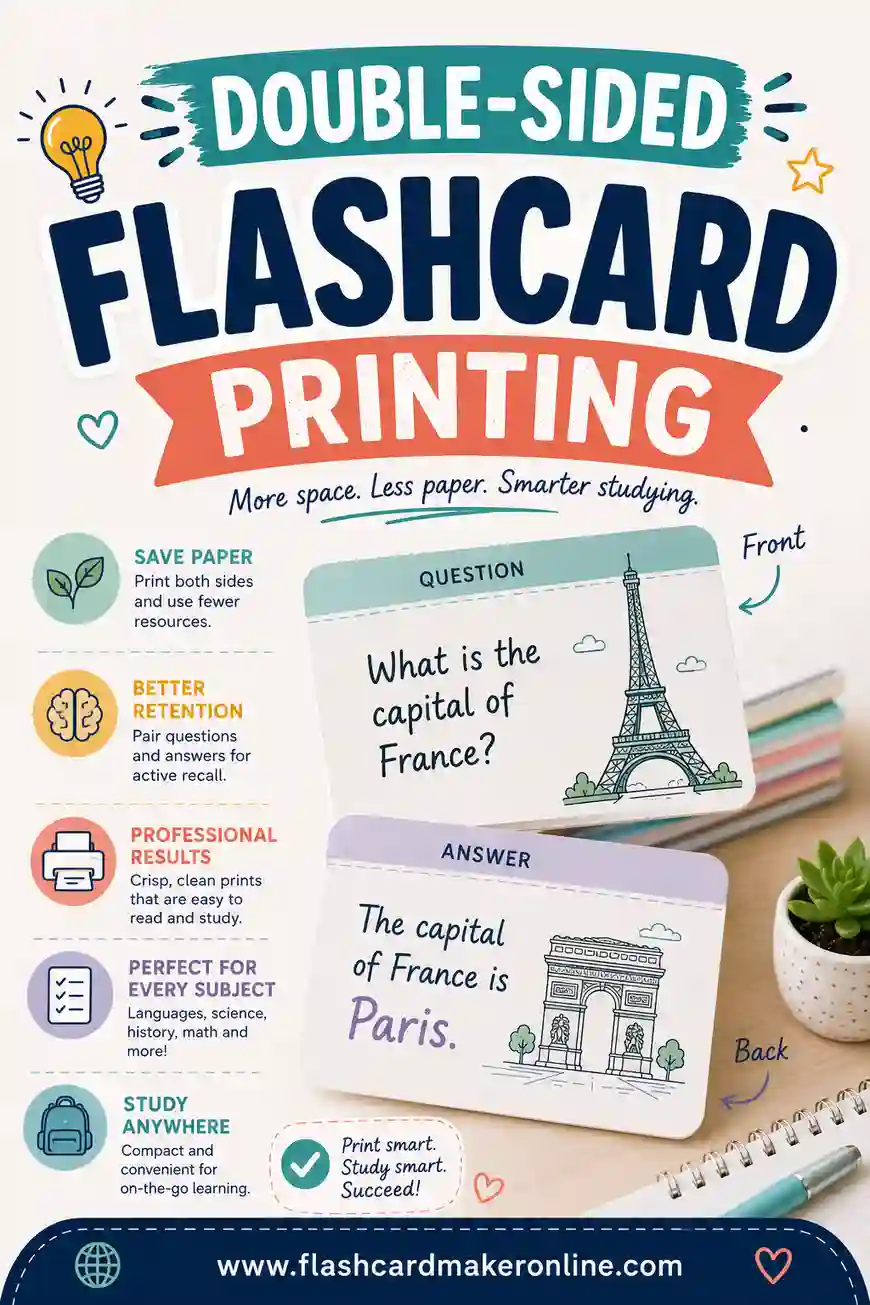
- Under Print layout, choose Double-sided if your printer can print on both sides, or Cut-out grid if it can't.
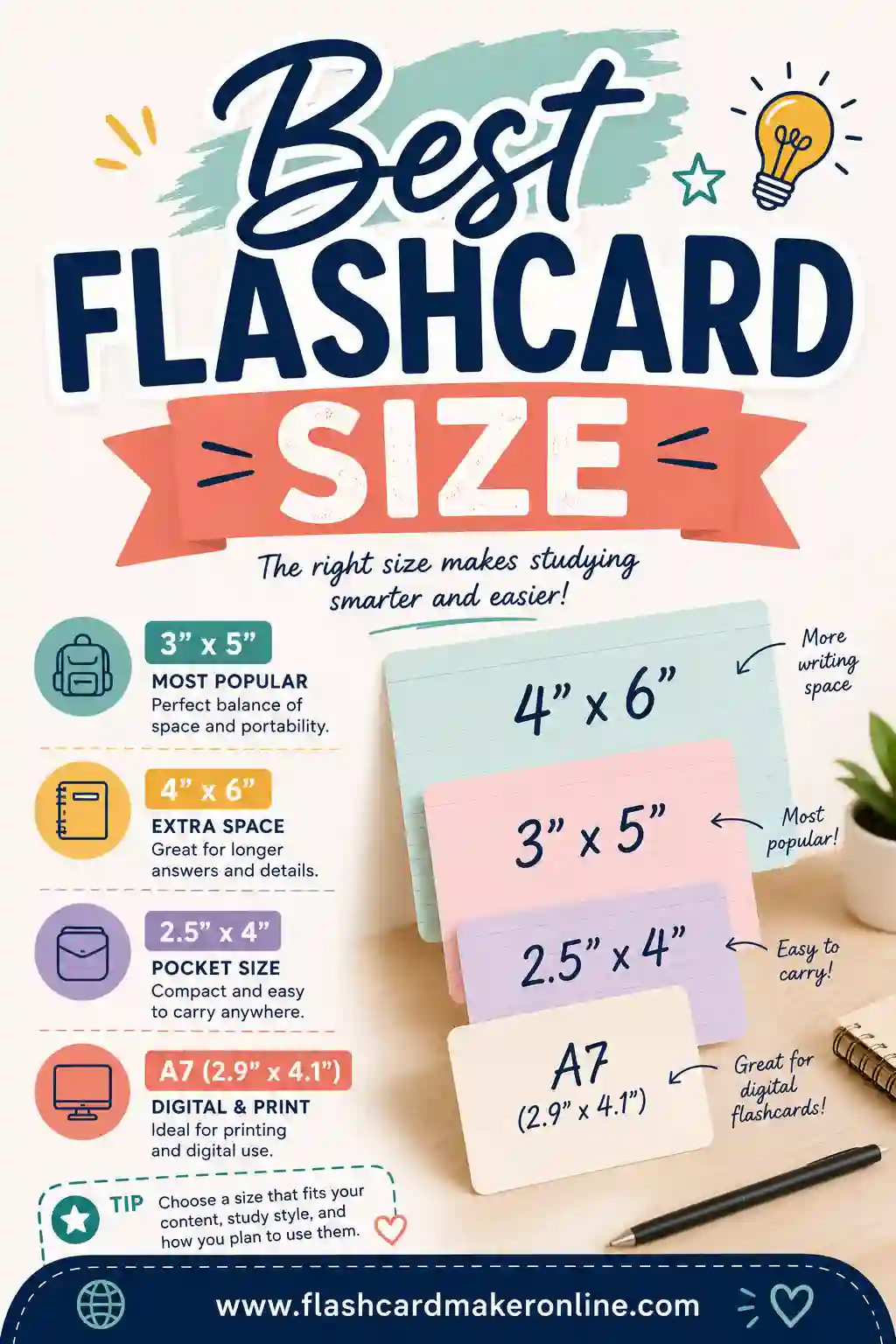
- Under Card size, choose 3×5 index card for a pocket deck or Standard to get 8 cards on a page.
- Click Print a test page first if you've never printed double-sided on this printer, so you can see which edge to flip on.
- Click Print. For double-sided, turn on duplex and flip on the long edge. Print at 100 percent or "Actual size," not "Fit to page."
At 3×5 size you get three cards per page, so 30 cards come out on ten sheets of paper printed on both sides. Card stock keeps you from seeing the answer through the paper. A binder clip or a rubber band turns the stack into something you can carry in a coat pocket.
If you'd rather not print both sides, choose Fronts only, print the fronts, and check your answers on your phone. You can also choose Save as PDF in the print dialog to keep a copy you can print at a relative's house.
The Ten-Minute Session, Step by Step
A minimum-day session should run the same way every time, so you don't spend any of your ten minutes deciding what to do. Here's a simple routine that fits a car ride, a quiet corner of a busy house, or the half hour before everyone else wakes up.
| Minute | What you do | What it's for |
|---|---|---|
| 0 to 1 | Open the deck, tick Shuffle, take one breath | Getting started without fuss |
| 1 to 7 | Go through all 30 cards. Say each answer out loud or in your head before you flip | Retrieval on every card |
| 7 to 9 | Go back through only the cards you missed | A second try while the miss is fresh |
| 9 to 10 | Pick the one card you missed worst and say it three times | One small win to end on |
That's it. You close the deck and go back to your family.
Rules that keep it honest
- Answer before you flip. Even a half answer counts. "Something about 21 years and a life in being" is better than flipping straight away, because the effort of reaching for it is what strengthens the memory.
- Be strict with yourself. If you got the gist but missed an element, that's a miss. Put it in the second pass.
- Don't add new cards mid-session. If you notice a gap, jot it down and fix the deck on your next full day.
- Stop at ten minutes. On a good day you'll be tempted to keep going. That's fine once in a while, but if every minimum day turns into 40 minutes, you'll start avoiding it on the days when ten is all you can give.
The paper version
With the printed deck, it's even simpler. Shuffle the stack by hand, go through it, and drop any card you miss into a second pile. Go through the second pile once more. Then put the stack back in your pocket.
If you want to track progress across days, put a small pencil tick on the back of each card you miss. After a week, the cards with three or more ticks are your real weak spots, whatever the flag says.
Where ten minutes hides on a holiday
You'll find more ten-minute windows than you'd expect once you start looking:
- In the passenger seat on a road trip (never while you're the one driving)
- Waiting at the gate, or on the plane before the doors close
- Before breakfast, while the house is still asleep
- While the roast is resting and the kitchen is too crowded to help
- In the gap between opening gifts and sitting down to eat
- Just before bed, so the last thing on your mind is your 30 cards and not the dishes
Pick two of these in advance for each busy day. If the first one gets eaten by something else, you've got a backup.
Plan Your Holiday Calendar Before December Starts
The minimum day works best when it's planned, not grabbed in a panic at 11 p.m. Sit down with a calendar before the holidays begin and give every day between now and your exam one of three labels.
- Full day. Your normal plan: question blocks, practice tests, new material, review.
- Half day. A morning or evening block of two to three hours, plus a minimum-day session at some other point.
- Minimum day. Travel, the holiday itself, a big family gathering, a day you're hosting. Ten minutes with the tiny deck is the whole requirement.
Mark them in color on a paper calendar or in your phone. When your family asks about plans, you'll be able to say exactly which days you're free and which you're not, and that makes the conversation much easier.
A sample calendar for an exam in late January
Here's one way a candidate might lay out the last two weeks of December. Your dates will be different, and the right balance depends on how far along you are, but the pattern works for most people.
| Date | Day type | What happens |
|---|---|---|
| Dec 18 to 20 | Full | Practice test, review the misses, update the weak-spot cards |
| Dec 21 | Half | Morning block, then pack. Minimum session in the evening |
| Dec 22 | Minimum | Travel day. Ten minutes in the passenger seat or at the airport |
| Dec 23 | Half | Two-hour morning block at the kitchen table, then family time |
| Dec 24 | Minimum | Ten minutes before everyone wakes up |
| Dec 25 | Minimum | Ten minutes before bed |
| Dec 26 | Half | Morning block, minimum session at night |
| Dec 27 | Minimum | Travel home |
| Dec 28 to 30 | Full | Back to the full plan. Practice test on the 30th |
| Dec 31 | Half | Morning block, then the evening off |
| Jan 1 | Minimum | Ten minutes, nothing more |
| Jan 2 onward | Full | Final weeks of the main plan |
Over those 15 days, this candidate does six full days, four half days and five minimum days. Without the minimum-day idea, each of those five days could easily have stretched into two or three days off. With it, every single day touches the material, and the restart on December 28th feels like a normal day.
Refresh the deck every few days
The deck is most useful when it reflects where you are right now. Every time you have a full day with practice questions, spend five minutes updating it:
- Remove the "(weak spot)" flag from any card you've gotten right on five minimum days in a row.
- Add new weak spots from the practice set you just finished.
- Cut a high-frequency card you know cold if you need room.
Keep the total at about 30. If you're using the paper copy, you don't have to reprint the whole thing. Write the new cards by hand on index cards and slip them into the stack, and take out the ones you've retired.
Sample Minimum Day Decks for Different Exams
These are short examples of the kind of card that belongs in a minimum-day deck. They're format examples only. Build your own deck from your prep course, your jurisdiction's rules, or your program's materials, and check every card against them.
Bar exam
| Front | Back |
|---|---|
| Hearsay (federal rules) | An out-of-court statement offered to prove the truth of the matter asserted |
| Adverse possession elements | Actual, open and notorious, exclusive, hostile, continuous for the statutory period |
| Rule against perpetuities | No interest is good unless it must vest, if at all, within 21 years after some life in being at its creation |
| Present sense impression | A statement describing an event made while or right after the speaker perceived it |
| Excited utterance | A statement about a startling event made while the speaker was still under the stress of it |
| Elements of negligence | Duty, breach, actual cause, proximate cause, damages |
The two hearsay exceptions make a good confusing pair: they sound alike, and the difference is timing and stress. Our bar exam flashcards page has more ideas for what tends to belong on bar cards.
MCAT
| Front | Back |
|---|---|
| Henderson-Hasselbalch equation | pH = pKa + log([A-]/[HA]) |
| Competitive inhibitor effect | Km goes up, Vmax stays the same |
| Noncompetitive inhibitor effect | Vmax goes down, Km stays the same |
| When pH equals pKa | The acid and its conjugate base are present in equal amounts |
| Ideal gas law | PV = nRT |
The two inhibitor cards are a classic pair. Keep both in the deck until you can answer each one instantly in shuffled order. For more on building cards for this test, see our MCAT flashcards page.
Nursing licensure
| Front | Back |
|---|---|
| Normal serum potassium | 3.5 to 5.0 mEq/L |
| Normal serum sodium | 135 to 145 mEq/L |
| Before giving digoxin | Check the apical pulse for a full minute and hold if below 60 in an adult (follow your facility's policy) |
| First-action priority framework | Airway, breathing, circulation |
| Rights of medication administration | Right patient, drug, dose, route, time (many programs teach more rights) |
Lab ranges vary a little between references and labs, so match your cards to the values your program and review book use. The NCLEX flashcards page has more examples.
Certification exams
For IT, finance, project management or trade certifications, minimum-day cards tend to be acronyms, process steps, formulas and the exact definitions the exam uses. A good test for each card: if you saw this term in a question stem, would you know right away what it's asking? If not, it belongs in your 30.
What to Say to Family (Short Scripts)
A lot of holiday study stress isn't about the material. It's about feeling rude, or being asked "Are you still studying?" for the fifth time. A clear, cheerful plan said once, early, saves you from negotiating every afternoon. Here are a few lines you can borrow.
Before the trip, to whoever is hosting: "I'd love to be there. My exam is on January 20th, so on the 23rd and 26th I'll need the morning to study, about three hours each. The rest of the time I'm all yours."
When someone asks why you're on your phone at the table: "It's my ten-minute exam review. I'm almost done, then I'm back."
When a relative wants to quiz you: "Sure, here." Hand them the printed deck and let them read the fronts. Plenty of relatives love this, and it turns your ten minutes into something you do together instead of something that pulls you away.
When you need to say no to an outing: "I can't do the whole afternoon, but I can come for the first hour. I have a study block after that."
You don't owe anyone a long explanation. A specific date, a specific time block, and a warm "the rest of the time I'm yours" covers almost every situation. If the holidays are stirring up worry about the exam itself, our page on test anxiety has some practical ideas. It's general information, not medical advice, so if the anxiety is affecting your sleep or health, talk to your doctor.
Troubleshooting the Minimum Day
Even a ten-minute plan hits snags. Here are the ones that come up most and what to do about each.
| Problem | Likely cause | Fix |
|---|---|---|
| The session keeps running to 20 minutes | Cards are too long | Split any card whose back takes more than one breath to say |
| You know every card by day four | The deck is too easy | Cut the cards you've gotten right five days running and add fresh weak spots |
| You keep skipping it | No set time | Tie it to something that happens every day, like your first coffee or brushing your teeth at night |
| Your full deck is gone from the maker | You cleared it to build the tiny deck | Use Import a file with the .csv you downloaded, or open your saved share link |
| Lines split in the wrong place when pasting | A colon on the front side | Rewrite the front without a colon, or paste with a tab between front and back |
| You feel guilty doing "only" ten minutes | All-or-nothing thinking | Remember the goal: no zero days. Ten minutes is a win on a travel day |
| You can't study on screen without getting distracted | Phone notifications | Use the printed deck and leave the phone in another room |
| The printed backs don't line up | Wrong flip edge | Print the test page first and flip on the long edge at 100 percent scale |
Two of these are worth a little more detail.
If you keep skipping it, the deck isn't the problem. The trigger is. A minimum day that happens "sometime today" usually doesn't happen. Pick a moment that's going to occur no matter what the day looks like, and attach the ten minutes to it.
If you're switching between decks a lot, keep both share links in your phone's notes, one labeled "Full deck" and one labeled "Minimum Day." Opening a link loads that deck into the maker. Just remember that each time you open one, it becomes the deck saved in that browser, so download a .csv of any edits before you switch. Pictures you've added to cards stay on the device where you added them, since the link carries only text.
After the holidays: folding it back in
On the first full day after the holidays, sit down with both decks and do a short review:
- Look at every card that still has a "(weak spot)" flag. These are the topics to put at the top of your next full study day.
- Copy any new cards you made in the tiny deck back into your main deck so nothing gets lost.
- Keep the Minimum Day deck. The final weeks before an exam often include days when you're sick, tired, or stuck with errands. The same 30 cards will carry you through those too.
- In the last few days before the test, you can turn the tiny deck into a warm-up. Ten minutes the morning of the exam, nothing new, just a calm run through the 30 things you most want fresh.
Start Your Minimum Day Deck Tonight
You don't need a free afternoon to set this up. Open the free flashcard maker, download a .csv of anything already in there, then paste your 30 cards with the weak-spot flags on the back. Get a share link for your phone, print a 3×5 pocket copy, and mark your minimum days on the calendar. When December gets loud, you'll already know what the day's studying looks like: ten minutes, 30 cards, done.
If you want to see the format before you commit, open the flashcard maker with the sample Minimum Day deck above and swap in your own cards one at a time.
▶ Open this deck in the flashcard maker
Frequently Asked Questions
How do you study for an exam over the holidays without missing family time?
Plan your days before the holidays start. Label each one as a full, half, or minimum day, tell your family which blocks you need, and keep a 30-card deck for the minimum days. Ten focused minutes keeps your key facts fresh without pulling you away from the people you're visiting.
Is ten minutes a day really worth it?
Ten minutes won't teach you new material, but that's not its job. It keeps your highest-yield facts active, keeps the study habit alive, and stops one busy day from turning into four days off. The real value is that you never have a zero day.
Why 30 cards and not 50 or 100?
Thirty cards fit in a ten-minute session with time for a second pass on misses. With 50 or 100 cards, you'd either rush every card or not finish the deck, and an unfinished deck makes it easy to skip the hard cards at the end.
What if my exam is in early January?
The same plan works; your calendar is just tighter. You might have fewer full days and more half days, so keep the Minimum Day deck focused on your weakest areas rather than facts you already know well. Refresh the weak spots after every practice set.
Can I study the deck offline?
Once the deck is loaded in your browser, it's saved there automatically. For a trip with no signal, the printed deck is the safest option. A 3×5 pocket copy needs no battery, no data, and no charger.
Should I add new topics to the Minimum Day deck?
Only topics you've already studied at least once. The tiny deck is for review, not for first-time learning. If you spot a gap, note it and cover it properly on your next full day, then add a card once you understand it.
Can a relative help me review?
Yes, and it often goes over well. Hand someone the printed deck, let them read the fronts out loud, and answer before they read the back. It turns study time into time together instead of time apart.
What should I do the day before the exam?
Keep it light. A calm pass through the Minimum Day deck is a good warm-up, but most candidates benefit more from rest, a normal meal, and a good night's sleep than from one more long session. Follow your prep course's advice for the final day.