Med-Surg Flashcards: What to Put on Cards for Each Disease
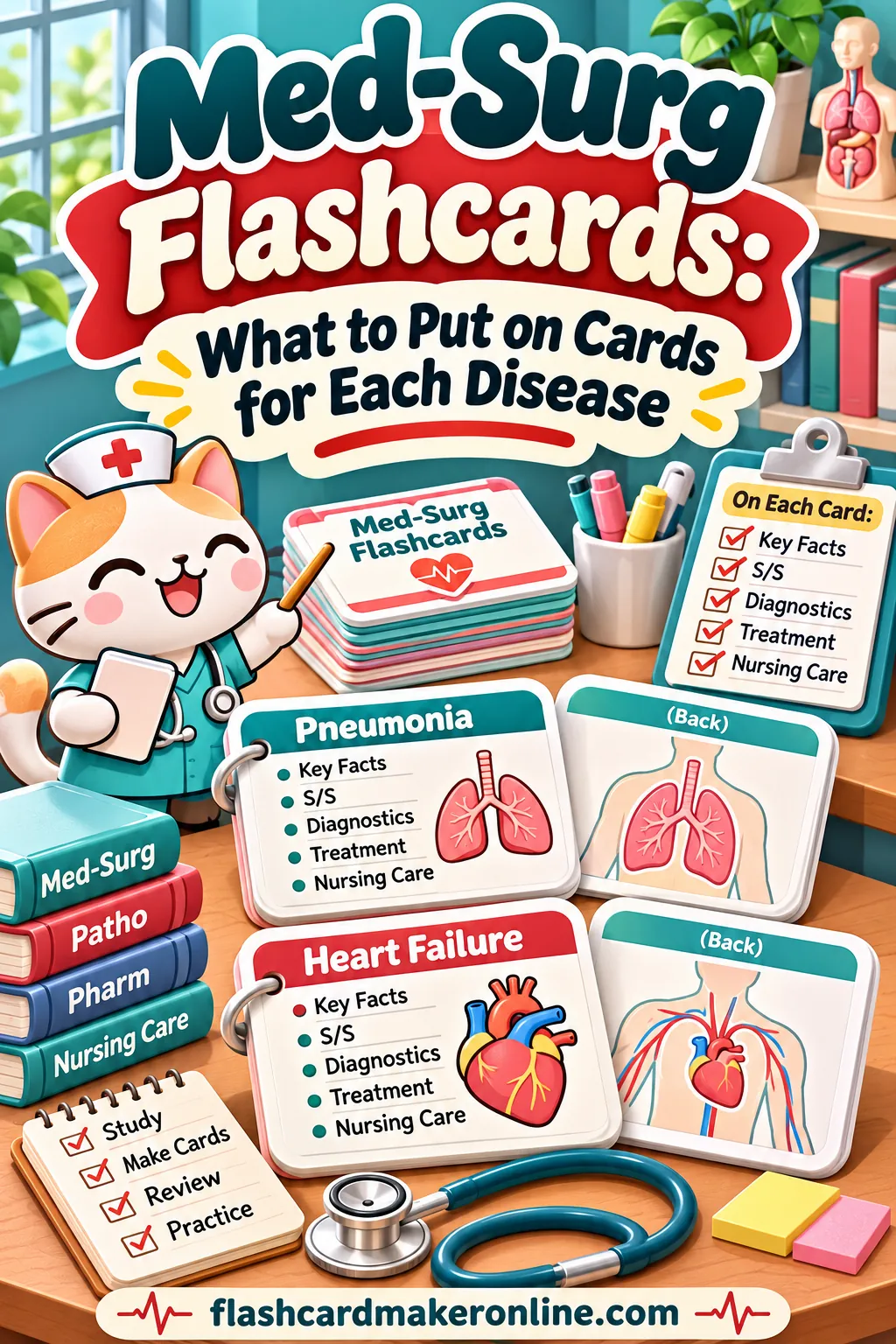
The fix for med-surg overload is one fixed template per disease: cause, key signs, labs, treatment, nursing priority, and one complication to watch, each on its own card. That turns a two-page textbook section into six short questions you can answer out loud. You can type the whole set into the free flashcard maker in a few minutes, study it on screen, and print it double-sided.
Medical-surgical nursing is the biggest content block in most nursing programs. Every body system, dozens of diseases, and each one has its own patho, labs, meds, and priorities. The usual result is a stack of cards with paragraphs on the back that you skim instead of recall. This guide shows what to put on each card, gives you a full sample deck you can paste in, and walks through a study plan that fits around clinicals.
One note before the cards: textbooks, programs, and facilities differ on some details, such as exact lab ranges and target numbers. Check every card against your course textbook, your instructor's slides, and your facility's policies. When they disagree with an example here, use theirs.
🃏 Quiz yourself: 10 cards from this page
Read the front, say your answer, then tap the card to check.
Make, study & print this deck → Opens the free flashcard maker with all 10 cards ready to edit or print.▶ Open this deck in the flashcard maker
Why Med-Surg Cards Turn Into Walls of Text
Most nursing students start with good intentions. They write "Heart failure" on the front and then copy everything they know onto the back. That card fails in three ways.
First, you can't recall a paragraph. When you flip it, you read it, nod, and move on. Reading feels like learning, but it isn't the same as pulling the answer out of your own head.
Second, the card has no question. "Heart failure" isn't asking you anything. Do you need the cause, the signs, or the drugs? Your brain doesn't know what to retrieve, so it retrieves nothing in particular.
Third, a big card hides your weak spots. You might know heart failure signs cold and have no idea which lab tracks it. With one giant card, you'd mark it "got it" and never fix the gap.
The answer is small cards with a clear question and a short answer. That idea has a name, the minimum information principle, and it matters even more in med-surg because the content is so dense.
The Six-Card Disease Template
Use the same six questions for every disease. Once the pattern is a habit, writing cards gets fast, and studying gets faster because your brain learns to expect the same slots.
| Card | Front (question) | What goes on the back |
|---|---|---|
| 1. Cause / patho | [Disease]. What's going wrong? | One or two lines on the core problem |
| 2. Key signs | [Disease]. Classic signs and symptoms? | 3–5 signs, the ones exams love |
| 3. Labs and tests | [Disease]. Key labs or diagnostics? | The one or two results that confirm or track it |
| 4. Treatment | [Disease]. Main treatments? | Drug classes or procedures, not every drug name |
| 5. Nursing priority | [Disease]. Top nursing priority? | The first thing you'd assess or do |
| 6. Watch for | [Disease]. Dangerous complication? | The emergency you're trying to catch early |
Some diseases need a seventh card for patient teaching, such as diet, activity, or medication safety. Add it only when there's something specific to teach. "Follow up with provider" doesn't need a card.
A few rules keep the backs short:
- Five items maximum. If a back needs more, split it. "Heart failure signs" becomes left-sided signs and right-sided signs.
- Use the words your exam uses. If your instructor says "JVD," put "JVD" on the card, not a paraphrase.
- Put the "why" in a separate card. "Why do we restrict fluids in SIADH?" is a great card. It's a different card from "SIADH treatment."
- One disease, one tag. Start every front with the disease name so you can sort and filter the deck later.
A worked example: heart failure
Here's what the template looks like for a single disease. Heart failure is a good test case because it has a lot of content and lots of chances to mix things up.
| Front | Back |
|---|---|
| Heart failure. What's going wrong? | The heart can't pump enough blood to meet the body's needs, so fluid backs up |
| Left-sided HF. Key signs? | Lung signs. Crackles, dyspnea, orthopnea, cough, pink frothy sputum if severe |
| Right-sided HF. Key signs? | Body signs. Dependent edema, JVD, weight gain, liver enlargement, ascites |
| Heart failure. Lab that helps confirm and track it? | BNP (B-type natriuretic peptide), higher in heart failure |
| Heart failure. Main treatment classes? | Diuretics, ACE inhibitors or ARBs, beta blockers, others per provider |
| Heart failure. Daily monitoring task? | Daily weight, same time, same scale, same clothing |
| Heart failure. Weight gain to report? | Use your program's number. Many teach about 2 to 3 lb in a day or 5 lb in a week |
| Heart failure. Diet teaching? | Sodium restriction, and fluid restriction if ordered |
| Heart failure. Emergency to watch for? | Acute pulmonary edema. Severe dyspnea, frothy sputum, anxiety |
Notice the trick on the left and right cards. "Left is lungs" is the memory hook, so the back starts with the word "Lung." Right-sided failure backs up into the body, so its back starts with "Body." When the hook sits right at the start of the answer, you'll catch it every time you flip.
Also notice the weight card says to use your program's number. Weight-gain thresholds differ between sources. A card with the wrong number is worse than no card, because you'll drill the mistake.
Sample Med-Surg Deck You Can Paste In
This is a starter deck covering high-yield diseases across the main body systems. It's written in the front : back format the maker uses for Paste a list, one card per line. Copy a block, paste it, and edit anything that doesn't match your textbook.
Cardiovascular and respiratory
Heart failure, left-sided. Key signs? : Lung signs. Crackles, dyspnea, orthopnea, cough, frothy sputum if severe
Heart failure, right-sided. Key signs? : Body signs. Leg edema, JVD, weight gain, enlarged liver, ascites
Heart failure. Lab that tracks it? : BNP, high in heart failure
Heart failure. Daily monitoring? : Daily weight, same time, same scale
Myocardial infarction. Key lab? : Troponin, rises with heart muscle damage
Myocardial infarction. Classic symptoms? : Chest pain or pressure, may spread to arm or jaw, sweating, nausea, shortness of breath
Myocardial infarction. Who may have atypical symptoms? : Women, older adults, and people with diabetes
Hypertension. Why is it called the silent killer? : Often no symptoms until organ damage
DVT. Classic signs? : One-sided leg swelling, warmth, redness, pain
DVT. Main danger? : Clot travels to the lungs as a pulmonary embolism
Pulmonary embolism. Classic signs? : Sudden dyspnea, chest pain, fast heart rate, anxiety, low oxygen
COPD. What's going wrong? : Long-term airflow limitation from chronic bronchitis or emphysema
COPD. Breathing technique to teach? : Pursed-lip breathing
COPD. Oxygen caution? : Some patients retain CO2, so give oxygen to the ordered target and monitor
Asthma. Rescue medication class? : Short-acting beta agonist, such as albuterol
Pneumonia. Classic signs? : Fever, productive cough, crackles, dyspnea, pleuritic chest pain
Pneumonia. Nursing priorities? : Airway, oxygenation, cough and deep breathe, get cultures before antibiotics if ordered
Endocrine
Type 1 diabetes. What's going wrong? : Autoimmune loss of insulin-producing beta cells
Type 2 diabetes. What's going wrong? : Insulin resistance and reduced insulin production
Hypoglycemia. Classic signs? : Shaky, sweaty, fast heart rate, anxious, confused
Hypoglycemia. First action if patient can swallow? : Give fast-acting carbohydrate, recheck glucose per protocol
DKA. Which diabetes type is it classic for? : Type 1
DKA. Key findings? : High glucose, ketones, metabolic acidosis, Kussmaul breathing, fruity breath
DKA. Main treatments? : IV fluids, IV insulin, electrolyte replacement
DKA. Potassium watch? : Insulin shifts potassium into cells, so serum K can drop
HHS. How is it different from DKA? : Very high glucose and severe dehydration, little or no ketosis, more common in type 2
Hyperthyroidism. Classic signs? : Heat intolerance, weight loss, fast heart rate, anxiety, tremor
Hypothyroidism. Classic signs? : Cold intolerance, weight gain, fatigue, constipation, slow heart rate
Thyroid storm. What is it? : Life-threatening surge of thyroid hormone. High fever, very fast heart rate, agitation
Addison disease. What's going wrong? : Adrenal glands make too little cortisol and aldosterone
Cushing syndrome. Classic signs? : Moon face, buffalo hump, central obesity, high glucose, thin skin
SIADH. Sodium and fluid? : Low serum sodium, fluid retention, concentrated urine
SIADH. First-line treatment? : Fluid restriction, then other treatment per provider
Diabetes insipidus. Classic signs? : Huge volume of dilute urine, intense thirst, high serum sodium
GI and liver
Cirrhosis. What's going wrong? : Liver scarring that blocks blood flow and liver function
Cirrhosis. Classic signs? : Jaundice, ascites, easy bruising, spider angiomas, confusion
Cirrhosis. What does lactulose treat? : High ammonia and hepatic encephalopathy
Hepatic encephalopathy. Classic sign on exam? : Asterixis, a flapping tremor of the hands
Esophageal varices. Main danger? : Sudden, severe bleeding
Acute pancreatitis. Key lab? : High serum lipase and amylase
Acute pancreatitis. Classic pain? : Severe upper abdominal pain that may radiate to the back
Acute pancreatitis. Early nursing priorities? : Pain control, fluids, NPO as ordered, monitor for complications
Appendicitis. Classic pain pattern? : Starts around the navel, moves to right lower quadrant
Appendicitis. Sign of rupture? : Sudden relief of pain then worsening, fever, rigid abdomen
Small bowel obstruction. Classic signs? : Cramping pain, vomiting, distension, no gas or stool
Peptic ulcer. Two common causes? : H. pylori infection and NSAID use
GI bleed, upper. Stool finding? : Black, tarry stool (melena)
Crohn disease vs ulcerative colitis. Pattern? : Crohn can affect any part of GI tract in patches. UC is continuous in colon and rectum
Renal, neuro, and other
Acute kidney injury. Three categories of cause? : Prerenal, intrarenal, postrenal
Chronic kidney disease. Electrolyte to watch? : Potassium, often high
Chronic kidney disease. Why anemia? : Kidneys make less erythropoietin
Hyperkalemia. Main danger? : Dangerous heart rhythms
UTI in older adults. Common atypical sign? : New confusion
Stroke. Quick screen? : Face droop, arm drift, speech trouble, time to call
Stroke. Why note last known well time? : Treatment options depend on timing
Increased ICP. Early sign? : Change in level of consciousness
Increased ICP. Cushing triad? : Rising systolic BP with wide pulse pressure, slow pulse, irregular breathing
Seizure. Nursing priorities during the seizure? : Protect from injury, turn to side, time it, don't restrain or put anything in mouth
Sepsis. Early signs? : Fever or low temp, fast heart rate, fast breathing, confusion, low BP
Osteoarthritis vs rheumatoid arthritis. Morning stiffness? : OA usually under 30 minutes. RA often longer
Post-op. Early signs of hemorrhage? : Rising heart rate, falling BP, restlessness, bleeding at site
Post-op. Why encourage incentive spirometer? : Prevents atelectasis and pneumonia
That's about 60 cards. It's a starting deck, not a complete one. Your course will cover more diseases and may stress different points. Add cards after each lecture using the same six-question template.
How to Build This Deck in the Free Flashcard Maker
Here's the exact process, start to finish. No account, no download.
- Open the flashcard maker. Type a deck title, like "Med-Surg Endocrine" or "Med-Surg Exam 2." Small decks by system are easier to manage than one 400-card monster.
- Check the presets. There's no med-surg preset, but Medical Terminology, Anatomy, Pharmacology, and Nursing Abbreviations are all in the "Start from a preset" menu. If abbreviations like JVD, BNP, or ICP trip you up, load the Nursing Abbreviations preset as a separate warm-up deck first.
- Click Paste a list. Paste one of the blocks above, one card per line, front and back split by a colon with spaces around it. Choose Add to deck to keep what's there or Replace deck to start fresh.
- Fix anything that doesn't match your course. Edit any card directly. Use + Add card for new ones.
- Add pictures where they help. A diagram of where right-sided heart failure edema shows up, or a labeled picture of the Cushing syndrome features, can make a card stick. You can add pictures to individual cards.
- Open Study mode. Hit Shuffle, answer each card out loud, then Flip. Use Prev and Next to move through. 🔊 Read aloud is handy when you're reviewing while cooking or folding laundry.
- Print it. Pick Double-sided so the front and back line up, and choose the 3×5 index card or Standard size for a pocket deck. Click Print a test page first to make sure your printer lines up, then print or save as PDF.
- Save a copy. Click Download .csv so you can re-import later with Import a file, or use Get share link to send the deck to your study group. Anyone with the link gets their own copy.
If you want a broader walkthrough of building medical decks, the guide on how to make medical flashcards goes deeper into formats and card types.
Disease Cards vs. Concept Cards
The six-card template covers individual diseases. But some med-surg content cuts across many diseases. Fluid and electrolyte balance, acid-base, shock, and infection control show up again and again. These deserve their own concept cards.
| Concept | Example front | Example back |
|---|---|---|
| Fluid volume excess | Fluid volume excess. Signs? | Edema, crackles, JVD, weight gain, high BP |
| Fluid volume deficit | Fluid volume deficit. Signs? | Thirst, dry mucous membranes, low BP, fast pulse, low urine output |
| Respiratory acidosis | Respiratory acidosis. Cause in a phrase? | Not blowing off enough CO2, such as hypoventilation |
| Metabolic acidosis | Metabolic acidosis. Classic example? | DKA |
| Shock | Hypovolemic shock. Early compensation? | Fast heart rate, cool pale skin, narrowing pulse pressure |
| Infection control | C. diff. Hand hygiene? | Soap and water, because alcohol gel doesn't kill spores reliably |
| Positioning | Increased ICP. Head of bed? | Raised per order, head midline |
Concept cards act like glue. When you meet a new disease, you can connect it to these patterns. Pancreatitis and burns both cause fluid shifts. DKA and sepsis can both cause metabolic acidosis. Seeing those links is what moves you from memorizing to thinking like a nurse.
For lab ranges themselves, keep a separate deck. Labs show up across every system, and mixing them into disease decks makes those decks bloated. Your program's lab values handout is the source to use for those cards.
Priority and "What Would You Do First" Cards
Nursing exams don't just ask what a disease is. They ask what you'd do first. Once your fact cards feel solid, add scenario cards that train judgment.
A good priority card has a short clinical picture on the front and an action plus a reason on the back.
| Front | Back |
|---|---|
| Post-op patient, new restlessness, HR rising, BP falling | Suspect bleeding or shock. Assess the site and vitals, notify provider |
| DKA patient on insulin drip, potassium dropping | Report and replace per order. Low K can cause dangerous rhythms |
| COPD patient, more drowsy after oxygen turned up | Possible CO2 retention. Assess, check ordered target, notify provider |
| Cirrhosis patient, new confusion and hand tremor | Possible hepatic encephalopathy. Assess, check ammonia if ordered, notify |
| Leg suddenly painful and swollen after surgery | Possible DVT. Don't massage the leg, notify provider |
| Patient with DVT now has sudden dyspnea and chest pain | Possible PE. Emergency. Call for help, oxygen per protocol, stay with patient |
These cards line up with how NCLEX-style questions work. Use the ABCs (airway, breathing, circulation) and the "acute before chronic, unstable before stable" frame as you write them. Your instructors may teach a specific prioritization model, so write cards that match it.
When you get a practice question wrong, turn it into one of these cards. Write the scenario in your own words. Put the correct answer and the one-line reason on the back. Over a semester, this becomes the most valuable section of your deck. For more NCLEX-specific deck ideas, see the guide to NCLEX flashcards.
Common mix-ups that need contrast cards
Med-surg is full of conditions that sound or look alike. If you keep confusing two, a plain card for each won't fix it. Make a contrast card that names both on the front and asks how they differ.
| Front | Back |
|---|---|
| DKA vs HHS. Ketones? | DKA has ketones and acidosis. HHS has little or none |
| Hyperthyroid vs hypothyroid. Temperature tolerance? | Hyper can't stand heat. Hypo can't stand cold |
| SIADH vs diabetes insipidus. Urine? | SIADH, little concentrated urine. DI, lots of dilute urine |
| Addison vs Cushing. Cortisol? | Addison, too little. Cushing, too much |
| Left vs right heart failure. Where does fluid back up? | Left, into lungs. Right, into body |
| Crohn vs ulcerative colitis. Pattern? | Crohn, patchy, anywhere in GI tract. UC, continuous, colon and rectum |
| Hypoglycemia vs hyperglycemia. Skin? | Hypo, cool and clammy. Hyper, often warm and dry |
| Upper vs lower GI bleed. Stool? | Upper, often black and tarry. Lower, often bright red |
A memory line some students use: "SIADH, soaked inside. DI, dry inside." It works because SIADH holds water in, and DI loses it. Put the hook on the back so it pops up each time you flip.
A Study Plan That Fits Around Clinicals
Med-surg runs alongside clinical shifts, care plans, and other classes. You don't need long sessions. You need short, steady ones.
| When | What to do | Time |
|---|---|---|
| Day of lecture | Write cards for every disease covered, six-card template | 20–30 min |
| Next day | First review of new cards, shuffle, answer out loud | 10–15 min |
| Every day | Review cards you missed, plus a shuffled mix of older cards | 15–20 min |
| Clinical days | Read aloud mode on the commute, or 5 minutes on a break | 5–10 min |
| Weekend | Priority and contrast cards, then a full shuffle of the unit | 30–45 min |
| Week before exam | Full deck by system, then everything shuffled together | 30–60 min a day |
Two habits make this work. First, write cards on the same day as lecture while it's fresh. Second, review a little every day instead of cramming. Spreading reviews out over days beats one long session. The guide on how to beat the forgetting curve explains why spacing helps so much.
Here's a simple way to handle your piles without any app scheduling. Keep three stacks of printed cards: "missed today," "shaky," and "solid." Review "missed today" daily, "shaky" every two or three days, and "solid" once a week. Cards move up when you get them right and drop back down when you don't.
After a week of a system, mix it with earlier systems. If you only ever study endocrine cards in an endocrine session, you'll know them in order but stumble when an exam jumps from cirrhosis to DKA to stroke. Shuffling across systems is closer to the real test.
Mistakes to Avoid With Med-Surg Flashcards
Copying the textbook onto the back. If a back takes more than ten seconds to read, it's too long. Split it until each card has one clear answer.
Using vague fronts. "Pancreatitis" is a label, not a question. "Pancreatitis. Key lab?" tells your brain exactly what to find.
Making cards and never studying them. Writing cards helps, but the real gain comes from answering them repeatedly. Book the review time.
Skipping the nursing card. Many students write patho, signs, and drugs but leave out the nursing priority. Nursing exams lean hard on what you'd assess and do. That card is often the most tested.
Mixing sources for numbers. Lab ranges, weight-gain thresholds, and target saturations vary by book. Pick your course's numbers and use only those.
Ignoring cards you find boring. Fluid and electrolyte cards feel dull, but they tie together half of med-surg. Keep them in rotation.
Rewriting the same disease ten times. If you already have heart failure cards from fundamentals, update that deck instead of starting a new one. One clean card per question beats three overlapping ones.
Studying only on screen or only on paper. Both have strengths. On-screen study is fast and easy to shuffle. Printed cards are great for sorting into piles and quizzing with a classmate. Many students do both from the same deck.
Variations for Different Courses and Levels
LPN/LVN programs. Same template, often with more focus on signs to report and basic care. Keep treatment cards to drug classes and nursing actions.
ADN and BSN students. Use the full six-card template and add priority cards. Your exams will push hard on "what would you do first."
Accelerated programs. Speed matters. Build small decks by system, paste them in fast, and lean on daily 15-minute reviews. Skip pictures unless a card truly needs one.
New grads and nurses on a med-surg floor. Your deck shifts to practical cards: early warning signs, when to call the provider, and unit-specific protocols. Always follow your facility's policies over any card.
Students who learn better with visuals. Add pictures to key cards, such as edema locations, a labeled diagram of the heart, or the classic findings of Cushing syndrome. The guide on dual coding explains why pairing words with pictures helps memory.
Whatever your level, the template stays the same. Cause, signs, labs, treatment, nursing priority, complication. It's the structure that keeps your cards short and your recall sharp.
Ready to start? Open the free flashcard maker, paste in one system from the sample deck above, and run your first Study session today.
▶ Open this deck in the flashcard maker
Frequently Asked Questions
How many med-surg flashcards should I make per disease?
Six is a good default: cause, key signs, labs, treatment, nursing priority, and one complication. Add a teaching card when there's something specific to teach, and contrast cards for diseases you mix up. Very common diseases like heart failure may need a few more.
Should I put drug names on med-surg disease cards?
Put drug classes on the disease card, like "diuretics" or "beta blockers." Keep individual drug details, such as side effects and nursing considerations, in a separate pharmacology deck. That keeps disease cards short and lets you study drugs on their own.
What's the best way to study med-surg flashcards for NCLEX?
Start with fact cards, then add priority and scenario cards once the facts feel solid. Turn every missed practice question into a card. Shuffle across body systems, since the exam doesn't go in order.
Can I print med-surg flashcards double-sided?
Yes. Choose the Double-sided layout so the front and back line up, and run a test page first to check alignment. The 3×5 index card size works well for a pocket deck you can carry to clinicals.
How do I share my med-surg deck with my study group?
Use Get share link. Anyone who opens the link gets their own copy of the deck, so each person can edit without changing yours. You can also download a .csv file and send it.
Is there a med-surg preset in the flashcard maker?
There isn't a med-surg preset, but there are related presets: Medical Terminology, Anatomy, Pharmacology, and Nursing Abbreviations. The fastest way to build a med-surg deck is to paste the sample cards from this page and edit them to match your textbook.
What if my textbook gives a different number than these cards?
Use your textbook's number. Lab ranges, weight-gain thresholds, and oxygen targets vary between sources and facilities. Edit the card before you start studying it so you never drill the wrong value.
How long before an exam should I start making cards?
Start on the first day of the unit. Write cards the same day as each lecture and review a little daily. A deck built over several weeks sticks far better than one written the weekend before the test.